
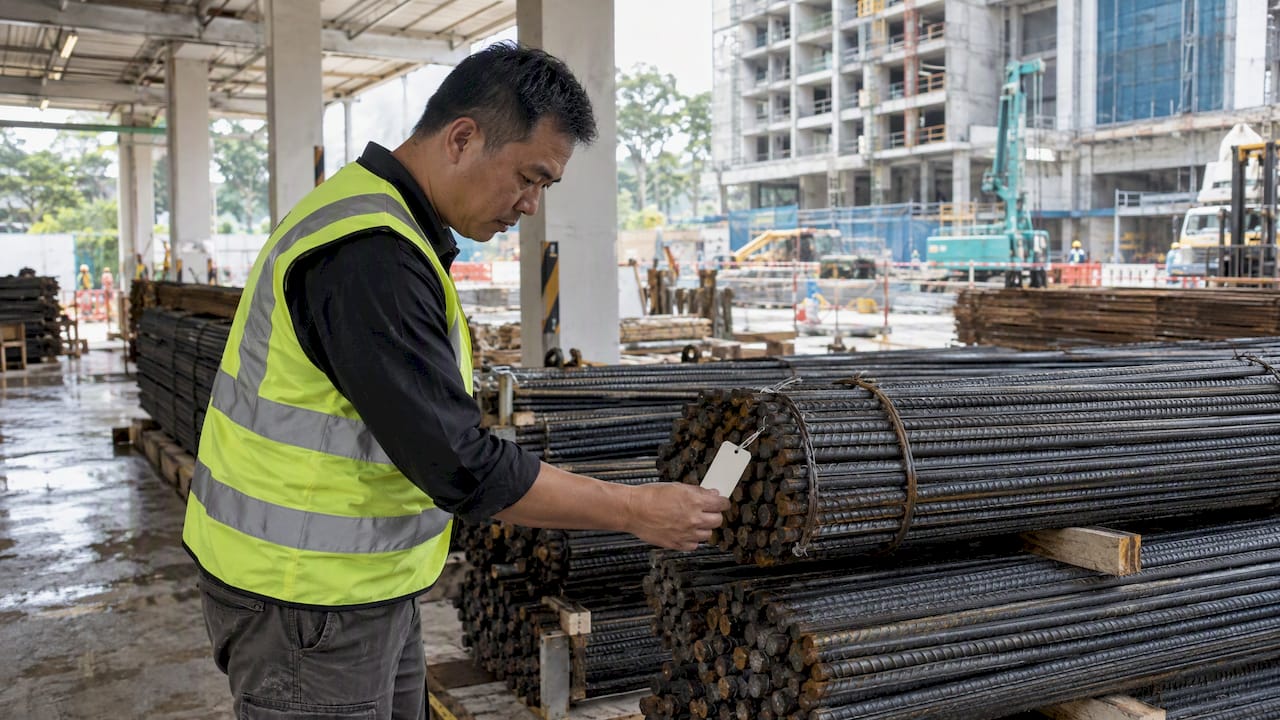
Material traceability in construction is the ability to prove, for any material in a structure, where it came from, what it was tested against, who certified it and where it was installed. In Singapore this is a regulatory expectation as well as good practice: the Building and Construction Authority (BCA) requires site and test records to be kept on site, and auditors read missing mill certificates as a sign of weak site management. This guide explains what to record, how much granularity to specify, where compliance usually fails, and how to build a system that survives an audit.
TL;DR
- Traceability means linking each delivered batch of steel, concrete or temporary works material to its certificate, its test results and its location in the works.
- Under BCA’s construction site records requirements, the qualified person must see that records such as mill certificates are kept on site, and lab tests must use SAC-SINGLAS accredited laboratories.
- Define the traceability level in the contract before ordering: lot traceability suffices for most projects, while piece-level tracking is costly and reserved for high-criticality work.
- Most failures occur where the paperwork and the physical delivery diverge, not where the paperwork is absent.
- Formwork and scaffold components now carry explicit traceability and reuse duties under a joint MOM and SCAL circular.
Table of Contents
- What material traceability covers
- What Singapore requires on site
- Three levels of traceability, and why scoping matters
- Where compliance actually fails
- Formwork and scaffold components now carry explicit duties
- Traceability, circularity and reuse
- Building a traceability system that survives audit
- Our perspective
- How we support contractors on traceability
- FAQ
- Sources
What material traceability covers
Research on the built environment describes traceability as the capability to follow the lifecycle, history, location and application of a building material, from its point of origin at the factory to installation or disposal. The same research frames it through five components: the purpose of tracing, the lifecycle stage tracked, the data required, stakeholder collaboration and the enabling technology.
For a contractor in Singapore, this reduces to a practical chain of custody with four links:
- Origin: the producer, the production lot or heat number, and the producer’s accreditation or certification.
- Evidence: the mill certificate, manufacturer test certificate or laboratory report that attaches to that lot.
- Receipt: the delivery order, the inspection on arrival and the check that the physical batch matches the document.
- Placement: where in the structure the batch was used, by date and by element.
A break in any link weakens the whole record. A mill certificate that cannot be tied to the bars stacked in the yard proves very little.
Tracking versus tracing
Two terms are often confused. Tracking follows a material forward, from supplier to site to installation, and answers where something is now. Tracing works backward from a finished element to its origin, and answers what went into this beam and who certified it. Procurement and logistics software is strong at the first. Regulators, engineers and incident investigators need the second. A system that only tracks will not satisfy an audit.
What Singapore requires on site
BCA’s guidance states that, to ensure proper supervision during construction, site and test records are to be kept and maintained on site while the work proceeds. The qualified person (QP) appointed for the project is responsible for these records. Several entries bear directly on material traceability:
| Record | What BCA expects |
|---|---|
| Steel reinforcement | The QP must ensure a copy of the mill certificate is kept on site to verify strength and quality. The source of supply is recorded and checked regularly. |
| Laboratory tests | Construction tests carried out in a laboratory must use a laboratory accredited under SAC-SINGLAS. |
| Site investigation reports | Certified by a qualified person, with soil tests done by a SAC-SINGLAS accredited laboratory. |
| Other site records | Site instructions from the QP, resident engineer or site supervisors are filed properly. |
The page also covers further categories, including concrete and prestressing steel records, so read the full list on BCA’s site against your specific structural permit. Requirements can be updated, so confirm the current version before relying on any summary, including this one.
The consequence of poor records is practical. Without them, a QP cannot demonstrate that supervision took place, and a contractor may struggle at inspection or at the point of sign-off. Treat the record set as part of the structure itself.
Accreditation is part of the record
A certificate is only as good as the body behind it. Holding a document that says a batch complies does not help if the testing or production source is not accredited. BCA specifies SAC-SINGLAS accredited laboratories for construction tests, and product certification schemes exist for materials such as concrete, precast concrete and structural steelwork. Certification bodies operating in Singapore describe these schemes as the means of confirming that products used in the built environment meet industry regulations and safety standards. When filing a certificate, record the issuing body and its accreditation status next to it. This single habit closes one of the gaps auditors most often find.
Three levels of traceability, and why scoping matters
Contracts frequently demand “full traceability” without saying what that means. The steel industry’s technical guidance sets out three recognized levels:
| Level | What it links | Typical use |
|---|---|---|
| Lot traceability | Materials to the project’s test reports | Most building and civil projects |
| Piece-mark traceability | Heat numbers to specific piece marks | Projects with defined critical members |
| Piece traceability | Heat numbers to each individual structural piece | High-criticality applications such as nuclear facilities |
The same source notes that piece-level tracking is the most expensive of the three and is generally reserved for high-criticality applications. The consequence for a Singapore contractor is simple: if a specification says “full traceability” and nobody defines it, a subcontractor may price the most demanding reading, or a client may assume it. Both outcomes produce disputes.
A worked example
Consider a residential tower with reinforced concrete cores. Rebar arrives in 20 deliveries over four months. Under lot traceability, each delivery is logged against its mill certificate, the source of supply is recorded, and the sampled test results are filed against that lot. If a test fails, the team identifies which delivery was affected and which pours drew on it.
Under piece-mark traceability, the team would additionally tie heat numbers to the specific bar marks cut and bent for named elements. This is more labor, more tagging and more record keeping. It is justified for transfer structures or critical connections, and probably unjustified for typical slab reinforcement. Deciding where to draw this line, and writing it into the specification before ordering, is the most cost-effective traceability decision on the project.

Where compliance actually fails
The common failure is rarely a total absence of records. It is a mismatch between a record and reality. A purchase order can be tracked perfectly in software while the delivered steel or concrete does not correspond to the batch-specific test report in the file. These are the patterns we see repeatedly in audit findings across the sector:
- Certificates without a batch link. A generic certificate is filed, but the heat or lot number does not match the delivery.
- Unverified accreditation. The document looks authoritative, yet the testing laboratory or producer is not in the accredited scope for that test.
- Late filing. Records are assembled at handover rather than as materials arrive, so gaps cannot be corrected while the material is still accessible.
- Scattered storage. Certificates sit with procurement, test reports with the site engineer and delivery orders with the storekeeper, so no one can assemble a complete chain quickly.
- Unwritten substitutions. An alternate supplier is used because of a shortage, and the change is not recorded against the affected elements.
Each of these is preventable with routine checks at the point of delivery, which is why the receiving gate matters more than the document control office.
Formwork and scaffold components now carry explicit duties
Traceability is not limited to permanent materials. A joint circular from the Ministry of Manpower (MOM) and the Singapore Contractors Association Ltd (SCAL), dated 22 November 2024, covers traceability and reusability of formwork structures and scaffolds. It sits among the entries on MOM’s WSH circulars page.
In summary, the circular asks manufacturers and suppliers to mark components, where reasonably practicable, so they can be tracked through the supply chain and quickly identified if a problem arises. It also asks them to supply test reports, factory production control certification and criteria for continued reuse, reuse with strength downgrade, or scrap. Contractors using these systems are asked to implement a verification system to review that documentation, inspect components against manufacturers’ specifications or the independent design, assess physical condition for reuse, and appoint a competent individual to oversee the process. Contractors who self-fabricate temporary works are treated as manufacturers, even for their own use.

For safety officers, this turns scaffold and formwork inventory into a traceable asset class. Our guidance on scaffolding checks for Singapore safety officers is a useful companion for the inspection side.
Traceability, circularity and reuse
Reuse is the reason traceability is rising on policy agendas. Reclaimed structural material can only return to service if its properties can be verified, and that depends on records that survive from the original construction. The research on circularity in the built environment argues that the lack of data traceability is a primary obstacle to moving toward a circular economy. In that sense, traceability functions as the central nervous system of circular construction: without a reliable signal from each component, the system cannot make safe decisions.
Contractors and builders outside Singapore are reaching the same conclusion. A general guide to construction materials for builders shows how widely material properties vary by type, which is precisely why each material’s history needs to be documented if it is ever to be specified again.
The documentation discipline also transfers across trades. A checklist of material documents contractors should demand before pipe lining installation illustrates the principle at small scale: the paperwork must be in hand and verified before the material goes into the works, not reconstructed afterward.
Building a traceability system that survives audit
A workable system does not require expensive technology at the outset. It requires clear responsibilities and a consistent sequence.
- Set the level in the contract. State whether the project needs lot, piece-mark or piece traceability, and for which materials and elements.
- Name the verifier. Assign one competent person per material class to check certificates against deliveries.
- Check at the gate. On arrival, compare the delivery order, the batch or heat marking on the material and the certificate. Reject or quarantine anything that does not match.
- Verify accreditation. Record the issuing laboratory or certification body and confirm its accredited scope for the test or product.
- Tag and locate. Mark the stored material, and record which element or location each batch is used in.
- File as you go. Keep the certificate, test report and installation record in one folder or digital record per batch, available on site as BCA expects.
- Review monthly. Sample three or four batches and attempt to trace them from the structure back to the producer. Any failure is a finding to fix now.
Paper, spreadsheet or software
Paper and spreadsheets work on small projects with disciplined document control, but they tend to fragment as packages multiply. A framework published in 2025 on standard operating procedures for material tracking observes that inefficient tracking leads to waste, budget overruns and delays, and that many digital tools have been introduced without a clear procedural foundation. That is the order we recommend: define the procedure first, then choose a tool to carry it. QR-coded labels and mobile receiving forms can help, but only if the underlying checks at the gate are already sound.
Our perspective
We approach traceability as a safety and quality control, not an administrative burden. In our work with construction companies, developers and safety officers, the records that fail at inspection are almost never the ones nobody thought about. They are the ones everybody assumed someone else was reconciling.
Three convictions shape our advice. First, traceability belongs inside the quality, environment and safety management system, not beside it. A documented receiving procedure, assigned responsibilities and periodic internal audits turn a loose habit into a controlled process. Second, the traceability level should be decided at design and procurement stage, when it costs little to specify, rather than at handover, when it costs a great deal to reconstruct. This is where Design for Safety thinking contributes: foreseeing which elements carry critical risk and documenting them accordingly. Third, verification matters more than volume. A thin file of matched, accredited and correctly located records is worth more than a thick file of unlinked certificates.
Our guidance on supplier certificates of conformance and ISO standards and our overview of quality management certification in construction explain how these controls fit into a certifiable system.
— Aman
How we support contractors on traceability
MOSAIC Eco-construction Solutions supports Singapore construction firms with quality, environment and safety consultancy, including WSH audit and inspection, ISO certification and EHS advisory and documentation. If your site records are scattered, your receiving procedure is informal or your next audit is approaching, our team can review the document chain and help you put a controlled process in place. You can start from our consultancy page or contact us through the main site.
FAQ
What is material traceability in construction?
It is the ability to follow a building material from its origin through delivery to its final position in the works, supported by certificates and test records. It lets you show what went into a structure and who certified it. In Singapore, site and test records of this kind are expected to be kept on site under BCA’s requirements.
What are the main types of traceability?
In practice, projects work at three levels: lot, piece-mark and piece traceability. Lot traceability links materials to the project’s test reports and suits most projects. The finer levels tie heat numbers to specific marks or individual pieces, at higher cost.
Do I need SAC-SINGLAS accredited laboratories?
BCA states that construction tests carried out in a laboratory must be done by a laboratory accredited under SAC-SINGLAS. Check the current BCA page and your structural permit conditions, and confirm the laboratory’s accredited scope covers the specific test.
Does traceability apply to scaffolds and formwork?
Yes. The MOM and SCAL circular of 22 November 2024 sets out expectations for marking, documentation, verification and reuse decisions for formwork structures and scaffolds. Contractors that self-fabricate these systems are treated as manufacturers under the circular.
Is a mill certificate enough on its own?
No. The certificate must match the delivered batch, and its issuer should be a recognized, accredited source. The BCA also expects the source of supply to be recorded and checked regularly, so filing the document without that verification leaves a gap.
Sources
- Construction site records, Building and Construction Authority
- Traceability and Reusability of Formwork Structures and Scaffolds, MOM and SCAL circular
- WSH circulars, Ministry of Manpower
- Material Identification and Traceability, AISC Steel Solutions Center
- A Traceability Framework to Enable Circularity in the Built Environment, MDPI Sustainability
- Improving Material Tracking for Sustainable Construction, MDPI Buildings
- Singapore Construction Certification, Element
- Types of construction materials: a 2026 guide for builders
- 6 CIPP material documents contractors must demand before installation