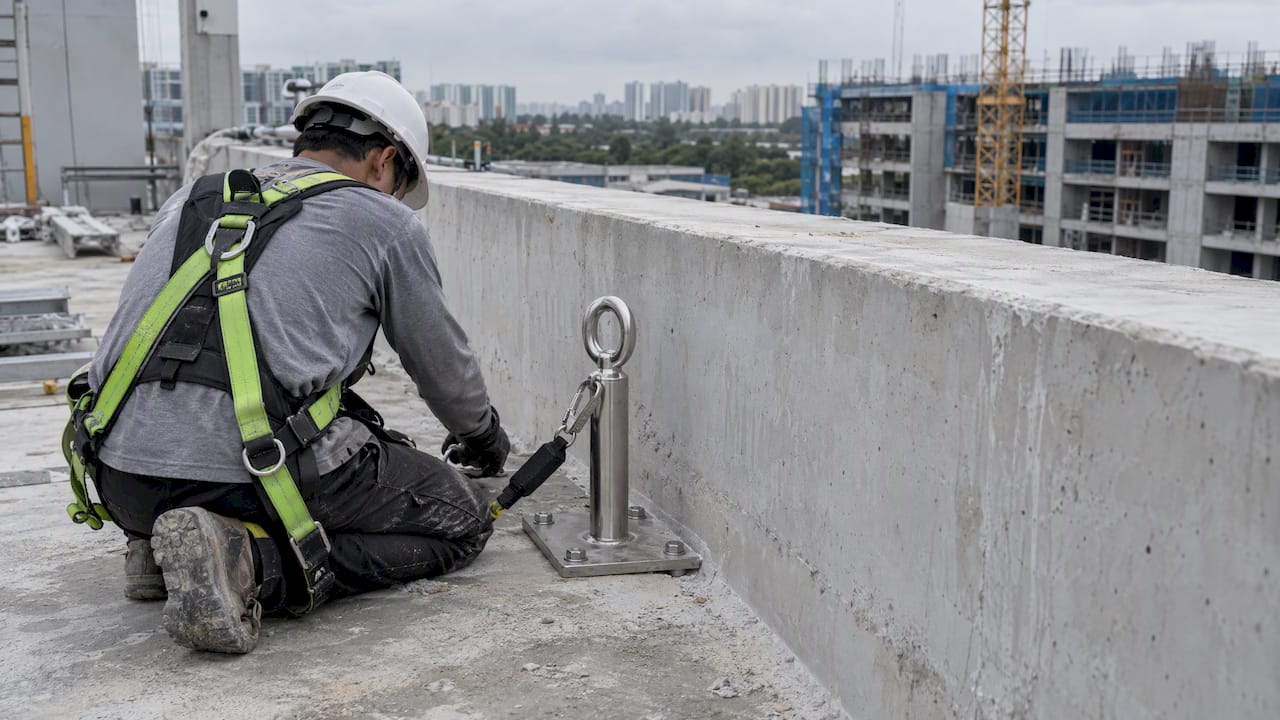
Prevention through design, also called Design for Safety, means designing out hazards early so projects avoid many worker injuries and long-term retrofit costs. NIOSH frames it as a proactive approach, the ANSI/ASSP Z590.3 standard writes it into management systems, and Singapore’s Design for Safety guidance makes early collaboration a duty.
TL;DR:
- Run Design Safety Reviews at concept, detailed design, and preconstruction stages; early reviews preserve more control options, while later checks confirm drawings and contractor plans.
- Include a frontline worker in design reviews because site experience can reveal hazards engineers miss; record controls, owners, and residual risks in a register.
- Choose passive controls such as parapets, permanent guardrails, and cast in anchor points before relying on harnesses, signs, or procedures that depend on worker behavior.
- Specify controls in bids, contracts, and drawings; Singapore projects also require early collaboration, design reviews, and a Design for Safety Register.
Table of Contents
- What prevention through design covers across a project’s life
- Why prevention through design pays off in safety and in budgets
- Core principles every design team should apply
- Standards and official guidance to build on
- The PtD toolkit and review process for construction
- How to embed PtD in a project: roles, contracts, timing, and records
- Concrete PtD controls: falls, embedded anchors, parapets, and struck-by risks
- Measuring PtD impact and making the business case
- Common barriers to PtD and the enablers that work
- Aman’s view: start small and keep the records
- How a Design for Safety Professional engagement helps you put PtD into practice
- FAQ
- Sources
What prevention through design covers across a project’s life
Prevention through design (PtD) is a proactive hazard management approach that builds safety measures into the conceptual and planning phases of a project. It covers the design, redesign, and retrofit of premises, structures, tools, facilities, equipment, and work processes, with one aim: remove the hazard at the source, as NIOSH describes. In the construction sector the same idea usually goes by the name Design for Safety (DfS), and we use both terms interchangeably here.
The lifecycle framing matters. A hazard designed into a roof edge does not disappear when the building is handed over. It returns every time someone cleans a window, services a unit, or repairs a membrane. PtD asks designers to think about construction, operation, maintenance, and eventual demolition together.
It also maps directly onto the hierarchy of controls. Elimination and engineering solutions sit at the top because they work without anyone remembering to do anything. Protective equipment and procedures sit at the bottom because they depend on constant human behavior. NIOSH notes that PtD is most reliable when hazards are eliminated at the source, so PPE or administrative controls are not the first line of defense.
Here is how the two camps differ in practice:
- PtD interventions: permanent guardrail supports, parapets at the right height, embedded anchor points, designed-in access routes, and layouts that keep pedestrians out of lifting zones.
- PPE and administrative controls: harnesses, warning signs, permit systems, toolbox talks, and supervision.
- PtD works before the crew arrives. Lower-order controls only work while the crew follows them.
- PtD benefits later users too. Maintenance staff and future owners inherit the safer design without extra effort.
Why prevention through design pays off in safety and in budgets
The safety argument is simple. Hazards that never get built cannot injure anyone, and construction hazards that are cheap to remove on a drawing become expensive to manage on site. Singapore’s DfS guidance notes that identifying design risks early allows a wider range of control options and costs less than reactive, post-design changes.
NIOSH calls for PtD controls to be written into project contracts and bid documents, because formal requirements prevent omission when time or budget gets tight. That single move turns a good intention into an obligation that survives value engineering.

The financial case follows the same logic. Professional literature on the standard stresses that PtD applied to construction projects manages long-term lifecycle costs, and that firms integrating it can avoid expensive maintenance-related safety interventions and liability exposure. Retrofitting an anchor point into finished concrete costs far more than casting it in, and the same principle applies to every late change.
Beyond the ledger, teams that adopt PtD tend to see these gains:
- Cleaner compliance: design risks are documented before regulators or clients ask for them.
- Easier operations: facilities that were designed with maintenance in mind need fewer special arrangements later.
- Fewer disruptions: problems solved on paper do not stop work on site.
- Stronger reputation: clients and tenants notice developers whose buildings are safe to build and safe to run.
PtD also changes how a team treats risk. Designers and engineers often prioritize measurable requirements such as aesthetics and cost, and as ASSP’s description of the standard suggests, PtD’s value lies in treating occupational risk as a design parameter on par with quality and schedule.
Core principles every design team should apply
Safe design guidance from different countries converges on a short list of ideas. Safe Work Australia sets out five principles and a staged process from pre-design through design completion, with systematic hazard identification and recording of risk controls throughout the lifecycle:
- Persons with control: anyone who makes design decisions, from developer to specialist designer, owns the safety outcome of those decisions.
- Lifecycle thinking: consider construction, use, maintenance, and demolition, not just the handover date.
- Systematic risk management: identify hazards, assess them, apply controls in order of effectiveness, and review the result.
- Capability: the people involved need the knowledge and resources to carry out the work safely.
- Information transfer: hazards and the controls chosen must travel with the project to contractors and eventually to the facility owner.
Passive controls deserve priority within that system. A parapet protects a worker at the roof edge whether or not that worker is paying attention, and a guardrail support cast into the slab is there on the day it is needed. Active controls, such as a harness that must be clipped on correctly every time, fail the moment someone is rushed.
Worker participation is the principle most often skipped. EU-OSHA guidance on worker participation highlights that PtD effectiveness depends on active worker representation, and that including workers in design reviews is a key success factor. NIOSH’s PtD process guidance adds that frontline workers surface hazards engineers and managers miss, which produces more pragmatic interventions.
Pro Tip: Invite one experienced site supervisor or foreman to your concept review. Ask them one question: “Where would you get hurt building this?” The answers are usually specific and quick to act on.
Standards and official guidance to build on
Several bodies of guidance carry most of the weight, and each answers a different practical need.
- NIOSH PtD initiative and toolkit. NIOSH’s initiative promotes research, education, practice, policy, and small-business resources to make PtD “business as usual,” with educational modules and case studies. Its Prevention through Design Toolkit for the Construction Industry adds sector-specific checklists and tables for preventing falls and struck-by incidents, and recommends embedding PtD controls in bids, contracts, drawings, and DfS Registers.
- ANSI/ASSP Z590.3. This consensus standard gives guidelines for addressing occupational risks in design and redesign processes. According to NIOSH’s summary of the standard, it supports lifecycle assessments that balance environmental and occupational safety goals and helps fold PtD into occupational safety and health management systems. In practice, it gives your design safety review a recognized backbone.
- Singapore’s Workplace Safety and Health (Design for Safety) Regulations. The regulations and guidelines require developers, designers, and contractors to collaborate as early as possible, run Design Safety Reviews, and keep a DfS Register. We cover the local rules in more depth in our Design for Safety overview.
You do not need to adopt all three. A team outside Singapore can lean on the NIOSH toolkit and Z590.3, while a team in Singapore will use the regulations as its legal base and the others as practical support.
The PtD toolkit and review process for construction
The process below follows the staged approach used in Singapore’s guidance and the NIOSH toolkit. It works at any scale because it asks the same questions at each milestone.
The three review phases
- GUIDE-1, concept stage: Check site constraints, building form, access routes, and the big-ticket hazards such as roof edges, deep excavations, and lifting paths. This is where the most control options are still open.
- GUIDE-2, detailed design: Review specific details: anchor points, guardrail supports, cladding fixings, service access, and the sequence of construction. Confirm that controls chosen at concept stage have survived into the drawings.
- GUIDE-3, pre-construction: Check that the contractor understands the design risks, that temporary works fit the permanent design, and that residual risks are communicated before mobilization.
Running a Design Safety Review
A useful review is a working meeting, not a signature ceremony. Singapore guidance observers note that in successful projects DfS meetings are collaborative forums that resolve design risks early, and some developers start them within their own internal team before bringing in outsiders.
- Attendees: developer representative, lead designer, relevant specialist designers, contractor or constructability adviser, a safety professional, and where possible a frontline worker.
- Agenda: foreseeable hazards for construction and maintenance, the control chosen for each, who owns it, and what residual risk remains.
- Outputs: an updated risk list, action owners with dates, and entries for the DfS Register.
The DfS Register
The register records identified design risks, the controls adopted, and any residual risks that later users must manage. It should stay with the facility after handover, so future owners and maintenance teams can see what the design assumed. Our guide to the DFSP role explains how a dedicated professional keeps it current.
How to embed PtD in a project: roles, contracts, timing, and records
PtD fails when everyone assumes someone else owns it. A clear role split fixes that.
- Developer: sets the expectation, allocates time and budget for reviews, and makes sure design risks are carried into tender documents.
- Designers: identify foreseeable risks in their own work, eliminate or reduce them, and pass on what remains.
- Contractor: reviews the design for buildability and safety, feeds back early, and plans construction around the recorded risks.
- Design for Safety Professional (or similar role): facilitates the reviews, maintains the register, and keeps the process moving. Our page on DFSP lifecycle responsibilities lays out what that role covers.
Contract wording is where good intentions become requirements. Practical levers include:
- Require submission of the DfS Register as part of design deliverables.
- Put a design risk register into tender documents so bidders price the controls.
- Tie review milestones to payment stages, so skipped reviews hold up invoices.
- Include PtD controls in bids, contracts, and drawings, as NIOSH recommends.
Timing is the other half. Hold the first review at concept stage, repeat it at detailed design, and again before construction starts. Feed outcomes into procurement, so contractors price what the design actually requires rather than discovering it on site.
Documentation should be boring and consistent: one register, one owner, dated entries, and a handover copy.
Pro Tip: Add a one-line standing agenda item to every design coordination meeting: “Any new hazards created by today’s changes?” It catches late changes that quietly undo earlier controls.
Concrete PtD controls: falls, embedded anchors, parapets, and struck-by risks
General principles only help when they turn into things a designer can draw and a reviewer can check. NIOSH’s guidance on embedded safety features recommends safety design reviews, control selection through the hierarchy of controls, and planning permanent embedded features such as concrete straps, anchor points, and guardrail supports, which protect workers during construction and later maintenance.
- Embedded anchors and concrete straps: cast into slabs and beams, they give fall protection systems a verified attachment point without drilling into finished structure later.
- Parapets and permanent guardrails: a parapet at the right height removes the roof-edge fall hazard instead of managing it. Prefer these over temporary edge systems wherever the design allows.
- Struck-by mitigation: plan drop zones, crane exclusion areas, and material-handling routes on the drawings, so pedestrian paths and lifting paths do not cross.
- Permanent versus temporary: specify permanent features when maintenance will need the same protection years later, and note in the register where temporary measures are still required.
Here is how those controls line up against the hazards they address:
| Hazard | Preferred design control | Fallback if not feasible |
|---|---|---|
| Fall from roof edge | Parapet or permanent guardrail | Embedded anchors for fall arrest |
| Fall during slab edge work | Cast-in guardrail supports | Temporary edge protection |
| Struck by falling object | Planned drop zones and covered walkways | Exclusion zones and spotters |
| Struck by lifting load | Separate pedestrian and crane routes | Controlled access with signaling |
For worked project examples, our Design for Safety case-study guide shows how these controls were applied on real jobs.
Measuring PtD impact and making the business case
Managers respond to numbers, and a simple estimate beats a perfect one that never gets written.
- Avoided incident cost: estimate the likelihood and cost of the injuries, stoppages, and investigations that the design change removes.
- Avoided rework: count the redesign, demolition, or retrofit cost that an early decision prevents.
- Avoided downtime: note programme days saved by not stopping work to resolve a late hazard.
- Cost of the control: compare it against the sum above, which gives a rough benefit-cost ratio.
The American Industrial Hygiene Association (AIHA) publishes business-case tools for this kind of estimate, and the general method is the same in every version: list the costs, list the benefits, compare.
NIOSH stresses that formalizing PtD requirements in contracts and bid documents prevents them from being dropped under time or budget pressure, which is itself an argument for putting the cost of controls into the budget from the start.
Present non-financial evidence alongside the numbers: smoother compliance, less supervision effort, and a stronger reputation with clients and workers.
Common barriers to PtD and the enablers that work
The same obstacles appear on most projects, and they have practical fixes.
- Late procurement: contractors join after the design is frozen. Fix it by involving a contractor or constructability adviser at concept stage.
- Perceived up-front cost: the control is visible in the budget, the injury is not. Fix it with the simple avoided-cost estimate above.
- Siloed decisions: architects, engineers, and contractors each assume the others handle safety. Fix it with one named owner and a shared register.
- Treating reviews as paperwork: reviews become a signature exercise. Fix it by running them as working sessions with real agenda items.
Quick wins any team can adopt this month:
- Add PtD requirements to the next tender document.
- Book the first Design Safety Review before drawings are final.
- Ask for worker input at that review.
- Start a register, even a one-page version, and keep it.
Aman’s view: start small and keep the records
The common mistake is waiting for a perfect system. Teams that wait never start, and teams that start with a review can learn more from the process than from a policy document. Pick a live project, run one honest Design Safety Review at the next design milestone, and write down what you found. That record is the beginning of a register, and the register is the beginning of a habit.
Keep the first steps measurable: track the risks identified, the ones designed out, and those that remain with the contractor. These measures tell a manager whether the effort is working. When internal capacity is thin, bringing in a professional to facilitate the first few reviews is a sensible shortcut, not a sign of weakness. It sets a pattern your own staff can then carry forward.
— Aman
How a Design for Safety Professional engagement helps you put PtD into practice
Knowing the process and running it under project pressure are different things. Our team provides Design for Safety Professional services for developers, designers, and contractors who want the reviews run properly without building the capability from scratch.

A typical engagement gives you:
- Facilitated Design Safety Reviews at each design milestone.
- A DfS Register set up, populated, and ready for handover.
- Contract and tender wording that locks the requirements in.
- Training for your design and project staff, so the habit stays after we leave.
If your team already has the time and the expertise, run the process in-house. If reviews keep slipping or the register never gets finished, a dedicated professional usually pays for itself. Contact us through our Design for Safety Professional page to talk through your project.
FAQ
What does PtD stand for in safety?
PtD stands for Prevention through Design. It is a proactive approach that builds safety measures into the design stage, with the aim of removing hazards at the source. In the construction sector it is often called Design for Safety.
What is PtD in construction?
In construction, PtD means identifying foreseeable risks in the design, running reviews, and recording the controls in a DfS Register. NIOSH’s construction toolkit provides checklists for preventing falls and struck-by incidents. The goal is a project that is safer to build and safer to maintain.
When should the first PtD review happen?
At concept stage, before the design is fixed. Early review leaves the widest choice of controls and costs the least to act on, and the review should be repeated at detailed design and before construction starts.
Who is responsible for PtD on a project?
Everyone who makes design decisions shares responsibility: the developer, the designers, and the contractor. A dedicated Design for Safety Professional or similar role keeps the process organized and the register current.