
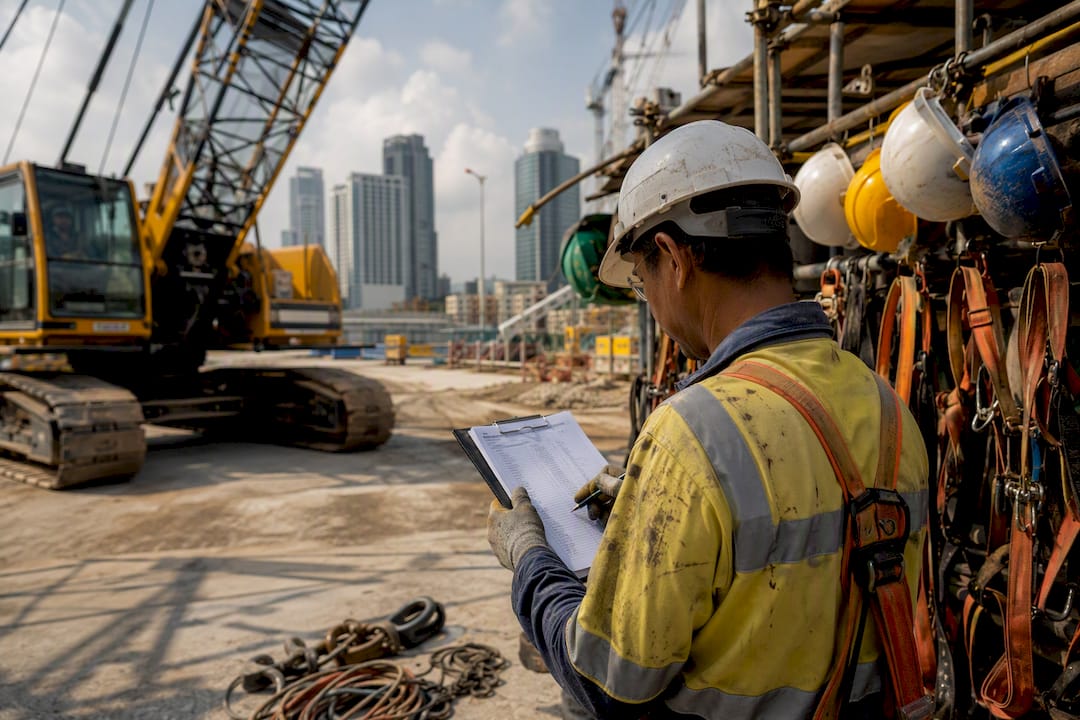
In Singapore, every crane lifting operation must be accompanied by a lifting plan supported by a risk assessment, a safe work procedure (or method statement), and an approved permit-to-work. This is the statutory baseline for lifting plan requirements under the Workplace Safety and Health framework, and there is no discretionary version of it. A basic lifting plan may satisfy routine, low-risk lifts, but anything outside that envelope demands engineering input before the crane hook moves.
Before a single load leaves the ground, three documents must exist and align with each other:
- Risk assessment (RA) identifying hazards specific to the load, site, and crane configuration.
- Safe work procedure (SWP) or method statement describing the step-by-step lifting sequence.
- Permit-to-work (PTW) issued only after the lifting plan, RA, and SWP have been reviewed and endorsed.
On the day itself, three non-negotiables follow: complete pre-use checks on the crane and rigging gear, brief the entire lifting crew on the approved plan, and stop work immediately if site conditions deviate from what the plan describes. Resume only after re-approval.
Key Takeaways
A compliant Singapore lifting plan requires a linked RA, SWP, and PTW, detailed load and rigging data, assigned roles with verified competencies, and an enforced stop-work and re-approval rule whenever site conditions change.
| Point | Details |
|---|---|
| Legal baseline | Every crane lift in Singapore needs a lifting plan backed by an RA, SWP, and approved PTW. |
| Checklist minimums | Load weights, centre of gravity, gear certificates, rigging method, and a zone sketch are non-negotiable. |
| Roles matter | The lifting supervisor owns stop-work authority; the project manager owns final PTW approval. |
| Escalation trigger | Multi-crane, heavy or irregular loads, and proximity to infrastructure require engineering input. |
| Compliance partner | Com helps translate WSH Council templates into site-specific, audit-ready lifting plans. |
Table of Contents
- What Are Singapore’s Lifting Plan Requirements for a Compliant Checklist?
- Who Is Responsible for Each Part of the Lifting Plan?
- How Does the Permit-to-Work Approval Process Work?
- When Do You Need an Engineering-Designed Lifting Plan Instead of a Basic One?
- What Happens on the Day of the Lift?
- How Does Com Support Lifting Plan Compliance on Site?
- What Most Guides Get Wrong About Lifting Plans
- Get Help Building a Lifting Plan That Holds Up
- Sources
What Are Singapore’s Lifting Plan Requirements for a Compliant Checklist?
A lifting plan is only as good as the data behind it, and the WSH Council’s sample checklist sets a clear minimum bar. Skip any one of these categories and the plan is incomplete, regardless of how polished the paperwork looks.
- Load data. Record net weight, gross weight (including rigging and packaging), overall dimensions, and the centre of gravity. Sling angles and attachment points must be calculated against this data, not estimated on-site.
- Crane and gear certification. Confirm the lifting machine (LM) certificate is current, verify the safe working load (SWL) against the load chart for the actual boom length and radius, and check that every sling, shackle, and spreader beam carries valid test certificates.
- Rigging method. Document the rigging drawing, connection points, and whether spreader beams or lifting beams are required to control sling angles on irregular loads.
- Sketch or zone plan. Show crane placement, the swing path, proximity to existing structures, buried utilities, and overhead lines, plus the exclusion zone boundary.
- Environmental and communications checklist. Ground bearing capacity, wind speed limits, visibility conditions, the communication method between signalman and operator, and an escape route if the lift goes wrong.
Crane selection itself deserves attention here too. A rough terrain crane handles uneven ground differently than a tower or crawler crane, and that choice changes the ground-bearing calculations in your plan.
Pro Tip: Never copy a lifting plan template from a previous project without re-verifying the load chart against the exact crane model, boom configuration, and ground conditions on the new site. The WSH Council’s own guidance treats this as a common and preventable failure point.
Who Is Responsible for Each Part of the Lifting Plan?
Compliance breaks down fastest when responsibility is vague. Singapore’s framework assigns specific duties to specific roles, and each one needs to be documented, not assumed.
- Lifting supervisor. Owns the plan on-site. Briefs the crew before the lift, keeps the approved document physically available, and has the authority to stop work the moment conditions change. The WSH Council’s lifting supervisors guidebook makes this stop-work power a defining feature of the role, not an optional courtesy.
- Safety assessor. Reviews the plan, RA, and SWP for consistency and inspects site conditions before endorsing the PTW request.
- Project manager. Gives final approval on the PTW and signs off on any re-approval after a stop-work event.
- Crane operator, rigger, and signalman. Each must hold verifiable competency credentials appropriate to their task, checked against training records before the lift begins.
Pre-use inspections aren’t a one-time event. They repeat before every lift, and the supervisor’s sign-off on each inspection is the evidence an auditor will ask for first.
How Does the Permit-to-Work Approval Process Work?
A PTW is not a rubber stamp attached to the lifting plan. It is the gatekeeping step that confirms every supporting document has been checked and is consistent with what will actually happen on-site.
- Assemble the packet. Submit the lifting plan, RA, SWP, equipment and gear certificates, and the zone sketch together, not as separate submissions reviewed in isolation.
- Site verification. The safety assessor inspects ground conditions, crane setup, and exclusion zones against what the paperwork describes, then endorses the PTW if everything matches.
- Final approval. The project manager reviews the assessor’s endorsement and authorizes the permit before any lift proceeds.
- Validity and revalidation. A PTW is tied to specific conditions. Change the crane position, the load, or the site layout, and the permit needs re-approval before work resumes.
Keep every endorsed PTW, along with the certificates and inspection records behind it, on file. Auditors reviewing a lifting operation after the fact will want to trace each approval back to the exact site conditions that justified it.
When Do You Need an Engineering-Designed Lifting Plan Instead of a Basic One?
Not every lift needs a structural engineer. But the moment you rely on judgment alone for a genuinely complex lift, you have moved past what the Code of Practice on Safe Lifting Operations considers acceptable practice.
- RA drives the plan, not the other way around. Control measures identified in the risk assessment become conditions written directly into the lifting plan and PTW. Treating these as separate paperwork exercises undermines the entire control chain.
- Multi-crane or tandem lifts almost always require engineering review of load distribution between cranes.
- Heavy or irregularly shaped loads with an unpredictable centre of gravity need calculated rigging solutions, not standard slinging.
- Proximity to critical infrastructure, such as live utilities, occupied structures, or rail lines, pushes a lift into the complex category regardless of load weight.
- Ground conditions that can’t support standard outrigger loads call for documented ground-bearing calculations, and sometimes temporary bearing mats or structural support beneath the crane.
When any of these apply, the engineering output, whether that’s a load path analysis or outrigger bearing design, must be referenced directly inside the lifting plan itself, not filed as a separate report nobody reads on-site.
What Happens on the Day of the Lift?
The plan on paper and the lift on-site are two different things until someone connects them. That connection happens through a specific sequence of checks and a briefing that leaves no ambiguity about who does what.
- Verify before you lift. Confirm crane and gear certificates are current, cross-check the load weight against what was documented in the plan, inspect ground conditions, and test communication equipment between the signalman and operator.
- Brief the full crew. Cover each person’s role, the lift sequence step by step, emergency procedures, and the exact hand signals or radio protocol in use.
- Watch for stop-work triggers. Site layout changes, unstable or saturated ground, unexpected obstructions, or wind exceeding the plan’s stated limit all mean the lift stops immediately.
- Re-approve before resuming. Any stop-work event routes back through the supervisor and project manager for updated approval, not a verbal go-ahead.
- Keep the paper trail. Signed pre-use checklists, briefing attendance, and any re-approval records are exactly what an inspector asks to see first.
Pro Tip: Even a minor change, like repositioning the crane a few meters or adding a temporary hoarding, technically invalidates the approved plan. Treat that as an automatic stop-work trigger rather than a judgment call, because the WSH Council identifies this exact scenario as the most common field compliance failure.
How Does Com Support Lifting Plan Compliance on Site?
Com works alongside safety officers and project teams to turn Singapore’s lifting plan requirements into documents that survive both daily use and audit scrutiny.
- Development of risk assessments, safe work procedures, and PTW advisory tailored to the actual crane and site conditions, not a generic template.
- Verification of crane operator, rigger, and signalman competency records ahead of ConSASS audits or BizSAFE assessments.
- Customization of WSH Council sample templates to reflect site-specific ground conditions, load charts, and exclusion zones.
- Documented re-approval procedures that keep the lifting plan a working reference rather than a paper exercise abandoned after the first site change.
What Most Guides Get Wrong About Lifting Plans
Most guidance on lifting plans treats the document as an approval hurdle, something to file before the crane arrives and forget once the PTW is signed. That framing is backwards. The lifting supervisors guidebook makes a point worth repeating: accidents on lifting sites trace back to poor planning and coordination far more often than mechanical failure. The crane rarely breaks. The plan simply stops matching reality, and nobody notices until something goes wrong.

The conventional advice, use the WSH Council checklist, get the PTW signed, move on, treats compliance as a paperwork milestone. It isn’t. A lifting plan that survives contact with an actual site is one the crew has internalized, one the supervisor is willing to halt the moment ground conditions or crane position shift even slightly. That single habit, stopping work at the first deviation rather than pushing through to save time, separates sites with clean safety records from sites collecting incident reports.
If you take one thing from this guide, prioritize the stop-work discipline over the paperwork polish. A plan enforced loosely is worse than no plan at all, because it creates false confidence.
— Aman
Get Help Building a Lifting Plan That Holds Up
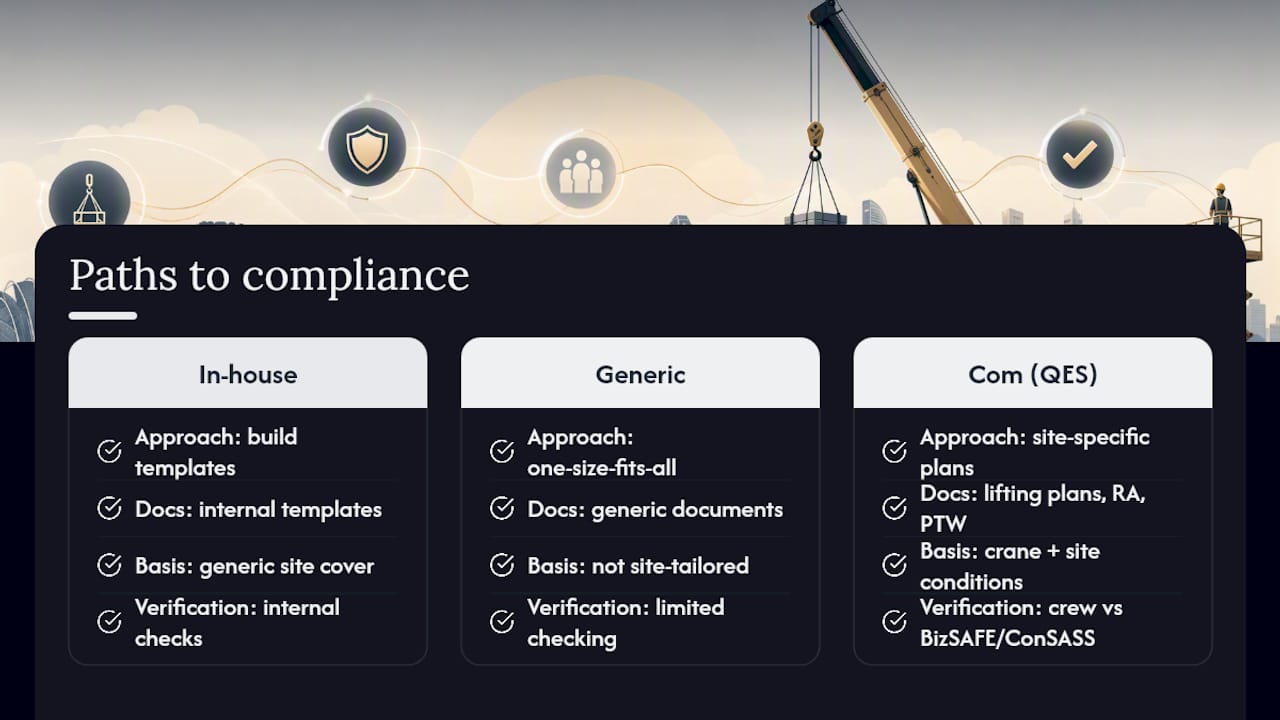
There are other paths to compliance here: an in-house safety team building templates from scratch, or a generic consultancy offering one-size-fits-all documents. Com takes a different route. As a Singapore-based QES consultancy, it builds lifting plans, risk assessments, and PTW documentation around your actual crane configuration and site conditions, then verifies crew competencies against what BizSAFE and ConSASS audits expect to see.
That means less time reworking a rejected PTW submission and fewer surprises when an inspector asks for evidence behind a re-approval. Com’s team has supported construction companies across Singapore through the exact checklist items covered in this guide, from load chart verification to stop-work documentation. If your current lifting plans are closer to a paper exercise than a working site document, get in touch about regulatory compliance support and start with a review of your next planned lift.
Sources
Cross-check every plan against these: the WSH Council’s planning guidance for the legal baseline, the Code of Practice on Safe Lifting Operations for standards, and the Operation of Cranes Regulations for statutory authority.
- Planning a lift — WSH Council