
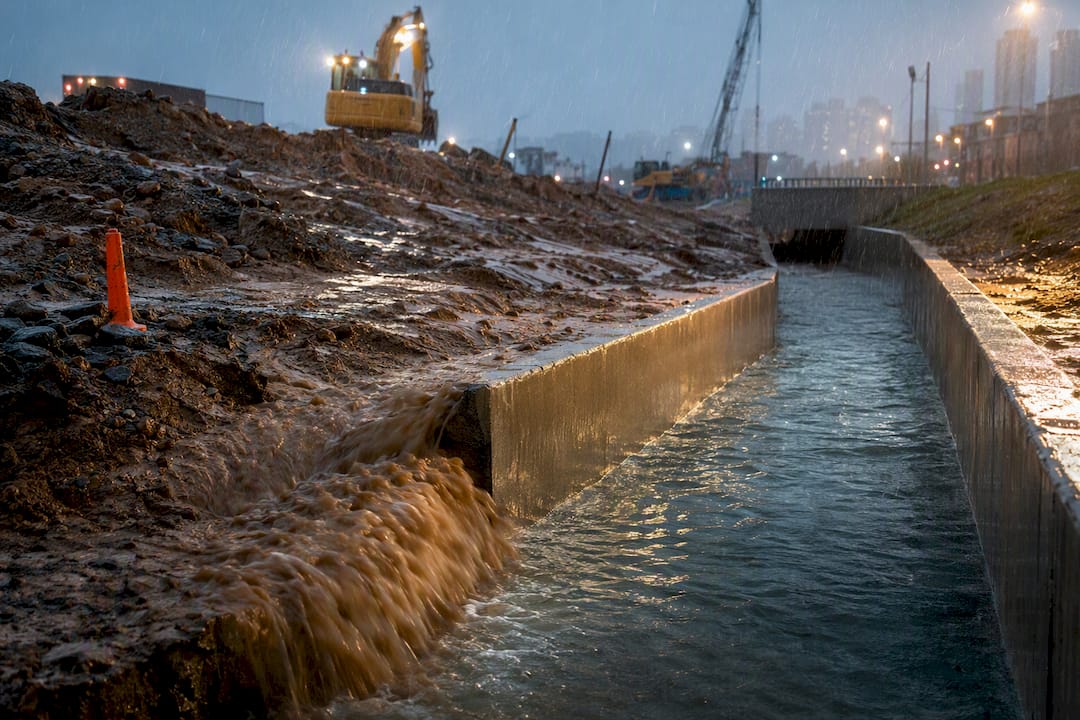
Earth Control Measures (ECM) are the site systems that treat silty rainwater runoff before it reaches public drains, and Singapore construction professionals face three immediate obligations: keep discharged Total Suspended Solids (TSS) under 50 mg/L, secure a Qualified Erosion Control Professional (QECP)-endorsed ECM plan cleared by PUB before earthworks begin, and install CCTV or Silt Imagery Detection System (SIDS) monitoring with a maintained Blue-Marker at every discharge point.
TL;DR:
- ECM plans must be designed with site-specific data, including slope, soil, and catchment boundaries, and endorsed by a qualified professional before submission to PUB.
- Discharged silty rainwater must contain TSS below 50 mg/L, but process water from activities like tunneling or batching requires separate handling outside standard ECM systems.
- Monitoring systems must include 1280×720 camera snapshots every five minutes, with online access, a visible Blue-Marker on discharge pipes, and at least 15 days of footage retention.
- Maintenance routines such as desilting, camera checks, and Blue-Marker repainting depend on site conditions and weather patterns to prevent compliance failures.
- Responsibility for ECM compliance is shared among the QECP, ECMO, and contractors, with clear documentation, routine checks, and credential verification key to ongoing adherence.
Table of Contents
- What Are the Regulatory Requirements for Earth Control Measures?
- How Do You Design an ECM Plan for a Singapore Site?
- What ECM Controls Actually Work on Singapore Sites?
- What Are the CCTV and SIDS Monitoring Requirements?
- Who Is Responsible for ECM Compliance on Site?
- Implementation Checklist: Timelines and Cost Considerations
- How Do You Prepare for a PUB Inspection?
- MOSAIC’s Approach to ECM Compliance in Practice
- Why ECM Deserves Treatment as an Operational System, Not a Compliance Checkbox
- Get Support Designing and Running Your ECM Compliance System
- Where to Find the Official ECM Rules and Templates
- Sources
- FAQ
What Are the Regulatory Requirements for Earth Control Measures?
PUB sets the compliance bar at a hard number: silty rainwater runoff discharged from a construction site into public drains must carry TSS below 50 mg/L. That threshold applies specifically to sediment-laden stormwater picked up as rain crosses exposed earth, disturbed slopes, and stockpiles. It does not apply to every liquid leaving a site, and that distinction trips up more contractors than any other part of the framework.
Process water, slurry from bored piling, tunneling spoil, or wash water from concrete batching falls outside standard ECM treatment entirely. That water needs segregation and handling under separate environmental controls, not a silt trap sized for rainwater. Treating process water as if it were ordinary runoff is one of the fastest ways to fail an inspection, because the contamination profile and the required treatment train are different animals.
The submission process itself is procedural, not optional paperwork. Before a single bucket of earth moves, the project must have a QECP-designed plan endorsed and submitted to PUB for clearance. The ECM report itself needs to stand on its own as a technical document, and practitioner write-ups from firms like PEC Civil Consultant confirm what PUB reviewers actually check line by line.
A complete ECM report generally needs to include:
- Site-specific erosion control designs matched to actual slope gradients and soil type, not a generic template
- A management system describing who inspects what, how often, and who signs off on corrective action
- Topographical details showing catchment boundaries, natural drainage paths, and existing site contours
- Discharge point locations cross-referenced against public drain connections
- A construction sequence showing which controls go in before which earthworks phase
PUB’s enforcement authority extends to site visits without advance notice, and inspectors compare the endorsed plan against what is physically installed. A plan that shows a sedimentation tank on paper but has a smaller tank on the ground is a compliance gap regardless of how well the paperwork reads.
The most common submission mistakes are avoidable. Contractors submit generic plans copied from a previous project without adjusting for the new site’s catchment area. Others leave out the topographical survey entirely, forcing a resubmission cycle that costs weeks. A few assume verbal approval from a site visit counts as clearance. It doesn’t. Nothing replaces the written endorsement sitting in PUB’s file before mobilization.
Because ECM exists to protect drainage capacity and reduce flood risk, PUB treats sediment accumulation in public drains as a systemic hazard, not a cosmetic issue. A single uncontrolled site during a heavy monsoon burst can silt up a downstream drain segment that serves dozens of other properties. That is the underlying reason the numeric limit exists at all, and it explains why enforcement rarely offers much leniency on the 50 mg/L figure itself.
How Do You Design an ECM Plan for a Singapore Site?
A defensible ECM plan follows a logical sequence from site data to installed hardware, and skipping steps almost always shows up later as a rejected submission or a failed inspection. The sequence below reflects what QECPs and PUB reviewers expect to see, in order.
- Gather the site assessment data first. Pull the catchment boundary, topographic survey, and available bore-log records before drafting a single control measure. A site with shallow bedrock and steep cut slopes behaves nothing like a flat reclaimed plot, and the treatment train has to reflect that difference.
- Establish hydrology and sizing inputs. Local rainfall intensity data and standard runoff calculation methods determine how much water each control needs to handle during a design storm event. Undersized silt traps are the single most frequent cause of TSS exceedances during heavy rain.
- Map the catchment to discharge points. Every drainage path on site should trace to a specific, numbered discharge point, and each point needs its own treatment justification, not a shared assumption that “it all goes to one tank eventually.”
- Design the treatment train. Sequence controls from source to discharge: erosion prevention at the point of disturbance, sediment capture in the middle, and a final polishing step before the water leaves the site boundary.
- Document assumptions and calculations. Every sizing decision needs a traceable number behind it. Reviewers want to see the runoff coefficient, the design rainfall intensity, and the resulting flow rate that sized the tank or trap.
- Prepare drawings that match the site, not a template. Discharge point coordinates, control locations, access routes for desilting equipment, and CCTV/Blue-Marker positions all belong on the same set of drawings the QECP endorses.
Pro Tip: Build the maintenance access route into the drawing set from day one. A silt trap that performs beautifully on paper but sits behind a stacked materials yard becomes impossible to desilt on schedule, and that gap shows up in the CCTV log long before an inspector ever visits.
Sizing decisions deserve more scrutiny than most teams give them. A treatment train designed for a modest shophouse renovation looks nothing like one for a large-scale earthworks package with multiple cut-and-fill zones. Rainfall intensity assumptions that undersize a system by even a modest margin will pass on a dry week and fail spectacularly during the first major storm cell. QECPs who have worked through several wet seasons tend to size conservatively for exactly this reason, because the cost of a slightly larger tank is trivial compared to the cost of a TSS exceedance, a stop-work order, or a resubmission cycle.
Drawings and calculations submitted alongside the plan should read as a coherent technical package, not a stack of disconnected documents. PUB reviewers move faster through submissions where the topographical survey, the hydrology calculation, and the drawing set all agree on the same catchment boundaries and discharge point numbering. Internal consistency across the report is what separates a same-cycle endorsement from a plan bounced back for clarification, and every week spent on clarification is a week the site cannot start earthworks.
What ECM Controls Actually Work on Singapore Sites?
No single control handles a Singapore site alone. Tropical storm intensity means most sites need a layered combination, and the right combination depends on catchment size, soil type, and how long the earthworks phase runs.
- Silt fences catch sheet erosion off small slopes and disturbed areas but perform poorly against concentrated flow. They work best as a first line of defense, not a standalone solution.
- Sediment traps and tanks capture the bulk of suspended solids from moderate catchments and remain the workhorse of most ECM treatment trains on mid-size sites.
- Filter bags and dewatering systems handle pumped water from excavations and cofferdams, filtering sediment before discharge in situations where gravity settling alone isn’t fast enough.
- Vegetative cover and mulching reduce erosion at the source rather than treating runoff after the fact, and the effect is measurable: maintaining 30% soil cover cuts sheet and rill erosion by roughly 70%, while 40% cover pushes that reduction closer to 80%.
- Diversion channels redirect clean upslope water around a disturbed area so it never mixes with silty runoff in the first place.
- Check dams slow concentrated flow in channels and swales, giving sediment time to settle before water reaches a trap or tank.
Vegetative cover deserves more attention than most site teams give it, because it is the only control on this list that reduces the erosion problem at its source rather than managing the consequence. A site that hydroseeds exposed slopes early, even temporarily, generates dramatically less sediment for every downstream trap and tank to handle. That single decision often determines whether a treatment train sized on paper actually keeps up with real storm loading.
Combining systems is standard practice, not a sign of an oversized design. A typical mid-size Singapore earthworks package pairs silt fences at the disturbance boundary, check dams in any concentrated flow channel, a sediment trap as first-stage settling, and a tank or filter bag system as the final polishing step before discharge. Relying on one control alone, no matter how well it is sized, tends to fail the moment storm intensity exceeds the design assumption for that single system.
Maintenance access separates a control that performs on paper from one that performs in a monsoon. Sediment traps need desilting equipment access wide enough for a mini excavator, not a wheelbarrow. Filter bags need replacement stock stored on site, because a clogged bag mid-storm with no spare on hand is a TSS failure waiting to happen. Diversion channels need periodic clearing of debris that collects at bends. None of these controls is “install and forget,” and the sites that get flagged repeatedly are almost always the ones where maintenance access was an afterthought in the original drawing set.
What Are the CCTV and SIDS Monitoring Requirements?
PUB requires continuous visual monitoring at every discharge point, and the technical specification is precise rather than open to interpretation. The ECM Guidebook sets the camera resolution at 1280×720 with color snapshots captured every five minutes, accessible online, and retained for at least 15 days.
By the numbers: Discharge point cameras must capture 1280×720 color snapshots at five-minute intervals, with a minimum 15-day snapshot retention window and a strict monthly downtime allowance.
TSS sampling supports the CCTV record rather than replacing it. Samples should come from the actual discharge point, not from an upstream tank where settling hasn’t finished, and every sample needs a timestamp, a location reference, and a lab result logged against that discharge point’s history. Recordkeeping matters as much as the sampling itself, because an inspector reviewing a TSS exceedance will ask for the surrounding week’s sampling history, not just the single result in question.
Practical requirements for a compliant setup include:
- Weatherproof camera housings rated for outdoor tropical exposure, not indoor-grade equipment adapted for site use
- Continuous power supply, ideally with battery or generator backup so a grid outage doesn’t create a monitoring gap
- Adequate lighting at the discharge point so night-time snapshots remain usable evidence, not black frames
- A maintained Blue-Marker painted on the discharge pipe, visible in every snapshot as the fixed reference point inspectors check against
- Online accessibility so PUB officers can review the feed remotely rather than requiring a site visit for every check
The PUB ECM Guidebook documents these camera checklist items in detail, including weatherproofing, lighting, and continuous power as installation baseline items, and a broader breakdown of the video surveillance obligations sits in this mandatory VSS compliance guide.
One detail catches out more sites than it should: the Blue-Marker is not decorative signage. It functions as the fixed visual reference an inspector uses to confirm the CCTV feed is actually pointed at the correct discharge point, and its visibility, position, and paint condition are enforceable items in their own right. A faded or obscured Blue-Marker can turn an otherwise compliant camera setup into a flagged item during review.
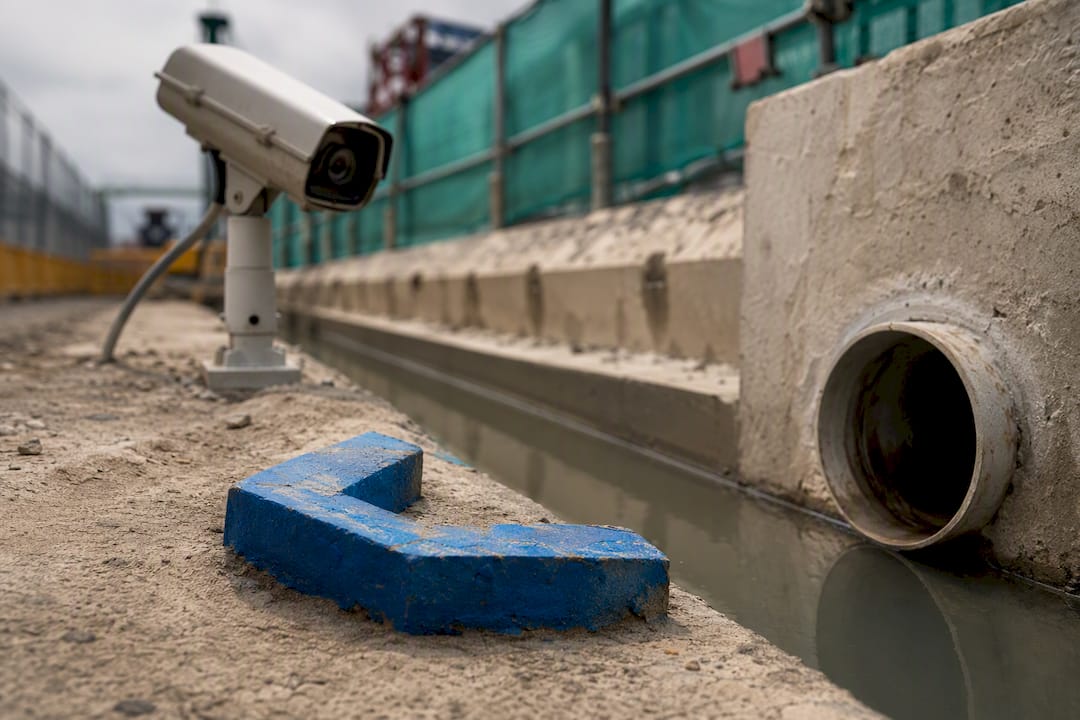
Operational reliability comes down to a handful of routine tactics that separate systems with clean uptime records from ones that generate repeated compliance flags. Power redundancy through a secondary source prevents a single outage from wiping out a day’s snapshot record. A scheduled camera lens cleaning routine, ideally tied to the same visit as desilting checks, keeps snapshots legible through Singapore’s humidity and dust conditions. Assigning one named person to confirm the online feed is live each morning, rather than assuming it, closes the gap where downtime accumulates unnoticed until an inspector asks for a specific date’s footage.
Who Is Responsible for ECM Compliance on Site?
Three roles carry distinct, non-overlapping responsibilities, and confusion between them is a common source of compliance gaps.
The QECP designs the ECM plan and puts a professional endorsement on it before PUB submission. That endorsement is the credential PUB relies on to accept the technical adequacy of the design, and a QECP who signs off on a plan is putting professional judgment behind every sizing calculation in it.
The Earth Control Measures Officer (ECMO) runs the plan day to day once it’s approved. Typical ECMO duties include:
- Daily visual checks of every treatment control for silt buildup, damage, or bypass flow
- Reviewing the previous day’s CCTV/SIDS snapshots for gaps or obvious discharge issues
- Logging desilting activity, maintenance events, and any corrective action taken
- Coordinating with the main contractor when a control needs urgent repair or replacement
- Maintaining the sampling schedule and ensuring lab results get filed against the correct discharge point
Contractors carry responsibility for installation matching the endorsed drawings and for keeping the system operating through every phase of earthworks, not just at project start. A contractor who installs a smaller tank than specified, or who removes a diversion channel during a later construction phase without updating the plan, owns that gap regardless of what the ECMO’s logs show.
Credential verification matters more than most teams realize. The IES/ACES ECMO registry lists trained personnel and gives project teams a way to confirm an ECMO’s credentials before engagement rather than taking a resume at face value. Checking that registry during procurement is a five-minute task that avoids discovering a credential gap mid-project.
Implementation Checklist: Timelines and Cost Considerations
Compliance planning needs to start well before mobilization, because plan endorsement and equipment procurement both run on their own clocks, and neither compresses easily under schedule pressure.
Pre-mobilization tasks should follow this sequence:
- Engage a QECP as early as the feasibility or detailed design stage, not after the earthworks contract is awarded
- Commission the site survey and any needed bore-log data QECPs require for sizing calculations
- Draft the ECM plan and circulate it internally for buildability review before formal submission
- Submit the endorsed plan to PUB and track the clearance timeline against the planned mobilization date
- Procure treatment plant equipment and CCTV/SIDS hardware in parallel with the review period, not after clearance arrives
Plan endorsement review and equipment procurement typically run on overlapping but independent timelines, and treating them as sequential rather than parallel is one of the most common scheduling mistakes on Singapore projects. Ordering CCTV hardware only after PUB clearance arrives routinely adds weeks to the mobilization date that a parallel procurement track would have avoided.
Cost drivers worth budgeting for early include:
- Hiring versus purchasing treatment plant equipment, which shifts the cost profile between capital expenditure and ongoing rental
- CCTV/SIDS system complexity, since online accessibility and continuous power redundancy cost more upfront than a basic recording setup
- Maintenance frequency, because a site with fine-grained silty soil needs more frequent desilting than one with sandier conditions
- QECP fees for plan design and any required revisions if the first submission comes back with comments
A ground-level checklist for the site team: confirm the QECP endorsement is filed, confirm CCTV feeds are live and accessible online, confirm the Blue-Marker is visible and freshly painted, confirm desilting equipment access is clear, and confirm the latest TSS sample result is logged before the week ends.
How Do You Prepare for a PUB Inspection?
Routine maintenance is what keeps a compliant design compliant in practice, and the schedule needs to be built around Singapore’s rainfall pattern rather than a fixed calendar interval. Desilting intervals should tighten during the monsoon season and can relax somewhat during drier stretches, but the ECMO’s daily checks never pause.
Auditors and PUB inspectors typically request the same core evidence set:
- Recent TSS sampling results with timestamps and discharge point references
- CCTV/SIDS snapshot history covering the retention window, with no unexplained gaps
- Maintenance logs showing desilting dates, volumes removed, and who performed the work
- The endorsed ECM plan and drawings, to confirm installed controls match what was approved
- Blue-Marker condition, checked against the same snapshots the CCTV system has been recording
Typical failures follow a predictable pattern. Cameras go offline during a power outage and nobody notices for several days. A silt trap fills past capacity because the desilting schedule slipped during a busy work week. A Blue-Marker fades to the point an inspector can no longer confirm which discharge point the feed shows. Every one of these has a quick remediation: a battery backup for the camera, a firmer desilting calendar tied to rainfall forecasts, and a repaint schedule for the marker tied to the same maintenance visit as the desilting run.
Record-keeping templates that log date, inspector name, TSS result, maintenance action, and CCTV status in one running sheet make audit preparation close to instant rather than a scramble the week before a scheduled review. Practitioners can adapt the templates and step sequencing from this environmental compliance guide to build that running log from the start of a project rather than retrofitting one after the first inspection flags a gap.
MOSAIC’s Approach to ECM Compliance in Practice
A QES consultancy earns its value on ECM compliance by closing the gap between a technically sound plan and a construction supervision system that survives real inspection conditions. MOSAIC works with project teams from QECP engagement through the first months of CCTV operation because the failure points on most sites show up after installation, not during design.
Coordinating QECP endorsement, CCTV/SIDS commissioning, and audit response as one continuous workflow, rather than three separate vendor relationships, closes the gaps where responsibility usually falls through:
- Aligning the QECP’s sizing assumptions with the contractor’s actual construction sequence before drawings get finalized
- Commissioning CCTV/SIDS hardware against the exact resolution, interval, and retention specification PUB inspectors check
- Running a pre-inspection audit walkthrough that mirrors what a PUB officer will actually request on site
- Training the ECMO and site team on daily check routines that catch problems before they become TSS exceedances
Pro Tip: Schedule a full monitoring system dry run at least two weeks before earthworks start, not the week of. A camera that looks fine on installation day sometimes reveals gaps in online accessibility or power stability only after a few days of continuous operation.
The recurring theme across compliant sites is coordination rather than any single clever control. A sediment trap sized correctly by a QECP still fails if the contractor’s desilting schedule doesn’t match the storm pattern, and a CCTV system installed to spec still generates gaps if nobody owns the daily uptime check. Reducing rework on ECM compliance comes down to treating design, monitoring, and maintenance as one system with one accountable owner, not three disconnected checkboxes signed off by three different parties.
Why ECM Deserves Treatment as an Operational System, Not a Compliance Checkbox
The recurring failure pattern across Singapore ECM compliance isn’t bad design. It’s treating a well-designed plan as finished once PUB grants clearance, when the real risk sits in the months of daily operation that follow.
Early QECP engagement, well before contract award, consistently produces plans that clear review faster because the sizing assumptions match the actual construction sequence from the start. Teams that wait until mobilization pressure forces the issue end up resubmitting, and every resubmission cycle costs schedule days that no project recovers cheaply.
Monitoring reliability deserves more investment than most budgets allocate to it. A camera system with power redundancy and a named daily owner costs marginally more than a bare-minimum setup, but it eliminates the recurring compliance failures that come from unnoticed downtime. Cross-discipline coordination between the QECP, the ECMO, and the main contractor’s site team, meeting on a fixed cadence rather than only after something goes wrong, is the single habit that separates sites with clean inspection histories from sites flagged repeatedly for the same preventable gaps.
— Aman
Get Support Designing and Running Your ECM Compliance System
Getting an ECM plan endorsed is only half the job. Keeping the treatment train, CCTV feed, and maintenance logs audit-ready for the full duration of earthworks is where most sites actually lose time and money. Consultants work alongside project teams and QECPs to close that gap, from plan review through CCTV/SIDS commissioning and ongoing audit support.

QES consultancy services can cover the full compliance chain relevant to ECM: safety and environmental audits that catch gaps before PUB does, training programs that bring ECMOs and site teams up to speed on daily monitoring duties, and broader certification support for teams juggling ECM alongside BizSAFE or ISO requirements. If your site team needs structured training on monitoring reliability and audit readiness, the safety training programs cover the daily check routines that keep CCTV uptime and TSS logs inspection-ready. Teams already holding or pursuing broader certification can also look at BizSAFE Star certification support to fold ECM compliance into a wider safety management framework rather than running it as a standalone workstream. Clients can request a site assessment to start building an ECM compliance system that holds up under inspection, not just on paper.
Where to Find the Official ECM Rules and Templates
- The PUB ECM Guidebook is the primary technical reference, covering CCTV/SIDS specifications, Blue-Marker installation examples, and treatment control checklists.
- The PUB Earth Control Measures requirements page explains the regulatory rationale and links to current submission procedures.
- The LTA environmental protection reference covers QECP engagement requirements for construction projects.
- The IES/ACES ECMO registry lets project teams verify an ECMO’s credentials before engagement.
- MOSAIC’s construction safety compliance guide walks through broader audit-readiness steps that pair well with ECM-specific preparation.
Sources
- PUB (Public Utilities Board) – Earth Control Measures
- ECM Guidebook (PUB) PDF
- LTA — Environmental protection for construction (QECP reference)
FAQ
What Is an Earth Control Measure?
An Earth Control Measure is a system, such as a silt trap, sedimentation tank, or filter bag, that treats silty rainwater runoff from a construction site so Total Suspended Solids stay below 50 mg/L before discharge into public drains.
How Is Wastewater Managed on Singapore Construction Sites?
Silty rainwater runoff goes through ECM treatment trains regulated by PUB, while process water such as slurry from piling or tunneling is segregated and handled under separate environmental controls rather than standard ECM systems.
How Do You Register as an Earth Control Measures Officer?
There is no separate government registration process; ECMOs typically gain recognition through the IES/ACES ECMO registry, which lists trained personnel and serves as the industry reference point for verifying credentials.
What Are the CCTV Requirements for PUB ECM Sites?
PUB requires cameras at each discharge point to capture 1280×720 color snapshots every five minutes, stay accessible online, and retain at least 15 days of footage with minimal monthly downtime.
Who Needs to Endorse an ECM Plan Before Earthworks Begin?
A Qualified Erosion Control Professional must design and endorse the ECM plan, and that plan must receive PUB clearance before any earthworks activity starts on site.