

The Paradigm Shift Toward Upstream Risk Mitigation in the Built Environment
The global construction industry represents a colossal economic engine, valued at approximately $14.4 trillion in 2022, accounting for 14.2% of the global Gross Domestic Product (GDP).1
From 2022 to 2032, this sector is projected to experience an annual growth rate of 6.2%, driven primarily by government-funded infrastructure development, rapid industrialization, and the rising demand for green construction methodologies.1
The United States remains a dominant force within this market, accounting for 21.6% of total global construction activity in 2022.1
Despite this immense financial scale and technological advancement, the construction sector is consistently recognized as one of the world’s most hazardous industries.1
According to data from the International Labor Organization (ILO), at least 108,000 construction workers suffer fatal occupational injuries on site every year, representing approximately 30% of all work-related fatalities globally.1
In the United States alone, the Bureau of Labor Statistics (BLS) recorded 4,764 workplace fatalities across all sectors in 2020, with the construction industry absorbing a disproportionately high percentage of these tragedies.4
This stark juxtaposition between economic dominance and occupational peril highlights a systemic failure in traditional, reactive safety management strategies.3
Historically, safety interventions were isolated to the construction phase, relying heavily on the constructor’s reactionary enforcement of safe work practices on site.3
However, empirical research and industry consensus demonstrate that safety practices executed solely during the construction phase are fundamentally inadequate to ensure worker safety.3
The modern solution lies in an upstream, proactive paradigm known globally as Design for Safety (DfS), or Prevention through Design (PtD).5
Design for Safety is formally defined as the deliberate, systematic process of identifying, analyzing, and reducing occupational safety and health risks through optimal design choices during a project’s conceptual and planning phases.6
By addressing risks at their source, hazards can be entirely eliminated or significantly reduced before physical construction commences, shifting the focus from managing the hazard to designing it out completely.8
Navigating this complex transition requires highly specialized expertise. A Design for Safety (DfS) Consultant acts as an indispensable catalyst, bridging the historical, often siloed divide between architectural intent and ground-level constructability.10
By intervening before the first concrete is poured, a DfS consultant orchestrates a seamless integration of safety protocols, ensuring that projects are not only visually and functionally remarkable but also intrinsically safe to build, maintain, and eventually decommission.7
The integration of such a consultant serves as a transformative mechanism for developers, delivering proven improvements in schedule optimization, regulatory compliance, and overall project profitability.10
The subsequent analysis delineates the regulatory imperatives driving this shift and explores the five core methodologies DfS consultants deploy to streamline the construction lifecycle.
The Global Regulatory Landscape and the Compliance Imperative
To fully comprehend the value a DfS consultant brings to the modern built environment, one must analyze the stringent regulatory frameworks currently driving global construction markets.
Institutionalizing safety at the design phase fundamentally alters commercial liabilities and operational workflows across the supply chain.
Global fatality rates differ widely depending on the adoption of these upstream legislative frameworks, proving that regulatory pressure is a primary driver of occupational safety.1
For example, after the United Kingdom implemented safety management in the design phase in 1994, the construction fatality rate decreased by over 40%.12
By 2010, the UK’s all-industry fatality rate was approximately one-third of the US rate, and its construction fatality rate was merely one-quarter of the US rate.1
The structural differences between international frameworks dictate the specific operational strategies a DfS consultant must deploy to ensure strict compliance while maintaining project momentum.5
| Regulatory Framework | Jurisdiction | Mandatory Application Criteria | Key Facilitator Role | Primary Liability and Collaboration Structure |
| WSH (Design for Safety) Regulations 2015 | Singapore | Mandatory for projects ≥ S$10 million that meet the Planning Act definition of “development” undertaken by a business. | Design for Safety Professional (DFSP) | Shared liability among Developers, Designers, and Contractors. Structured collaboration via formal DfS review meetings (GUIDE-1 to GUIDE-3) and a mandatory DfS Register. |
| Construction (Design and Management) Regulations (CDM 2015) | United Kingdom | Mandatory for all construction work, regardless of size or duration. | Principal Designer | Places absolute accountability on the Client. Requires continuous information sharing among all appointed duty holders from the pre-construction phase onwards. |
| Prevention through Design (PtD) | United States | Voluntary standard (ANSI/ASSE Z590.3); driven by NIOSH initiatives rather than a unified federal mandate. | PtD Consultant / Engineer | Liability varies heavily by state jurisdiction and specific contractual obligations. Collaboration relies on project-specific voluntary integration rather than statutory mandates. |
In Singapore, the Workplace Safety and Health (Design for Safety) Regulations 2015, which became effective on August 1, 2016, represent a global benchmark for integrating safety into the commercial lifecycle of a project.5
This subsidiary legislation under the main WSH Act legally compels developers and designers to identify and eliminate foreseeable risks, explicitly linking legal liability to the “upstream” creators of risk.5
The regulations mandate that developers appoint a Design for Safety Professional (DFSP)—a role that can be fulfilled by an independent third-party consultant—to facilitate the DfS review process.14
Failure to comply with these regulations is not treated as a minor administrative oversight; it carries severe punitive measures, including maximum fines of up to S$500,000 for corporate entities.14
Conversely, the United States lacks a unified federal regulation equivalent to the UK’s CDM or Singapore’s DfS regulations, relying instead on the National Institute for Occupational Safety and Health (NIOSH) Prevention through Design (PtD) initiative.5
This reliance on voluntary adherence partially explains why the US risk level and fatality rates remain significantly higher than those of the UK or Singapore.1
When analyzing fatality rates using equivalent evaluation conditions across a time-series approach, the risk level ranks highest in China (2.27), followed by South Korea (2.05), Mexico (1.23), Singapore (0.98), Japan (0.80), and the United Kingdom (0.47).12
By mastering these complex jurisdictional nuances, a DfS consultant effectively shields developers from extensive legal exposure and regulatory fines, acting as a navigational anchor that streamlines the pathway from conceptual blueprint to physical reality.
Way 1: Orchestrating Early Contractor Involvement (ECI) to Mitigate Rework
The traditional design-bid-build delivery method often isolates architects and engineers from the contractors who must eventually execute their visions.15
This disjointed approach is a primary catalyst for downstream inefficiencies, leading to designs that are functionally impossible to build without significant modifications.
The performance of large capital projects utilizing this traditional model has been historically poor; a 2017 McKinsey report reviewing 500 global infrastructure projects valued above $1 billion found that a staggering 95% of projects suffered from schedule or budget overruns, with only 5% completed within their original parameters.16
A DfS consultant actively disrupts this siloed methodology by mandating Early Contractor Involvement (ECI) and robust design-assist frameworks.15
ECI allows the contractor to be appointed under a two-stage contract before the details of the final construction have been fully developed and priced, transforming the contractor from a mere executor into a proactive service provider during the critical front-end planning stages.18
By establishing this direct line of communication between owners, designers, and key trade contractors, the DfS consultant facilitates a collaborative environment where constructability, material availability, and safety are evaluated concurrently.15
The integration of ECI resolves constructability issues long before they manifest as costly physical delays on the job site.
For instance, engaging a masonry design-assist partner early in the schematic phase allows for the rigorous optimization of precast concrete panels.19
During one such project, the early inclusion of precast fabrication subconsultants enabled the design team to precisely pinpoint relieving angle locations, optimize panel dimensions (length, width, and height), and detail complex chamfered projections.19
This proactive collaboration minimized the number of different form liners required, streamlining the fabrication process and ensuring a higher quality installation.19
Similarly, by employing techniques such as bypass framing, contractors can prefabricate and install backup walls before concrete slabs are even poured.19
Because rebar layouts, slab penetrations, and shafts are coordinated simultaneously, the building envelope can be largely enclosed prior to winter weather, drastically reducing the need for temporary enclosures and heating, ultimately compressing the overall construction schedule by months.19
Furthermore, a DfS consultant utilizes ECI to surgically mitigate the root causes of construction rework.
Studies indicate that design errors and omissions cost the global construction industry billions annually, with rework consuming anywhere between 4% and 20% of total project budgets, depending heavily on project complexity.20
In Australia, the direct and indirect costs of design errors have been estimated to account for approximately 14% of the total contract value.20
| Primary Causes of Construction Rework | Percentage of Total Rework | Strategic DfS Consultant Intervention |
| Poor Collaboration | 48% | Mandating integrated design charrettes and continuous Early Contractor Involvement (ECI). |
| Miscommunication | 26% | Establishing a centralized, single source of truth via robust Building Information Modeling (BIM) protocols. |
| Inaccessible / Bad Data | 22% | Deploying cloud-based model sharing platforms (e.g., BIM 360) ensuring field-level access. |
| Lack of Alignment | 12% | Implementing strict governance checkpoints and constructability reviews before schematic finalization. |
By serving as a neutral, safety-focused mediator, the DfS consultant ensures that the design does not progress prematurely without essential stakeholder input.15
This is particularly critical in modern construction environments plagued by supply chain volatility and extreme equipment lead times.
For example, long-lead items such as industrial generators, specialized elevators, or advanced manufacturing components can frequently require lead times extending up to 60 weeks.15
ECI transforms real-time, model-based estimating into an active design tool, allowing teams to weigh structural options—such as selecting metal panels over precast concrete—based on immediate material availability rather than theoretical preference.15
This alignment is a proven, highly effective mechanism to prevent budget overruns, mitigate payment delays, and maintain absolute schedule stability.22
The success of ECI is thoroughly documented in complex, high-value infrastructure projects globally, such as the Panama Canal Expansion, the Macau Bridge in Hong Kong, and the Afsluitdijk in the Netherlands.16
In these high-stakes environments, obtaining early contractor feedback regarding marine construction methods, dredging equipment constraints, and waste management plans for disposal debris proved critical to avoiding years of protracted litigation and claims disputes.16
The 2023 Arcadis Global Construction Disputes Report explicitly identified owner/contractor willingness to compromise, robust contract reviews, and early constructability reviews as the top factors in mitigating project disputes.16
Way 2: Navigating Architectural Resistance and Enhancing Lifecycle Maintainability
Despite the empirically proven benefits of upstream safety integration, DfS consultants frequently encounter entrenched resistance from architectural and engineering teams.
The design process is inherently complex, and time pressure, limited practical field experience among younger engineers, and the rapid erosion of traditional mentoring cultures contribute significantly to an environment where safety is treated as a peripheral concern.20
The resistance from design professionals typically stems from two primary sources: a fundamental lack of practical construction safety expertise, and a profound fear of assuming increased legal liability.24
In a seminal study analyzing 23 distinct design firms, a significant portion of designers indicated that their legal counsel explicitly advised them against addressing construction worker safety in their architectural plans.25
The prevailing apprehension is that by dictating safety measures, design professionals expose themselves to additional, undeserved liability for the execution of work on site.25
Furthermore, there is a widespread perception that performing rigorous safety-related actions during the design phase will inevitably increase both direct and overhead costs for the design firm.26
Research corroborates this hesitance; a review of 164 journal articles related to DfS in construction revealed that approximately 60% of the literature addresses the critical issue of designer knowledge, awareness, and education, highlighting it as a pervasive industry barrier.27
A skilled DfS consultant systematically overcomes this institutional barrier by absorbing the procedural burden and reframing safety as a natural, value-adding extension of design excellence and lifecycle maintainability.29
They act as the vital conduit of knowledge, providing architects with established safety databases and frameworks, such as the IES-NUS DfS Library of Construction-Related Risks developed by the National University of Singapore.30
This library is crucial because it clearly delineates the nuanced differences between a contractor’s operational hazard (which the contractor must manage) and an inherent design risk (which the architect must mitigate), thus clarifying liability boundaries.30
To further plug the competency gap without stifling architectural creativity, consultants increasingly utilize gamified training tools, such as the “SafeSim Design” training game, which immerses designers in practical DfS concepts.30
The impact of the DfS consultant’s intervention is perhaps most evident in the realm of building maintainability.29
Decisions finalized during the schematic design phase dictate the long-term safety of facility managers, cleaners, and maintenance personnel for decades to come.29
A classic example of a DfS intervention involves the specification of window sills. If a DfS consultant ensures that window sills are specified at a height of 42 inches (plus or minus 3 inches), the sill inherently acts as a compliant guardrail.32
This seemingly minor architectural adjustment eliminates the necessity for contractors to build, maintain, and eventually dismantle temporary wooden guardrails during the construction phase, saving substantial material costs (often referred to colloquially as saving a forest of “2×4 trees”) while permanently eliminating fall hazards for future occupants.32
Similarly, the incorporation of parapet walls can function as permanent perimeter fall protection, provided the DfS consultant coordinates with the structural engineer to account for the associated increases in snow or wind loading early in the design phase.32
The tragic consequences of ignoring DfS principles are frequently highlighted in National Institute for Occupational Safety and Health (NIOSH) fatality investigations.
In 2022, a demolition laborer fell 19 feet to his death while working on a roof, and a roofing project manager fell 30 feet to his death after stepping on an unprotected fiberglass skylight.33
A DfS consultant reviews roofing plans to ensure that skylights are either designed with integrated, shatterproof safety grates or elevated on curbs with structural guardrails, engineering the fall hazard out of existence before the skylight is even procured.32
Furthermore, as sustainable architecture and eco-friendly design proliferate, the inclusion of complex features like vegetated green roofs introduces severe, long-term fall hazards for the maintenance workers required to tend the flora.10
Without proactive DfS intervention, these aesthetic features become operational liabilities. The DfS consultant ensures that certified anchor points, safe access routes, and adequate parapet heights are integrated seamlessly into the sustainable vision, reinforcing the foundational principle that a building cannot be considered truly “green” if its maintenance is hazardous to human life.10
Case studies in densely populated urban environments further demonstrate the efficacy of this approach.
For example, during the preliminary design stage of the Joint-user complex building in Tseung Kwan O, Hong Kong—a project encompassing a public library and sports center surrounded by high-rise residential developments—a major health and safety concern was identified regarding the dredging and disposal of contaminated sediment.34
By utilizing a Project Supervisor acting in a DfS capacity, the team recognized that the leakage of contaminated sediment during transportation posed a severe environmental and occupational risk.34
Rather than relying on the contractor to manage the hazard reactively during execution, appropriate mitigation measures were provisioned directly within the design stage, resulting in the most cost-effective and secure resolution of the issue.34
Way 3: Integrating 4D and 5D Building Information Modeling (BIM) for Advanced Safety Simulation
The modern DfS consultant does not rely solely on 2D blueprints or static spreadsheets; they heavily leverage advanced Building Information Modeling (BIM) to transition safety planning from a theoretical exercise into a highly accurate, data-driven simulation.35
BIM is a primary driver of Construction 4.0, fundamentally altering how design and construction are approached by utilizing complex algorithms to automatically assess various elements of a project, including potential safety risks.35
While 3D BIM provides essential spatial intelligence, 4D BIM integrates chronological scheduling data, and 5D incorporates real-time cost analytics, creating a comprehensive, dynamic digital twin of the construction site.35
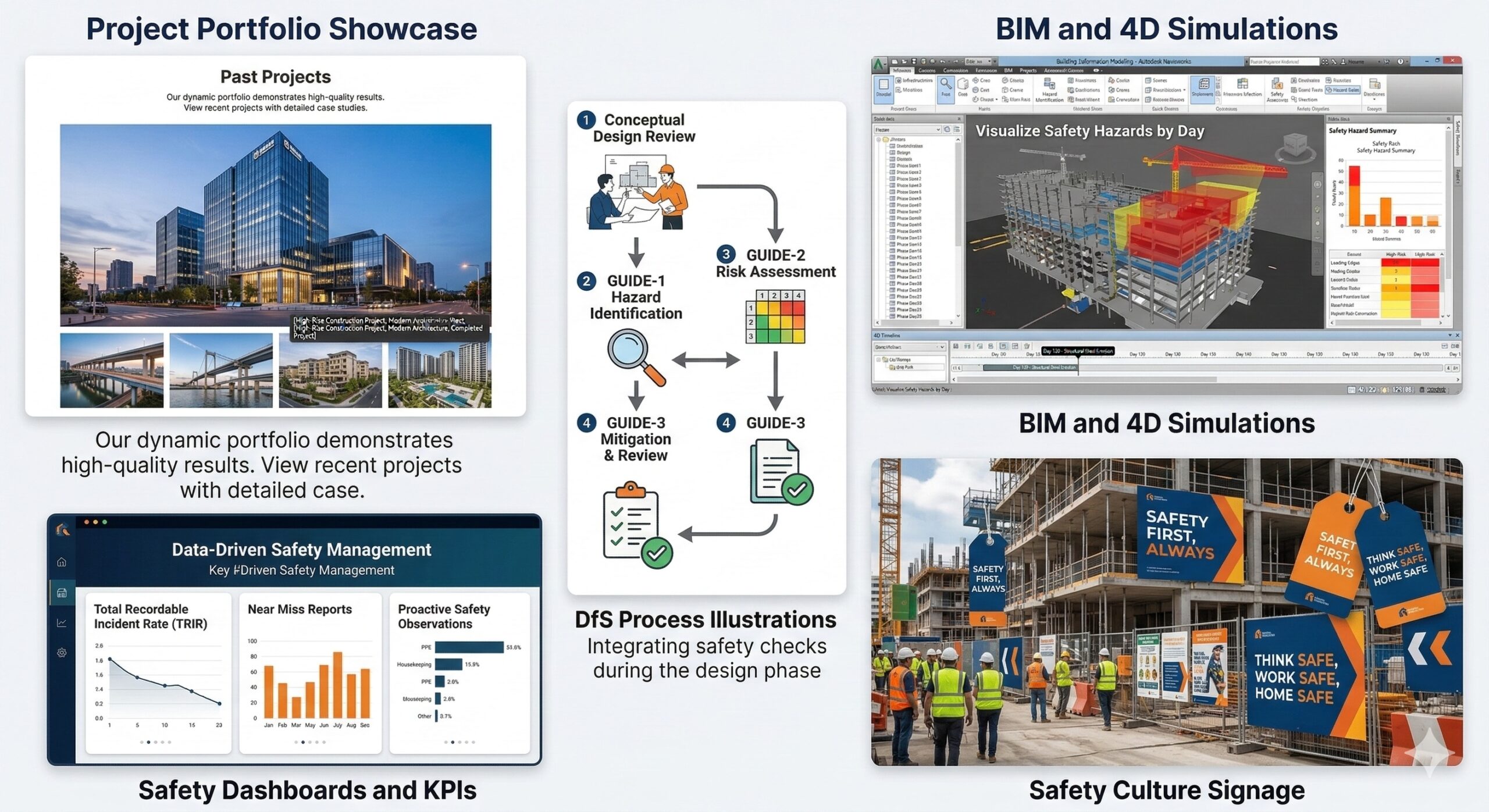
Through 4D simulations executed on platforms such as Autodesk Navisworks, the DfS consultant can cross-reference specific safety risk indices directly with the construction schedule.35
This capability allows project managers to foresee overlapping hazardous activities—such as simultaneous deep excavation work occurring adjacent to overhead crane lifting operations—and systematically resolve these temporal clashes before workers ever step foot on site.35
Vital safety-related attributes, including element location, material density, and designated construction zones, are embedded directly into the BIM framework.35
Predefined hazard likelihoods derived from Job Hazard Analyses (JHA) are integrated via customized plugins (often supported by Microsoft Excel databases), enabling end-users to view a timeline that summarizes potential hazards by day, or isolates risks associated with individual 3D elements using visual aids like radar charts.35
This proactive digital visualization is especially effective in mitigating the most common fatal hazards: falls, electrocution, struck-by incidents, caught-in-between accidents, structural collapse, and fire.35
Moreover, DfS consultants deploy automated safety rule-checking software, such as Solibri, to verify architectural compliance dynamically.
These tools automatically verify that escape routes meet exact dimensional tolerances required for rapid evacuation, confirm the correct spatial placement of fire-stopping elements, and guarantee adequate physical clearance for the safe access and maintenance of overhead mechanical, electrical, and plumbing (MEP) equipment.10
By executing these specialized checks digitally, the consultant guarantees that vital design changes flow seamlessly to the job site, maintaining the agility required for fast-paced design-build delivery methods while entirely avoiding the devastating, compounding delays associated with on-site geometric failures.10
The implementation of BIM for safety is particularly crucial in complex, subterranean environments.
In China, where the number of metro lines and operational mileage has expanded massively (reaching over 7,209 kilometers), the complexity of underground station construction has led to frequent accidents; a study noted 246 metro construction safety accidents between 2002 and recent years.39
To combat this, safety knowledge bases (KB) have been developed into BIM software as inspection plug-ins to achieve automated analysis and retrieval of safety risks specifically tied to metro design specifications, providing designers with a precise visualization of risk components to locate and pre-control hazards.39
To quantify and manage this technological landscape, DfS consultants utilize a variety of digital risk assessment platforms to maintain a centralized, immutable source of truth.
Traditional methods—such as paper checklists, spreadsheet logs, and handwritten incident reports—create unacceptable delays, data gaps, and limited visibility; a hazard observed on a Monday might not reach a safety manager’s desk until Thursday.40
Digital tools provide real-time alerts, traceable documentation, and centralized executive dashboards.40
| Construction Safety Management Software | Free Version Available | Paid Plan Pricing Structure | Mobile App Capability | Core Functionality and DfS Integration Focus |
| SafetyCulture | Yes | $24/user/month | Yes | Highly popular for mobile inspections, checklist standardization, and field-level hazard reporting. Strong capability for customizing specific workflows (e.g., utility strike risks) over generic templates.41 |
| Fieldwire | Yes | $39/user/month | Yes | Focuses heavily on task management, blueprint viewing, and real-time issue tracking on the job site.41 |
| eSUB | No | $49/user/month | No | Subcontractor-focused risk management, tracking daily reports, and specific trade-level compliance.41 |
| HammerTech | No | $89/month | Yes | Centralized safety operations, digital orientations, and high-level site risk assessment aggregation.41 |
| Autodesk Build / BIM 360 | No | ~$7,000/year | Yes | Deep BIM integration, comprehensive 3D/4D issue resolution, clash detection, and seamless model sharing across the entire supply chain.10 |
As noted by industry practitioners, the effectiveness of these tools relies heavily on customization.
Generic risk assessment software often fails to capture the true, specific hazards of complex operations, such as excavation work requiring precise proximity tracking to high-pressure gas lines or managing expiring 811 utility tickets.42
The DfS consultant ensures that these digital platforms are meticulously tailored to reflect the exact parameters of the specific project, ensuring data is not just collected, but practically applied in the field.42
Way 4: Standardizing the DfS Register and Safety Review Meetings
The administrative and legal cornerstone of the DfS methodology is the Design for Safety Register.
This living, highly structured document acts as the central, comprehensive repository for all identified hazards, detailed risk evaluations, and subsequent engineering mitigation strategies.7
Without a dedicated consultant to rigorously manage this documentation, complex projects frequently succumb to compliance failures, disjointed inter-disciplinary communication, and dangerously fragmented safety protocols.43
The DfS consultant structures the compliance journey through a series of mandatory, highly organized review meetings, strategically aligned with distinct project phases.
In the comprehensive Singaporean framework, these critical junctures are formalized as GUIDE-1 (Concept Design Review), GUIDE-2 (Detailed Design & Maintenance Review), and GUIDE-3 (Pre-Construction Review).7
- GUIDE-1 (Concept Design): Focuses on the overarching structural concepts and site layout, identifying massive, macro-level risks before the design is locked in.
- GUIDE-2 (Detailed Design & Maintenance): Evaluates specific building components, ensuring the detailed design is safe to construct, clean, repair, and maintain. This phase produces detailed risk analyses and updates the DfS Register with specific mitigation measures.7
- GUIDE-3 (Pre-Construction Review): Facilitates a safe, comprehensive handover of all design risk information to the appointed principal contractor, ensuring the integration of DfS information into the contractor’s site-specific safety plans and securing formal acknowledgment of residual risks.7
During these structured charrettes, the DfS consultant employs sophisticated analytical methodologies to uncover latent or hidden hazards that might otherwise go unnoticed.44
One such method is Fault Tree Analysis (FTA), a reliability and logic-based methodology used to analyze the specific sequential events that could lead to an accident or structural failure.44
The undesirable event is placed at the top of a logic tree, and the various contributing events are constructed below using logic symbols.44
Additionally, the consultant leads structured “What-If” brainstorming sessions with an assembled team of experienced architects, engineers, and contractors.44
By gathering extensive information—such as video analyses of similar facilities, detailed design documents, and maintenance schedules—the consultant poses rigorous, scenario-based questions.44 Examples for a highway construction project include:
- “What if workers must access deep drains? Are these drains classified as a hazardous confined space?”
- “Will heavy equipment be operating in close proximity to overhead high-voltage power lines?”
- “Do articulated dump trucks have sufficient turning radii and shoulder space to stop safely without encroaching on live traffic?”
- “What if a worker attempts to manually lift drain covers? Are they manufactured from lightweight composite materials, or do they feature ergonomic lifting handles?” 44
All findings from these rigorous sessions are documented meticulously in the DfS Register.43
If a risk cannot be entirely engineered out due to unavoidable structural or financial constraints, it is officially recorded as a “residual risk”.7
The consultant assumes the critical responsibility of ensuring that these residual risks are formally communicated to the principal contractor.7
This ensures that downstream site-specific safety manuals and daily operational risk assessments (like toolbox talks) accurately reflect the lingering dangers inherent in the finalized design.43
This meticulous record-keeping is far more than an administrative exercise; it provides absolute, demonstrable protection against regulatory audits, defends the developer against liability claims, and ensures that vital safety knowledge is safely handed over to the facility’s eventual end-users and management corporations.8
Way 5: Maximizing Return on Safety Investment (ROSI) and Tracking KPIs
The most compelling, business-critical argument a DfS consultant presents to project developers and stakeholders is the profound financial leverage generated by the Return on Safety Investment (ROSI).
While engaging a specialized consultant and performing detailed 4D safety reviews incurs upfront capital expenditure, the downstream financial benefits are exponential.
The data clearly indicates that the value of DfS can be expressed in hard currency, derived from a calculated mix of avoided costs, massive efficiency gains, and direct government financial incentives.5
Research compiled by the National Safety Council (NSC) and other occupational health bodies consistently demonstrates that every $1 invested in injury prevention yields a guaranteed return of between $2 and $6.5
When applied specifically to upstream design-phase interventions, this multiplier expands dramatically; numerous studies suggest that $1 spent on DfS engineering can save up to $10 in subsequent downstream rectification, litigation, and operational costs.5
These significant savings materialize across two primary financial vectors: Direct (Hard) Costs and Indirect (Soft) Costs.47
- Direct (Hard) Costs: These are easily quantifiable expenditures. Safer operations driven by DfS result in a stark reduction in workers’ compensation claims.46 A strong, documented compliance record directly yields lower insurance premiums and entirely eliminates the threat of devastating regulatory fines and post-accident lawsuits.46
- Indirect (Soft) Costs: Often ignored by traditional accounting, these costs frequently double the amount an employer ends up spending following an incident.47 Workplace accidents cause severe site disruptions, requiring extensive incident investigations, the physical repair of damaged property, and significant administrative overhead.47 Furthermore, accidents severely degrade workforce morale, leading to a climate of worker stress, high absenteeism, employee replacement costs, and plummeting productivity.47
The Occupational Safety and Health Administration (OSHA) estimates that businesses spend an astonishing $97.4 billion annually on costs associated with occupational injuries and illnesses—expenditures that evaporate directly from company profit margins.47
By establishing robust safety and health management systems early, workplaces can reduce their injury and illness costs by 20% to 40%.47
In the modern, highly competitive business environment, these margins are often the difference between operating profitably in the black or running severely in the red.47
To prove this ROI and ensure continuous improvement, the DfS consultant implements a rigorous framework of Key Performance Indicators (KPIs).
Moving beyond rudimentary “accident rates,” a sophisticated consultant tracks both lagging and leading indicators to provide a comprehensive view of Health, Safety, Environment, and Quality (HSEQ) performance.48
| KPI Category | Specific Metric | Operational Purpose and Definition |
| Lagging Indicator | Fatalities | Measures the absolute number of work-related deaths. The most severe outcome, used to critically evaluate systemic failures in hazard identification and risk assessment.50 |
| Lagging Indicator | Total Recordable Incident Rate (TRIR) | A high-level mathematical benchmark tracking the total sum of workplace incidents over a specific period (e.g., following the introduction of new machinery) to determine if safety standards are worsening or improving.50 |
| Leading Indicator | Inspection Completion Rates | Tracks the safety officer’s ability to conduct regular, proactive safety inspections against the scheduled baseline, ensuring minimum health and safety requirements are continuously met.52 |
| Leading Indicator | Proactive Safety Observations | Measures the frequency of hazards reported before an incident occurs, demonstrating a strong safety culture and a high level of workforce engagement in hazard recognition.52 |
| Financial Metric | Insurance Premium Savings | Tracks year-over-year reductions in insurance costs directly correlated to strong compliance records and reduced claims.46 |
By actively managing these KPIs through centralized digital dashboards, the DfS consultant ties safety data directly to financial performance.46
This approach connects safety metrics to project cost reports, proving to developers that safety is not a sunk compliance cost, but a guaranteed driver of project profitability and brand reputation.14
Furthermore, the streamlined construction process achieved through ECI and BIM integration frequently allows clients to take occupancy of buildings months ahead of schedule, dramatically accelerating the commencement of operational revenue generation.19
Strategic Digital Authority: SEO and Marketing for Construction Safety Consultancies
For DfS consultancies to effectively scale their life-saving impact across the global construction industry, they must achieve an unshakeable digital authority.
In a highly competitive, modernized market where traditional marketing methods are rapidly losing efficacy, a sophisticated Search Engine Optimization (SEO) strategy is paramount.53
Research demonstrates that 97% of consumers and business owners research local services online before making a hiring decision.54
If a construction safety consultancy fails to appear at the top of Google’s Search Engine Results Pages (SERPs), they forfeit highly qualified, high-intent leads directly to their competitors.54
Building this digital presence requires a highly disciplined, multi-layered SEO architecture that captures broad industry visibility while simultaneously driving targeted, high-intent conversions.56
This is achieved through the strategic deployment of both high-volume short-tail keywords and highly specific long-tail keyword phrases.
| Keyword Strategy Classification | Example Search Query | Search Volume (US) / Competition | User Intent and Strategic Value |
| High-Volume Broad / Short-Tail | “Construction companies” | 110,000 / Low Competition 53 | Top of the funnel. Builds general brand awareness and massive site traffic, though conversion rates may be lower due to broad intent. |
| High-Volume Broad / Industry Specific | “Ready Mix Concrete” or “Roofing” | 74,000 / 40,500 57 | Captures users actively seeking specific construction supply services or specialty trades. |
| Mid-Tail Localized | “Builders Near Me” | 60,500 57 | High local intent. Highlights the absolute necessity of robust Local SEO and optimized Google Business Profiles for regional domination.55 |
| Long-Tail Conversion | “Affordable SEO consultant for startups in NYC” | Low Volume / High Conversion 59 | Ultra-specific intent. Users typing these 4+ word queries are financially qualified and ready to hire immediately, cutting through intense market competition.59 |
| Question-Based / PAA (People Also Ask) | “How do I care for suede boots?” (Example) | Informational 60 | Captures users seeking guidance. Creating dedicated blog content answering these exact queries establishes profound industry authority and trust.59 |
To identify these lucrative long-tail opportunities, consultancies leverage AI-powered SEO tools such as SEMrush, Ahrefs, and Google Keyword Planner, filtering keyword lists by word count and difficulty to instantly identify low-competition gaps in the market.58
Furthermore, analyzing user-generated content (UGC), site search logs, and forums like Reddit or Quora provides a goldmine of exact-match phrases that actual customers use to describe their pain points.60
However, ranking on the first page of Google is only half the battle; the content must compel the user to click.
To maximize the efficacy of these targeted keywords, consultancies must master the psychology of emotional triggers and “power words.”
The integration of specific, emotionally charged vocabulary directly influences human cognitive triggers, neural pathways, and decision-making processes, drastically improving user engagement, click-through rates (CTR), and conversion metrics.61
Research consistently demonstrates that content evoking strong emotional responses generates significantly longer time-on-page metrics and exponentially more social shares than emotionally neutral content.61
Different power words are utilized based on the specific intent of the content:
- Security, Trust, and Confidence: When targeting commercial intent on landing pages, words such as Proven, Certified, Authentic, Guaranteed, Backed By, and No-Risk are critical.63 Promising a developer that a DfS methodology is a proven process delivering guaranteed ROI appeals directly to their psychological desire for financial security and risk aversion.10
- Urgency and Exclusivity: To combat FOMO (Fear Of Missing Out) and drive immediate action on calls-to-action (CTAs), marketers deploy words like Act Now, Limited Time, Exclusive, Hurry, and Expires Soon.63
- Curiosity and Innovation: For informational blog posts, words like Discover, Transformative, Secret, and Revolutionary entice readers to investigate the content further.63
Structurally, the digital publication must be executed flawlessly to satisfy both search engine crawler bots and human readers.
The SEO Title Tag (Title Tag) is the most critical element for initial visibility and must be kept concise—ideally under 60 characters—to prevent awkward truncation on SERPs.10
It must front-load the primary focus keyword (e.g., “DfS Consultant”) and frequently utilize numeric hooks or question formats (e.g., “5 Ways…”, “How To…”), as these structures are proven to drive higher engagement.10 Directly beneath the title, the Meta Description serves as a 150-160 character enticing, keyword-rich preview.10
While the meta description does not directly alter the search algorithm’s ranking mathematics, the strategic injection of power words radically influences the human decision to click, thereby driving the CTR—which is a major ranking factor.10
Internally, massive reports and 10,000-word guides must be logically organized using proper HTML header tags (H1, H2, H3), breaking down the content into highly readable, easily digestible sections.10
When this rigorous technical SEO optimization is combined with the strategic acquisition of authoritative backlinks, the creation of dedicated project portfolio pages, and the continuous monitoring of performance metrics via Google Search Console, a construction safety consultancy can establish an unshakeable digital dominance.10
This digital authority ultimately translates online search queries into real-world infrastructure contracts, scaling the vital, life-saving impact of the DfS methodology across the globe.
The Vanguard of the Built Environment
The transition from a two-dimensional, theoretical blueprint to a massive, highly complex physical reality is fraught with immense logistical, financial, and human risks.
Traditional construction paradigms, characterized by fragmented communication, disjointed supply chains, and purely reactive safety measures, are no longer commercially or ethically viable in an era demanding rapid delivery, sustainable design, and stringent regulatory compliance.
The Design for Safety (DfS) consultant emerges as the central unifying force in the modern built environment.
By aggressively championing Early Contractor Involvement (ECI), these professionals dissolve the historical barriers between architectural design intent and ground-level field execution, ensuring structures are fundamentally buildable.
By integrating advanced 4D and 5D BIM technologies, they elevate hazard identification from a manual, error-prone checklist to a highly automated, predictive digital science.
By absorbing the immense administrative complexities of the DfS Register and systematically mitigating the liability fears of architectural teams, the consultant ensures that safety enhances, rather than restricts, creative design.
Ultimately, the deployment of a DfS consultant represents a supreme exercise in corporate risk management and capital efficiency.
The metrics, drawn from global mega-projects and detailed KPI tracking, are unequivocal: early upstream interventions generate a Return on Safety Investment that vastly eclipses the initial expenditure.
This rigorous methodology drastically reduces the incidence of rework, accelerates construction schedules, slashes insurance premiums, and, most importantly, prevents tragic occupational fatalities.
As regulatory frameworks like the WSH (DfS) Regulations in Singapore and CDM 2015 in the United Kingdom continue to set the global benchmark for construction compliance, the role of the DfS consultant will only expand in necessity and scope.
For developers, general contractors, and industry leaders worldwide, embracing this specialized expertise is no longer merely a legal obligation; it is an innovative, empirically proven strategy to guarantee project success and definitively safeguard human life across the global construction landscape.
Works cited
- COMPARISONS OF PTD/DFCS APPROACHES BETWEEN US VS. UK CONSTRUCTION SECTORS . NORA SECTOR COUNCIL MEETING NOVEMBER 16 -17, 2022 – CPWR, accessed March 8, 2026, https://www.cpwr.com/wp-content/uploads/PR-NORA24-Choi-PTD_Update.pdf
- An Update on Global Comparisons of Design for Construction Safety and Health among the United Kingdom, Singapore, South Korea, a – ISOES, accessed March 8, 2026, https://isoes.info/wp-content/uploads/2025/03/Choi22024.pdf
- Quantification and Assessment of Safety Risk in the Design of Multistory Buildings – Regulations.gov, accessed March 8, 2026, https://downloads.regulations.gov/OSHA-2015-0002-0083/attachment_4.pdf
- ESTIMATION OF COST IMPACT OF RISK OF INJURY FROM CONSTRUCTION ACCIDENTS USING LONG SHORT-TERM MEMORY NEURAL NETWORK ARCHITECTURE, accessed March 8, 2026, https://docs.lib.purdue.edu/cgi/viewcontent.cgi?article=2104&context=cib-conferences
- Design for Safety in Construction: Uncovering Long-Term Cost Savings (Hidden ROI), accessed March 8, 2026, https://mosaicsafety.com.sg/design-for-safety-in-construction-uncovering-long-term-cost-savings-hidden-roi/
- About Design for Safety, accessed March 8, 2026, https://www.tal.sg/wshc/topics/design-for-safety/about-design-for-safety
- WSH (Design for Safety) Regulations 2015: A Guide for Developers and Designers, accessed March 8, 2026, https://mosaicsafety.com.sg/wsh-design-for-safety-regulations-2015-a-guide-for-developers-and-designers/
- Workplace Safety and Health (Design for Safety) Regulations 2015 – Singapore Statutes Online, accessed March 8, 2026, https://sso.agc.gov.sg/SL/WSHA2006-S428-2015
- Framework for productivity and safety enhancement system using BIM in Singapore | Engineering, Construction and Architectural Management | Emerald Publishing, accessed March 8, 2026, https://www.emerald.com/insight/content/doi/10.1108/ecam-05-2016-0122/full/html
- 5 Ways a DfS Consultant Streamlines Your Construction Process …, accessed March 8, 2026, https://mosaicsafety.com.sg/5-ways-a-dfs-consultant-streamlines-your-construction-process/
- Introduction to Workplace Safety and Health (WSH) (Design for Safety) Regulation | SP – Singapore Polytechnic, accessed March 8, 2026, https://www.sp.edu.sg/pace/courses/all-courses/course-details/introduction-to-wsh-(design-for-safety)-regulation
- Comparative Analysis of the National Fatality Rate in Construction Industry Using Time-Series Approach and Equivalent Evaluation Conditions – PMC, accessed March 8, 2026, https://pmc.ncbi.nlm.nih.gov/articles/PMC8872405/
- Workplace Safety and Health Guidelines – Prevention through Design, accessed March 8, 2026, https://designforconstructionsafety.org/wp-content/uploads/2018/05/wsh_guidelines_design_for_safety1.pdf
- DFSPs: Revolutionizing Construction Safety in Singapore, accessed March 8, 2026, https://mosaicsafety.com.sg/dfsps-revolutionizing-construction-safety-in-singapore/
- Getting Ahead: The Benefits of Early Contractor Involvement in the Industrial Market, accessed March 8, 2026, https://jedunn.com/blog/getting-ahead-the-benefits-of-early-contractor-involvement-in-the-industrial-space/
- Early Contractor Involvement (ECI) – pianc usa, accessed March 8, 2026, https://pianc.us/wp-content/uploads/2023/12/PIANC-USA_WG194_17JAN2024.pdf
- The Power of Design-Assist in Construction – SMS Engineering, accessed March 8, 2026, https://www.smseng.com/post/the-power-of-design-assist-in-construction
- Early Contractor Involvement Models on Transit Projects Name of Speaker, accessed March 8, 2026, https://www.apta.com/wp-content/uploads/Early-Contractor-Involvement-Models-on-Transit-Projects_Jake-Speck-and-Jay-Wong.pdf
- Time, Money, and Other Benefits of Design Assist – Goody Clancy, accessed March 8, 2026, https://www.goodyclancy.com/perspective/design-assist/
- Design errors and construction costs: causes, consequences and mitigation strategies, accessed March 8, 2026, https://www.smay.pl/en/expert-blog/design-errors-and-construction-costs-causes-consequences-and-mitigation-strategies/
- The Hidden Value of a Design Review: Saving Time, Money, and Headaches Down the Road – Environmental Health & Engineering, accessed March 8, 2026, https://eheinc.com/insights/blog/value-of-the-design-review-cutting-costs-in-the-beginning-can-cost-more-later/
- How Design-Build Construction Reduces Risk at Every Stage – finfrock, accessed March 8, 2026, https://finfrock.com/how-design-build-construction-reduces-risk/
- EARLY CONTRACTOR INVOLVEMENT – SAME, accessed March 8, 2026, https://www.same.org/wp-content/uploads/2024/10/ECI-Presentation_092024.pdf
- Mitigating construction safety risks using prevention through design – PubMed, accessed March 8, 2026, https://pubmed.ncbi.nlm.nih.gov/20497796/
- Investigation of the Viability of Designing for Safety – CPWR, accessed March 8, 2026, https://www.cpwr.com/wp-content/uploads/krgambatese.pdf
- Challenges – Prevention through Design, accessed March 8, 2026, https://designforconstructionsafety.org/challenges/
- Design for safety implementation factors: a literature review | Request PDF – ResearchGate, accessed March 8, 2026, https://www.researchgate.net/publication/328227948_Design_for_safety_implementation_factors_a_literature_review
- Clearing the Path: Overcoming Barriers to Prevention through Design (PtD) Utilization in the US Construction Industry – MDPI, accessed March 8, 2026, https://www.mdpi.com/2313-576X/10/3/74?
- Exploring Architectural Design Factors Affecting Building Maintainability and Strategies to Overcome Current Shortcomings | Journal of Performance of Constructed Facilities | Vol 36, No 6 – ASCE Library, accessed March 8, 2026, https://ascelibrary.org/doi/10.1061/%28ASCE%29CF.1943-5509.0001770
- The IES-NUS DfS Library of Construction-Related DfS Risks and understanding WSH (DfS) Regulations and Actual Implementation Issues – Department of the Built Environment – NUS College of Design and Engineering, accessed March 8, 2026, https://cde.nus.edu.sg/dbe/2021/12/the-ies-nus-dfs-library-of-construction-related-dfs-risks-and-understanding-wsh-dfs-regulations-and-actual-implementation-issues/
- Architectural perspectives on the prevention through design concept: navigating worldview of barriers, opportunities and implementation strategies – Emerald Publishing, accessed March 8, 2026, https://www.emerald.com/ecam/article/doi/10.1108/ECAM-01-2025-0002/1310732/Architectural-perspectives-on-the-prevention
- Design for Construction Safety Instructor Guide | OSHA, accessed March 8, 2026, https://www.osha.gov/sites/default/files/training-library_DfCSInstructorGuide.pdf
- Prevention through Design in the Construction Industry – Building Innovation Conference, accessed March 8, 2026, https://www.buildinginnovation.org/sites/default/files/presentations/Prevention-Through-Design.pdf
- Untitled – Prevention through Design, accessed March 8, 2026, https://designforconstructionsafety.org/wp-content/uploads/2018/05/design_for_safety_worked_examples.pdf
- Construction safety management visualization with 4D BIM | 3 – Taylor & Francis eBooks, accessed March 8, 2026, https://www.taylorfrancis.com/chapters/edit/10.1201/9781003213796-3/construction-safety-management-visualization-4d-bim-sajith-wettewa-bonaventura-hadikusumo
- Challenges and Benefits of Using BIM Technologies to Improve Construction Safety: An Exploratory Case Study – Purdue e-Pubs, accessed March 8, 2026, https://docs.lib.purdue.edu/cgi/viewcontent.cgi?article=1028&context=cib-conferences
- 3D-BIM and 4D-BIM Models in Construction Safety Management – ResearchGate, accessed March 8, 2026, https://www.researchgate.net/publication/351948693_3D-BIM_and_4D-BIM_Models_in_Construction_Safety_Management
- Integrating Building Information Modelling and Health and Safety Design Phase – BIM Safe, accessed March 8, 2026, https://guidance.bimsafe.nz/wp-content/uploads/2024/07/BIMSafe-Report_Design_final.pdf
- A Design for Safety (DFS) Framework for Automated Inspection Risks in Metro Stations by Integrating a Knowledge Base and Building Information Modeling – PMC, accessed March 8, 2026, https://pmc.ncbi.nlm.nih.gov/articles/PMC10049134/
- Digital Safety Tools for Construction: Building Safer, Smarter Jobsites, accessed March 8, 2026, https://abctn.org/digital-safety-tools-for-construction-building-safer-smarter-jobsites/
- Top Construction Risk Assessment Software of 2026 – SafetyCulture, accessed March 8, 2026, https://safetyculture.com/apps/construction-risk-assessment-software
- Risk Assessment Software : r/SafetyProfessionals – Reddit, accessed March 8, 2026, https://www.reddit.com/r/SafetyProfessionals/comments/1n2c8ux/risk_assessment_software/
- Workplace Safety and Health Guidelines – Design for Safety, accessed March 8, 2026, https://www.tal.sg/wshc/-/media/tal/wshc/resources/publications/wsh-guidelines/files/wsh-guidelines-design-for-safety.pdf
- Design for Construction Safety Participant Guide – OSHA, accessed March 8, 2026, https://www.osha.gov/sites/default/files/training-library_DfCSParticipantGuide.pdf
- Safety Meeting Agenda Objectives & Best Practices [+Template] – AlertMedia, accessed March 8, 2026, https://www.alertmedia.com/blog/safety-meeting-agenda/
- How to Measure ROI of Construction Safety Beyond Fewer Incidents – Teknobuilt, accessed March 8, 2026, https://www.teknobuilt.com/how-to-measure-roi-of-construction-safety-beyond-fewer-incidents/
- How to calculate safety ROI for construction firms | MMA – Marsh McLennan Agency, accessed March 8, 2026, https://www.marshmma.com/us/insights/details/calculating-your-safety-roi-for-your-construction-company.html
- Performance Indicators (KPIs) and Metrics for Health and Safety – Astutis, accessed March 8, 2026, https://www.astutis.com/astutis-hub/blog/kpi-metrics-health-safety
- Health and Safety KPIs: 8 Essential Indicators to Monitor HSEQ Performance, accessed March 8, 2026, https://safetydocs.safetyculture.com/blog/health-and-safety-kpis-8-essential-indicators-to-monitor-hseq-performance/
- 18 Health And Safety KPIs To Track In 2025 (+ Template) – Cascade Strategy, accessed March 8, 2026, https://www.cascade.app/blog/kpis-health-and-safety
- What Are Safety KPIs? (With Definition and Examples) | Indeed.com, accessed March 8, 2026, https://www.indeed.com/career-advice/career-development/what-are-safety-kpis
- 24 Safety KPIs You Should Be Measuring This Year – AssessTEAM, accessed March 8, 2026, https://www.assessteam.com/safety-kpis-list/
- Free SEO Keyword Research – 50 Most Popular Keywords for Construction Companies & Where to Use Them – Digital Success Blog, accessed March 8, 2026, https://www.digitalsuccess.us/blog/free-seo-keyword-research-50-most-popular-keywords-for-construction-companies-where-to-use-them.html
- Construction Company Keywords That Attract Potential Clients – ITVibes, accessed March 8, 2026, https://www.itvibes.com/blog/search-engine-optimization/construction-company-keywords/
- SEO for Construction Companies: Local Search Guide (2025) – Arvow, accessed March 8, 2026, https://arvow.com/blog/seo-for-construction-companies
- How to Build an SEO Content Strategy for Singapore in 2025 – Hamilton Sherwind, accessed March 8, 2026, https://hamiltonsherwind.com/how-to-build-an-seo-content-strategy-for-singapore-in-2025/
- The Best SEO Keywords for Construction – SEOpital, accessed March 8, 2026, https://www.seopital.co/blog/seo-keywords-for-construction
- Construction SEO Keywords | 235 Keywords You Can Use Now, accessed March 8, 2026, https://onebasemedia.co.uk/construction-seo-keywords/
- Long-Tail Keywords in 2025: The Secret to Dominating Search Results – Daniel James Consulting, accessed March 8, 2026, https://www.danieljamesconsulting.com/post/long-tail-keywords-in-2025-the-secret-to-dominating-search-results
- Long-Tail Keywords: The Ultimate Guide for 2026 – Yotpo, accessed March 8, 2026, https://www.yotpo.com/blog/long-tail-keywords-guide/
- Why Emotionally Charged Keywords Drive Engagement: The Psychology Behind Click-Worthy Content | Hashmeta, accessed March 8, 2026, https://hashmeta.com/blog/why-emotionally-charged-keywords-drive-engagement-the-psychology-behind-click-worthy-content/
- 99+ Emotional Trigger Words That Spark Curiosity And Boost Conversions – Snov.io, accessed March 8, 2026, https://snov.io/blog/emotional-trigger-words/
- SEO Power Words That Drive Clicks & Conversions – Ignite Visibility, accessed March 8, 2026, https://ignitevisibility.com/15-powerful-words-marketing-seo/
- 25 (more) High-Converting Power Words – The Copy Worx, accessed March 8, 2026, https://thecopyworx.com/25-more-high-converting-power-words/
10 Amazing SEO Practices for Construction Companies – ProjectMark, accessed March 8, 2026, https://www.projectmark.com/blog/seo-for-construction-companies