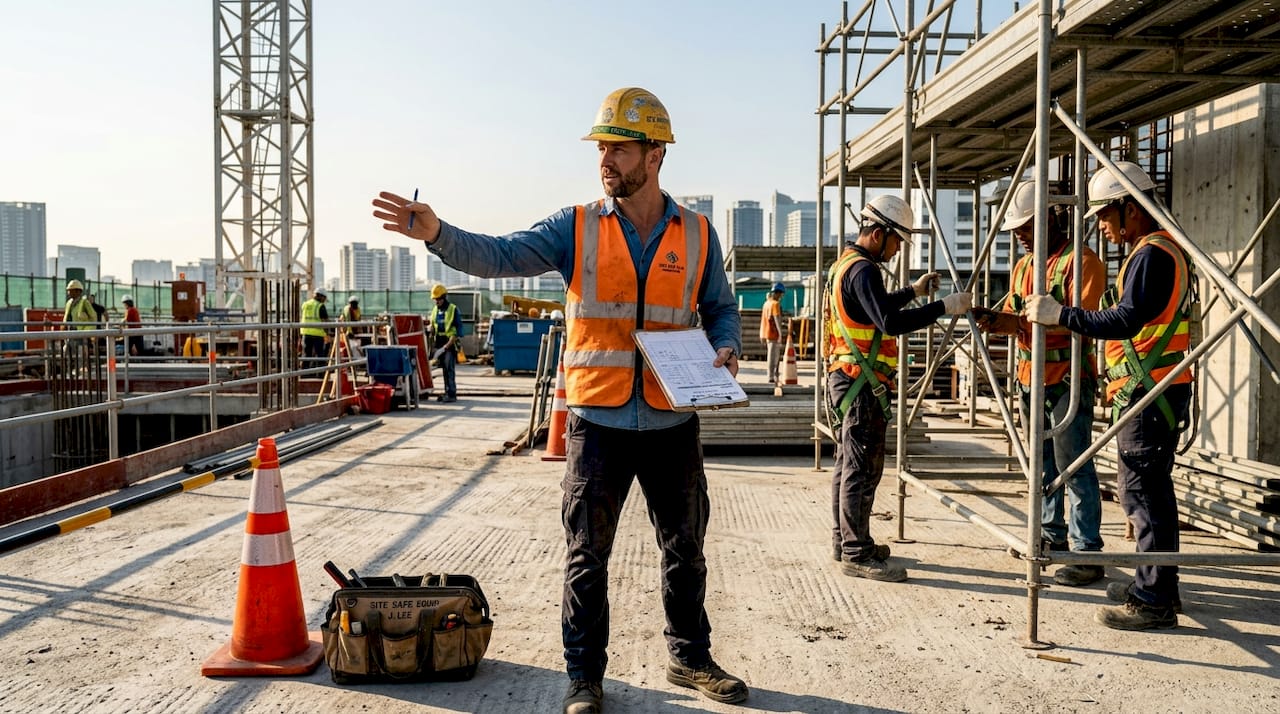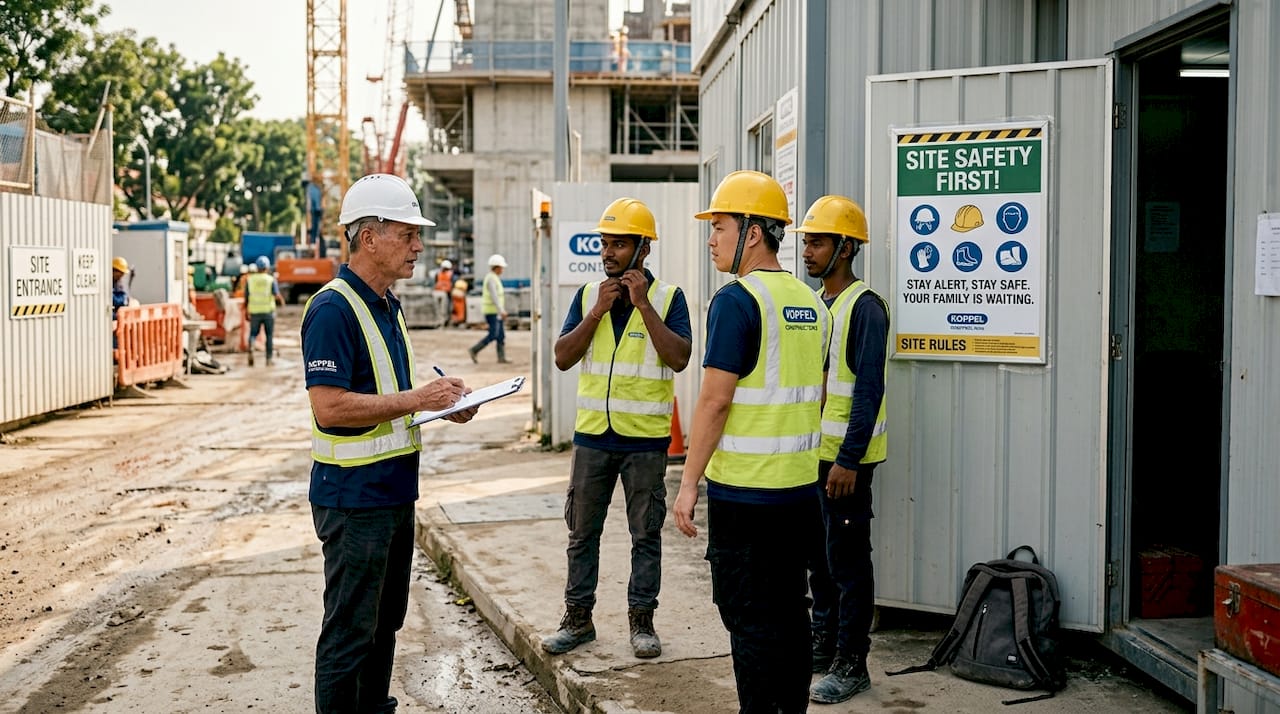
Overlooking safety at the design stage is among the most consequential mistakes a Singapore construction firm can make. Design-stage hazards, once embedded in drawings and specifications, propagate through every phase of construction, exposing workers, subcontractors, and project owners to risks that become exponentially more difficult and costly to resolve on-site. Design for Safety is mandated by the Workplace Safety and Health (Design for Safety) Regulations 2015, establishing binding compliance obligations for qualifying projects. This guide provides a hands-on roadmap covering regulatory essentials, actionable integration steps, common compliance pitfalls, and audit-readiness strategies to help construction firms build safer, legally sound projects from the ground up.
Table of Contents
- What you must know before starting: Essentials of design for safety
- Step-by-step process: How to integrate design for safety
- Common pitfalls and mistakes: What to avoid
- Verification and ongoing compliance: Ensuring your project passes audits
- What most firms get wrong about design for safety in Singapore
- Get expert support for your safety compliance goals
- Frequently asked questions
Key Takeaways
| Point | Details |
|---|---|
| DfS is mandatory | Singapore construction projects over $10 million must follow Design for Safety regulations by law. |
| Early planning saves lives | Integrating safety at the design stage greatly reduces workplace hazards and fatal accidents. |
| Stakeholder involvement matters | Effective DfS relies on strong collaboration between developers, designers, and site teams. |
| Document and verify | Maintaining detailed records and ongoing reviews ensures compliance and smoother audits. |
| Expert help available | Outsourcing safety expertise and audits can streamline DfS implementation and certification. |
What you must know before starting: Essentials of design for safety
With the stakes clearly established, it is critical to clarify who must comply, what Design for Safety (DfS) truly involves, and what the regulatory framework demands from your project team before a single structural drawing is finalized.
Design for Safety requirements in Singapore are triggered by a specific financial threshold: DfS is mandated for projects with a contract sum of $10 million or more under the Workplace Safety and Health (Design for Safety) Regulations 2015. This threshold is not arbitrary. It reflects the scale at which project complexity and worker exposure reach levels where upstream design decisions carry the greatest systemic risk consequences.
Understanding core terminology is prerequisite to effective compliance:
- Design for Safety (DfS): A regulatory and professional process requiring that designers, architects, and engineers identify, assess, and eliminate or mitigate foreseeable construction and maintenance hazards through design modifications before they become site realities.
- Risk mitigation: The structured application of the hazard control hierarchy, favoring elimination and substitution over administrative controls or personal protective equipment.
- DfS Professional (DfSP): A certified individual, registered with the Workplace Safety and Health Council, responsible for coordinating the DfS process and verifying that design teams fulfill their statutory obligations.
- Workplace fatality statistics: Singapore’s Ministry of Manpower reported 13 construction fatalities in 2023, underscoring persistent risk levels that DfS regulations are specifically designed to address.
The following table summarizes the key DfS compliance parameters that project teams must internalize before project kickoff:
| Parameter | Regulatory Requirement |
|---|---|
| Contract sum threshold | $10 million and above |
| Applicable legislation | WSH (Design for Safety) Regulations 2015 |
| Responsible party | Developer and appointed DfSP |
| DfS review timing | During design phase, prior to construction |
| Documentation required | DfS report, risk register, mitigation records |
| Consequence of non-compliance | Legal liability, fines, certification impact |
Failure to comply is not merely a procedural lapse. It can result in legal consequences, project delays, and loss of certifications such as BizSAFE and ISO 45001, both of which are increasingly required by major developers and government agencies as conditions of contract award. The intersection of DfS with broader compliance frameworks means that safety certification and DfS are mutually reinforcing, and gaps in one area routinely surface as deficiencies in the other during third-party audits.
“Design for Safety obligations are statutory, not advisory. Firms that treat them as administrative formalities expose themselves to enforcement action, civil liability, and reputational consequences that can outlast any single project.”
Step-by-step process: How to integrate design for safety
Knowing what triggers a DfS requirement equips you to build the right workflow. Here is exactly how to operationalize DfS in practice, from project kickoff through design finalization.

DfS aims to reduce risks at source through upstream design intervention, an approach that has contributed to measurable reductions in construction fatalities when implemented with rigor and leadership commitment. The process is not a single event; it is a structured workflow embedded within the design lifecycle.
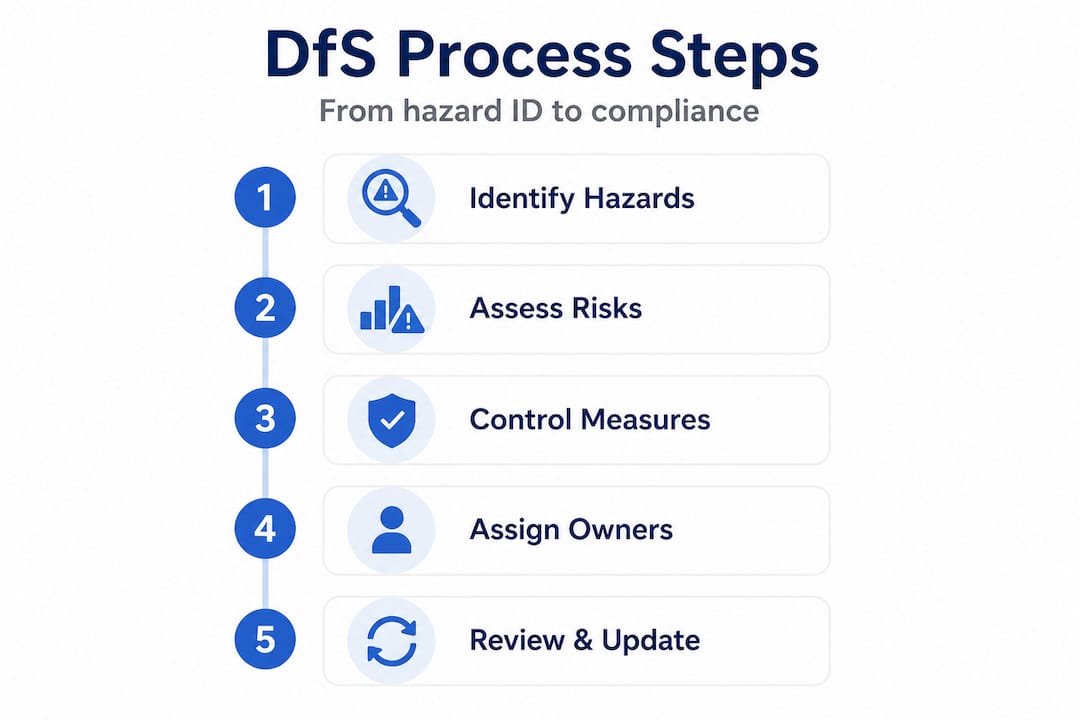
Step-by-step DfS integration process:
- Confirm regulatory applicability. Verify the contract sum against the $10 million threshold at the earliest feasibility stage. If the project qualifies, initiate DfS planning before design development begins.
- Appoint a qualified DfSP. Engage a certified Design for Safety Professional who will lead risk identification workshops and coordinate with the full design team. Review the roles of DfS professionals to ensure the appointment meets statutory criteria.
- Hold a project kickoff DfS workshop. Convene architects, structural engineers, M&E consultants, the main contractor (if appointed), and the DfSP to map foreseeable construction and maintenance hazards against design intentions.
- Develop the DfS risk register. Document all identified hazards, their likelihood and severity ratings, proposed design modifications, residual risk levels, and responsible parties for follow-up actions.
- Apply the hazard control hierarchy in design. Prioritize elimination (removing the hazard entirely through redesign) before substitution, engineering controls, and finally administrative measures. Decisions must be traceable in the DfS documentation.
- Integrate residual risk information into the DfS report. Hazards that cannot be eliminated at the design stage must be communicated clearly to the main contractor via the DfS report, ensuring site-level controls are planned in advance.
- Review at each design stage gate. DfS is not a one-time exercise. Conduct formal reviews at schematic design, design development, and construction document stages to capture changes that introduce new hazards.
- Record and track all mitigation actions. Use a structured compliance log to assign, date, and close out each mitigation action, creating an audit trail that demonstrates due diligence throughout the project lifecycle.
Review how risk management during design integrates with these steps to strengthen your firm’s procedural framework.
The following comparison illustrates the difference between reactive and proactive DfS approaches:
| Approach | Timing of hazard identification | Cost implication | Legal exposure |
|---|---|---|---|
| Reactive (site-level) | During or after construction | High (rework, delays, incidents) | Significant |
| Proactive (DfS-integrated) | At design stage | Low (design modifications) | Minimized |
Pro Tip: Assign a DfS action owner for every risk register entry and set calendar-based review checkpoints within your project management system. This single practice prevents mitigation items from falling through the cracks between design packages and contractor handover.
Common pitfalls and mistakes: What to avoid
As you operationalize DfS, anticipating common mistakes can save your project from major regulatory exposure, costly incident investigations, and audit failures that cascade into certification consequences.
Construction projects regulated under DfS represent the segment responsible for approximately 80% of fatal accidents in Singapore, which is precisely why the regulations concentrate compliance obligations on qualifying projects. The following pitfalls represent the most consistent failure modes observed across the industry:
- Late or absent DfS reviews. Initiating DfS documentation only at the construction documentation stage, rather than during schematic design, forfeits the opportunity for impactful elimination and substitution. Late reviews become compliance exercises rather than safety interventions.
- Poorly documented mitigation actions. Vague or incomplete risk register entries, such as “contractor to manage on-site,” fail to demonstrate that design-stage mitigation was genuinely considered. Auditors and enforcement officers will probe these gaps immediately.
- Excluding frontline worker perspectives. Design teams that limit DfS workshops to professional consultants frequently miss practical, field-level hazards that experienced site workers could have identified. Safety is a knowledge problem as much as a design problem.
- Relying on non-certified materials or methods. Specifying structural connections, formwork systems, or temporary works without verifying that secure fixing practices align with approved standards introduces residual hazards that compromise the integrity of even a well-documented DfS plan.
- Treating DfS as project-team-only responsibility. Developers who delegate DfS entirely to consultants without maintaining oversight lose visibility into whether mitigations are actually being tracked and implemented, a pattern that surfaces as a systemic failure during Workplace Safety and Health Council audits.
- Failure to update the DfS report after design changes. Design value-engineering exercises, often conducted late in the procurement phase, can introduce new hazards. If the DfS documentation is not updated to reflect these changes, the firm operates with a compliance document that no longer reflects actual site conditions.
“The most dangerous DfS document is one that looks complete on paper but has not been actively maintained. Regulators are increasingly sophisticated at identifying the difference between genuine risk management and retroactive paperwork.”
Pro Tip: Establish a design change notification protocol that automatically triggers a DfS review whenever a design modification exceeds a predefined scope threshold. This prevents undocumented hazards from entering the construction phase unnoticed.
Understanding the future of safety design reinforces why proactive hazard elimination, rather than reactive compliance, is the competitive and legal standard to which firms are increasingly held.
Verification and ongoing compliance: Ensuring your project passes audits
After initial design integration and phased execution, keeping your project compliant and audit-ready requires ongoing diligence, systematic documentation management, and an institutional safety culture that sustains itself beyond the DfS report’s initial approval.
Failure to comply with DfS obligations can result in legal consequences and materially decreased safety outcomes for workers and contractors. Ongoing compliance is therefore not an administrative afterthought; it is a project risk management imperative.
Essential records for audit readiness:
- Completed and signed DfS review forms for each design stage
- Fully populated risk register with closure evidence for all resolved action items
- Minutes of DfS workshops, including attendance records and discussion summaries
- Evidence of design change reviews and updated DfS reports
- Training records demonstrating that relevant staff have received DfS awareness instruction
- Site walkthrough logs cross-referenced against the DfS risk register entries
Digital platforms and safety management dashboards significantly reduce the administrative burden of maintaining these records while improving accessibility for internal and external audit purposes. Cloud-based document management systems allow project teams to flag overdue mitigations, generate compliance status reports, and share evidence packages with auditors without manual collation.
| Compliance activity | Recommended frequency | Record type |
|---|---|---|
| DfS workshop review | Each design stage gate | Meeting minutes, updated risk register |
| Risk register audit | Monthly during design phase | Internal audit checklist |
| Site walkthrough vs. DfS plan | Bi-monthly during construction | Walkthrough report |
| DfS report update | Upon significant design change | Revised DfS report version |
| Training refresher | Annually for design team | Training attendance records |
Periodic site walkthroughs conducted by the DfSP or a qualified safety professional serve the critical function of verifying that design-stage mitigations have been faithfully translated into physical site conditions. Discrepancies between the DfS documentation and actual construction practices represent both a regulatory risk and a safety incident risk that requires immediate corrective action.
Review your workplace safety compliance framework and consider formalizing your DfS process within the structure of implementing safety management systems to ensure that DfS records are integrated with broader safety performance monitoring.
Pro Tip: Assign a dedicated compliance tracking owner within your project team who is responsible for maintaining the DfS evidence package as a live document, rather than a static submission artifact. This single structural decision dramatically improves audit outcomes.
What most firms get wrong about design for safety in Singapore
The construction industry’s dominant failure mode with DfS is not ignorance of the regulations. Most qualifying firms know the threshold, have appointed a DfSP, and have produced a DfS report. The failure is categorical: treating DfS as a compliance artifact rather than as a dynamic, project-shaping instrument.
When DfS workshops are scheduled as contractual obligations rather than genuine creative exercises, the outcomes are predictable. Risk registers become templated documents recycled from previous projects with marginal modification. Design modifications are minimal, favoring expedience over genuine hazard elimination. The DfSP’s role is reduced to a sign-off function rather than an integrative, advisory one. And crucially, the opportunity to use design ingenuity to fundamentally reduce construction risk is forfeited in favor of paperwork completion.
The firms that achieve genuine safety improvement through DfS share a distinctive orientation: they engage the DfSP at concept stage, involve site-experienced personnel in design workshops, and treat every flagged hazard as a design problem to be solved rather than a liability to be documented. This mindset shift produces designs that are materially safer to construct and maintain, generating downstream benefits that include fewer incidents, lower insurance premiums, smoother audits, and stronger BizSAFE and ISO performance profiles.
The case studies on real DfS transformation demonstrate precisely this pattern. Projects where senior leadership mandated DfS engagement from feasibility onwards consistently reported fewer design-stage hazards reaching construction phase, and proportionally fewer workplace incidents overall.
The uncomfortable reality is that DfS regulations exist because the industry’s historical default was to treat worker safety as a construction-phase problem. Every firm willing to internalize DfS as a design discipline, rather than a statutory inconvenience, positions itself ahead of both the regulatory curve and the competitive landscape. Safety leadership is not a soft differentiator in Singapore’s construction market. It is increasingly a hard requirement for project award, insurance coverage, and certification maintenance.
Get expert support for your safety compliance goals
Navigating DfS obligations alongside BizSAFE certification, ISO 45001 compliance, and project audit preparation simultaneously demands specialist expertise and structured support systems that most construction firms cannot maintain in-house across every project.

MOSAIC Ecoconstruction Solutions provides the full spectrum of DfS consultancy, safety audit preparation, and outsourced safety manpower services that qualifying construction firms require. Whether your priority is preparing for a safety audit, outsourcing safety manpower to meet statutory coverage requirements, or accessing outsourced safety officer services for specific project phases, MOSAIC brings proven expertise and a track record across Singapore’s most demanding construction environments. Engage with us to translate regulatory obligations into genuine project safety outcomes.
Frequently asked questions
When is design for safety mandatory for my construction project in Singapore?
DfS is required for all construction projects with a contract sum of $10 million or more under the Workplace Safety and Health (Design for Safety) Regulations 2015.
What penalties can happen if my project skips DfS requirements?
Non-compliance can lead to legal action, fines, and disqualification from certifications, as failure to comply with DfS regulations carries statutory enforcement consequences.
What’s the main benefit of design for safety beyond compliance?
Well-implemented DfS reduces risks at source through upstream design changes, significantly lowering workplace injuries and fatal accidents before construction begins.
How can my team prepare effectively for a DfS audit?
Maintain fully documented DfS reviews, a current risk register with evidence of closed-out actions, and records of regular safety workshops and site walkthroughs to demonstrate active compliance rather than retrospective documentation.
Who is responsible for overseeing DfS in a Singapore construction project?
The developer and appointed Design for Safety Professional are principally responsible for ensuring that the DfS process is initiated, documented, and maintained throughout the project’s design and construction phases.
Recommended
- The Comprehensive Guide to Design for Safety Professionals (DFSP) in Singapore Construction Projects – MOSAIC Eco-construction Solutions Pte Ltd
- Design for Safety in Singapore – MOSAIC Eco-construction Solutions Pte Ltd
- Essential Guide: Singapore Construction Safety Standards
- Guide to the Design for Safety Professional (DFSP) in Singapore: A Lifecycle Approach to Construction Safety – MOSAIC Eco-construction Solutions Pte Ltd
- Fixings in building safety: essential guide for secure structures – Aussie Nails and Fasteners Warehouse