
First Impressions Matter: How ConQUAS Impacts Property Value and Buyer Confidence
1. Executive Summary: The Currency of Trust in the Built Environment
In the intricate and capital-intensive landscape of Singapore’s real estate market, the adage “first impressions matter” transcends mere aesthetics.
It functions as a rigorous economic determinant that governs asset appreciation, rental yield sustainability, and the long-term viability of property developers.
At the heart of this ecosystem lies the Construction Quality Assessment System (ConQUAS), a national yardstick introduced by the Building and Construction Authority (BCA) in 1989.
Over nearly four decades, ConQUAS has evolved from a technical checklist into a potent financial instrument that influences the flow of billions of dollars in public and private capital.1
The contemporary Singaporean property buyer operates in a market defined by high entry costs and sophisticated regulatory frameworks.
As of 2025, the correlation between construction quality and financial performance is no longer anecdotal but empirically proven.
Academic research indicates that a one-standard-deviation improvement in a project’s ConQUAS score correlates with an approximate 2.92% increase in property selling prices, affirming the existence of a tangible “quality premium” that permeates both the primary developer sales and the secondary resale markets.3
However, the landscape is undergoing a seismic shift. The introduction of the BCA’s ConQUAS Banding System in May 2023.
Coupled with the rigorous standards of the ConQUAS 2025 framework, has transitioned the industry from a culture of voluntary quality assurance to one of radical transparency.
Today, a developer’s past performance is not just a marketing byline; it is a critical variable in the Price Quality Method (PQM) used for government land tenders, directly dictating a firm’s ability to replenish its land bank and remain operational.5
This report offers an exhaustive analysis of the ConQUAS ecosystem. It dissects the technical anatomy of the assessment, explores the financial implications for investors and homeowners through the lens of Return on Investment (ROI) and rental yield.
Analyzes the strategic maneuvers of major developers like City Developments Limited (CDL), UOL Group, and Kingsford Development.
Through a forensic examination of legal precedents—such as the landmark The Seaview litigation—and a comparative analysis with international standards in Hong Kong and Japan, this report establishes that understanding ConQUAS is the single most critical due diligence step for the astute investor in 2025.
2. The Anatomy of Quality: Evolution and Technical Rigor of the ConQUAS Framework
To fully appreciate the economic leverage of ConQUAS, stakeholders must first understand the technical rigor that underpins the score.
ConQUAS operates on the fundamental principle that while architectural design is subjective, workmanship is measurable, quantifiable, and standardized.
2.1 Historical Trajectory and Strategic Objectives
The genesis of ConQUAS in 1989 was a strategic intervention by the BCA to professionalize a fragmented construction industry.
Prior to its implementation, quality was an amorphous concept, often leading to disputes between architects, contractors, and developers regarding what constituted “acceptable” workmanship.
The system was designed with three core objectives that remain relevant today:
- Standardization: To establish a singular national quality assessment system for new building projects, eliminating the ambiguity of varying standards.
- Objectivity: To ensure assessments are data-driven by measuring constructed works against specific workmanship standards and tolerances.
- Efficiency: To enable systematic quality assessment within reasonable cost and time constraints, utilizing a sampling approach that statistically represents the whole project.1
The system is not static; it is a living framework that adapts to technological advancements and rising consumer expectations.
- ConQUAS 21 (1998): This iteration marked a pivotal shift towards a “customer-oriented” approach. It refined the scoring mechanism to place greater weight on internal finishes—the elements homeowners interact with daily—rather than just structural integrity.2
- ConQUAS 2022 & 2025: The most recent overhauls represent a paradigm shift towards “liveability” and “functionality.” The modern framework is designed to penalize major defects that compromise habitability, such as water seepage and window leakages, far more heavily than cosmetic flaws. This aligns the assessment with the primary pain points of modern homeowners.1
2.2 The Scoring Methodology: A Technical Breakdown
The credibility of ConQUAS rests on its transparent and replicable assessment methodology. The total score is a weighted aggregate of three distinct components: Structural Works, Architectural Works, and Mechanical & Electrical (M&E) Works.
2.2.1 Structural Works (Weightage: 40% – 50%)
Structural integrity is the non-negotiable prerequisite for safety and asset longevity.
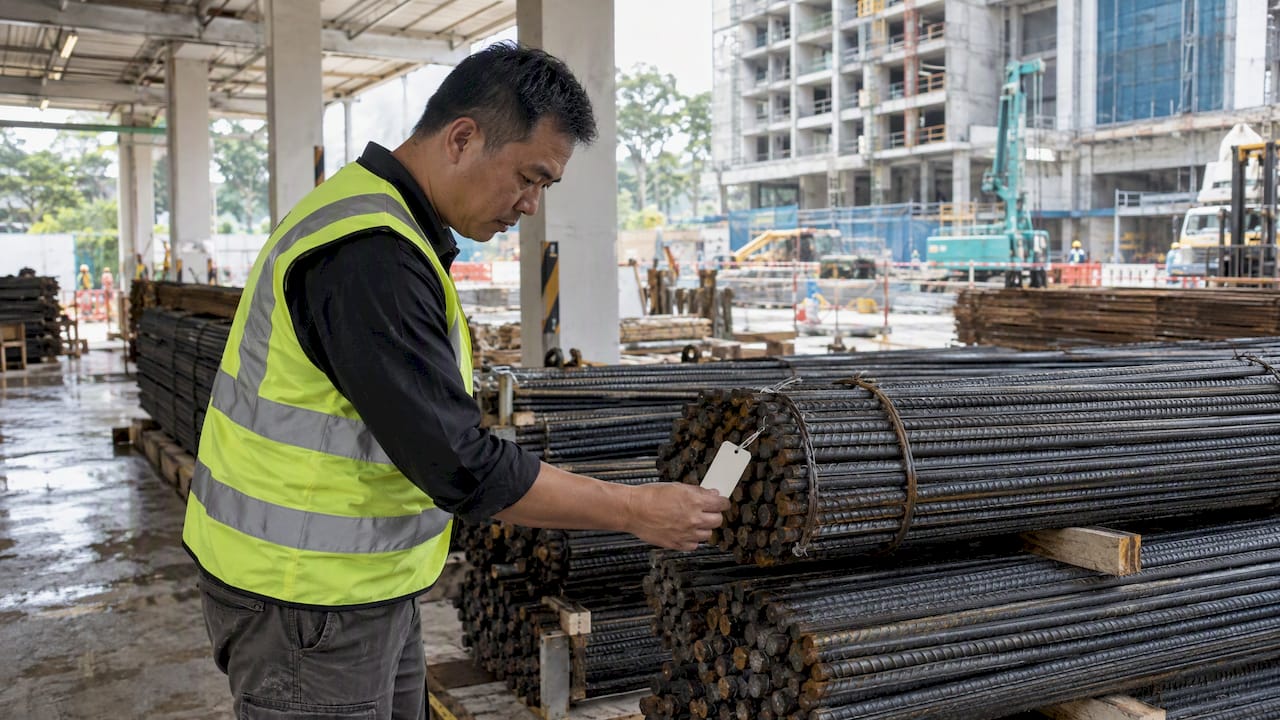
This component is unique because assessment must occur during the construction process; once concrete is poured, the reinforcement bars (rebars) are hidden forever.
- Assessment Areas: Formwork, steel reinforcement, prefabricated components, and concrete quality.
- Tolerances: The standards are exacting to ensure structural stability.
- Cross-Sectional Dimension: +5mm / -3mm.
- Verticality (Plumb): 3mm per meter deviation allowed.
- Significance: While structural excellence is often invisible to the buyer, it is the primary defense against “latent defects”—issues like structural cracks or spalling concrete that appear years later and can bankrupt a Management Corporation (MCST).2
2.2.2 Architectural Works (Weightage: 40% – 60%)
This component is the “visible canvas” of the property and typically accounts for the largest portion of the score in private residential projects. It is the primary driver of buyer satisfaction and the source of most complaints during the Defects Liability Period (DLP).
- Scope: Floors, internal walls, ceilings, doors, windows, and components (wardrobes, vanity tops).
- Assessment Protocol: A mix of visual inspection and tool-based measurement.
- Floors: Assessors check for finishing (surface polish), alignment (lippage between tiles), and hollowness (delamination). A tapping rod is used to detect hollow sounds indicating poor adhesion, a common precursor to “popping” tiles.
- Internal Walls: Smoothness is checked using a 1.5m straight edge. The surface must be level to within 3mm per 1.2m.
- Watertightness: This is a critical functional test. Bathrooms undergo water ponding tests where the floor is flooded for 24 hours to check for seepage. Windows are subjected to water spray tests to simulate wind-driven rain, ensuring the building envelope is secure.2
2.2.3 Mechanical & Electrical (M&E) Works (Weightage: ~20%)
- Scope: This covers the performance of essential services such as electrical switches, air-conditioning installation, and water pressure.
- Testing: Mandatory leak tests for pressurized pipes and functional tests for electrical points ensure that the “guts” of the unit are operational upon handover.2
2.3 The 3-Tier Sampling Regime: Incentivizing Excellence
A defining feature of the modern ConQUAS system is the 3-Tier Sampling Scheme. This risk-based approach allocates regulatory resources where they are needed most, incentivizing developers to maintain high standards to avoid costly delays.
Table 1: The 3-Tier ConQUAS Sampling Regime
| Tier Level | Sampling Intensity | Applicability Criteria | Operational Implication |
| Tier 1 | 25% Sampling | Firms with consistent, Band 1 track records (e.g., CDL, Woh Hup). | “Green Lane” status. Lower inspection costs, faster clearance for TOP. |
| Tier 2a | 50% Sampling | Firms with average performance or recent minor lapses. | Increased scrutiny and higher manpower costs for the developer. |
| Tier 2b | 100% Sampling | Firms with poor records or recurring defects. | Rigorous, unit-by-unit checks. Potential project delays due to inspection volume. |
| Tier 3 | 100% + Supervision | Projects with major systemic risks or past failures. | Highest level of regulatory oversight. Severe reputational damage. |
2
For a developer, falling into Tier 2b or 3 is a commercial disaster. It implies a 100% inspection rate, which requires significantly more man-hours from BCA officers and the main contractor.
This extends the construction timeline, delays the Temporary Occupation Permit (TOP), and increases holding costs, directly eroding profit margins.10
2.4 ConQUAS vs. The Quality Mark (QM)
It is vital for buyers to distinguish between the baseline ConQUAS score and the premium Quality Mark (QM).
- ConQUAS: A statistical representation of the project’s quality based on sampling (unless the project is in a lower tier). It gives a “project-wide” assurance.
- Quality Mark (QM): A voluntary scheme where every single unit is assessed. To achieve a QM certificate, an individual apartment must score at least 85 points in internal finishes and be free of major defects.11
- Strategic Value: Developers like UOL Group and CDL often commit to QM for their luxury projects (e.g., Amber Park, The Tapestry) as a key differentiator. A QM-certified unit offers the buyer certainty that their specific home has been inspected, whereas a ConQUAS score offers probability. This distinction is often reflected in the price premium commanded by QM projects.13
3. The Economics of Quality: Valuation, ROI, and Price Premiums
The assertion that “quality pays” is often treated as a platitude in marketing brochures. However, in the context of Singapore’s property market, it is a statement supported by robust econometric analysis.
The relationship between ConQUAS scores and property metrics—such as resale value and capital appreciation—is statistically significant.
3.1 The “Quality Premium” in Primary and Secondary Markets
A landmark study by Ooi et al. (2014), which analyzed over 100,000 transaction records in Singapore, established a direct correlation between workmanship quality and housing prices. The findings were definitive: a one-standard-deviation improvement in the ConQUAS score increases the selling price of an average home by 2.92%.3
This “quality premium” operates through two distinct mechanisms:
3.1.1 The Reputation Premium (Primary Market)
In the primary market (new launches), buyers rely heavily on the developer’s reputation because the physical product does not yet exist.
Developers with high ConQUAS track records (Band 1 firms) can command higher launch prices because buyers price in the “peace of mind.”
They are willing to pay a premium to avoid the risk of delayed handovers, shoddy workmanship, and the hassle of defect rectification.
This is why projects by developers like CDL often launch at a premium relative to nearby competitors yet still achieve high sell-through rates.16
3.1.2 The Resale Premium (Secondary Market)
In the secondary market, quality manifests as the physical condition of the asset.
A building constructed with high structural and architectural standards ages more gracefully.
- Durability: High-quality external finishes resist algae and peeling paint. Robust waterproofing prevents unsightly water stains.
- Buyer Perception: Resale buyers can physically inspect the unit. A well-maintained 10-year-old condo with original marble flooring that is still level and crack-free will command a higher price than a neighbor with popped tiles or water damage.
- Market Efficiency: The Ooi et al. study found that the quality premium persists in the resale market, suggesting that the market efficiently prices in the durability benefits of high ConQUAS scores over the asset’s lifecycle.3
3.2 Capital Appreciation vs. Asset Depreciation
Construction quality acts as a critical hedge against depreciation.
All buildings deteriorate, but the rate of deterioration is determined by initial workmanship.
- The “Sinking Fund” Trap: Older condominiums often struggle with insufficient sinking funds. If a development was poorly built, it will face premature failure of major systems—lifts, waterproofing membranes, and facade cladding. Rectifying these requires massive capital injections, leading to “special levies” on owners.
- Case in Point: As noted in reports on aging condos like Fernwood Towers, deteriorating infrastructure can lead to frequent breakdowns and financial strain on the MCST. High maintenance costs depress net rental yields and make the development less attractive to future buyers, thereby stalling capital appreciation.18
- The High-Quality Advantage: Conversely, a project with high ConQUAS scores requires less major rectification. This keeps maintenance fees stable and preserves the cosmetic appeal of the development (e.g., landscaping, pools), supporting sustained capital growth and higher resale volumes.2
3.3 Mitigating the “Lemons” Market
The real estate market is classically plagued by information asymmetry—the developer knows the true quality of the build, but the buyer does not.
This creates a “lemons market” where buyers discount all properties to account for the risk of buying a defective one.
- The ConQUAS Solution: ConQUAS bridges this gap by providing a verified, independent signal of quality. By making these scores public and banding developers, the BCA reduces the risk premium buyers demand. This effectively raises the floor price for properties built by reputable developers, as the market can distinguish a “peach” (high quality) from a “lemon” (defective).15
4. The New Era of Accountability: The ConQUAS Banding System
In May 2023, the BCA introduced a transformative change to the landscape: the ConQUAS Banding System.
Previously, scores were project-specific, allowing developers to hide a poor track record behind a single successful project.
The new system aggregates a developer’s and builder’s performance over a rolling six-year period, assigning them a Band from 1 to 6. This has fundamentally altered the incentives in the industry.5
4.1 The Bands Defined: A Hierarchy of Trust
The banding system provides a simplified, consumer-friendly metric for assessing risk.
Table 2: ConQUAS Developer Banding Definitions
| Band | Definition | Implications for Buyer | Examples (Current) |
| Band 1 | Very low incidence of major defects. Exemplary, consistent track record. | Highest confidence. Minimal risk of major defects. | City Developments Ltd (CDL), Woh Hup, UOL Group.14 |
| Band 2 | Low incidence of major defects. Good consistency. | High confidence. Reliable quality. | GuocoLand (Projects like The Avenir).20 |
| Band 3-4 | Moderate performance. Average incidence of defects. | Moderate caution. Standard industry quality. | Various mid-tier contractors. |
| Band 5-6 | High incidence of major defects. Poor track record. | Red Flag. High risk of delays, rectification issues, and “lemons.” | Developers with recent “no-sale” licenses or major complaints. |
5
4.2 Strategic Implications for Developers
The Banding System is not merely a label; it is a commercial lever that affects a developer’s entire business model.
4.2.1 Marketing Leverage and Brand Equity
Band 1 status is a powerful marketing tool. Developers like CDL and UOL prominently display the ConQUAS Banding logo in their showflats and marketing collaterals. In a market where buyers are increasingly educated and risk-averse, being a Band 1 developer justifies a price premium. It signals to the buyer that the premium they are paying is an insurance policy against future defects.21
4.2.2 The Price Quality Method (PQM) in Public Tenders
The government puts its money where its mouth is via the Price Quality Method (PQM).
This framework is used to evaluate tenders for public sector construction projects.
- The Formula: Tenders are not awarded solely on the lowest price. They are evaluated based on a weighted score of Price (typically 40%-60%) and Quality (40%-60%).7
- The Quality Component: A significant portion of the Quality score is derived from the contractor’s ConQUAS track record, safety performance (MOM demerit points), and past performance.
- Economic Impact: A contractor with a low ConQUAS history (Band 5/6) suffers a “quality penalty.” To win a tender against a Band 1 firm, they must bid significantly lower to compensate for their poor quality score. This erodes their profit margins and can lead to a “race to the bottom” or eventual insolvency. Conversely, high-quality firms can bid higher and still win based on their superior Quality score, preserving their margins and ensuring sustainable business operations.23
4.2.3 Bonus Scheme for Construction Quality (BSCQ)
Although the BSCQ is being phased out in favor of the PQM and Banding system, its legacy remains relevant.
It historically allowed contractors to earn bonus payments for exceeding ConQUAS score thresholds, directly linking quality to revenue.
The shift to PQM suggests a move from “bonuses for good work” to “penalties for bad work” (e.g., debarment, price loading), signaling a tougher regulatory stance.23
4.3 Consumer Behavior and Market Discipline
With data now publicly available on the Quality Housing Portal (QHP), buyers can “vote with their wallets.”
A Band 6 rating is a red flag that can stall sales velocity. In an era of social media, where defect compilations go viral on platforms like TikTok and Reddit, a developer’s reputation is fragile.
The transparency of the QHP forces market discipline that regulatory codes alone cannot achieve; developers must improve quality to survive.5
5. Case Studies: The Spectrum of Quality and Value
To illustrate the real-world impact of ConQUAS scores on property value and buyer experience, we analyze distinct case studies representing the best, the worst, and the complex middle ground of the Singapore market.
5.1 The Gold Standard: City Developments Limited (CDL) & Woh Hup
Context: CDL and its primary builder, Woh Hup, are consistently rated Band 1 under the ConQUAS system. They are frequently cited as the benchmark for quality in Singapore.16
- Strategy: Their success stems from a proactive “quality culture.” They employ internal “pre-ConQUAS” assessments using their own certified inspectors before BCA officers arrive. They also leverage technology, such as 360-degree cameras and digital defect tracking apps, to monitor workmanship in real-time.2
- Project Spotlight – Amber Park: Located in the competitive District 15, Amber Park commanded strong launch prices and sustained sales momentum. The project achieved high QM scores, reinforcing buyer confidence.
- Value Impact: Buyers associate the CDL/Woh Hup brand with reliability. This reputation allows them to launch projects at a premium. For example, resale units in CDL projects often hold value better during downturns because the physical asset remains in good condition, requiring less expenditure from the sinking fund.14
5.2 The Cautionary Tale: The Seaview
Context: The Seaview, a freehold condominium on Amber Road completed in 2008, became the center of a high-profile $32 million lawsuit regarding construction defects.27
- The Defects: Independent surveyors found major defects including foul odors, falling concrete blocks, and popping swimming pool tiles. These were not merely cosmetic issues; they affected the safety and liveability of the estate.27
- The Legal Quagmire: The Management Corporation (MCST) sued the developer (Mer Vue Developments), main contractor (Tiong Aik), and architect (RSP). In a controversial 2016 High Court ruling, the defendants successfully relied on the “independent contractor defense,” limiting the homeowners’ direct recourse against the developer. Although the case eventually settled out of court, the legal battle dragged on for years.
- Value Impact: Despite its prime freehold status and location, The Seaview’s price appreciation was historically volatile compared to its neighbors. The stigma of the lawsuit and the visible defects likely suppressed capital gains during the litigation years. While prices have recovered (recent resale ~$2,700 psf in 2025), the net return for original owners was impacted by the years of distress, legal fees, and potential levies for rectification.28 This case serves as a stark reminder that “freehold” status does not immunize a property from the value-destroying effects of poor workmanship.
5.3 The Profitability Paradox: Kingsford Waterbay
Context: Kingsford Development has faced significant regulatory hurdles in Singapore.
In 2017, they were fined for safety lapses at Kingsford Hillview Peak and Kingsford Waterbay.
In 2019, the Controller of Housing issued a “no-sale license” for their subsequent project, Normanton Park, citing their poor track record.30
- The Paradox: Despite the negative headlines, safety stop-work orders, and documented quality complaints (e.g., poor finishing at Hillview Peak), Kingsford Waterbay has ironically been one of the most profitable resale condos in District 19 in recent years.32
- Economic Analysis: How can a project with “quality issues” be profitable?
- Entry Price: Kingsford launched Waterbay at extremely competitive prices (~$1,100 psf) in 2015, undercutting nearby launches.34
- Market Timing: The project rode the massive post-COVID property boom. Buyers who bought low in 2015 sold high in 2022-2024.
- Location/Volume: The sheer size (1,000+ units) and riverfront frontage appealed to HDB upgraders, masking workmanship concerns.
- Insight: This case suggests that while quality is critical, entry price and market timing can overshadow workmanship defects in the short term regarding pure capital gains. However, the reputational cost to the developer was severe. The “no-sale license” on Normanton Park restricted their cash flow and forced them to undergo 100% Quality Mark inspections, fundamentally altering their business model to survive in Singapore.30
5.4 The Regulatory Rehabilitation: Normanton Park
Following the Waterbay debacle, the “no-sale license” imposed on Normanton Park prohibited Kingsford from selling units until they obtained the Temporary Occupation Permit (TOP) and QM certifications for all units.35
- Mechanism: This forced the developer to prioritize quality over speed. They had to prove the building was defect-free before collecting money from buyers.
- Outcome: Ironically, this strict regulatory intervention increased buyer confidence. When Normanton Park eventually launched, buyers knew it had undergone the most rigorous inspection regime possible (100% QM).
- Value: Normanton Park subsequently saw strong sales and resale transactions, with units flipping for significant profits.36 This demonstrates that the ConQUAS/QM regulatory framework can effectively rehabilitate a project’s value proposition, turning a “high-risk” developer into a provider of “verified quality” homes.
6. The Rental Market Connection: Yields, Maintenance, and Tenant Retention
While buyers focus on resale value, the manifestation of ConQUAS scores—the physical condition of the building—has a direct and measurable impact on the rental market.
6.1 Maintenance Costs and Net Rental Yield
Gross rental yield is a simple calculation: (Annual Rent / Purchase Price).
However, the Net Rental Yield tells the true story of investment performance, as it subtracts maintenance costs.
- The Cost of Low Quality: A building with low ConQUAS scores (particularly in M&E and waterproofing) typically suffers from recurring issues. Lifts break down, pool pumps fail, and basement carparks leak.
- Impact on Owners: The MCST must raise monthly maintenance fees to cover these repairs. Higher maintenance fees eat directly into the landlord’s net income. In severe cases, such as the Fernwood Towers example, deteriorating infrastructure necessitated “special levies”—lump sum payments from owners to fund major overhauls (e.g., lift replacement). These levies can wipe out a year’s worth of rental profit.18
6.2 Tenant Retention and the “Flight to Quality”
In a competitive rental market, such as the one observed in 2024-2025 where supply is rising, tenants have choices.37
- Defect Disruption: Tenants differ from owners; they have no emotional attachment to the property. If they experience repeated disruptions—water seepage ruining clothes in wardrobes, air-conditioning failures, or mold growth—they will not renew their lease.
- Vacancy Costs: High tenant turnover leads to vacancy periods. A one-month vacancy reduces annual yield by ~8%.
- The “New” Premium: Tenants increasingly prefer newer developments (built to ConQUAS 2022/2025 standards) because of better functionality and aesthetics. Older projects with poor workmanship age visually (peeling paint, cracked tiles), forcing landlords to lower rents to attract tenants. This “flight to quality” is particularly pronounced in the expatriate market, where corporate leases favor Band 1 developer buildings because facility management is reliable and hassle-free.38
7. International Benchmarking: Singapore’s Centralized Advantage
Singapore’s ConQUAS system is often cited globally as a gold standard for construction quality.
Comparing it with systems in other major real estate markets highlights its unique strength: centralization and transparency.
7.1 Hong Kong: The Quality Building Assessment Scheme (QBAS)
- System: Hong Kong utilizes the QBAS and industry-led awards like the Quality Building Award (QBA). It relies heavily on professional bodies (HKIA, HKIE) and peer review.40
- Comparison: While Hong Kong’s system celebrates excellence, it lacks the centralized, government-mandated “teeth” of ConQUAS. In Singapore, the score is a “hard number” linked to regulatory consequences (PQM) and land tendering penalties. Hong Kong’s awards are reputational accolades; ConQUAS is an operational license.
- Green Building Integration: Hong Kong’s focus is heavily shifted toward sustainability (BEAM Plus), similar to Singapore’s Green Mark, but the workmanship defect data is less publicly accessible to the average buyer compared to Singapore’s Quality Housing Portal.42
7.2 Japan: Housing Quality Assurance Act
- System: Japan operates the Housing Performance Evaluation System under the Housing Quality Assurance Act (2000). It uses a 10-category rating system (1-5 stars).44
- Focus: Japan’s system is highly specialized regarding seismic stability, fire resistance, and degradation measures due to its geographical risks.
- Dispute Resolution: A key feature of the Japanese system is the existence of “Designated Housing Dispute Resolution Agencies” linked to the evaluation system. This provides a formal, low-cost channel for resolving defect disputes, a model Singapore is moving toward with increased mediation support.46
- Comparison: While Japan’s system is technically exhaustive regarding safety, Singapore’s ConQUAS is more focused on architectural finishes (tiling, flooring) and watertightness (due to tropical rain), directly addressing the aesthetic and functional priorities of the Singaporean buyer.
7.3 The Singapore Advantage: Radical Transparency
The integration of ConQUAS data into the Quality Housing Portal (QHP) gives Singapore a unique competitive advantage.
In few other global markets can a prospective buyer look up a specific developer’s defect track record over the past six years before signing a contract.
This transparency forces market discipline that regulatory codes alone cannot achieve; it empowers the consumer to act as a regulator.5
8. Buyer Due Diligence in 2025: A Strategic Guide
For the property investor or homebuyer in 2025, navigating the market requires utilizing the ConQUAS infrastructure effectively.
“First impressions” should be backed by hard data.
8.1 Pre-Purchase: The Digital Background Check
Before signing an Option to Purchase (OTP), buyers must perform digital due diligence:
- Check the Quality Housing Portal (QHP): Search for the developer and builder of the project.
- Band 1/2: Proceed with confidence. The risk of major workmanship defects is statistically low.
- Band 5/6: Exercise extreme caution. Factor in potential delays, rectification hassles, and the possibility of poor resale value. If buying, negotiate on price to reflect this risk.5
- Verify Quality Mark (QM) Status: Ask the agent if the project is targeting the Quality Mark. A QM project guarantees 100% inspection of your specific unit, whereas a standard ConQUAS project relies on sampling. This is a critical value differentiator.11
8.2 The Defects Liability Period (DLP) Strategy
Upon key collection (TOP), the legal DLP process begins. This is the buyer’s one opportunity to fix “first impression” defects at the developer’s cost.
- Timeline: The DLP typically lasts 12 months.
- The Inspection Checklist: Buyers should engage professional defect inspectors or use a rigorous checklist based on ConQUAS standards:
- Flooring: Use a tapping rod to check for hollow tiles (delamination). Check for lippage (uneven height >1mm).
- Windows: Inspect seals and weep holes. Look for water marks near frames which indicate sealant failure.
- M&E: Test every power point with a circuit tester. Inspect false ceilings via access panels for signs of pipe leaks.47
- Reporting: Defects must be reported during the DLP. The developer is legally obliged to rectify them. After the DLP expires, the cost falls entirely on the owner (except for latent structural defects, which carry a 15-year liability).49
8.3 Red Flags for Resale Buyers
When buying a resale property, a ConQUAS score from 10 years ago is less relevant than the current condition, but it indicates the “bones” of the building.
- Warning Signs:
- Fresh coats of paint in specific areas (often hiding mold or cracks).
- Water stains on the ceiling of the unit below the one you are viewing (indicating inter-floor leakage).
- “Special Levies” in the AGM minutes.
- Strategic Move: Always request the MCST’s Annual General Meeting (AGM) minutes before buying. If there are records of discussion regarding lawsuits against the developer, massive waterproofing tenders, or lift overhaul levies, this is a sign of poor initial quality. Walk away or negotiate a steep discount to cover future liabilities.51
9. Future Trends: ConQUAS 2025 and the Digital Frontier
The BCA is not static. The ConQUAS 2025 framework introduces stricter standards that will shape the next generation of Singaporean properties.
9.1 Tightened Watertightness Standards
Recognizing that water leakage is the most damaging and litigious defect in the tropics, ConQUAS 2025 reduces the allowable non-compliance rate for window watertightness tests from 15% to 10%.1
This is a significant tightening of standards that will force builders to adopt better detailing and high-performance sealants.
For buyers, this suggests that condos built post-2025 will likely have lower long-term maintenance costs regarding facade waterproofing.
9.2 Design for Manufacturing and Assembly (DfMA) & PPVC
ConQUAS now awards bonus points for high-productivity methods like Prefabricated Prefinished Volumetric Construction (PPVC).
- Impact: PPVC moves construction from the open site to controlled factory environments. This improves precision (tolerances of ±2mm) and reduces on-site workmanship errors.
- Implication for Buyers: Future condos will have more standardized, “industrial-grade” precision in finishes. However, PPVC modules are structural boxes, meaning there will be less flexibility for homeowners to hack walls and renovate layouts. The “perfect” finish comes at the cost of customizability.10
9.3 Digitalization and “Digital Twins”
The use of 360-degree cameras and “digital twins” for assessment is becoming standard. This creates an immutable digital record of the unit at handover.
- Benefit: This reduces disputes between developers and homeowners regarding whether a scratch or dent was “pre-existing” or caused by the owner’s renovation contractor. It brings objective evidence to the emotional process of handover.2
10. Conclusion: The Value of Certainty
In the final analysis, ConQUAS is more than a score; it is the currency of trust in Singapore’s built environment.
- For the developer, a Band 1 rating is a license to operate, a tool to command price premiums, and a shield against regulatory penalties.
- For the government, it is a mechanism to enforce safety, efficiency, and productivity without draconian over-regulation.
- For the buyer, ConQUAS and the Quality Mark represent the mitigation of risk.
In a market where a mass-market condominium unit costs upwards of $1.5 million, the “first impression” of quality translates directly into financial security.
While market timing and location remain the primary drivers of capital appreciation, construction quality is the silent guardian of that value.
It determines whether an asset ages into a vintage classic like The Claymore, or a decaying liability requiring constant cash infusions.
As we move toward 2026, the integration of the Banding System, the transparency of the Quality Housing Portal, and the rigorous standards of the new framework ensure that in Singapore’s property market, quality is not just an accident—it is a systemic guarantee.
For the investor, the message is clear: Check the Band, check the Mark, and invest in quality.
Appendix: Data Tables and Reference Guides
Table 3: The Impact of ConQUAS on Stakeholders
| Stakeholder | Benefit of High ConQUAS Score | Risk of Low ConQUAS Score |
| Developer | Premium pricing power, Band 1 status, Eligibility for government tenders (PQM), Brand equity. | “No-sale” license, Price loading penalties in land sales, Reputational damage, Lower sales velocity. |
| Contractor | “Green Lane” (Tier 1) inspections, Lower rework costs, Higher PQM score for future bids. | Tier 3 (100%) inspections, Higher manpower costs, Debarment from public tenders. |
| Buyer | Higher resale value (+2.92%), “Peace of mind,” Lower maintenance fees, Better rental retention. | “Lemons” risk, disrupted living (repairs), lower rental yield, special levies. |
| MCST | Lower sinking fund utilization, longer asset lifespan, fewer legal disputes. | High repair costs, frequent breakdowns, need for special levies, potential litigation. |
Table 4: Key ConQUAS Milestones
- 1989: ConQUAS Launched.
- 1998: ConQUAS 21 (Focus on homeowner expectations/finishes).
- 2002: Quality Mark (QM) launched for 100% unit inspection.
- 2014: Ooi et al. study confirms 2.92% price premium for quality.
- 2019: “No-Sale” license issued to Kingsford (Normanton Park) for poor track record.
- 2023: Introduction of Developer Banding System (Band 1-6).
- 2025: ConQUAS 2025 Framework (Stricter watertightness, focus on liveability).
Table 5: PQM Weightage in Public Tenders (Effective 2025)
| Component | Building Tenders | Civil Engineering Tenders |
| Price | 40% – 60% | 50% – 70% |
| Quality | 60% – 40% | 50% – 30% |
| Note: Quality score heavily weighted by ConQUAS track record and Safety (MOM) performance. |
7
Works cited
- BCA Construction Quality Assessment System, accessed January 5, 2026, https://www1.bca.gov.sg/docs/default-source/docs-corp-buildsg/quality/conquas-(private-residential)-manual.pdf
- Singapore’s Construction Quality Assessment System (ConQUAS), accessed January 5, 2026, https://mosaicsafety.com.sg/singapore-construction-quality-assessment-system-conquas/
- The impact of construction quality on house prices | Request PDF – ResearchGate, accessed January 5, 2026, https://www.researchgate.net/publication/269724600_The_impact_of_construction_quality_on_house_prices
- The impact of construction quality on house prices – IDEAS/RePEc, accessed January 5, 2026, https://ideas.repec.org/a/eee/jhouse/v26y2014icp126-138.html
- CONQUAS banding system – Lentor Collection, accessed January 5, 2026, https://lentorcollection.sg/conquas-banding-system/
- CONQUAS | Building and Construction Authority (BCA), accessed January 5, 2026, https://www1.bca.gov.sg/buildsg/quality/conquas
- PQM Framework (For Public) | PDF | General Contractor | Summation – Scribd, accessed January 5, 2026, https://www.scribd.com/document/663417175/pqm-framework-for-public
- BCA Construction Quality Assessment System CONQUAS Overview | PDF – Scribd, accessed January 5, 2026, https://www.scribd.com/document/365261536/BCA-Construction-Quality-Assessment-System-CONQUAS-Overview
- CONQUAS 2022: Construction Quality Assessment System – Studylib, accessed January 5, 2026, https://studylib.net/doc/27015439/conquas-2022-r2-v5
- ConQUAS: Singapore Construction Quality Gold Standard, accessed January 5, 2026, https://mosaicsafety.com.sg/conquas-singapore-construction-quality-gold-standard/
- Quality Mark – Singapore – Building and Construction Authority (BCA), accessed January 5, 2026, https://www1.bca.gov.sg/buildsg/quality/quality-mark
- ANNEX B – FACTSHEET FOR NEW QM APP About the BCA Quality Mark (QM) Home Mobile Application NEW! The new Quality Mark Home mob, accessed January 5, 2026, https://www.nas.gov.sg/archivesonline/data/pdfdoc/20140116004/annex_b_-_factsheet_for_new_qm_app.pdf
- UOL is recognised as Quality Champion by BCA, accessed January 5, 2026, https://uolhomes.com.sg/collab-article/uol-is-recognised-as-quality-champion-by-bca/
- QEA Award 2022 – Building and Construction Authority (BCA), accessed January 5, 2026, https://www1.bca.gov.sg/docs/default-source/docs-industry-corp/qea-e-booklet-2022.pdf?sfvrsn=ee382da5_2
- The Impact of Construction Quality On House Prices Q | PDF | Condominium – Scribd, accessed January 5, 2026, https://www.scribd.com/document/663419797/The-Impact-of-Construction-Quality-on-House-Prices-q
- City Developments Ltd (CDL) – Building and Construction Authority | Search For Quality Housing | Search and Compare CONQUAS Score and QM Score by Properties, Developers and Contractors, accessed January 5, 2026, https://www.bca.gov.sg/quality-housing-portal/ProjectDetail.aspx?cat=Developer&name=City+Developments+Ltd+(CDL)&buildtype=Private+Housing
- These Resale Condos In Singapore Were The Top Performers In 2025 — And Not All Were Obvious Winners, accessed January 5, 2026, https://stackedhomes.com/these-resale-condos-in-singapore-were-the-top-performers-in-2025-and-not-all-were-obvious-winners/
- Some ageing condos in Singapore struggle with failing infrastructure, inadequate sinking funds | The Straits Times, accessed January 5, 2026, https://www.straitstimes.com/singapore/some-ageing-condos-in-singapore-struggle-with-failing-infrastructure-inadequate-sinking-funds
- New banding system to rate condo developers, builders on construction workmanship, accessed January 5, 2026, https://hlbc.com.sg/new-banding-system-to-rate-condo-developers-builders-on-construction-workmanship/
- GuocoLand Ltd – Building and Construction Authority | Search For Quality Housing | Search and Compare CONQUAS Score and QM Score by Properties, Developers and Contractors, accessed January 5, 2026, https://www.bca.gov.sg/quality-housing-portal/ProjectDetail.aspx?cat=Developer&name=GuocoLand+Ltd&buildtype=Private%20Housing
- New Construction Quality Banding to help Homebuyers make Informed Choices, accessed January 5, 2026, https://www1.bca.gov.sg/about-us/news-and-publications/media-releases/2023/05/25/new-construction-quality-banding-to-help-homebuyers-make-informed-choices
- PRICE QUALITY METHOD – Building and Construction Authority (BCA), accessed January 5, 2026, https://www1.bca.gov.sg/docs/default-source/docs-corp-procurement/pqm_framework.pdf?sfvrsn=bf44a2a5_6
- CONQUAS for Public Projects | Building and Construction Authority (BCA), accessed January 5, 2026, https://www1.bca.gov.sg/buildsg/quality/conquas-for-public-projects
- PRICE QUALITY METHOD (PQM) – Building and Construction Authority (BCA), accessed January 5, 2026, https://www1.bca.gov.sg/docs/default-source/docs-corp-procurement/crs/pqm-framework-(for-public)_1-feb-2023.pdf?sfvrsn=62230380_2
- Search For Quality Housing | Search and Compare CONQUAS Score and QM Score by Properties, Developers and Contractors – Building and Construction Authority (BCA), accessed January 5, 2026, https://www.bca.gov.sg/quality-housing-portal/
- District 15 Resale vs New Launch Condos – Analysing Price Gaps for Larger Family Units, accessed January 5, 2026, https://stackedhomes.com/district-15-resale-vs-new-launch-condos-family-units/
- Suit over condo defects settled out of court | The Straits Times, accessed January 5, 2026, https://www.straitstimes.com/singapore/suit-over-condo-defects-settled-out-of-court
- The Sea View Price Trend – Singapore Property Resale and Rental Price, accessed January 5, 2026, https://stackproperty.sg/private/projects/the-sea-view
- The Sea View – Price, Reviews & Availability (2026) – PropertyGuru, accessed January 5, 2026, https://www.propertyguru.com.sg/project/the-sea-view-66
- Normanton Park can buy or cannot buy for investment? – Home Quarters SG, accessed January 5, 2026, https://www.homequarters.com.sg/normanton-park-can-buy-or-cannot-buy-for-investment/
- Why Kingsford, the developer that bought Normanton Park en bloc, is blocked from selling units _Today 21.04.2019 – Pioneer Training, accessed January 5, 2026, https://www.pioneertraining.org/why-kingsford-developer-bought-normanton-park-en-bloc-blocked-selling-units-today-21042019
- Resale Condo Market Performance in 2023 – PropNex, accessed January 5, 2026, https://www.propnex.com/picks-details/747/resale-condo-market-performance-in-2023
- ANALYSIS: Most profitable condos in 2024 – Singapore Property News – EdgeProp.sg, accessed January 5, 2026, https://www.edgeprop.sg/property-news/analysis-most-profitable-condos-2024
- Kingsford Waterbay condo at Upper Serangoon View, accessed January 5, 2026, http://kingsfordwaterbaycondo.blogspot.com/
- Fault lines: A look at defect resolution in condos – The Business Times, accessed January 5, 2026, https://www.businesstimes.com.sg/opinion-features/features/fault-lines-look-defect-resolution-condos
- Most expensive sales transactions in Normanton Park – EdgeProp Buddy, accessed January 5, 2026, https://buddy.edgeprop.sg/discover/most-expensive-sales-transactions-in-normanton-park-33e405d1-a581-47ae-bdd8-97f65498b8bd
- Rental market stabilises, with higher supply set to cap growth in 2026 | The Straits Times, accessed January 5, 2026, https://www.straitstimes.com/singapore/housing/rental-market-stabilises-with-higher-supply-set-to-cap-growth-in-2026
- Rental Yields in Singapore’s Prime Districts: Investor’s Guide 2025, accessed January 5, 2026, https://sgluxuryhomes.com.sg/rental-yields-in-singapores-prime-districts/
- Exploring the Impact of Land Scarcity on Condo Demand A Look at Singapore’s Thriving Property Market and Ongoing Condo Launches – Queens Peak, accessed January 5, 2026, https://www.queens-peak.sg/exploring-the-impact-of-land-scarcity-on-condo-demand-a-look-at-singapores-thriving-property-market-and-ongoing-condo-launches/
- Press Release – Hong Kong Housing Society, accessed January 5, 2026, https://www.hkhs.com/en/media/press_release_detail/id/526
- Quality Building Award 2024 Unveils Finalist List – Laotian Times, accessed January 5, 2026, https://laotiantimes.com/2024/05/17/quality-building-award-2024-unveils-finalist-list/
- Building/Asset Investments | Performance (Environment) | Swire Properties Sustainability Report 2024, accessed January 5, 2026, https://sd.swireproperties.com/2024/en/performance-environment/building-asset-investments
- Year-end Performance Review of 2023/24 Programme of Activities for Development and Construction – Housing Authority, accessed January 5, 2026, https://www.housingauthority.gov.hk/en/common/pdf/about-us/housing-authority/ha-paper-library/BC42-24EN.pdf
- 41.Housing Quality Assurance Low, accessed January 5, 2026, https://www8.cao.go.jp/kisei-kaikaku/oto/otodb/english/houseido/hou/lh_9999-71.html
- Act on the Promotion of Housing Quality Assurance – English – Japanese Law Translation, accessed January 5, 2026, https://www.japaneselawtranslation.go.jp/en/laws/view/4729/en
- Act on the Promotion of Housing Quality Assurance – English – Japanese Law Translation, accessed January 5, 2026, https://www.japaneselawtranslation.go.jp/en/laws/view/4891/en
- How to Manage Your Condo MCST Following a Defect Report – UncleDefect.SG, accessed January 5, 2026, https://uncledefect.sg/how-to-manage-your-condo-mcst-following-a-defect-report/
- BTO Defect Checklist & Defect Liability Period Guide (2026): Step-By-Step on What to Do After Collecting Your Keys – HomeMatch, accessed January 5, 2026, https://www.homematch.sg/renovation-guides/bto-defect-checklist-defect-liability-period
- Condo Owner – What to Know | Building and Construction Authority (BCA), accessed January 5, 2026, https://www1.bca.gov.sg/public/private-property-ownership/be-condo-savvy/condo-owner
- What is the Defects Liability Period for Your Singapore Home? – SingaporeLegalAdvice.com, accessed January 5, 2026, https://singaporelegaladvice.com/law-articles/defects-liability-period-singapore-home/
- Essential Property Inspection Checklist for Singapore Buyers | Homejourney Guide, accessed January 5, 2026, https://www.homejourney.sg/blog/property-inspection-checklist-singapore-buyers-homejourney
Some ageing condos in Singapore struggle with failing infrastructure, inadequate sinking funds – Reddit, accessed January 5, 2026, https://www.reddit.com/r/singapore/comments/1mjlb8v/some_ageing_condos_in_singapore_struggle_with/