
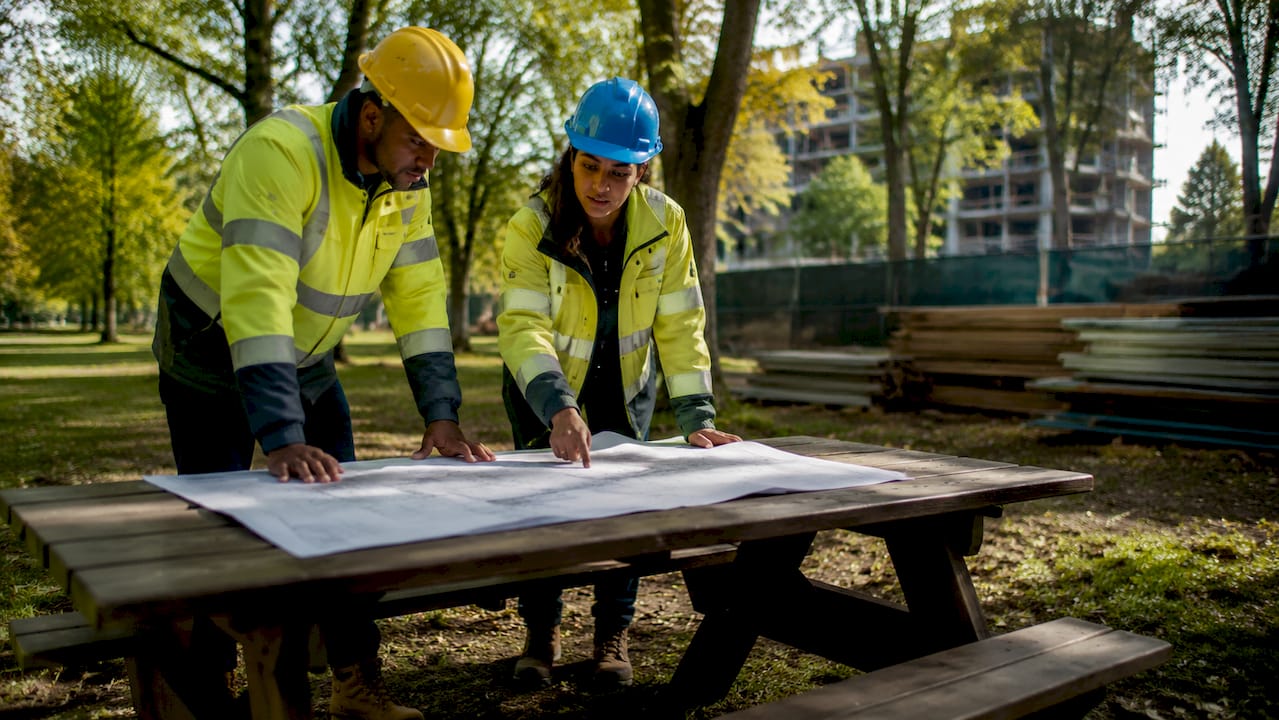
Project risk assessment steps are a systematic sequence of activities designed to identify, evaluate, and manage threats to project safety, schedule, cost, and regulatory compliance. In construction, where common site hazards include falls, dropped objects, scaffold failure, and electrocution, a structured risk management process is not optional. It is the operational backbone of every defensible safety program. Frameworks like ISO 31000:2018 and tools including risk matrices, risk registers, and job safety analyses (JSAs) define the standard. This article presents the six core project risk analysis steps that construction professionals must execute to achieve safety excellence and audit readiness.
1. Assemble the right risk assessment team
The foundation of any credible risk assessment process is the composition of the team conducting it. A practical construction risk assessment requires input from project managers, site supervisors, field workers, subcontractors, and safety officers. Each stakeholder brings a distinct perspective on exposure, and excluding any one group creates blind spots that auditors and incident investigators will later identify.
Risk identification should span five recognized categories: safety hazards, schedule risks, cost risks, compliance obligations, and quality failures. This breadth matters because risk assessment must cover all factors impacting project delivery, not just physical hazards. A subcontractor who flags a procurement lead time issue in week one prevents a schedule compression crisis in week eight.
Structured identification techniques include:
- HAZID workshops conducted at the design stage to capture phase-level threats before construction begins
- Job Safety Analyses (JSAs) at the task level to document step-by-step hazard exposure for field crews
- Bowtie analysis to map causes and consequences of high-severity events
- Historical data review using incident logs, near-miss records, and project post-mortems from comparable sites
- Permit-to-work reviews to surface hazards embedded in high-risk activities like confined space entry or hot work
A layered assessment methodology combining HAZID at the design stage with task-level JSAs provides the most defensible coverage and reduces the probability of audit failure. This dual-layer approach is now considered standard practice in Singapore and across major construction markets.
Pro Tip: Include at least two field-level workers in every risk identification session. Site crews routinely identify hazards that design-stage reviews miss entirely, particularly those related to sequencing, access constraints, and tool-specific exposures.
2. Evaluate and prioritize risks using a risk matrix
Once risks are identified, the project risk evaluation phase assigns quantitative scores to each item based on two dimensions: likelihood of occurrence and severity of consequence. The industry standard tool is a 5×5 risk matrix, where each axis runs from 1 (negligible) to 5 (critical). The product of these two scores produces a risk rating that determines prioritization.

| Risk Rating | Score Range | Required Action |
|---|---|---|
| Extreme | 20–25 | Immediate escalation and control implementation |
| High | 12–19 | Senior management review within 48 hours |
| Medium | 6–11 | Scheduled control measures with defined timeline |
| Low | 1–5 | Monitor and document; no immediate action required |
Schedule risk analysis deserves specific attention because it is frequently underweighted in construction assessments. Key schedule risk indicators include total float time per critical path activity, compression ratios when milestones are moved, and resource loading conflicts across concurrent work packages. A project with zero float on three simultaneous critical path activities carries a materially different risk profile than one with distributed float across the program.
Scoring discipline is critical at this stage. Residual risk ratings must reflect the actual effectiveness of controls applied, not theoretical best-case outcomes. Many assessments fail audits precisely because initial and residual scores are recorded inconsistently, undermining the entire evaluation’s validity.
Pro Tip: After applying controls, re-score every risk item independently. Do not assume a control reduces severity by a fixed increment. Validate the residual rating against observable evidence that the control is functioning as intended.
3. Build and maintain a live risk register
The risk register is the operational record of the entire assessment process. It is not a static document produced at project inception and filed away. Effective risk registers include fields covering risk description, category, probability score, impact score, combined rating, assigned owner, response plan, current status, and review date. Each field serves a governance function.
Risk ownership is the most frequently neglected element of register management. Every risk item requires a named individual who is accountable for monitoring the threat, implementing the response plan, and escalating when trigger thresholds are breached. Assigning ownership to a role title rather than a named person produces accountability gaps that surface during audits and incident investigations.
Update cadences should be governed by two triggers:
- Milestone-driven reviews aligned with project phase transitions, such as mobilization, structural completion, and fit-out commencement
- Event-driven reviews triggered by incidents, near-misses, significant scope changes, or regulatory updates
Governance thresholds for risk register updates based on milestones, incidents, or significant context shifts are what separate a living management tool from a compliance artifact. Construction managers who treat the register as a living document consistently outperform those who treat it as a one-time deliverable when measured against audit outcomes and incident rates.
Pro Tip: Assign a dedicated risk register custodian on projects exceeding six months in duration. This person owns the update schedule, tracks overdue actions, and prepares the register for each formal review cycle. Without this role, registers drift into obsolescence within two months of project mobilization.
For structured templates and guidance on maintaining compliant registers, the risk register support resources from MOSAIC provide field-tested frameworks aligned with Singapore regulatory expectations.
4. Define and implement risk response plans
Risk response planning translates identified and scored risks into concrete management actions before those risks materialize. The four recognized response types in project risk management are: avoid (eliminate the condition creating the risk), transfer (shift financial or operational exposure to a third party through contracts or insurance), mitigate (reduce probability or impact through controls), and accept (formally acknowledge low-rated residual risks with documented rationale).
In construction, mitigation actions must follow the hierarchy of controls, which ranks interventions by effectiveness:
- Elimination: Remove the hazard entirely, such as prefabricating structural elements off-site to eliminate working-at-height exposure
- Substitution: Replace a hazardous process or material with a safer alternative
- Engineering controls: Install physical barriers, guardrails, or mechanical ventilation systems
- Administrative controls: Implement permit-to-work systems, toolbox talks, and work scheduling to reduce exposure duration
- PPE: Provide personal protective equipment as the last line of defense, never the primary control
Compliance and audit expectations require that controls be verifiably implemented and owned, with clear documentation and escalation procedures. An auditor reviewing a risk register will look for evidence that engineering controls were installed, not merely planned. Response plans that exist only on paper do not satisfy ALARP (As Low As Reasonably Practicable) requirements under Singapore’s Workplace Safety and Health Act or equivalent statutory frameworks.
For a detailed breakdown of how compliance requirements intersect with control hierarchies, construction managers should reference jurisdiction-specific guidance alongside ISO 31000.
Pro Tip: Draft response plans during the risk identification phase, not after scoring is complete. Early drafting forces the team to think concretely about feasibility and cost, which in turn produces more accurate probability and impact scores.
5. Monitor risks continuously and conduct scheduled reviews
Continuous monitoring is the phase that distinguishes organizations that manage risk from those that merely document it. ISO 31000:2018 frames risk management as an iterative rather than linear process, meaning monitoring and review are not end-of-project activities. They are embedded throughout the project lifecycle.
Key risk indicators (KRIs) provide early warning signals before a risk event occurs. Effective KRIs for construction projects include:
- Schedule variance percentage against the baseline program at each reporting period
- Subcontractor financial health indicators such as delayed invoicing or workforce reductions
- Incident frequency rates tracked weekly against project benchmarks
- Regulatory inspection outcomes and any non-conformance notices received
- Material procurement lead times relative to installation milestones
Scheduled and event-driven reviews compensate for risk mutations and environmental changes that invalidate earlier assessments. A risk rated medium at project mobilization may escalate to extreme following a subcontractor insolvency event or a regulatory amendment. Reviews must be structured to catch these transitions before they become incidents.
Communication and consultation across project teams are equally critical. Risk information must flow from site level to project management and upward to senior leadership, with clear escalation protocols for high and extreme-rated items. Siloed risk data is functionally equivalent to no risk data at all.
For guidance on integrating iterative monitoring into construction project workflows, process improvement frameworks offer practical coordination models applicable across project scales.
Key takeaways
Effective project risk assessment in construction requires a structured, iterative sequence that spans team assembly, risk identification, scoring, register management, response planning, and continuous monitoring throughout the project lifecycle.
| Point | Details |
|---|---|
| Assemble a cross-functional team | Include field workers, subcontractors, and safety officers to capture all risk categories. |
| Use a 5×5 matrix with residual scoring | Score risks before and after controls; residual ratings must reflect actual control effectiveness. |
| Maintain a live risk register | Assign named owners and update the register at milestones and after significant events. |
| Apply the hierarchy of controls | Prioritize elimination and engineering controls over administrative measures and PPE. |
| Monitor with KRIs and scheduled reviews | Track schedule variance, incident rates, and procurement indicators as early warning signals. |
Why most construction risk assessments fail before the first audit
From years of working alongside construction project managers and safety officers across Singapore, the pattern is consistent: organizations invest heavily in the initial risk identification phase and then treat the resulting document as a completed deliverable. This is the single most consequential error in construction risk management.
Treating risk assessment as a one-time event rather than an iterative lifecycle process is the root cause of most audit failures and a significant proportion of serious incidents. The risk register that accurately reflected site conditions at mobilization is materially inaccurate by week six if no one has updated it. Auditors know this, and they test for it by asking named risk owners to describe the current status of their assigned items.
The second failure mode is the absence of a dual-layer assessment structure. Design-stage HAZID workshops capture phase-level threats, but they cannot anticipate the specific hazard combinations that emerge when a particular crew executes a particular task with particular equipment on a particular day. Task-level JSAs are not bureaucratic overhead. They are the mechanism by which design-stage assumptions are validated or corrected against operational reality.
The third issue is the conflation of qualitative and quantitative techniques. A 5×5 matrix is a qualitative tool. It produces relative rankings, not absolute probabilities. For high-consequence, low-frequency events such as scaffold collapse or crane failure, quantitative methods including fault tree analysis or bowtie modeling provide a materially more defensible basis for control selection. The most credible assessments combine both approaches, using qualitative scoring for the broad risk inventory and quantitative analysis for the items that sit at the top of the register.
The practical recommendation is to integrate ISO 31000 and OSHA standards as the structural framework, apply Singapore’s WSH Act requirements as the compliance floor, and treat every risk register update as an opportunity to test whether the project’s risk profile has shifted since the last review.
— Aman
How MOSAIC supports your risk assessment and audit compliance

MOSAIC Eco-construction Solutions provides construction project managers with the structured support needed to execute every stage of the risk management process to audit standard. From risk register templates calibrated to Singapore regulatory requirements to end-to-end safety audit preparation, MOSAIC’s consultancy services address the full spectrum of project risk evaluation and compliance obligations. For project teams preparing for BizSAFE assessments, MOM inspections, or ISO 31000 alignment reviews, MOSAIC’s safety audit preparation services provide the technical depth and documentation rigor that auditors require. Contact MOSAIC to engage a consultancy team with a proven track record in construction safety excellence across Singapore’s most demanding project environments.
FAQ
What are the core project risk assessment steps?
The core steps are: assemble the assessment team, identify risks across all categories, evaluate probability and impact using a risk matrix, assign ownership and define response plans, maintain a live risk register, and monitor risks continuously throughout the project lifecycle.
How often should a construction risk register be updated?
A risk register should be updated at each project phase milestone and immediately following any incident, near-miss, significant scope change, or regulatory amendment. Governance thresholds tied to these triggers keep risk data current and audit-ready.
What is the hierarchy of controls in construction risk management?
The hierarchy ranks controls from most to least effective: elimination, substitution, engineering controls, administrative controls, and PPE. Auditors expect evidence that higher-order controls were considered and implemented before relying on administrative measures or personal protective equipment.
Why do risk assessments fail compliance audits?
Most audit failures occur because residual risk ratings do not accurately reflect the controls applied, risk registers are not updated after initial completion, or named risk owners cannot demonstrate active monitoring of their assigned items.
What is the difference between HAZID and JSA in construction?
A HAZID is a design-stage workshop that identifies phase-level hazards across the project scope. A JSA is a task-level analysis that documents step-by-step hazard exposures for specific field activities. Both are required for a defensible, layered risk assessment.