
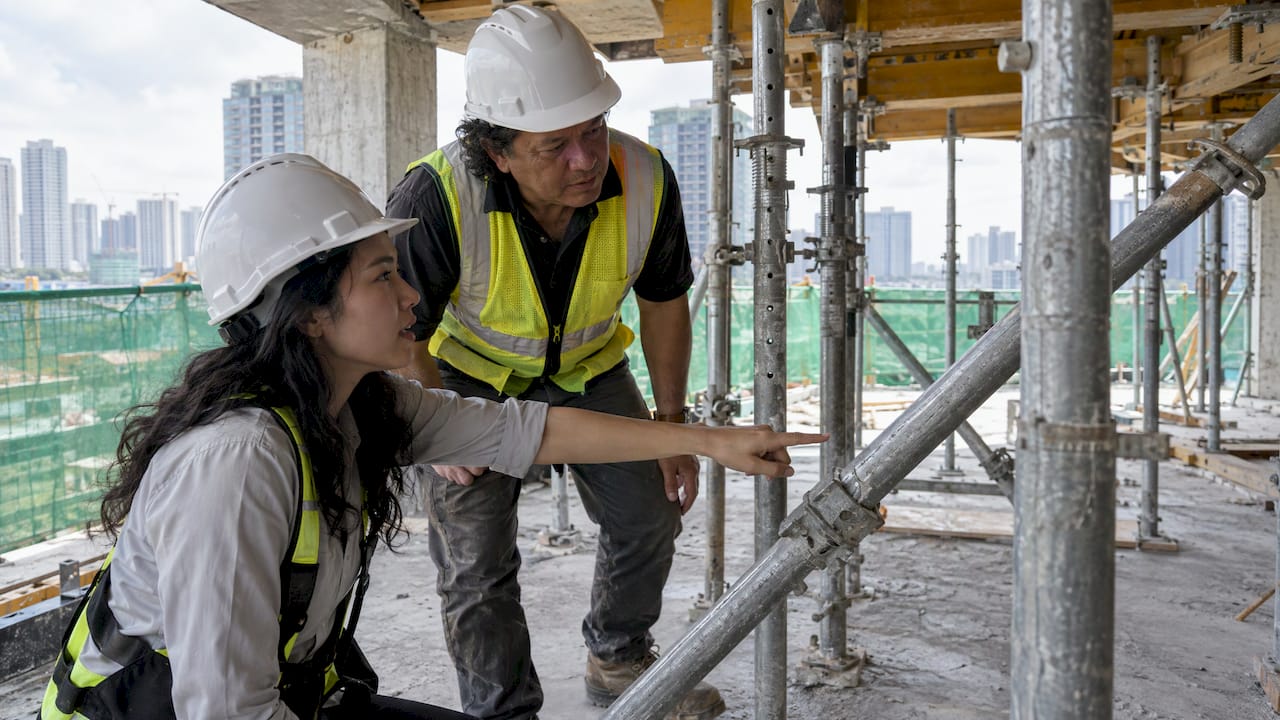
ALARP stands for “as low as reasonably practicable”. In construction it means a risk is not closed until every control that is reasonably practicable has been applied and the remaining risk is documented and justified. In Singapore the principle is built into the duty to eliminate foreseeable risks and, failing that, to minimize them, and it is tested most closely at the design stage under the Design for Safety (DfS) Regulations. Our Design for Safety Professional service supports developers, designers and contractors in turning that duty into decisions that stand up to audit.
TL;DR
- ALARP is a judgment that balances the size of a risk against the time, trouble, cost and physical difficulty of removing it. It is not a license to stop when the budget runs out.
- Singapore’s WSH (Risk Management) Regulations require all reasonably practicable steps to eliminate foreseeable risks first, then minimization through substitution, engineering controls, administrative controls and PPE.
- Under the DfS Regulations, developers, designers and contractors must work together through DfS review meetings to eliminate or reduce design risks, and the developer keeps a DfS Register of residual risks.
- Risk assessment records must be kept for at least three years, and assessments reviewed at least every three years or sooner after an injury or a significant change.
Table of Contents
- What ALARP means on a construction project
- Where ALARP sits in Singapore law
- The order of controls decides what is reasonably practicable
- How to decide what is reasonably practicable
- Applying ALARP at design stage under the DfS Regulations
- The hazard-to-control workflow
- What to document to prove ALARP
- How we support ALARP decisions
- Our perspective
- FAQ
- Sources
What ALARP means on a construction project
Every construction activity carries residual risk: work at height, lifting, excavation, temporary works, interfaces between trades. ALARP is the standard for deciding when further effort to reduce that risk is no longer required. Official procurement guidance in New Zealand describes a risk as ALARP only when the cost, time or effort of reducing it further would be grossly disproportionate to the benefit gained. The word “grossly” matters: the scales are tipped toward safety, not toward cost.
That is why ALARP differs from “acceptable risk”. Acceptability is a tolerance level. ALARP is a process of showing that you have exhausted the sensible options before you accept what remains.
The REDAS Design for Safety Good Practice Guide, updated for 2025, uses a three-band rule of thumb that many Singapore project teams carry into their risk matrices:
| Risk level | Status | What the team does |
|---|---|---|
| High | Intolerable | Reduce the risk unless the cost of doing so is grossly disproportionate to the benefit |
| Medium | ALARP band | Apply controls, weighing costs and benefits |
| Low | Negligible | No further mitigation needed |
The band structure is set out in the REDAS DfS Good Practice Guide. The matrix gives you a starting position. The ALARP argument is what you write down for the Medium band, and for any High risk you cannot remove.
Where ALARP sits in Singapore law
Singapore rarely uses the acronym in statute. The duty is written as “reasonably practicable”, and the test is the same. Under the Workplace Safety and Health (Risk Management) Regulations, employers, self-employed persons and principals must assess risks and take all reasonably practicable steps to eliminate any foreseeable risk to people affected by their work. Where elimination is not reasonably practicable, they must implement reasonably practicable measures to minimize the risk, put safe work procedures in place and specify the roles and responsibilities of those carrying the measures out. The amended Regulations took effect on 1 January 2025.
The acronym itself appears in the WSH Council’s Code of Practice on Risk Management (third revision, 2021). It says contractors and suppliers must take reasonably practicable measures to eliminate the risk posed by their work or reduce it to ALARP. For a main contractor, this means your subcontractors’ risk assessments are part of your own ALARP case, not a separate paper trail.
The order of controls decides what is reasonably practicable
ALARP is not satisfied by choosing the cheapest control. The Code of Practice sets a sequence: eliminate first, then, where elimination is not reasonably practicable, control in this order:
- Substitution: replace the hazardous material, process or equipment with a safer one.
- Engineering controls: guardrails, barriers, ventilation, mechanical handling aids.
- Administrative controls: permit-to-work systems, safe work procedures, training, supervision, scheduling.
- Personal protective equipment (PPE): the last line, used when the higher controls leave residual risk.
A common audit finding in any market is an assessment that jumps straight to “workers to wear harness” or “toolbox briefing” without showing why the first two rungs were not practicable. An ALARP argument needs a sentence at each rung explaining why the higher control was applied, or why it could not be.
How to decide what is reasonably practicable
The WSH Guidelines on Design for Safety define the term as a balance between the risk and the time, trouble, cost and physical difficulty of avoiding it. The factors to weigh are the severity of harm, the likelihood of it occurring, what is known about the hazard, and the availability, suitability and cost of safeguards. The judgment is objective, and whether an employer can afford the safeguard is not a consideration, particularly where serious injury is possible. The greater the likelihood or severity, the more reasonable it is to go to considerable expense and effort.

The UK Institute of Construction Management makes the same point from a different angle: if cost is the only barrier, another way must be found to design out or reduce the risk. Disproportion is reached only when additional cost would produce a barely discernible difference in risk.
A worked example
Take a hypothetical rooftop plant platform with a fall-from-height hazard, with the risk assessed as High because a fall could be fatal and maintenance visits are frequent.
- Eliminate: can the plant be relocated to ground level or a lower roof? If the design is still open, this is usually practicable and the cheapest moment to ask.
- Engineer: if the plant must stay, permanent edge protection and a guarded access route are collective measures that protect everyone, every visit.
- Administer: access permits and inspection routines support the engineered control but do not replace it.
- PPE: anchor points for a fall arrest system are the fallback for residual exposure.
If the team relies on harnesses alone because guardrails “cost too much”, the argument fails on the points above: severity is high, a collective measure exists, and affordability is not a valid reason. The documented argument is the deliverable, not just the guardrail.
Applying ALARP at design stage under the DfS Regulations
The cheapest risk reduction happens before drawings are frozen. The WSH (Design for Safety) Regulations 2015, in operation since 1 August 2016 with minor amendments gazetted in 2024, require developers, designers and contractors to work together through DfS review meetings to identify and eliminate or reduce, as far as reasonably practicable, all foreseeable design risks. An academic comparison of global DfS regimes notes that the regulations followed serious construction accidents in 2014, with the mandatory requirements applying to projects with a contract value above S$10 million.
The Guidelines add two practical rules:
- A design risk must be reduced at its source.
- Collective protective measures, such as guardrails, must be used as far as reasonably practicable instead of individual measures such as PPE or personal fall arrest systems.
These turn ALARP from a general principle into a design instruction. For a deeper look at how the regime works for large projects, see our guide to Design for Safety on projects above S$10 million and our explanation of the WSH (Design for Safety) Regulations 2015 for developers and designers.
The hazard-to-control workflow
A public-sector handbook from the Land Transport Authority sets out three steps: hazard identification, risk evaluation, and risk control, including evaluating residual risk and prioritizing hazards. Applied to ALARP, the workflow looks like this:
- Identify hazards by activity, location and phase, including temporary works and maintenance after handover.
- Evaluate risk using severity and likelihood, and rank the hazards so that effort goes to the High and Medium items first.
- Select controls by working down the hierarchy, recording why each higher option was or was not practicable.
- Re-rate the residual risk after controls. If it remains High, the team must either find another control or justify, with evidence, why none is practicable.
- Assign responsibility by name and role for each control, as the Regulations require.
- Review when conditions change.
The weak point is step 4. Teams often rate the initial risk carefully and then copy the same residual score across rows. An auditor reads that as a risk matrix filled in to finish a form, not to manage a hazard.
What to document to prove ALARP
An ALARP claim that is not recorded cannot be defended. The key documents under Singapore’s framework are:
- Risk assessment records and control measure records, kept for at least three years from the approval date, per the Code of Practice.
- A Risk Register, maintained and available for review by designated persons and regulatory agencies.
- Review triggers: at least every three years, after any bodily injury from a hazard, on significant changes in work practices or workers’ health, and when new WSH risk information emerges.
- A DfS Register, kept up to date by the developer, with records of all DfS review meetings and every residual design risk. Appointed designers and contractors must have access to it, according to the REDAS guide.
The residual design risk entries are where ALARP lives. Each should state the hazard, the options considered, the option chosen, the reason a better option was rejected and who now owns the risk. The contractor then carries that residual risk into the site risk assessment, so the logic connects from design through to construction.
How we support ALARP decisions
Our services cover the points in a project where ALARP evidence is created and challenged. Our Design for Safety Professional service supports the design review process, and our guide to appointing a DfS Professional explains the appointment under the Regulations. For site operations, our WSH Audit and Inspection service tests whether controls recorded on paper are in place on the ground, and our EHS Advisory and Documentation service covers the risk registers and procedures that make the record. Contact us through mosaicsafety.com.sg to discuss your project.

Our perspective
ALARP is often treated as the last box on a risk matrix. We treat it as the point where a project shows its safety culture. A team that can explain, in writing, why a collective control was chosen over PPE, and who owns the residual risk, has done the harder work than a team with a long list of generic controls.
With more than 20 years of experience, we have built our approach on tailored solutions and continuous support after the engagement, because ALARP is not settled once. Designs change, methods change and the records must change with them. Integrating Design for Safety, WSH audit and documentation under one consultant team keeps the argument consistent from design review to site inspection.
Our advice to developers and contractors is to put the ALARP discussion in the first design review, when elimination is still cheap, and to keep it visible in the registers until handover.
Aman
FAQ
What is the full form of ALARP?
ALARP means “as low as reasonably practicable”. It describes reducing a risk until the further effort needed would be grossly disproportionate to the benefit. Singapore’s legislation expresses the same idea as taking all reasonably practicable steps.
Is ALARP the same as acceptable risk?
No. Acceptable risk is a level you are prepared to tolerate. ALARP is the demonstration that you have applied every reasonably practicable control before accepting what remains. Under the REDAS rule of thumb, Medium risks sit in the ALARP band and are controlled with costs and benefits weighed, while High risks are intolerable unless reduction is grossly disproportionate.
Can a contractor use cost to argue a control is not reasonably practicable?
Cost is one factor, but the WSH Guidelines state that whether an employer can afford the safeguard is not a consideration, especially where serious injury is possible. The argument must rest on disproportion between the cost and the risk reduction gained, backed by records.
How long must risk assessment records be kept in Singapore?
The Code of Practice on Risk Management requires RA records to be kept for at least three years from the approval date. Assessments must be reviewed at least every three years, and sooner after an injury, a significant change in work practices or when new risk information appears.
Who is responsible for ALARP in a design risk?
Under the DfS Regulations, the developer has the duty to ensure foreseeable design risks are eliminated or reduced as far as reasonably practicable. Designers and contractors work with the developer through DfS review meetings, and residual risks are recorded in the DfS Register.
Sources
- Risk management, Construction procurement (New Zealand Government Procurement)
- REDAS WSH Design for Safety Good Practice Guide 2025
- Workplace Safety and Health (Risk Management) Regulations, Singapore Statutes Online
- Code of Practice on Risk Management, third revision 2021 (WSH Council)
- WSH Guidelines, Design for Safety (WSH Council)
- As competently safe as reasonably practicable (Institute of Construction Management)
- An Update on Global Comparisons of Design for Construction Safety
- Construction Safety Handbook (Land Transport Authority)