

Get audit-ready now: assemble three evidence bundles (internal audits, management review outputs, corrective action records), appoint an audit coordinator, and schedule a pre-audit walkthrough within the next two weeks. The single highest-value move is proving that past corrective actions actually worked, not just that they were marked closed. Everything else in this guide builds on that foundation.
TL;DR:
- Having documented root-cause verification for past corrective actions is critical for passing surveillance audits, rather than just showing closed statuses.
- Preparing evidence bundles such as internal audit reports, management review minutes, and corrective action logs in advance ensures quick retrieval and reduces nonconformity risks.
- Conducting a mock audit with someone unfamiliar with your system can reveal overlooked gaps and improve overall audit readiness.
- Address common pitfalls like outdated documentation, superficial audits, and low employee awareness to avoid repeat nonconformities.
- Appointing an audit coordinator early and following a structured timeline from eight to 12 weeks before the audit increases the chances of a smooth process.
Table of Contents
- What Is an ISO Surveillance Audit, and How Is It Different From Certification?
- What Documents and Records Should You Have Ready?
- How Do You Build an 8 to 12-Week Audit Prep Timeline?
- What Are the Most Common Surveillance Audit Findings?
- How Should You Run Audit-Day Logistics?
- How Do You Respond to Findings After the Audit?
- How Does MOSAIC Help Construction Teams Prepare for Audits?
- A Manager’s Guide to Prioritizing When Time Runs Short
- Get Hands-On Help Preparing for Your Next Audit
- Where to Verify Standards and Certification Body Accreditation
- Sources
- FAQ
What Is an ISO Surveillance Audit, and How Is It Different From Certification?
A surveillance audit is a shorter, periodic check that a certification body runs between full certification cycles to confirm your management system is still working as claimed, not a fresh evaluation from scratch. It typically happens once or twice within the three-year certification cycle, with recertification arriving at the end of that cycle as the full-scope review.
Auditor time on a surveillance visit is usually a fraction of what the initial certification audit required. Industry guidance under IAF MD5 suggests it averages about a third of the original audit duration, which is why the visit feels tighter and more targeted. That compression matters: auditors have less time, so they sample harder rather than reviewing everything.
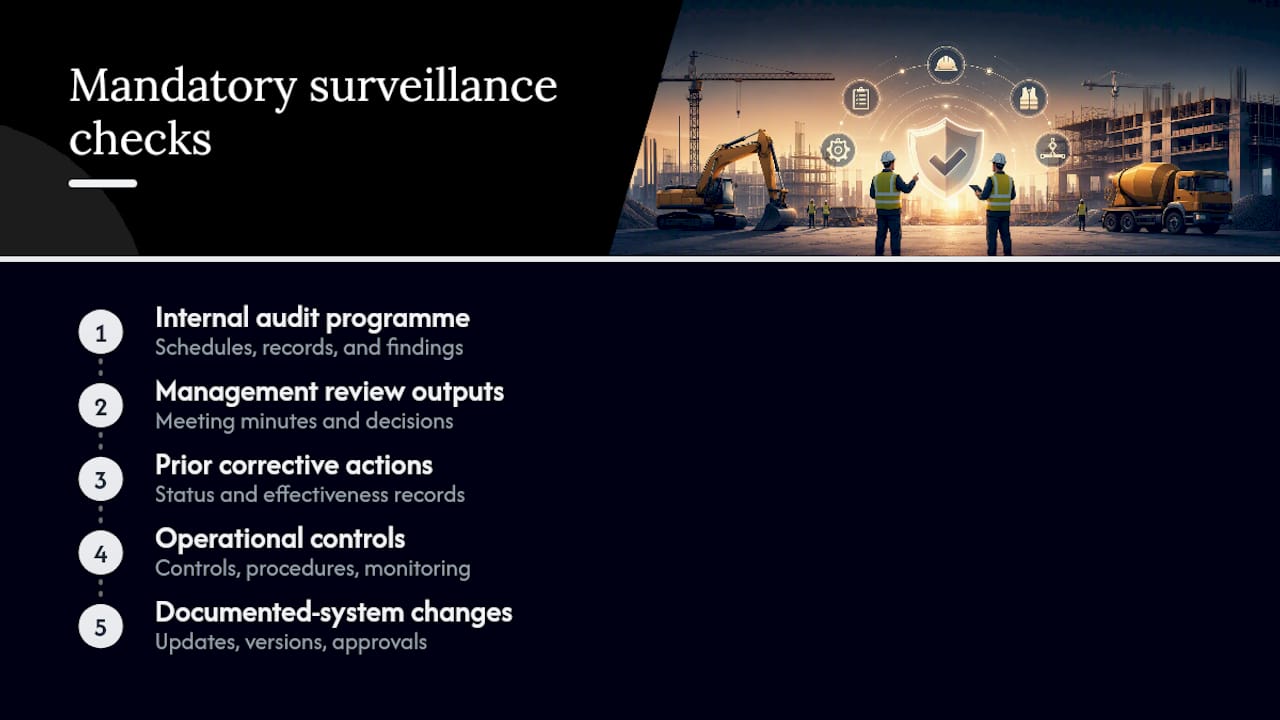
Under ISO’s own standards guidance, certification bodies are required to check specific mandatory elements at every surveillance visit: your internal audit program, management review outputs, handling of prior corrective actions, operational controls, and any changes to your documented management system. Miss preparation on any one of those five, and you have handed the auditor an easy finding.
What Documents and Records Should You Have Ready?
Auditors do not review paperwork for its own sake. They read records to test whether your management system actually functions the way your documentation says it does. Build these evidence bundles well before audit day, and index them so anyone on your team can retrieve them in under a minute.
- Internal audit reports with a defined scope, clear findings, and dated follow-up actions, not generic checklist ticks.
- Management review minutes showing real decisions, assigned owners, and deadlines, not a meeting that happened but produced nothing.
- Corrective action logs that document root-cause analysis and, critically, verification evidence that the fix held up over time.
- Training records and competency evidence tied to actual job roles, plus digital calibration certificates and maintenance logs for equipment covered under your scope.
- Performance data, risk registers, supplier evaluations, and, where relevant, statement of applicability reviews for management-system clauses tied to information security or safety.
Every one of these five bundles maps directly to something ISO/IEC 17021-1 requires certification bodies to check. Skipping one is not a minor gap. It is a documented, foreseeable path to a nonconformity.
If your organization runs ISO 45001 alongside a quality standard, your surveillance audit checklist needs a parallel safety-specific track: incident logs, near-miss reporting, and hazard assessments reviewed on the same cadence as your quality records. Construction firms in particular tend to treat safety records as a separate silo from quality documentation, and auditors notice the disconnect immediately.
How Do You Build an 8 to 12-Week Audit Prep Timeline?
Turning a checklist into a calendar is what separates teams that walk into audit day calm from teams that spend the week before scrambling for signatures. Assign an audit coordinator early. This person owns the timeline, and a separate auditor guide walks the certification body’s assessor through the building on the day itself. The guide’s job is to facilitate access to records and staff, not to manage what the auditor sees or filter their questions.
- Weeks 8 to 12 before the audit: Confirm audit scope with your certification body, schedule any outstanding internal audits, and set a date for management review if one has not happened in the last cycle.
- Weeks 4 to 6 before the audit: Verify that every open corrective action has documented root-cause work and evidence the fix actually held, not just a closed status. Index your evidence into a single shared folder or system, and run short refresher sessions for staff whose roles touch audited processes.
- Weeks 1 to 2 before the audit: Run a mock audit or full walkthrough with someone outside the day-to-day process, finalize room logistics, and confirm your interview list with process owners.
- Audit day: Execute your logistics plan, let the auditor guide manage movement and access, and capture notes on every question asked so you can act on patterns immediately after.
- Within 48 hours after the audit: Hold a debrief with process owners, log any findings formally, and assign corrective action owners before momentum fades.
Pro Tip: Run your mock audit with someone who has never seen your management system documentation before. A fresh set of eyes almost always catches the gaps your internal team has stopped noticing.
Structured preparation like this, built around internal audits, management review, and mock walkthroughs, is consistently linked to smoother, less disruptive surveillance visits. If your team already runs internal audits on a regular cycle, this guide to preparing ISO internal audits is worth reviewing alongside your timeline.
What Are the Most Common Surveillance Audit Findings?
Most nonconformities repeat across industries because the same shortcuts keep getting taken. Here is where teams lose points, and what actually fixes each one.
- Outdated or inconsistent documentation. Fix it with basic version control, a document owner for each procedure, and a quick quarterly check that live copies match the master version.
- Corrective actions closed on paper without evidence. Auditors specifically re-open prior findings to confirm the fix worked in practice, and a closed status with no verification data reads as a red flag rather than reassurance.
- Superficial internal audits. Sampling that only confirms a form exists misses the point. Internal audits should test whether the process actually produces the intended outcome, not just whether paperwork was filed.
- Low employee awareness. Staff who have memorized a script for one likely question but cannot explain their actual job process signal a system that exists on paper only. Short, role-specific refreshers beat scripted answers every time.
- Supplier traceability gaps. A quick internal check of supplier evaluation records and approval status before audit day catches gaps you can close in days rather than discovering them live.
Common, repeat pitfalls like outdated documentation and incomplete corrective action verification show up across almost every industry sector, which is exactly why a mock audit run weeks in advance catches them before an external assessor does.
How Should You Run Audit-Day Logistics?
Good logistics keep the audit contained instead of letting it swallow your whole operation. Build a document index in advance, with digital access plus one printed backup set for anywhere connectivity is unreliable, like an active construction site. Assign specific escorts for each area the auditor plans to visit, and clarify upfront which zones are open to observation and which require advance notice for safety reasons.
Brief frontline staff and process owners separately, and keep it short. The goal is not rehearsed answers. It is confidence to describe their actual process honestly and to say “I don’t know, but I can find out” when that is the truthful response. Guessing under pressure creates more findings than admitting a gap ever will.
Build in buffer time so the auditor can sample records and observe work without halting production. Coordinating observation windows with operations ahead of time, rather than reacting in the moment, is what keeps a surveillance visit from turning into a lost production day.
How Do You Respond to Findings After the Audit?
Certification bodies typically distinguish major findings, which threaten certification and demand an immediate response plan, from minor findings, which usually carry a correction window depending on the certification body’s own policy. Check your specific registrar’s timeline rather than assuming a universal deadline.
Every corrective action needs genuine root-cause analysis, not a surface-level fix, paired with a measurable way to verify the fix actually worked once implemented. Auditors treat prior nonconformities as high-priority evidence on the next visit, and effective, verified corrective action is one of the strongest signals of a mature management system a certification body will see.
Document the implementation evidence and feed it into your next management review agenda. If you are unsure whether your proposed fix meets the certification body’s expectations, ask before your response deadline rather than after a repeat finding shows up next cycle.
How Does MOSAIC Help Construction Teams Prepare for Audits?
Construction QES teams carry evidence that general guidance rarely accounts for: site safety logs, ConSASS assessment inputs, and subcontractor competency registers that shift as crews rotate between projects. External consultants structure mock audits around this evidence, walking sites similarly to certification body assessors and producing evidence indexes for reuse in future surveillance cycles.
When gaps run deeper than a document refresh, typically unresolved corrective actions or a management review that has gone stale, We recommend bringing in external support before the certification body’s visit rather than after a finding. A short prep engagement usually leaves a project team with a prioritized fix list and a clearer sense of what a real audit day feels like.
A Manager’s Guide to Prioritizing When Time Runs Short
If audit day is close and you cannot finish every item on the checklist, do these three things first. Close out any critical corrective actions with real verification evidence, not a status update. Confirm your management review has produced documented decisions and assigned owners. Index your internal audit reports so they are retrievable in seconds, not buried in someone’s inbox.
Beyond that, an internal mock audit is usually enough if your team has run one recently and your corrective action backlog is short. Bring in outside help when you are looking at multiple open major findings from the last cycle or when nobody internally has run a mock audit in over a year.
The best teams treat every finding as a design input for the next improvement cycle, not a fire to put out and forget. That mindset shift is what actually reduces findings over time, not more paperwork.
— Aman
Get Hands-On Help Preparing for Your Next Audit
This service is a practical alternative to piecing together audit prep from scattered checklists and outdated templates. Instead of guessing what your certification body will sample, it includes running mock audits, building reusable document indexes, coaching teams through corrective action design, and conducting site walk-throughs that mirror what an actual assessor will do.

A short engagement typically leaves your team with a prioritized fix list, a staff briefing on likely interview questions, and an evidence index your quality manager can maintain long after the engagement ends. Fewer open findings on audit day means fewer follow-up visits and less disruption to your project schedule. If your organization is pursuing broader certification support, MOSAIC’s ISO certification services for construction companies cover the full path from initial certification through ongoing surveillance readiness. Reach out through MOSAIC’s main site to scope a prep engagement before your next audit window opens.
Where to Verify Standards and Certification Body Accreditation
Confirm your certification body’s accreditation on the JAS-ANZ Accredited Bodies Register, and review current standard scope directly through ISO. Always check your specific registrar’s local policies against IAF and ISO guidance before assuming a timeline or requirement applies universally.
Sources
- ISO — International Organization for Standardization
- JAS-ANZ Accredited Bodies Register
- Preparing for your ISO 27001 surveillance audit — TUV NORD
- How Should an Organization Prepare for a Surveillance Audit? — QMII
FAQ
What Is a Surveillance Audit in ISO Terms?
A surveillance audit is a periodic check, usually once or twice within a three-year certification cycle, that confirms your management system still meets the standard’s requirements between full certification and recertification audits.
What Are the Objectives of an ISO 27001 Surveillance Audit?
The core objectives are verifying that internal audits and management reviews are happening, confirming prior corrective actions were effective, and checking that any changes to your information security management system are properly controlled and documented.
What Is an ISO Audit Checklist, and Do I Need One?
An ISO audit checklist is an itemized list of documents, records, and process evidence, such as internal audit reports, corrective action logs, and training records, organized so your team can retrieve them quickly during an audit. Building one before your surveillance visit is one of the most effective ways to reduce last-minute scrambling.
How Do I Prepare for an ISO 9001 Surveillance Audit?
Start by assembling your three core evidence bundles (internal audits, management review outputs, and corrective action records), then run a mock audit within a week or two of the actual visit to catch gaps early. Assigning a dedicated audit coordinator to manage the timeline is what keeps this process from falling apart under deadline pressure.
How Long Does a Typical Surveillance Audit Take?
Surveillance audit duration is usually a fraction of the original certification audit time, often cited at roughly one-third under IAF MD5 guidance, though the exact length depends on your organization’s size and scope.