
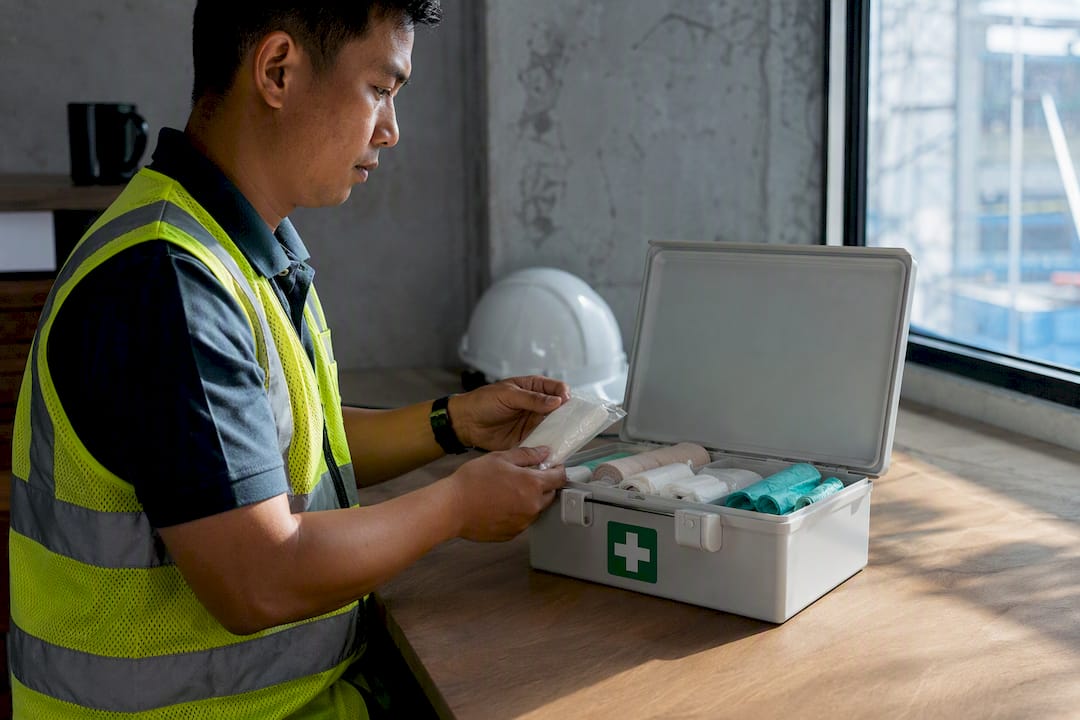
Every Singapore workplace must provide sufficient, well-maintained first-aid boxes, with one on each floor of a multi-floor building. Once headcount exceeds 25, employers must appoint first-aiders at a ratio of one per 100 employees or part thereof, applied per shift. Cross 500 persons at work, and a dedicated first-aid room becomes mandatory. Every appointed first-aider must hold training the Commissioner for Workplace Safety and Health deems acceptable, typically the Occupational First Aid Course, with periodic retraining. These obligations sit inside the Workplace Safety and Health (First-Aid) Regulations, enforced through the Ministry of Manpower and the WSH Council.
TL;DR:
- Workplaces with over 25 employees must appoint first-aiders at a ratio of one per 100 workers per shift, not overall headcount, requiring more staff for rotating shifts.
- First-aid rooms are mandatory once a site exceeds 500 persons at work simultaneously, reflecting the increased need for private treatment space.
- First-aid boxes must be sufficiently stocked, well-maintained, clearly visible, and checked regularly with a strict focus on expiry dates and accessibility.
- Certified first-aiders need training from accredited providers like the Singapore Red Cross, with certification valid for two years and mandatory refresher courses.
- Employers often fail to maintain accurate shift coverage and expiry tracking, risking non-compliance even if first-aid equipment and certificates appear adequate.
Table of Contents
- What Are the First Aid Requirements in Singapore Law?
- First Aid Box Contents and Maintenance Checklist
- Which First Aid Certification Meets Singapore’s Legal Standard?
- How Do You Operationalize First Aid Compliance Day to Day?
- When Do Workplaces Need More Than the Legal Minimum?
- How MOSAIC Helps Sites Build Sustained First-Aid Compliance
- What Employers Consistently Get Wrong About First Aid Compliance
- Sources
- FAQ
What Are the First Aid Requirements in Singapore Law?
The Workplace Safety and Health (First-Aid) Regulations form the legal backbone for every first-aid decision a Singapore employer makes. The regulation does not leave provision to interpretation. It sets out exactly how many boxes a workplace needs, where they go, what condition they must be kept in, and who must be trained to use them.
First-aid box provision and placement follows a straightforward rule: every workplace needs a sufficient number of first-aid boxes, and where the workplace occupies a building with multiple floors, each floor needs its own sufficient supply. “Sufficient” is deliberately open, because a 15-person office and a 400-worker factory floor carry different risk profiles. The regulation is specific on condition, though. Boxes must be:
- Adequately equipped and maintained in good order at all times
- Clearly identified so workers can locate one without hesitation during an emergency
- Positioned in well-lit, easily accessible locations, never behind locked doors or buried in storage
- Checked frequently enough to catch depleted or expired stock before it becomes a problem
- Free of anything that isn’t a genuine first-aid requisite. No painkillers stashed alongside bandages, no random office supplies
First-aider appointment kicks in once a workplace employs more than 25 people. Below that threshold, the law doesn’t mandate a designated first-aider, though most safety officers appoint one anyway as good practice. Above it, the ratio is one first-aider for every 100 employees or part thereof, meaning a 150-person workplace needs two, not one. Crucially, this ratio applies per workplace and per shift, not per total company headcount. A factory running three rotating shifts of 40 workers each doesn’t satisfy the rule with one first-aider who only works days. Each shift needs its own coverage, which means employers with round-the-clock operations often need more first-aiders than a simple headcount calculation suggests.
First-aid rooms become mandatory once a workplace has more than 500 persons at work at any one time. This isn’t a suggestion for large sites. It’s a hard threshold tied directly to the scale of potential casualties and the practical need for a private, equipped space to administer treatment away from the factory floor or worksite traffic.
Non-compliance carries real consequences. Occupiers who fail to provide adequate first-aid boxes, fail to appoint sufficient first-aiders, or fail to maintain a required first-aid room can face enforcement action under the Workplace Safety and Health Act, including fines. Appointed first-aiders themselves carry a duty to keep their skills current, and occupiers bear responsibility for verifying that training remains valid, not just that a certificate was once issued.
First Aid Box Contents and Maintenance Checklist
A compliant first-aid box isn’t defined by a single mandated packing list; the regulation focuses on maintenance and suitability rather than dictating brand names or exact quantities. That said, the Singapore First Aid Guidelines 2021 and standard occupational practice converge on a core set of items every general workplace box should carry:
- Adhesive dressings and sterile gauze in multiple sizes
- Triangular bandages for slings and immobilization
- Adhesive tape and safety pins
- Disposable gloves (several pairs, not one)
- Antiseptic wipes or solution
- Scissors and tweezers
- A resuscitation face shield or pocket mask
- Eye wash solution, especially where dust or chemical splash is a risk
- A first-aid instruction leaflet or quick-reference card
- Cold compress packs for sprains and minor trauma
Workplaces handling chemicals, heavy machinery, or elevated fall risk should tailor contents beyond this baseline. A construction site box, for instance, benefits from burn dressings and larger trauma pads that an office box never needs.
Ownership matters as much as contents. Every box should have a named person in charge, typically the appointed first-aider or a designated safety coordinator, responsible for its condition. The box itself must stay mobile and unlocked, clearly labeled with a first-aid cross, and stored somewhere workers can reach it in under a minute during a genuine emergency.
Pro Tip: Assign a laminated inspection card inside the lid of every box. A first-aider who checks stock weekly can initial and date the card in seconds, giving inspectors instant proof of maintenance without digging through separate logs.
A workable inspection rhythm looks like this: a quick visual check daily during shift handover, a full stock count weekly to catch usage patterns, and a formal audit monthly that includes expiry-date review. Any item used during treatment should trigger immediate restocking rather than waiting for the next scheduled check. Expired items are a common finding during WSH inspections, and they’re entirely avoidable with a simple recurring calendar reminder.
Which First Aid Certification Meets Singapore’s Legal Standard?
The regulation requires first-aiders to complete training “acceptable to the Commissioner,” a phrase that sounds vague until you see how it plays out in practice. The Commissioner doesn’t approve courses one by one on request. Instead, the market has settled on the Occupational First Aid Course (OFAC) as the recognized standard, delivered by accredited providers including the Singapore Red Cross Academy.
A compliant OFAC program typically bundles:
- Workplace-specific first-aid modules covering wound care, fractures, and shock management
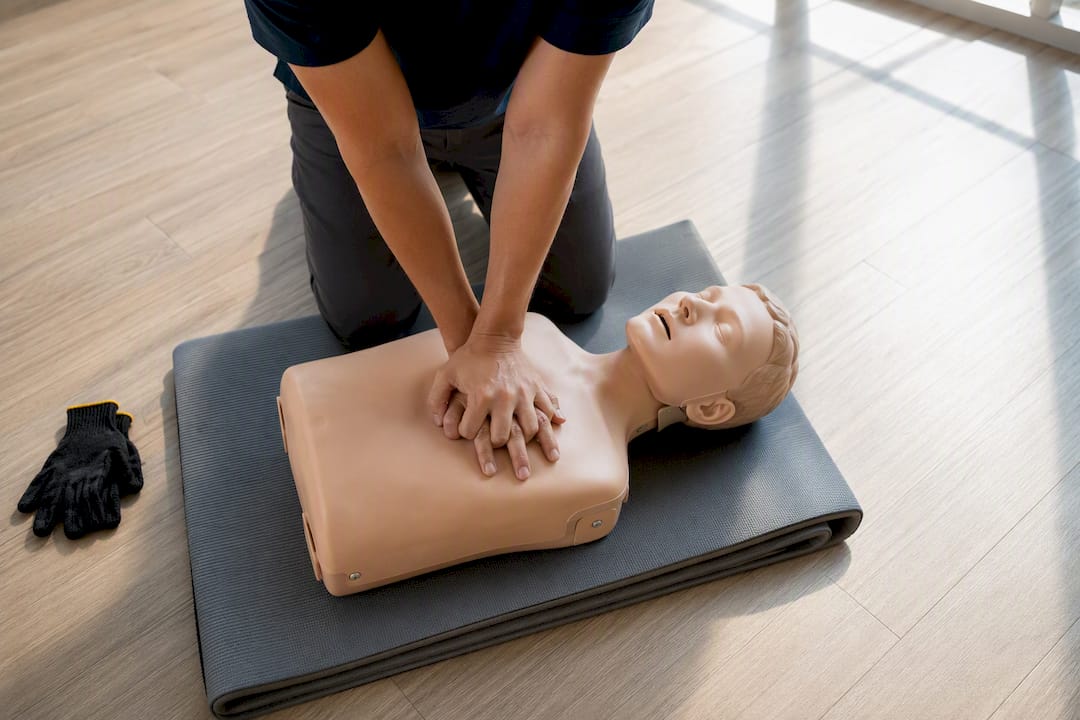
- CPR and AED components, since cardiac events remain a leading cause of workplace fatality
- Response protocols for hazardous-substance exposure, relevant to manufacturing and construction settings
- Casualty handling and safe movement techniques for confined or elevated work areas
When vetting a course provider, check for accreditation signals tied to the Singapore Red Cross First Aid Council (SRFAC) or Singapore Aquatics Council frameworks, and confirm the curriculum aligns with WSH Council technical notes on occupational first aid. A course missing CPR/AED content, or one that skips hazardous-substance response for a chemical-handling workforce, likely won’t satisfy an inspector’s questions if something goes wrong.
Certificate validity typically runs two years across SRFAC-accredited qualifications, after which a refresher course is required before the certificate lapses. The Commissioner also retains authority to require additional retraining beyond the standard cycle, particularly following regulatory updates or incident investigations. Employers who let certifications quietly expire without noticing create a compliance gap that’s invisible until an inspector or, worse, an actual emergency exposes it.
Fitness matters too. Course prerequisites generally expect candidates to be in reasonable medical and physical condition, since CPR and casualty handling demand physical exertion that not every employee can safely perform. Before enrolling someone, ask whether they have back, joint, or cardiac conditions that might make chest compressions or lifting a casualty unsafe for them. It’s a short conversation that prevents a much harder one later.
How Do You Operationalize First Aid Compliance Day to Day?
Meeting the legal minimum on paper and running a genuinely prepared workplace are two different things. Turning the regulation into daily practice takes four concrete steps.
- Appoint and publish. Name your first-aiders formally, then post a notice at a visible workplace location listing their names and locations. Build in redundancy, if your primary first-aider is on leave, someone else needs to be reachable within the same shift.
- Keep the paper trail current. Maintain a training register tracking certification dates and expiry, a treatment log recording every incident where first aid was administered, and a first-aid box inspection log with dated entries.
- Fold first aid into existing processes. Add first-aider names and box locations to your emergency action plan, new-hire induction materials, and shift handover checklists rather than treating first aid as a standalone program.
- Prepare your audit file. Inspectors typically want to see current certificates, the expiry tracker, recent box inspection forms, and the treatment log side by side. Keeping these in one folder, physical or digital, turns a stressful inspection into a five-minute document handover.
Safety officers managing multi-site construction operations often find it useful to fold this checklist directly into a broader workplace safety and health management system rather than running first aid as an isolated compliance task.
When Do Workplaces Need More Than the Legal Minimum?
Some environments demand protection beyond the baseline regulation, and the law recognizes this directly. Where workers face potential exposure to toxic or corrosive substances, employers must provide drenching or flushing facilities within the immediate work area, positioned close enough for quick use after a splash to eyes or skin.
- Construction sites, shipyards, and manufacturing plants often need higher first-aider ratios than the legal minimum, given the elevated injury frequency in these settings
- Large or dispersed construction sites frequently justify an on-site first-aid room even below the 500-person threshold, purely for practical response time
- AEDs aren’t universally mandated in Singapore, but clinical evidence consistently links workplace AED availability to better cardiac arrest survival. Where one is installed, staff need training and clear signage pointing to its location
- Integrate DRSABC assessment steps and DARE coordination with SCDF into your emergency action plan, so first-aiders know exactly when to escalate to a 995 call versus manage on-site
Teams designing new facilities or renovating existing layouts sometimes benefit from mapping AED placement and evacuation routes into their site plan at the design stage, rather than retrofitting emergency response into a finished floor plan.
How MOSAIC Helps Sites Build Sustained First-Aid Compliance
Getting the paperwork right once is manageable. Keeping first-aider ratios accurate as headcount shifts, tracking certificate expiries across multiple shifts, and setting up a compliant first-aid room on a live construction site is a different order of complexity. This is where a QES consultancy earns its keep.
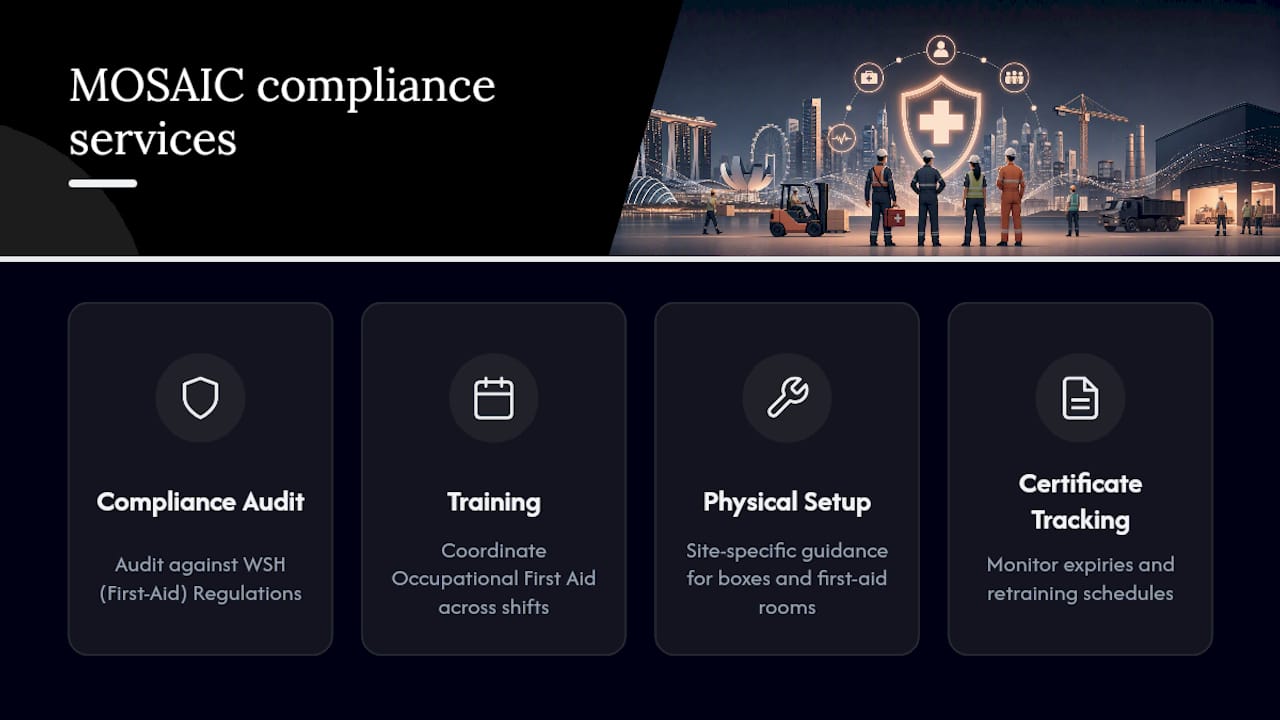
A structured engagement typically covers a compliance audit against the WSH (First-Aid) Regulations, coordination of Occupational First Aid training schedules across shift patterns, and physical setup guidance for first-aid boxes and rooms tailored to site-specific hazards. Certificate tracking systems remove the guesswork around who’s due for retraining and when.
Multi-shift construction projects, factories with hazardous processes, or any site scaling past the 25 or 500-employee thresholds are the clearest candidates for bringing in outside consultancy support. If your site fits that profile, Com’s compliance consultancy services can help translate the regulation into a working system rather than a filing cabinet of certificates.
What Employers Consistently Get Wrong About First Aid Compliance
Most employers treat first-aid compliance as a checklist exercise: buy the box, appoint someone, file the certificate. The regulation rewards that approach on paper, but it misses the point entirely. The per-shift ratio requirement is the clause most workplaces quietly violate without realizing it, because they calculate coverage against total headcount instead of who’s actually on-site during a given shift. A night shift with zero certified first-aiders present is non-compliant even if the day shift has three.
The bigger gap is between equipment and readiness. A fully stocked box means nothing if nobody remembers where it is during an actual emergency, and a certified first-aider whose training lapsed eighteen months ago is functionally no different from having no first-aider at all. Prioritize the tracking system before the equipment upgrade. Know your expiry dates, know your shift coverage gaps, and treat the first-aid room threshold as a planning trigger well before you hit 500 people, not a scramble once you cross it.
— Aman
Sources
- Workplace Safety and Health (First-Aid) Regulations
- Singapore First Aid Guidelines 2021 | SMJ
- SINGAPORE RED CROSS ACADEMY COURSE INFORMATION (Occupational First Aid)
FAQ
What Are the Requirements for First-Aiders in Singapore?
Workplaces with more than 25 employees must appoint first-aiders at a ratio of one per 100 employees or part thereof, applied per shift, with training acceptable to the Commissioner for Workplace Safety and Health.
What Are the General First Aid Requirements for Singapore Workplaces?
Every workplace needs sufficient, well-maintained first-aid boxes, appointed first-aiders once headcount exceeds 25, and a dedicated first-aid room once more than 500 persons are at work.
What Is the Minimum Qualification for a Certified First-Aider?
The recognized standard is the Occupational First Aid Course, covering wound care, CPR and AED use, and hazardous-substance response, with certification typically valid for two years before refresher training is due.
What Is the Minimum First-Aid Requirement at Work Below 25 Employees?
Below 25 employees, the law doesn’t mandate an appointed first-aider, but every workplace still needs an adequately stocked, accessible first-aid box regardless of headcount.
How Often Must First-Aid Boxes Be Checked?
The regulation requires boxes to be checked frequently and kept in good order at all times; most compliant workplaces run a daily visual check, a weekly stock count, and a monthly full audit.