
Introduction
RAG (Retrieval-Augmented Generation) systems can reduce ISO 45001 audit preparation time by 60–80% in heavy construction projects by automating the retrieval, parsing, and classification of safety evidence scattered across sites, subcontractors, and document formats. For companies that currently spend 3–6 weeks manually gathering documented information before an external audit, that reduction translates to finishing in under one week-with higher accuracy and fewer compliance gaps.
This article is written for HSE managers, safety officers, and compliance teams at heavy construction firms with 50+ employees and multiple active project sites. It covers the practical implementation of RAG-based evidence parsing for ISO 45001 audits, from system architecture through document ingestion to challenge mitigation, with attention to the defined scope of the occupational health and safety management system, including boundaries, OHS activities, and assigned roles and responsibilities across project sites. It does not cover general AI strategy or IT infrastructure planning unrelated to occupational health and safety compliance.
The core answer: RAG systems automate evidence collection from various sources like safety logs, training records, incident reports, and risk assessments, then categorize and retrieve that documentation against specific ISO 45001 clause requirements-eliminating the manual search-and-sort process that dominates audit preparation in construction.
After reading this article, you will understand:
-
How RAG architecture maps to ISO 45001 evidence management in heavy construction
-
Which evidence categories benefit most from automated parsing and gap analysis
-
Concrete processing-time benchmarks comparing manual vs. RAG-enabled audit prep
-
How to handle legacy documents, multi-site complexity, and subcontractor coordination
-
ROI indicators and next steps for piloting a RAG system ahead of your next audit

Understanding RAG Systems for Occupational Safety Compliance
Retrieval-Augmented Generation is an AI architecture that combines a large language model with an external retrieval mechanism-typically a vector database or document store-so the system retrieves relevant document chunks first, then generates contextual responses grounded in actual source material. Unlike standalone language models, RAG reduces hallucination by anchoring every output to verifiable evidence, which is exactly what auditors require when auditing management systems against ISO 45001.
For occupational health and safety management, this means a RAG system can ingest thousands of safety documents, match them to specific ISO clause requirements, and produce audit-ready summaries with direct citations to source records. Retrieval-Augmented Generation converts unstructured data into searchable formats, making previously buried evidence instantly accessible.
Core RAG Components for Safety Documentation
A RAG system built for safety management system compliance has several distinct layers:
-
Document retrieval mechanisms that use hybrid retrieval systems combining keyword and vector searches for improved accuracy. These locate specific safety records, incident reports, and training certificates across distributed repositories.
-
Knowledge base integration containing ISO 45001 clause requirements, local legal requirements (such as Singapore’s WSH regulations), and construction industry standards. This corpus allows the system to cross-reference retrieved documents against what auditors actually check.
-
Generation and summarization pipelines that produce gap analysis reports, evidence summaries, and compliance status dashboards-all linked back to source documents with provenance metadata.
-
Audit trail and provenance tracking ensuring evidence provenance is critical and should be documented for compliance. Every generated output links to timestamped, versioned source files.
Automated parsing matters because heavy construction projects generate large volumes of unstructured evidence. Without systematic retrieval, safety teams spend most of their audit preparation time simply locating documents rather than evaluating their adequacy.
Heavy Construction Documentation Challenges
The volume of documentation on a typical heavy construction project is staggering. A high-rise project may involve dozens of trade contractors, each producing daily safety logs, site-specific risk assessments, method statements, permits, equipment inspections, and environmental safety data. Construction sites produce diverse types of evidence including digital and non-digital formats-handwritten inspection forms, scanned certificates, photos of site conditions, audio recordings from toolbox talks, and digital templates that vary across subcontractors.
Format inconsistencies compound the problem. Different subcontractors use different templates, naming conventions, and filing systems. Older documentation may exist only on paper. Version control is often non-existent across site offices. When preparing for a safety audit, compliance teams frequently discover that critical records are missing, misfiled, or stored in formats that can’t be easily searched.
This fragmentation directly increases the time and risk associated with ISO 45001 audit preparation, which is precisely where RAG systems deliver their highest value.

ISO 45001 Occupational Health and Safety Evidence Categories in Heavy Construction Projects
ISO 45001 requires documented evidence of system implementation across multiple clause families-from planning (Clause 6) through support (Clause 7), operation (Clause 8), performance evaluation (Clause 9), and continual improvement (Clause 10). Each clause demands specific types of documented information, and auditors review documented information during the ISO 45001 audit with expectations of traceability, currency, and completeness. Single artifacts do not directly prove ISO 45001 compliance; multiple sources should be used to demonstrate that controls are effectively implemented.
Risk Assessment Documentation
Under ISO 45001 clauses 6.1.2 and 6.1.4, organizations must maintain records of risk assessments and evaluations for audits. In heavy construction, this includes site-specific hazard identifications for tower crane operations, excavation, lifting operations, fall arrest systems, and maintenance tasks. Method statements describe work sequences and identify controls. Auditors check that risk assessments exist for all tasks, that they include current review dates and named owners, and that identified hazards have corresponding safety measures in place.
RAG systems excel here because risk assessments are typically generated by multiple parties across multiple sites. The system can retrieve all risk assessments matching a specific work activity, pull related maintenance documentation as operational control evidence, cross-reference them against the relevant ISO clauses, compare them with past similar hazards, and flag where risk assessment documentation lacks legal requirements references or evidence of worker participation. ISO 45001 requires documented risk assessments for all tasks, and automated gap tagging can streamline evidence tracking in audits by identifying which assessments are missing or outdated.
ISO 45001 audits check that controls are in place for identified risks, meaning the system must also link risk assessments to operational control evidence-not just confirm the assessment exists. Error traps in RAG classification logic can increase the assessed risk level significantly if documents are misclassified, which is why human-in-the-loop review remains essential.
Worker Training and Competency Records
ISO 45001 clause 7.2 requires organizations to ensure that workers performing tasks under their control are competent based on education, training, or experience. In heavy construction, this means managing training records for welders, crane operators, scaffolders, riggers, and dozens of other trades-plus subcontractor personnel. Training records must show that workers have seen risk assessments relevant to their assigned tasks.
RAG systems can parse digital training certificate files, cross-check expiry dates against the audit timeframe, flag expired certifications, and match trade qualifications against required competency matrices. For a firm with 50+ employees and multiple subcontractors, manually verifying training records can consume 3–4 hours per evidence set. A RAG system can reduce this to 10–12 minutes while catching gaps that manual review often misses, such as safety training coverage for high-risk work categories.
Incident and Near-Miss Reporting
Under clauses 9.1 and 10.2, ISO 45001 requires documented information on incidents, nonconformities, corrective actions, and their effectiveness. Heavy construction environments face fall incidents, struck-by incidents, equipment malfunctions, and near misses, each demanding investigation records, root cause analysis, corrective actions, and follow-up verification.
A RAG system can retrieve past incident reports similar in type, generate summaries showing trends, and cross-reference whether organizations have been able to implement corrective actions and verify their effectiveness. This supports both internal audit preparation and the continual improvement cycle that auditors expect to see demonstrated. Effective evidence retrieval aids in performing gap analysis for compliance, particularly when auditors probe whether corrective actions from previous audit findings have been closed and validated.
Temporal reasoning is important to ensure the validity of documents during audits-incident investigation records must show that actions were taken within appropriate timeframes and that effectiveness reviews actually occurred.

Implementing RAG Systems for Construction Safety Internal Audit Preparation
Moving from understanding evidence categories to practical deployment requires a structured approach. The following procedures are most relevant when a company is preparing for ISO 45001 certification, approaching its next ISO 45001 audit cycle, or looking to systematize compliance across a growing portfolio of construction projects. Top management involvement is crucial for ISO 45001 implementation, and that commitment extends to resourcing the technology infrastructure that supports the management system.
System Setup and Document Ingestion Process
Implementation begins before the first document is parsed. A pre-audit can identify gaps before the official audit, and conducting a gap analysis before the ISO 45001 audit helps define the ingestion plan against the ISO 45001 scope of the organization’s health and safety management system, including which sites, contractors, activities, roles, and responsibilities must be covered.
-
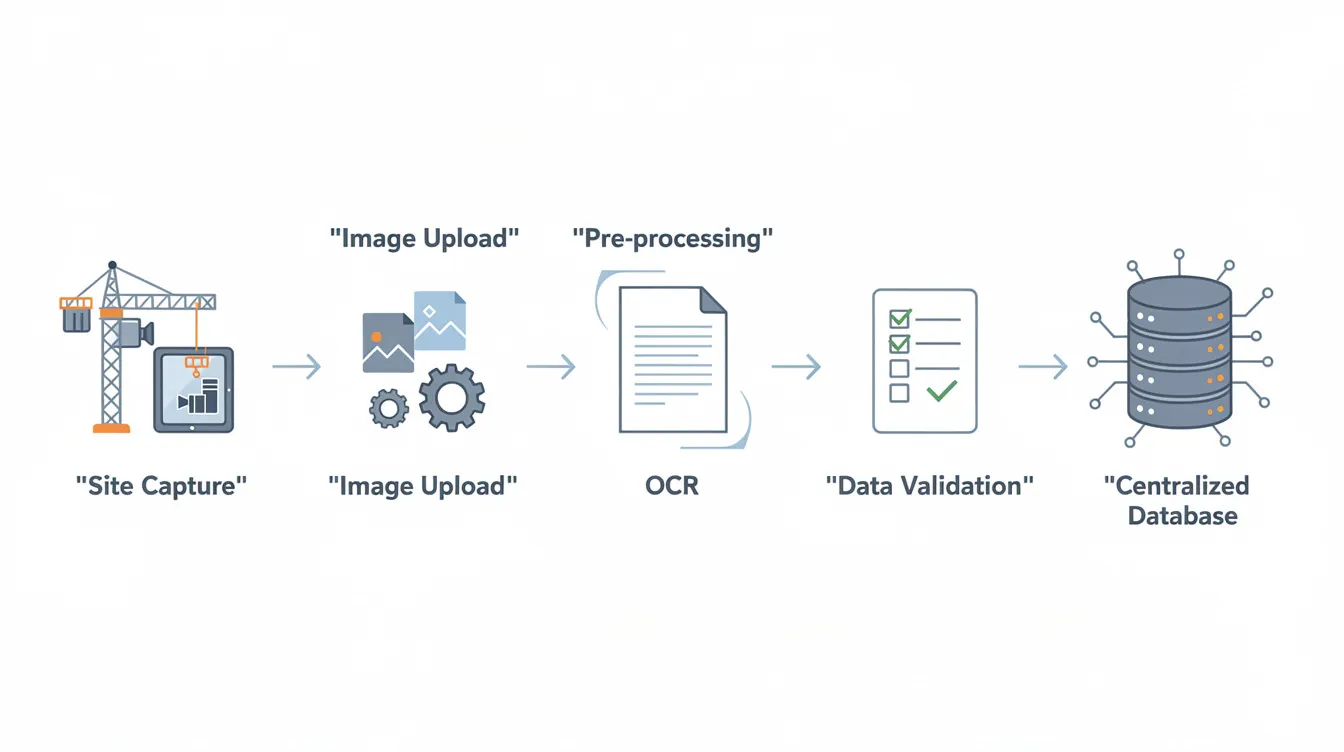
Configure document repositories by mapping all existing sources: site offices, shared drives, cloud storage, physical filing cabinets, and project management platforms. Connect these to a centralized safety management system repository where the RAG system can access them.
-
Establish OCR processing for scanned permits, certifications, and handwritten safety logs. RAG systems utilize optical character recognition for processing handwritten logs, converting paper-based evidence into searchable text with metadata tagging for project name, date, site, discipline, and document type.
-
Create automated workflows linking project management systems with safety documentation databases so that completed method statements, inspection records, and SWMS automatically flow into the ingestion pipeline. Metadata filtering should occur before or alongside semantic retrieval processes to ensure documents are correctly tagged at the point of entry.
-
Set up real-time synchronization between site documentation and central compliance repositories using mobile upload tools. Site personnel capture evidence directly, and the system validates format compliance, completeness, and legibility on submission.
ISO 45001 requires documented evidence of management’s safety commitment, so the system should also ingest management review minutes, safety policy statements, and records of top management participation in safety governance.
Evidence Parsing and Classification Framework
The classification framework aligns document types to ISO 45001 clauses and uses NLP to detect content characteristics-whether a document is a certificate, whether a corrective action has been closed, whether a risk was properly assessed, and who was involved. ISO 45001 emphasizes employee participation and consultation, so the system must also identify evidence of worker involvement in hazard identification and risk management processes.
The SiteShield multi-modal RAG framework achieved recall of 0.96, precision of 0.76, and an F1-score of approximately 0.82 when processing construction safety evidence including images and audio inputs-demonstrating that automated parsing can achieve high accuracy in identifying compliance-relevant content.
|
Evidence Type |
Manual Processing Time |
RAG Processing Time |
Accuracy Improvement |
|---|---|---|---|
|
Risk Assessments |
4–6 hours |
15–20 minutes |
95% vs 78% compliance detection |
|
Training Records |
3–4 hours |
10–12 minutes |
99% vs 85% certificate validation |
|
Incident Reports |
2–3 hours |
8–10 minutes |
92% vs 71% root cause linkage |
These benchmarks are extrapolated from adjacent compliance automation case studies. A federal agency case reported a 40% reduction in audit preparation time using RAG plus AI evaluation harnesses. In financial services, a RAG knowledge base implementation reduced search time per compliance inquiry from over 6 hours to under 3 minutes. A mid-size general contractor ($14M revenue, 65 workers) that implemented safety compliance workflow automation saw administration time drop 58%-from 62 to 26 hours per week-while inspection documentation volume increased 340% and OSHA citations dropped from 4 per year to zero over 18 months.
For construction managers evaluating ROI: the investment includes data digitization, staff onboarding, and platform licensing, but the returns include saved labor hours, fewer nonconformity findings, reduced risk of compliance penalties, and potentially lower insurance premiums. Continuous compliance monitoring can proactively identify evidence gaps rather than surfacing them during the stress of audit preparation.
Auditors require direct access to source documents for verification purposes, so the RAG system must always preserve links between generated summaries and original records. Management must define roles and responsibilities for health and safety within the system, and audit management workflows should clearly assign ownership of evidence review and approval.
Common Challenges and Solutions
Every successful implementation of RAG for construction safety compliance encounters predictable obstacles. Addressing them proactively determines whether the system delivers its promised efficiency gains.
Legacy Documentation Format Inconsistencies
Heavy construction firms often have 3–5 years of historical safety records in mixed formats: paper logs, scanned PDFs of varying quality, spreadsheets, and inconsistent templates from different project phases. Auditors may require past internal audit records, corrective actions, and management reviews spanning several years to assess continuous improvement.
Solution: Implement document standardization templates and deploy automated format conversion tools for construction-specific forms. Prioritize progressive scanning and digitization of historical records, starting with evidence most frequently requested during ISO 45001 audits-risk assessments, training records, and incident investigations. Use de-duplication and version control systems to maintain clean data. Define minimum format requirements for all new documentation going forward, creating audit checklists that specify acceptable formats.
Multi-Site Data Integration Complexity
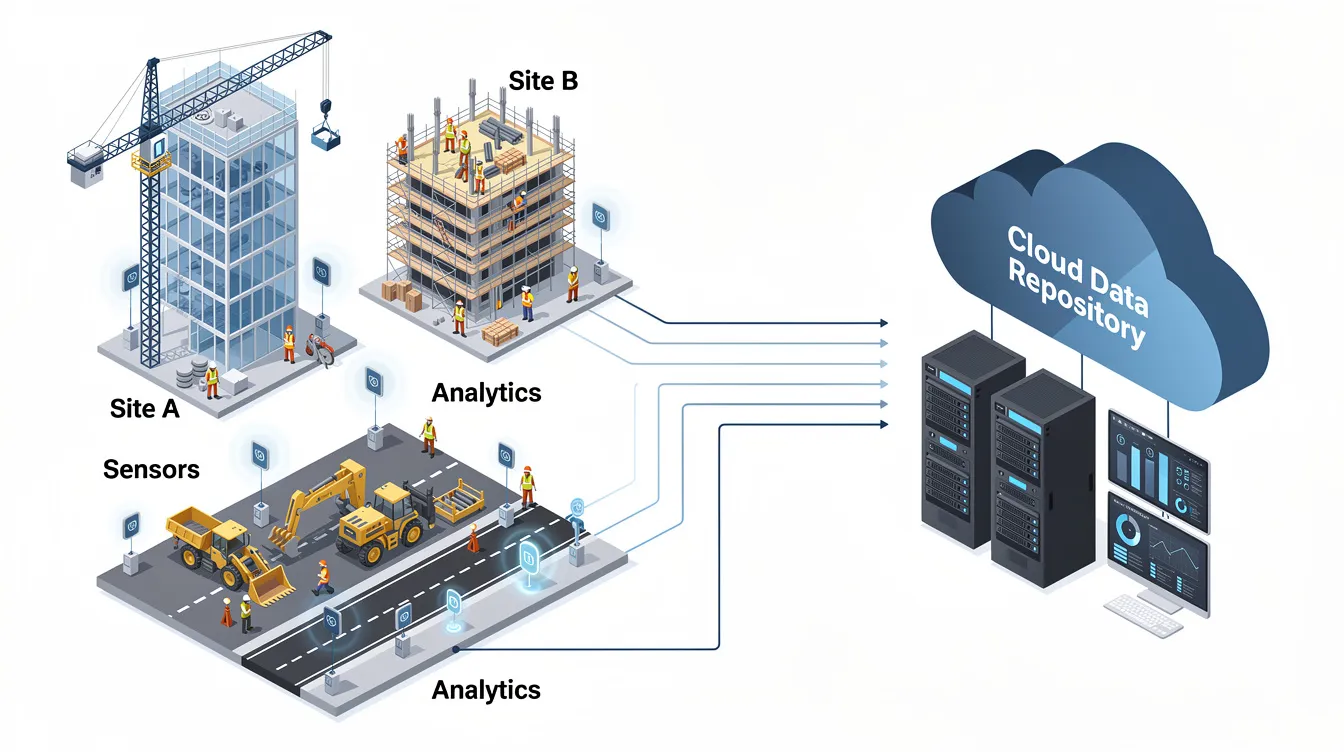
Construction companies operating across multiple sites face the challenge of synchronizing documentation from dispersed project offices, each with its own filing practices and access constraints. The organization’s context varies by site, and evidence must be traceable to specific locations and timeframes.
Solution: Establish cloud-based centralized repositories with site-specific access controls and mobile synchronization capabilities. Use API connectors to integrate project management platforms, HR systems, and subcontractor portals so documentation flows automatically into the ingestion pipeline. Set metadata requirements including project, location, date, subcontractor, and discipline to enable precise retrieval. Schedule regular refresh cycles to ensure the knowledge base reflects current site conditions.
Subcontractor Documentation Coordination
Subcontractors operate their own systems and often lack the capacity or motivation to maintain documentation to the principal contractor’s standards. ISO 45001 clause 8 requires operational controls extending to contractors, and relevant interested parties include subcontractor workers whose safety evidence must be captured.
Solution: Create standardized data exchange protocols specifying format, frequency, and required content for subcontractor safety onboarding and ongoing compliance. Deploy digital portals where subcontractors upload directly, with auto-validation checking field completeness, date stamps, and file legibility. The RAG system can then verify compliance of incoming documentation against required clauses and flag missing or non-compliant items for follow-up-turning a reactive scramble before audits into a managed, ongoing process.
ISO 45001 emphasizes employee participation and management support across the entire workforce, including subcontractor employees. Emergency preparedness and contractor risk management are critical in construction safety, and the RAG system should track evidence for both.
Conclusion and Next Steps
RAG systems offer heavy construction companies a realistic path to reducing ISO 45001 audit preparation time by 60–80%-from 160–240 work-hours down to 40–60 work-hours for a firm with multiple sites. Beyond time savings, the results achieved include improved compliance accuracy, better safety outcomes through proactive gap identification, and stronger evidence of the continual improvement that auditors and the international organization behind ISO standards expect to see. However, ISO 45001 certification does not guarantee better OHS results-the system must drive genuine improvements in workplace safety practice, not just documentation efficiency. Management reviews should include health and safety performance data to ensure technology investment translates to real risk reduction.
To move forward with practical implementation:
-
Audit current documentation systems across all sites and subcontractors-conduct a mock audit to identify where evidence is missing, fragmented, or inaccessible
-
Select a RAG platform suitable for construction workflows, evaluating its ability to ingest multiple formats, support mobile upload, include local regulatory corpora, and maintain audit trail features with human-in-loop review
-
Pilot on a single project site to validate processing accuracy, train safety officers on the system, and establish baseline metrics for your next audit
-
Scale across your construction portfolio, standardizing procedures and embedding the system into ongoing compliance monitoring rather than treating it as an audit-time tool
For organizations exploring related topics, consider how AI and emerging WSH technologies are reshaping construction safety, how risk management regulations are evolving, and what leadership commitment looks like when preparing for next ISO audit cycles. Multi-modal RAG integrating video, images, and audio-plus agentic RAG architectures with modular agents for hazard detection, training compliance, and incident summarization-represent the next frontier in identifying hazards and ensuring compliance at scale.
Additional Resources
-
RAG system vendor comparison checklist for construction safety applications-evaluate format ingestion capability, OCR quality, local regulatory corpus coverage, audit trail features, security, site-level access controls, and scalability across projects
-
ISO 45001 evidence mapping template aligned with heavy construction project phases-map each clause (6.1 through 10.2) to required evidence types, source locations, responsible parties, and review frequencies. ISO 45001 consulting support can help structure this mapping for your organization’s context
-
Sample ROI calculator for construction companies considering RAG implementation-factor in current audit prep hours, documentation team costs, non-conformity remediation expenses, insurance premium impacts, and the value of improved bidding competitiveness through demonstrated ISO compliance