
A temporary barricade around an opening may look adequate during a walk-through. But if it can be moved easily, leaves an unprotected edge during material handling, or is not suited to the work sequence, it is not controlling the risk. Engineering controls for site risks must work under real construction and industrial conditions – changing crews, tight programs, weather exposure, deliveries, maintenance, and simultaneous operations.
For project leaders, the value is direct: well-selected controls reduce reliance on individual behavior, make safe work easier to perform, and provide stronger evidence that foreseeable hazards have been addressed. They are not a substitute for planning, supervision, or competent workers. They are the physical and technical measures that make those systems more reliable.
Why engineering controls deserve early attention
The hierarchy of controls places elimination and substitution ahead of engineering measures. Where a hazard cannot be designed out or replaced with a safer method, engineering controls are generally more dependable than administrative rules and personal protective equipment. A guard, extraction system, interlocked gate, or edge-protection system does not depend solely on a worker remembering a procedure at the right moment.
That distinction matters on active sites. Administrative controls such as permits, toolbox talks, signs, and exclusion-zone instructions remain necessary, but they can weaken when schedules shift or several trades work in the same area. PPE limits exposure but does not remove the source of danger. Engineering measures act on the hazard, its energy, or the path between the hazard and the person.
The strongest approach is to consider controls during design, tender planning, and method development rather than after an incident or inspection finding. Retrofitting a control is often more expensive, can disrupt production, and may force teams into a short-term workaround that creates new risks.
Start with the hazard and the work sequence
A control should never be selected because it is familiar or because it was used on the last project. Begin with a task-specific assessment: what can cause harm, who may be exposed, when exposure occurs, and what changes as the work progresses? A concrete-pouring operation, for example, may involve falls from edges, movement of plant, hose whip, manual handling, wet surfaces, and interaction with adjacent trades. One generic control will not manage all of those risks.
The work sequence is equally important. A fixed barrier that protects workers during one activity may obstruct emergency access or material movement during the next. A dust enclosure may be effective until penetrations are left open for cables and ducts. Site teams need to identify these transition points before work begins and assign responsibility for reinstating controls when they are removed or altered.
Consider four practical questions during planning:
- Can the hazard be eliminated through a different design, construction method, or prefabricated component?
- Can workers be separated from the hazard by distance, containment, guarding, or physical segregation?
- Can the energy be isolated, limited, or automatically stopped when unsafe conditions arise?
- Can the control remain effective through installation, use, inspection, maintenance, and dismantling?
These questions keep the discussion focused on actual risk reduction rather than purchasing equipment for compliance optics.
Common engineering controls for site risks
Falls, openings, and work at height
Collective fall-prevention systems are usually preferable to measures that protect only one person at a time. Properly designed edge protection, secured covers for floor openings, working platforms, scaffold guardrails, and safety nets can prevent a fall or reduce its consequences across a work area. Their effectiveness depends on correct loading capacity, attachment, dimensions, access arrangements, and inspection after modification or severe weather.
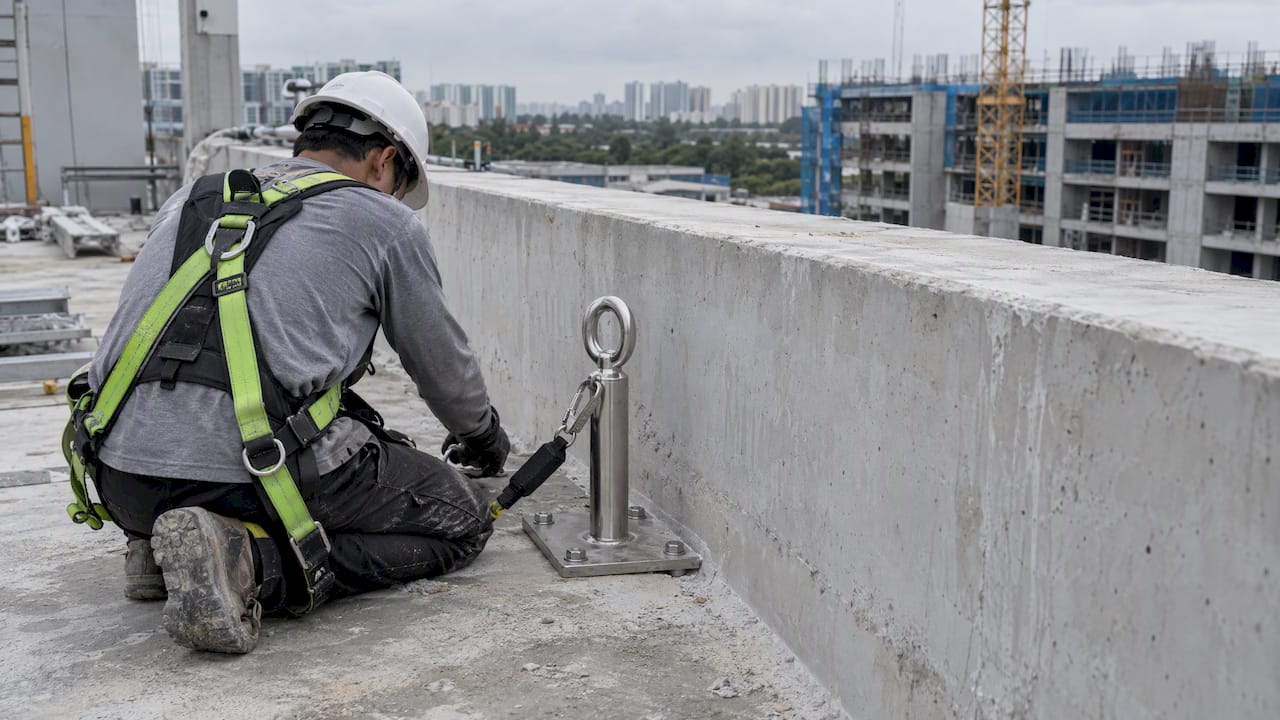
Not every location can accommodate the same solution. A permanent parapet may be viable in one design, while a temporary edge-protection system is needed in another. Where personal fall arrest is unavoidable, the anchor arrangement, clearance distance, rescue plan, and compatibility of components must be planned as a complete system. Calling a harness an engineering control would overstate its role; it is PPE supported by an engineered anchorage arrangement.
Plant, vehicles, and people
Vehicle-pedestrian interaction remains one of the most serious site risks because visibility, reversing, noise, and time pressure can combine quickly. Physical segregation is more reliable than asking pedestrians and operators to remain alert. Examples include designated walkways protected by barriers, separate access gates, fixed loading zones, wheel stops, and purpose-designed crossing points.
Plant-side measures can also reduce exposure. Cameras, proximity detection, speed-limiting devices, reversing alarms, and interlocks have value, but they should not be treated as a replacement for traffic design. Technology can assist an operator; it cannot compensate for a poorly organized delivery route with workers regularly walking through blind spots.
Dust, fumes, noise, and airborne contaminants
Controlling contaminants at the source is central to occupational hygiene. Local exhaust ventilation, on-tool extraction, wet-cutting methods, enclosed transfer systems, and negative-pressure enclosures can reduce what enters the breathing zone. The key is matching the measure to the contaminant and task. A general fan may disperse dust rather than capture it, while an enclosure without adequate airflow may give a false sense of protection.
Noise control follows the same principle. Select lower-noise equipment where feasible, isolate noisy equipment, use acoustic barriers, and maintain machinery so vibration and noise do not increase over time. Hearing protection may still be required, but it should be the final layer, not the entire plan.
Machinery, electrical systems, and stored energy
Machine guarding, interlocked access panels, emergency stops, fixed enclosures, and lockable isolation points protect workers from moving parts and energy release. Controls must be appropriate for normal operation, cleaning, adjustment, and maintenance. Guards are sometimes removed because they slow production or make access difficult. That is a design and usability problem worth resolving, not a reason to normalize unsafe work.
Electrical risk can be reduced through protected distribution boards, suitable cable routing, ground-fault protection where required, equipment enclosures, and clear isolation arrangements. Water, temporary power, damaged cords, and frequent relocations make construction environments particularly demanding. Inspection and maintenance need to be built into the control strategy.
Verify performance, not just installation
A control is not complete when it is installed. It must be inspected, tested where applicable, and verified during the work it was intended to protect. Site leaders should ask whether workers can bypass it, whether it introduces access or ergonomic issues, and whether its condition has changed since the last inspection.
Verification should include competent-person checks, documented inspections, corrective-action tracking, and observation of actual work practices. For higher-risk controls, acceptance criteria should be clear before use. This may include load ratings, airflow performance, guard integrity, electrical test results, or confirmation that a segregation route remains unobstructed.
Inspection records matter for audit readiness, but records alone do not prove effectiveness. A signed checklist cannot compensate for a damaged barrier, blocked extraction intake, or missing machine guard. Supervisors need authority to stop work when a critical control has failed and a practical route to restore it quickly.
Manage change before controls are compromised
Construction sites change constantly. A new subcontractor, revised lifting plan, added penetration, extended work hours, or altered access route can make an existing control inadequate. Change management should therefore trigger a review whenever work methods, equipment, layout, materials, or interfaces change materially.
This does not require unnecessary paperwork for every minor adjustment. The level of review should reflect the risk. However, changes affecting fall protection, lifting operations, temporary works, hazardous substances, electrical isolation, or traffic management deserve formal assessment and communication before implementation.
A practical control register can help project teams track critical measures, their locations, inspection frequency, responsible persons, and conditions for removal. It also gives EHS managers and project leaders a focused basis for site audits: not merely whether documentation exists, but whether the controls identified in risk assessments are present and functioning.
Build controls into the project, not around it
Effective engineering controls require coordination among designers, project managers, supervisors, subcontractors, and workers. Design for Safety reviews can identify opportunities to eliminate hazards before the site is mobilized. During construction, method statements, permits, inspections, and toolbox communication should explain how each critical control is used, protected, and maintained.
MOSAIC supports construction and industrial organizations in translating risk assessments and regulatory obligations into practical controls, inspection processes, and site documentation. The goal is not to over-engineer every task. It is to apply proportionate, reliable measures that protect people while keeping operations workable.
The best test is simple: when the schedule tightens and the site becomes busy, does the control still prevent exposure? If the answer is uncertain, review the design with the people doing the work before uncertainty becomes an incident.