Process safety management, formally codified under OSHA’s 29 CFR 1910.119 standard, is a regulatory and operational framework designed to prevent catastrophic releases of hazardous chemicals that can cause mass casualties, facility-wide damage, or large-scale evacuations. It is not a general workplace safety program. For safety professionals, compliance officers, and construction stakeholders managing sites that handle flammable gases, toxic substances, or highly reactive materials, PSM represents the most rigorous and consequential tier of safety obligation. This article breaks down every dimension of the framework, from applicability criteria to the 14 core elements, so you can apply it with precision.
Table of Contents
- Key Takeaways
- What is process safety management and when it applies
- The 14 elements of PSM explained
- How PSM differs from general occupational safety
- Lifecycle application of PSM in construction and industrial settings
- My perspective on where PSM implementation actually fails
- How MOSAIC Safety supports your PSM compliance
- FAQ
Key Takeaways
| Point | Details |
|---|---|
| PSM addresses catastrophic risk | The framework targets chemical releases causing mass casualties, not routine personal injuries like slips or cuts. |
| OSHA thresholds determine applicability | Coverage triggers when processes involve highly hazardous chemicals at or above listed threshold quantities. |
| 14 integrated elements form the system | Each element connects to the others; a gap in one, such as incomplete process safety information, degrades the entire system. |
| Process safety and occupational safety are distinct | A facility can have excellent injury statistics and still be critically exposed to major chemical incident risk. |
| Lifecycle management is non-negotiable | PSM must govern every phase from design through decommissioning, not just active operations. |
What is process safety management and when it applies
Process safety management, known as PSM, is a systematic approach to managing the hazards associated with processes involving highly hazardous chemicals (HHCs). OSHA’s standard 29 CFR 1910.119 establishes the regulatory baseline, covering any process that involves an Appendix A chemical at or above its listed threshold quantity, or that involves a Category 1 flammable gas or liquid with a flashpoint below 100°F at quantities of 10,000 pounds or more.
Understanding whether your operation falls under PSM coverage is not a passive exercise. Consider a construction project involving large-scale ammonia refrigeration for a cold-storage facility build. If the ammonia inventory at that site exceeds 10,000 pounds, PSM compliance is mandatory. The same logic applies to construction-adjacent industrial processes involving chlorine, hydrogen fluoride, or other Appendix A chemicals.
Several conditions and exemptions matter in practice:
- Retail facilities are explicitly exempt, even when handling otherwise covered chemicals.
- Oil or gas well drilling and servicing operations are excluded from PSM coverage.
- Normally unoccupied remote facilities may qualify for modified requirements.
- Threshold quantities apply per process, not per facility-wide aggregate, meaning a single covered process triggers the entire standard.
- Flammable liquids stored in atmospheric tanks below their normal boiling point are exempt from the flammable threshold calculation.
For construction organizations operating as contractors on facilities subject to PSM, the contractor management element of the standard directly governs their obligations, including pre-task training on process hazards and incident reporting protocols.
Pro Tip: Never assume PSM does not apply simply because construction is the primary activity. If your scope involves tie-ins, maintenance, or modifications to covered processes, you are operating within a PSM-regulated environment and must comply with host employer obligations.
The 14 elements of PSM explained
OSHA’s PSM framework is structured around 14 interrelated elements that collectively form a management system for catastrophic hazard control. They are not a checklist. They function as an interdependent architecture, and weak links in process safety information cascade directly into faulty hazard analysis, flawed operating procedures, and compromised mechanical integrity.
- Process Safety Information (PSI): Documentation of hazardous chemical properties, process technology (P&IDs, design basis), and equipment specifications. This is the foundational element. Every other analytical and operational element depends on its accuracy.
- Process Hazard Analysis (PHA): Structured methodology, such as HAZOP, What-If, or Fault Tree Analysis, to systematically identify and evaluate hazards. PHAs must be revalidated every five years at minimum.
- Operating Procedures: Written, step-by-step instructions for all operating modes including normal operations, startup, shutdown, emergency shutdown, and temporary operations.
- Training: Operators must be trained on operating procedures and process hazards before assuming responsibilities. Refresher training is required every three years.
- Mechanical Integrity: Inspection, testing, and preventive maintenance programs for pressure vessels, piping, relief systems, controls, and emergency shutdown devices.
- Management of Change (MOC): Formal review and authorization process for any change to process chemicals, technology, equipment, or procedures. This element prevents unreviewed modifications from introducing new hazards.
- Pre-Startup Safety Review (PSSR): Verification that all safety systems are functional, documentation is complete, and training is current before starting or restarting a covered process.
- Incident Investigation: Systematic root-cause analysis of incidents and near-misses, with corrective action tracking and communication to affected employees.
- Emergency Planning and Response: Site-specific emergency action plans and coordination with local emergency responders.
- Compliance Audits: Verification that PSM program elements are in place and functioning correctly, conducted at least every three years.
- Employee Participation: Workers must be consulted in the development of PHAs and have access to PSM documents. Regulatory access to PHAs is a hard requirement, not a courtesy.
- Contractors: Host employers must inform contractors of known hazards, verify contractor safety programs, and review contractor safety performance before and during work.
- Trade Secrets: Employers must provide PSI to employees and their designated representatives even when trade secret protections apply, subject to confidentiality agreements.
- Incident Investigation Recordkeeping: All PHA findings, incident reports, audit results, MOC records, and training documentation must be retained for specified periods.
| Element | Core function | Common deficiency |
|---|---|---|
| Process Safety Information | Provides the factual foundation for all other elements | Outdated P&IDs and missing design basis data |
| Process Hazard Analysis | Identifies and evaluates process hazards | Overdue revalidations; superficial team reviews |
| Management of Change | Controls risk from process modifications | Incomplete close-out; verbal approvals without documentation |
| Mechanical Integrity | Maintains equipment reliability | Gaps in inspection frequency; deferred repairs |
| Incident Investigation | Drives learning and corrective action | Stopping at immediate cause without root-cause depth |
Pro Tip: PHA revalidation is one of the most frequently cited PSM deficiencies in OSHA enforcement actions. Build revalidation due dates into your facility’s asset management calendar, not just the safety department’s tracking sheet, to prevent the date from slipping.
How PSM differs from general occupational safety
The distinction between PSM and general occupational health and safety is not semantic. It is structural and consequential. General occupational safety programs address the hazards workers encounter daily: struck-by incidents, falls from elevation, electrical contact, ergonomic injuries. These are important and costly. PSM addresses something categorically different.
PSM targets catastrophic chemical release prevention, specifically the scenarios that cause multiple fatalities in a single event, require community evacuations, or destroy process infrastructure. The 1984 Bhopal disaster, the 1989 Phillips Petroleum explosion in Pasadena, Texas, and the 2005 Texas City refinery fire all represent the class of event PSM exists to prevent.
Consider these critical distinctions:
- General safety programs are designed to reduce injury frequency and severity for individual workers. PSM is designed to prevent low-probability, high-consequence events that can kill dozens or hundreds of people simultaneously.
- Occupational safety metrics like total recordable incident rate (TRIR) and lost-time injury frequency (LTIF) do not capture PSM performance. A plant can maintain excellent TRIR statistics while harboring the exact conditions that precede a catastrophic incident.
- Hazard control hierarchy in occupational safety often focuses on administrative controls and PPE. PSM emphasizes inherently safer design, engineering controls, and barrier-based protection at the process level.
This does not mean PSM and general safety operate in isolation. An integrated safety management system that encompasses both disciplines provides the most defensible protection. But conflating the two creates a dangerous blind spot: organizations that measure safety performance exclusively through injury statistics have no reliable signal that their PSM barriers are degrading.
Lifecycle application of PSM in construction and industrial settings
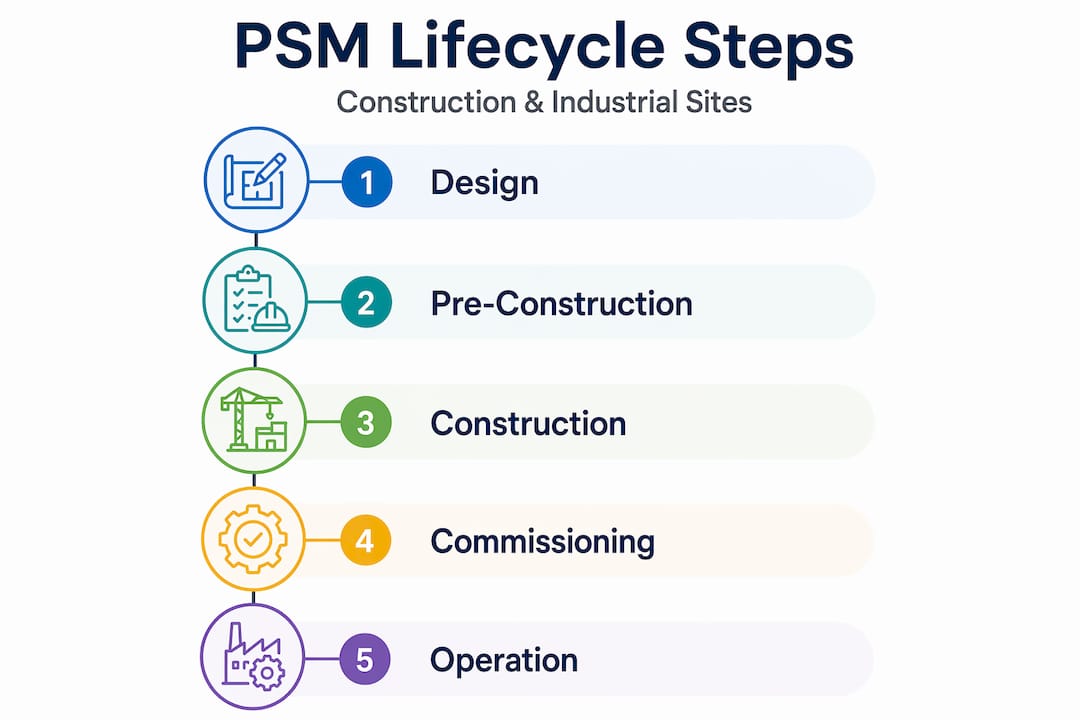
PSM is not a program you activate at commissioning and periodically audit. Effective process safety management spans the full lifecycle of a covered process: hazard identification during design, construction and fabrication verification, pre-startup validation, ongoing operations, planned and unplanned changes, temporary operations, shutdown, and ultimately decommissioning.
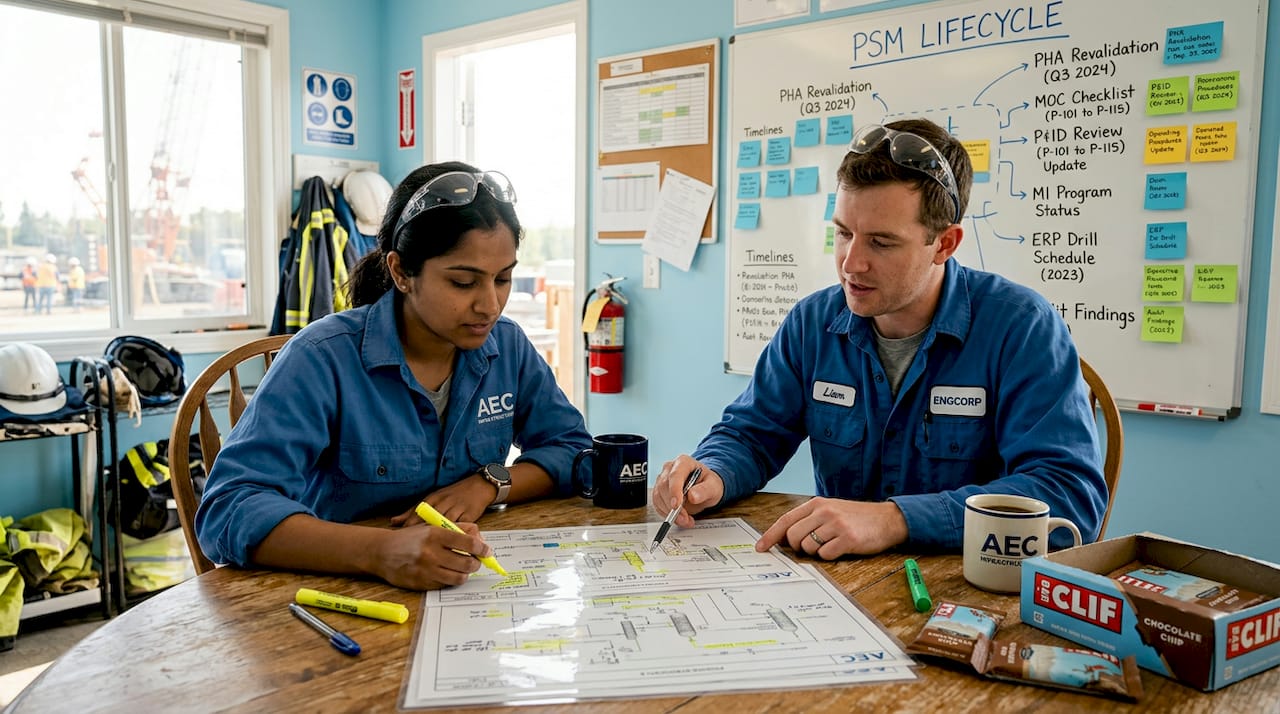
For construction organizations, the most consequential PSM touchpoints arise during the transitions between phases. The Management of Change and Pre-Startup Safety Review elements function as a paired safeguard: MOC governs the authorization of any change before it is implemented, and PSSR verifies that the change was executed correctly and that all barriers are functional before the process restarts. Skipping or shortcutting either one creates the precise failure mode that has preceded numerous major incidents.
Best practices for sustaining PSM across the lifecycle include:
- Maintaining living PSI documentation: P&IDs, material safety data, equipment specifications, and relief device sizing calculations must reflect the current state of the process at all times, not the original design.
- Structured employee involvement: Workers operating or maintaining covered processes possess observational knowledge that formal hazard analysis often misses. Structured participation in PHA reviews and MOC evaluations captures that knowledge systematically.
- Contractor integration: Construction contractors working within or adjacent to covered processes must receive site-specific hazard briefings and demonstrate comprehension before beginning work. Their incident data must be tracked and reviewed by the host employer.
- Documented training verification: Training completion records must demonstrate that each individual has understood the material, not merely attended a session. Competency verification is the standard.
- Audit-driven improvement cycles: Construction safety audit protocols applied to PSM elements should verify not just document existence but procedural adherence and barrier functionality.
| PSM lifecycle phase | Key activities | Primary PSM elements involved |
|---|---|---|
| Design and pre-construction | Hazard identification, inherently safer design | PSI, PHA, Contractor Management |
| Construction and fabrication | QC verification, contractor oversight | Mechanical Integrity, Contractor Management |
| Pre-startup | Safety review, documentation verification | PSSR, Training, Operating Procedures |
| Operations | Procedure adherence, equipment maintenance | Mechanical Integrity, MOC, Incident Investigation |
| Changes and modifications | Change authorization, impact assessment | MOC, PSSR, PSI update |
| Decommissioning | Hazard isolation, final documentation | Operating Procedures, PSI, Emergency Planning |
Pro Tip: The hazard identification process during early design is the highest-leverage point in the entire PSM lifecycle. Hazards eliminated at the design stage cost a fraction of what they cost to control through engineering or administrative measures later.
My perspective on where PSM implementation actually fails
I have worked with enough facilities and construction organizations to say with conviction that the failure mode in PSM is almost never technical. It is not that people lack knowledge of the 14 elements. The breakdown is organizational. Teams treat PSM as a discrete compliance program owned by the safety department rather than an operational discipline owned by everyone who touches the process.
In my experience, the most consequential gap is incomplete process safety information. When P&IDs are outdated, when relief device calculations are missing, or when material properties data has not been updated after a chemistry change, every subsequent element, including PHA, operating procedures, and mechanical integrity, is built on a flawed foundation. The errors compound silently until an incident makes them visible.
I have also seen incident investigation programs that close out findings with corrective actions that address symptoms rather than root causes. A valve fails, maintenance replaces it, and the investigation closes. Nobody asks why the inspection program did not catch the degradation before failure. The systemic vulnerability remains.
Getting real organizational buy-in requires framing PSM explicitly in terms of consequence scenarios, not compliance obligations. When leadership understands what a catastrophic release at their facility actually looks like, not in regulatory language but in operational and human terms, the priority shifts. That shift is what separates facilities that use PSM to prevent incidents from those that use it to respond to enforcement.
— Aman
How MOSAIC Safety supports your PSM compliance

Translating the 14 elements of PSM into a functioning, audit-ready program on an active construction or industrial site requires more than regulatory familiarity. It requires structured methodology, experienced personnel, and the capacity to maintain program integrity across every project phase. MOSAIC Safety provides construction organizations and industrial operators with the consultancy, audit support, training delivery, and specialized manpower services necessary to build and sustain compliant PSM programs.
MOSAIC Safety’s safety consultancy services cover gap assessments against PSM requirements, PHA facilitation, MOC system development, and PSSR preparation, serving clients from project conceptualization through commissioning. For organizations preparing for regulatory audits, the firm’s safety audit preparation guidance addresses PSM documentation standards, procedural verification, and deficiency remediation. Where site-level safety officer capacity is the constraint, outsourced safety manpower solutions provide qualified personnel with direct PSM program knowledge. Contact MOSAIC Safety to discuss your specific compliance requirements and operational context.
FAQ
What is PSM and who does it apply to?
Process Safety Management is OSHA’s regulatory framework under 29 CFR 1910.119 for preventing catastrophic releases of highly hazardous chemicals. It applies to any employer whose process involves covered chemicals at or above the applicable threshold quantity, including construction contractors working within PSM-regulated facilities.
How many elements does OSHA’s PSM standard include?
OSHA’s PSM program is structured around 14 integrated elements, including Process Safety Information, Process Hazard Analysis, Mechanical Integrity, and Management of Change, among others. Each element is interdependent, meaning a deficiency in one compromises the performance of the others.
Can a facility have good safety records but still fail at PSM?
Yes. A facility can have excellent injury statistics while harboring critical PSM deficiencies that create major incident risk. Occupational safety metrics and PSM performance are distinct measures that must be tracked and managed separately.
How often must process hazard analyses be revalidated?
OSHA requires PHA revalidation at intervals not exceeding five years. This revalidation must address the findings of prior PHAs, any incidents that have occurred, and any changes made to the process since the previous analysis.
What triggers PSM coverage for a construction project?
PSM coverage is triggered when a construction project involves, or connects to, a process containing a covered chemical at or above the threshold quantity. Contractors operating within host employer PSM programs must comply with the contractor management requirements of the standard regardless of their own independent regulatory status.
Recommended
- How to Build Site Safety Management System – MOSAIC Eco-construction Solutions Pte Ltd
- Hazard Identification Process Guide for Construction Safety
- Protecting Your People, Securing Your Projects: The Critical Importance of ConSASS – MOSAIC Eco-construction Solutions Pte Ltd
- Safety management systems: A complete guide for Singapore construction