Demystifying Risk Assessment: Why You Need a Professional WSH Consultant to Get It Right
Introduction to Workplace Safety
Workplace safety represents an absolute corporate priority globally today. Demystifying risk assessment remains essential for modern business success. A professional WSH consultant provides this critical operational expertise.1 Consequently, businesses can protect their valuable human capital effectively. Furthermore, regulatory bodies demand rigorous risk assessments across industries.2 Singapore’s Ministry of Manpower strictly regulates these vital safety practices.2 Therefore, businesses must conduct accurate risk assessments on a regular basis. ISO 45001 provides a robust international framework for these systems.3 Specifically, this standard integrates risk-based thinking throughout the management cycle.3 Thus, safety experts demystify complex regulatory requirements for corporate leaders. Additionally, consultants ensure complete compliance with constantly evolving safety laws.
The Core Principles of Risk Management
Risk management systematically identifies and evaluates dangerous workplace hazards.2 Subsequently, organizations must control these dangerous operational risks completely.2 It forms the essential cornerstone of an accident-prevention culture.2 Furthermore, strict legal regulations stipulate these critical risk assessment requirements.2 Specifically, this process applies equally to routine and non-routine operations.2 Routine operations include standard preparatory work and daily troubleshooting tasks.2 Conversely, non-routine operations involve complex commissioning, repair, and plant maintenance.2 Therefore, organizations must remain highly vigilant across all business functions. Ultimately, safety consulting ensures these systematic evaluations remain completely objective.1 A professional WSH consultant accurately demystifying risk assessment prevents tragedies.
Regulatory Frameworks and International Standards
Regulatory frameworks continually evolve to improve national workplace safety outcomes.4 As an employer, you must comply with strict national laws.5 A professional WSH consultant navigates these complex legislative frameworks expertly.1 They ensure strict adherence to the WSH Risk Management Regulations.5 Additionally, they monitor compliance with General Provisions and Auditing Regulations.5 Moreover, international standards elevate organizational safety protocols significantly worldwide. The SS ISO 45001 standard outlines occupational health management systems.5 Consequently, larger organizations pursue this prestigious certification for global recognition.3 ISO 45001 mandates risk assessments across the entire management cycle.3 Thus, demystifying risk assessment is crucial for achieving this certification.
The bizSAFE Certification Program
In Singapore, bizSAFE helps companies build critical workplace safety capabilities.5 All workplaces must conduct comprehensive risk assessments under WSH Regulations.5 Furthermore, bizSAFE Level 3 recognizes successfully implemented risk management systems.5 Achieving this requires engaging an accredited auditing organization for verification.5 Consequently, a professional WSH consultant prepares companies for these audits.6 They develop the mandatory Risk Management Implementation Plan meticulously.3 Furthermore, MOM strictly audits ISO 45001 compliance for specific sectors.7 For the metalworking industry, certification meets highly stringent audit criteria.7 Similarly, the shipyard sector utilizes ISO 45001 to ensure safety.7 Therefore, consultants are strictly necessary to navigate these complex standards.1
The Anatomy of an Effective Risk Assessment
How do organizations effectively identify and control dangerous workplace hazards? Primarily, the process involves a highly systematic operational site evaluation.8 Demystifying risk assessment requires following strictly established international safety methodologies.
| Regulatory Body | Core Assessment Steps Outlined | Primary Focus |
| MOM Singapore | Hazard Identification, Risk Evaluation, Risk Control | Strict legal compliance and hierarchical hazard mitigation |
| HSE United Kingdom | Identify, Decide, Evaluate, Record, Review | Comprehensive worker protection and continuous safety improvement |
The Singapore Ministry of Manpower Framework
Singapore requires three basic steps for absolute legal compliance.2 These primary steps include hazard identification, evaluation, and strict control.2 First, employers must accurately identify all potential workplace hazards.2 Second, they must analyze the risk level associated with hazards.2 Third, organizations must eliminate or reduce these evaluated risks.2 Furthermore, the strict hierarchy of control dictates proper mitigation strategies.2 A multidisciplinary team must conduct these critical risk assessments collaboratively.2 Specifically, this team should include management, engineers, and frontline supervisors.2 Moreover, production operators and technical safety staff provide crucial input.2 Ideally, the team leader possesses formal, accredited risk assessment training.2 Alternatively, organizations hire a professional WSH consultant for crucial oversight.2
The UK Health and Safety Executive Framework
The UK Health and Safety Executive outlines a five-step framework.9 Firstly, organizations must identify hazards by walking around the workplace.10 Secondly, they must decide exactly who might be harmed.10 Thirdly, organizations evaluate risks and establish necessary safety precautions.10 Fourthly, they must record findings and implement strict operational controls.10 Finally, they must review the assessment regularly to maintain efficacy.10 Demystifying risk assessment requires diligent adherence to these proven steps. A professional WSH consultant executes these steps with absolute precision. Consequently, workplaces become measurably safer and substantially more productive environments.
Detailed Hazard Identification Strategies
Many professionals fundamentally misunderstand the critical difference between hazards and risks.9 A hazard is literally anything with the potential to cause harm.9 Conversely, a risk calculates the actual chance of harm occurring.9 Specifically, risk combines probability with the potential severity of injury.9 Therefore, a professional WSH consultant accurately calculates these critical metrics.1 Demystifying risk assessment starts with incredibly thorough hazard identification protocols.
| Hazard Category | Practical Workplace Examples | Potential Harm |
| Physical Hazards | Trailing cables, moving machinery, uneven floors, heights | Slips, trips, falls, crushing injuries, fatalities |
| Chemical Hazards | Cleaning products, industrial solvents, toxic fumes, dust | Respiratory illness, chemical burns, severe allergic reactions |
| Biological Hazards | Deadly bacteria, contagious viruses, dangerous mould, sharps | Serious infections, infectious disease outbreaks, long-term sickness |
| Ergonomic Hazards | Poor workstation setup, repetitive manual tasks, heavy lifting | Musculoskeletal disorders, chronic joint pain, spinal injuries |
| Psychosocial Hazards | Severe stress, workplace bullying, long working hours | Mental health breakdowns, extreme fatigue, severe occupational burnout |
Firstly, physical hazards require careful and immediate visual evaluation.11 Furthermore, uneven floors pose significant tripping risks in retail environments.11 Additionally, working at height presents fatal fall dangers in construction.11 Secondly, chemical hazards demand rigorous scientific risk assessment protocols.11 Cleaning products and solvents are common examples requiring strict oversight.11 Moreover, toxic fumes and dust threaten respiratory health during manufacturing.11 Thirdly, biological hazards threaten healthcare workers and cleaners daily.12 Fourthly, ergonomic hazards destroy long-term physical worker health silently.11 Finally, psychosocial hazards affect mental health and workplace relationships deeply.12 A professional WSH consultant identifies all these hidden dangers expertly.
Risk Evaluation and Control Hierarchies
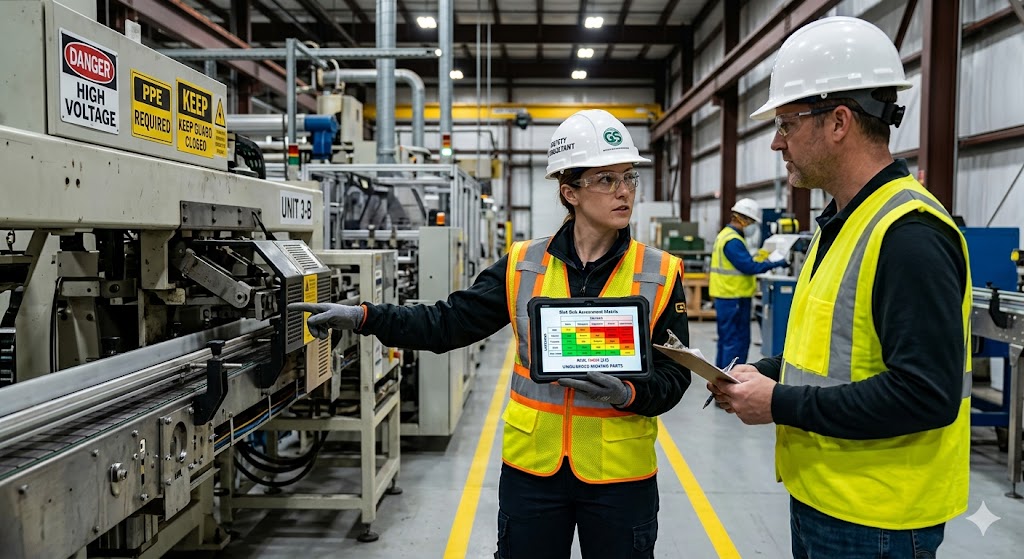
Once hazards are identified, meticulous risk evaluation must follow immediately.13 You must decide how likely it is that harm occurs.13 Additionally, you must evaluate how serious that resulting harm could be.13 This systematic process determines the exact level of operational risk.13 A professional WSH consultant utilizes advanced scoring systems for accuracy. Demystifying risk assessment relies heavily on these objective scoring matrices.
Subsequently, organizations must control the risks using established strategic hierarchies.13
| Control Strategy | Implementation Method | Effectiveness Level |
| Elimination | Redesigning the job to remove the hazard entirely | Most Effective |
| Substitution | Replacing dangerous materials, machinery, or processes | Highly Effective |
| Engineering | Isolating people from the hazardous work process entirely | Moderately Effective |
| Administrative | Organising work schedules to reduce dangerous hazard exposure | Less Effective |
| Personal Protective Equipment | Providing safety gear and ensuring strict worker compliance | Least Effective |
Too often, organizations jump straight to personal protective equipment solutions.14 This completely ignores more effective control options higher up the hierarchy.14 Consequently, hazards remain fundamentally uncontrolled within the physical work environment. Therefore, hiring a professional WSH consultant mitigates these critical errors.1 They ensure engineering and administrative controls are thoroughly explored first. Demystifying risk assessment ensures optimal protection for every vulnerable worker.
Common Risk Assessment Mistakes and Procedural Failures
Many organizations fail to conduct proper risk assessments despite strict regulations.15 Consequently, these systemic failures often lead to severe workplace accidents.16 Understanding these pitfalls is crucial for demystifying risk assessment effectively. A professional WSH consultant recognizes and eliminates these dangerous errors.
| Assessment Mistake | Description of Procedural Failure | Consultant’s Strategic Solution |
| Working in Isolation | Completing assessments without vital input from operational staff | Facilitating collaborative workshops with experienced frontline workers |
| Vague Language | Using highly ambiguous descriptions like ‘tall’ or ‘high’ | Employing precise, measurable, and highly specific technical terminology |
| No Action Plan | Failing to produce clear follow-up actions after assessment | Creating prioritized, actionable steps with assigned responsible personnel |
| Poor Version Control | Circulating multiple conflicting versions of safety documents | Implementing centralized digital registers and strict document management |
| Ignoring Near Misses | Overlooking incidents that did not result in immediate injuries | Investigating all near misses to identify hidden root causes |
One major mistake is conducting the risk assessment in isolation.15 A collaborative approach yields significantly better long-term workplace safety outcomes.14 Furthermore, companies frequently fail to involve their experienced frontline employees.17 These dedicated workers understand the practical, daily hazards of tasks.17 Therefore, excluding them severely compromises the integrity of the assessment.
Another common error involves using vague or highly ambiguous language.14 Risk assessments require clear, specific, and immediately actionable terminology.14 Additionally, failing to create a follow-up action plan is disastrous.14 A risk assessment without implementation achieves absolutely nothing for safety.14 Moreover, some companies neglect non-obvious hazards during their site evaluations.17 Ergonomic strain and long-term chemical exposure pose severe operational risks.17 Psychosocial hazards, including excessive workload and bullying, also require mitigation.12
Furthermore, poor version control creates dangerous confusion among safety teams.14 Multiple versions of a risk assessment circulate, causing conflicting safety instructions.14 Furthermore, organizations often neglect ongoing safety training for their staff.18 It is never enough to conduct safety training only once.18 Additionally, delaying critical machinery maintenance and inspections creates immense danger.19 Broken machines pose a significant risk for employees operating them.19 A professional WSH consultant aggressively prevents all these common mistakes.
Consultants Versus Internal WSH Officers
Organizations often confuse the specific roles of WSH Officers and Consultants.1 Demystifying risk assessment requires understanding these distinct professional safety designations. A WSH Officer operates as a specific legal role internally.1 They oversee daily safety on designated high-risk construction or manufacturing sites.1 Conversely, a WSH Consultant operates as an independent, external safety expert.1 Consultants provide high-level strategic advice and conduct objective external audits.1 Furthermore, they develop overarching safety management systems for corporate entities.1
The duties of an internal WSH Officer are heavily regulated legally.6 They chair the internal risk assessment team and investigate workplace accidents.6 Additionally, they coordinate statutory safety training for all active workers.6 However, the professional WSH consultant provides the overarching strategic framework.1 Consultants act as regulatory liaisons with government agencies during inspections.1 Therefore, a synergistic relationship between officers and consultants maximizes safety.6
Financial Implications of Workplace Accidents
Workplace accidents impose catastrophic human and financial costs globally today.20 In Singapore, work-related injuries cost an estimated SGD 10.45 billion.21 Astoundingly, this massive figure represented approximately 3.2% of national GDP.21 Furthermore, employers directly bore roughly SGD 2.31 billion of this cost.21 Consequently, failure to manage risk aggressively threatens corporate financial stability.22 Demystifying risk assessment reveals the true economic cost of negligence.
The Occupational Safety and Health Administration provides highly compelling economic data.22 OSHA states injuries cost United States employers $1 billion weekly.22 Furthermore, lost productivity costs companies roughly $63 billion annually.22 Injuries and illnesses drive up workers’ compensation and retraining expenses.22 Ultimately, company executives must recognize their duty to protect workers.23 It is highly unethical to risk someone’s life to save money.23 Therefore, a professional WSH consultant is an essential financial safeguard.
Regulatory Penalties and Composition Fines
The Ministry of Manpower imposes severe penalties for regulatory non-compliance.24 For instance, failing to conduct risk assessments incurs significant composition fines.24 These immediate composition fines generally range from $1,000 to $5,000.24 Moreover, missing safety signage results in fines up to $2,000.24 Additionally, inadequate personal protective equipment provision costs up to $3,000.24 Multiple violations discovered during a single inspection compound financial penalties rapidly.24 A workplace with five breaches could face $25,000 in immediate fines.24 Since June 2022, minimum composition fines doubled to $2,000 per lapse.25
Court Prosecutions and Maximum Fines
For serious or repeat offences, authorities prosecute under the WSH Act.24 Consequently, court-imposed penalties are significantly higher than standard composition fines.24 Specifically, maximum fines increased from $20,000 to $50,000 in 2024.25 Demystifying risk assessment helps organizations avoid these crippling legal penalties.
| Offence Category | Target Offender | Maximum Financial Penalty | Maximum Imprisonment |
| First Conviction under Act | Individual | $200,000 fine | 2 years |
| Repeat Offender under Act | Individual | $400,000 fine | 2 years |
| First Conviction under Act | Corporate Body | $500,000 fine | N/A |
| Repeat Offender under Act | Corporate Body | $1,000,000 fine | N/A |
Furthermore, ignoring official Stop Work Orders incurs monumental financial penalties.26 Fines can reach $500,000 alongside additional daily continuing financial penalties.26 Specifically, this includes an extra $20,000 for each day of continued offence.26 Additionally, causing death by negligence carries severe, life-altering legal consequences.24 Offenders face fines up to $500,000 and two years of imprisonment.24 Therefore, corporate leaders must engage a professional WSH consultant immediately.27 They ensure absolute compliance, protecting the company from total ruin.
New SAFE Measures and MAST Interventions
Regulatory frameworks continually evolve to improve national workplace safety outcomes.4 Singapore actively introduced Safety Accountability, Focus and Empowerment (SAFE) measures.4 These SAFE measures aggressively target sectoral, company, and worker accountability levels.4 Specifically, the Multi-Agency Workplace Safety and Health Taskforce drives implementation.28 MAST enforces highly coordinated action across higher-risk industrial business sectors.28 Consequently, Singapore’s workplace fatal injury rate fell to 0.96.28 This record low places Singapore among the safest countries globally.28
In 2025, MAST introduced enhanced safety measures for higher-risk machinery.29 Furthermore, combustible dust hazards received updated, stringent regulatory oversight parameters.29 These specific hazards pose a significant risk of catastrophic fire.29 For example, the 2021 Stars Engrg explosion highlighted these exact dangers.29 Consequently, the WSH Act Fifth Schedule expanded to include more machinery.29 Manufacturers and suppliers must now ensure all equipment is rigorously tested.29 Installers must ensure modifications never compromise the safe use of machinery.29 Therefore, a professional WSH consultant remains indispensable for navigating these updates.1 Demystifying risk assessment requires constant vigilance regarding these new laws.
Mandatory Video Surveillance Systems (VSS)
Technological advancements now play a massive role in demystifying risk assessment. Video surveillance systems became completely mandatory in June 2024.30 Construction projects exceeding $5 million in contract value must install VSS.30 Furthermore, VSS must monitor all designated high-risk work locations continuously.31 These specific areas include deep excavation sites and heavy lifting zones.31 Confined spaces and active vehicular traffic areas also require constant monitoring.32 Moreover, industrial vehicle operating zones require strict surveillance camera coverage.31 A professional WSH consultant ensures these systems are installed legally.
Technical Specifications for Video Surveillance
The technical requirements for these surveillance systems are extremely strict.30 Consequently, non-compliance with technical specifications triggers immediate regulatory enforcement actions.33 Failure to comply may result in a fine of $20,000.33
| Technical Requirement | Specification Mandated by MOM |
| Video Resolution Standard | Minimum HD 1080 (1920×1080 pixels) |
| Recording Frame Rate | Minimum 12 frames per second |
| Acceptable File Formats | .avi,.mp4, or common multi-media containers |
| Mandatory Data Overlays | Date stamp, time stamp, and accurate camera ID |
Remote monitoring deters unsafe workplace behaviors highly effectively and consistently.34 Professional safety consultants seamlessly guide companies through these complex technical requirements.1 Furthermore, they ensure surveillance implementation respects operational efficiency and legal boundaries.1 Thus, demystifying risk assessment involves embracing new digital monitoring technologies.
Case Studies in Catastrophic Industrial Accidents
Historical industrial accidents underscore the absolute necessity of robust risk management.20 Demystifying risk assessment prevents these horrific tragedies from occurring again. In 2020, a catastrophic explosion absolutely devastated Beirut, Lebanon completely.20 This horrific tragedy killed roughly 300 people and displaced thousands.20 Furthermore, it highlighted massive, systemic failures in hazardous material identification.20 Similarly, a Texas fertilizer plant explosion in 2013 caused immense devastation.20 These global events prove that risk assessment directly prevents systemic failures.20
Closer to home, construction falls frequently cause severe, life-altering injuries.16 One notable Singapore case involved a fatal formwork structure collapse tragically.16 The basic cause was a failure to identify completely incompatible activities.16 Additionally, the risk assessment lacked crucial hazard control mitigation measures.16 Furthermore, adequate supervision was fundamentally absent during the dangerous operational work.16 Proper professional WSH consultant oversight reliably prevents such completely avoidable tragedies.1
Another tragic case involved a worker falling 22 feet fatally.35 OSHA cited the employer for egregious willful violations of safety laws.35 The employer previously failed to provide required fall protection for workers.35 Consequently, the employer faced severe legal and financial repercussions immediately.35 Therefore, demystifying risk assessment is quite literally a matter of survival.
Preventing Accidents Through Proactive Measures
Conversely, effective safety interventions drastically reduce industrial injury rates globally.36 The UK Health and Safety Executive documents numerous successful intervention case studies.36 For example, an oil company successfully protected ankles and prevented slips.36 They achieved this by introducing highly specialized, risk-assessed protective footwear.36 Similarly, a food processor cut slip accidents by two-thirds easily.36 They utilized a logical, consultant-driven approach to physical hazard mitigation.36 A professional WSH consultant delivers these precise, highly effective safety interventions.
Furthermore, investigating near misses prevents future catastrophic accidents from occurring.6 Neglecting near misses represents a massive failure in risk management strategy.19 A near miss indicates a fundamental breakdown in operational hazard controls.15 Therefore, investigating all non-injury incidents is absolutely critical for safety. Professional WSH consultants excel at analyzing these subtle warning signs.6 They identify root causes and implement robust, preventative corrective actions immediately.6
The Incredible ROI of Safety Consulting
Hiring a professional WSH consultant yields highly substantial financial returns.37 Investing in workplace safety is never just a legal compliance burden. Instead, it represents a highly profitable strategic corporate business advantage.23 OSHA studies indicate that safety programs deliver excellent long-term financial returns.22 For every $1 invested, companies can save up to $6 eventually.22 These immense savings stem from drastically reduced occupational illnesses and injuries.22 Consequently, safety investments directly and positively improve the corporate bottom line.22
Furthermore, consultants optimize safety interventions for maximum organizational financial impact.38 They successfully lower insurance premiums and reduce operational downtime significantly.38 Insurance premium reductions of 10% to 25% are entirely achievable.38 For instance, saving 15% on a $500,000 premium yields $75,000 annually.38 Over five years, this equates to $375,000 in pure operational savings.38 A professional WSH consultant pays for themselves through these massive savings.
Additionally, Bridge Learning Platform provided a powerful safety ROI case study.39 One client saw a 57% reduction in dangerous accidents and incidents.39 They achieved this simply by implementing professional online safety courses.39 Demystifying risk assessment through proper training generates massive financial returns. Ultimately, establishing measurable benchmarks over time demonstrates the tremendous value of safety.22
Building a Resilient Safety Culture
Management commitment is absolutely critical for successful risk management programs.40 Safety must be a stated priority backed by highly visible action.40 Companies succeed when executives actively participate in safety training sessions.40 Furthermore, integrating safety into performance reviews drastically improves overall results.40 A professional WSH consultant facilitates this essential cultural shift within organizations.38
Additionally, employee engagement dramatically lowers workplace accident and injury rates.40 Companies with active worker participation achieve injury rates 50% below average.40 Workers closest to the hazards possess the best insights for prevention.40 Therefore, consultants establish formal mechanisms to capture this vital employee input.40 They deploy hazard reporting systems and facilitate regular safety committee meetings.40 Consequently, safety transforms from a burden into a shared organizational responsibility.38 Demystifying risk assessment empowers every worker to take ownership of safety.
Digital Visibility and SEO for Safety Consultants
Professional safety consultants must maintain incredibly strong digital market visibility.41 Consequently, search engine optimization drives sustainable business growth for consulting firms.41 Offering risk assessment services requires highly targeted SEO keyword strategies.42 For instance, consultants frequently target phrases like “workplace safety consultant”.43 Demystifying risk assessment online requires a deep understanding of digital marketing.
Moreover, safety content represents “Your Money or Your Life” (YMYL) topics.44 Therefore, search engines scrutinize safety advice extremely closely for accuracy.44 Flawed safety information puts people at massively increased risk of harm.44 Consequently, Google demands absolute expertise, authoritativeness, and trustworthiness in safety content. A professional WSH consultant provides this verifiable, high-quality technical expertise naturally.
Transition Words and Content Readability
Transition words fundamentally improve content readability for these highly technical topics.45 Yoast SEO guidelines emphasize the critical importance of transition words.45 When you do not use transition words, texts become difficult to understand.45 Furthermore, poor readability severely compromises your search engine ranking potential.45
| SEO Transition Type | Yoast Approved Example Words | Strategic Purpose in Safety Writing |
| Addition | additionally, also, moreover, furthermore | Expanding on complex safety concepts |
| Cause and Effect | because, hence, since, consequently, therefore | Explaining accident root causes clearly |
| Contrast | although, besides, however, conversely, nevertheless | Comparing differing operational risk levels |
| Emphasis | above all, certainly, indeed, specifically, notably | Highlighting critical legal safety rules |
| Time | afterward, before, subsequently, presently, meanwhile | Sequencing accident investigations logically |
Words like “additionally” and “furthermore” structure complex safety arguments clearly.46 Consequently, readers understand the exact relationship between the presented ideas.45 A professional WSH consultant utilizes these tools to educate the public. Demystifying risk assessment requires exceptionally clear, structured, and readable communication.
Managing SEO Risk in the Safety Sector
Interestingly, digital marketing involves its own form of risk assessment.42 Identifying potential SEO risks prevents catastrophic losses in digital visibility.42 Competitor actions, technical issues, and algorithm updates threaten search engine rankings.42 Furthermore, over-optimized anchor text patterns raise massive algorithmic red flags.47 Therefore, just as safety consultants mitigate physical risks, they mitigate digital ones.47
| SEO Risk Category | Potential Impact on Consulting Business | Digital Mitigation Strategy |
| Algorithmic Risk | Sudden drop in organic search traffic rankings | Diversify keyword targeting thoroughly and consistently |
| Technical Risk | Crawl anomalies and broken website links | Conduct regular technical SEO site audits |
| Content Risk | Outdated safety regulations on the website | Update content with latest WSH laws |
| Competitive Risk | Competitors bidding aggressively on branded terms | Monitor market share and brand visibility |
Ultimately, robust SEO ensures companies find highly qualified safety experts quickly.48 If a construction firm needs an ISO 45001 audit urgently, visibility matters.1 Consequently, a professional WSH consultant must track key performance indicators constantly.49 They monitor conversion rates, technical metrics, and high-value ranking positions.49 This dual expertise in workplace safety and digital presence guarantees success.50
Continuous Improvement and Review Protocols
A risk assessment is never a static, one-time paperwork exercise.9 Environments evolve rapidly as new equipment and processes are continually introduced.17 Consequently, regulations mandate strict, regular reviews of all risk assessments.3 Demystifying risk assessment highlights the absolute necessity of continuous organizational improvement.
Singapore law requires a comprehensive review at least every three years.3 Furthermore, assessments must be reviewed immediately following any accident or incident.3 Additionally, changes in work processes trigger mandatory, immediate risk reassessments.3 If new information about a hazard emerges, controls must be updated.3 ISO 45001 also requires risk assessments to be reviewed constantly.3 This review forms a critical part of the core management cycle.3
A professional WSH consultant manages this continuous review cycle seamlessly.1 They ensure documents never suffer from poor version control issues.14 Furthermore, they verify that implemented controls remain effective over long periods.14 They adjust administrative and engineering controls as the physical worksite evolves. Ultimately, this dedication to continuous improvement fosters a resilient safety culture.9
Conclusion
Demystifying risk assessment is absolutely essential for modern corporate survival today. Workplace safety mandates rigorous, professionally guided hazard identification and control protocols.2 Navigating complex compliance frameworks definitely demands highly specialized, dedicated consultant expertise.1 Furthermore, failing to identify operational hazards causes catastrophic human and financial losses.21
Alternatively, effective safety management reliably delivers highly positive, measurable financial returns.22 A professional WSH consultant lowers insurance premiums and massively boosts productivity. By adhering to strict standards, organizations protect their most valuable human assets.3 They avoid devastating legal penalties, composition fines, and severe court prosecutions.24 Therefore, proactive business leaders must prioritize professional workplace safety consultations immediately.37 Ultimately, workplace safety represents a highly strategic investment securing future operational success.
Works cited
- Comprehensive Guide to WSH Consultant Singapore Services – ProSkill Workforce Pte Ltd, accessed May 30, 2026, https://proskillworkforce.com/wsh-consultant/
- Risk management – MOM, accessed May 30, 2026, https://www.mom.gov.sg/workplace-safety-and-health/safety-and-health-management-systems/risk-management
- Risk Assessment Example: A Practical Guide for Singapore Workp…, accessed May 30, 2026, https://sageshield.com/risk-assessment-example-singapore-workplaces/
- Safety Accountability, Focus and Empowerment (SAFE) measures – MOM, accessed May 30, 2026, https://www.mom.gov.sg/workplace-safety-and-health/safe-measures
- About Risk Management, accessed May 30, 2026, https://www.tal.sg/wshc/topics/risk-management/about-risk-management
- Workplace Safety and Health Officer Singapore: Roles, Duties and Hiring Guide, accessed May 30, 2026, https://sageshield.com/wsh-officer-singapore-guide/
- Requirements for a safety and health management system – MOM, accessed May 30, 2026, https://www.mom.gov.sg/workplace-safety-and-health/safety-and-health-management-systems/safety-and-health-management-system-requirements
- Risk Assessment for a Safe Workplace (Code of Practice on WSH Risk Management) | Siso, accessed May 30, 2026, https://www.siso.edu.sg/product/309
- The 5 Steps to Risk Assessment: HSE Framework Explained (UK 2026) – KeyOstas, accessed May 30, 2026, https://keyostas.co.uk/5-steps-to-risk-assessment/
- INDG163 – Five steps to risk assessment, accessed May 30, 2026, https://www.aber.ac.uk/en/media/departmental/healthsafetyenvironment/riskassessment/indg163(v2).pdf
- What are the 5 stages of risk assessment? – Praxis42, accessed May 30, 2026, https://praxis42.com/resources/health-and-safety/5-stages-of-risk-assessment/
- What are the five steps to risk assessment? | TUC – Trades Union Congress, accessed May 30, 2026, https://www.tuc.org.uk/guidance/what-are-five-steps-risk-assessment
- Risk assessment: Steps needed to manage risk – HSE, accessed May 30, 2026, https://www.hse.gov.uk/simple-health-safety/risk/steps-needed-to-manage-risk.htm
- Common Risk Assessment Mistakes | Notify Technology, accessed May 30, 2026, https://www.notifytechnology.com/ten-common-risk-assessment-mistakes-and-how-to-avoid-them/
- 12 Common Risk Assessment Mistakes, and How to Avoid Them – Work Wallet, accessed May 30, 2026, https://www.work-wallet.com/blog/12-common-risk-assessment-mistakes-and-how-to-avoid-them/
- Case_Studies_of_Accidents_Inv, accessed May 30, 2026, https://www.tal.sg/wshc/-/media/TAL/Wshc/Resources/Publications/Case-Studies/Files/Case_Studies_of_Accidents_Involving_Working_at_Heights.pdf
- Top 10 Risk Assessment Mistakes Businesses Make (and How to Avoid Them), accessed May 30, 2026, https://unitedsafetypro.com/blog_/top-10-risk-assessment-mistakes-businesses-make-and-how-to-avoid-them/
- 5 common safety mistakes and how to avoid them – APS, accessed May 30, 2026, https://www.aps.org.uk/news-post/safety-spotlight-5-common-safety-mistakes-and-how-avoid-them
- 5 Common workplace safety mistakes and how to avoid them – BLR, accessed May 30, 2026, https://blr.com/resources/5-common-workplace-safety-mistakes-and-how-to-avoid-them/
- Risk Assessment for Industrial Accident Prevention – UNECE, accessed May 30, 2026, https://unece.org/sites/default/files/2024-06/2325788_E_ECE_CP.TEIA_45_WEB_0.pdf
- Economic Cost of Work-related Injuries and Ill-health in Singapore – ResearchGate, accessed May 30, 2026, https://www.researchgate.net/publication/259220728_Economic_Cost_of_Work-related_Injuries_and_Ill-health_in_Singapore
- How Safety Programs Improve Workplace Efficiency & ROI | CBIZ, accessed May 30, 2026, https://www.cbiz.com/insights/article/how-safety-programs-can-improve-your-bottom-line-property-casualty
- THE RETURN ON INVESTMENT FOR SAFETY, HEALTH, AND ENVIRONMENTAL (OSH) MANAGEMENT PROGRAMS NOTICE – ASSP, accessed May 30, 2026, https://www.assp.org/docs/default-source/standards-documents/assp-ohsms-roi_2020-version.pdf
- Workplace Safety Fines in Singapore: MOM Penalties and How to Avoid Them, accessed May 30, 2026, https://sageshield.com/workplace-safety-fines-mom-singapore/
- Action against errant companies – MOM, accessed May 30, 2026, https://www.mom.gov.sg/workplace-safety-and-health/safe-measures/action-against-errant-companies
- WSH Act: liabilities and penalties – MOM, accessed May 30, 2026, https://www.mom.gov.sg/workplace-safety-and-health/workplace-safety-and-health-act/liabilities-and-penalties
- Roles and Responsibilities under the Workplace Safety and Health Act – Dentons Rodyk, accessed May 30, 2026, https://dentons.rodyk.com/en/insights/alerts/2023/february/16/roles-and-responsibilities-under-the-workplace-safety-and-health-act
- 0325 WSH Report 2025 – Singapore – MOM, accessed May 30, 2026, https://www.mom.gov.sg/newsroom/press-releases/2026/0325-wsh-report-2025
- Enhanced Safety Measures for Higher-Risk Machinery and Combustible Dusts from 1 January 2025 – MOM, accessed May 30, 2026, https://www.mom.gov.sg/newsroom/press-releases/2024/1129-enhanced-safety-measures-for-higher-risk-machinery-and-combustible-dusts-from-1-january-2025
- Video surveillance system (VSS) for construction sector – MOM, accessed May 30, 2026, https://www.mom.gov.sg/workplace-safety-and-health/safe-measures/sectoral-level/video-surveillance-system-for-construction-sector
- A Complete Guide to Video Surveillance Systems (VSS) for Construction Worksites in Singapore – SCAL Academy, accessed May 30, 2026, https://scal-academy.com.sg/courses/course_detail/VSS-Guide
- FAQs for video surveillance system (VSS) for construction worksites with contract value of $5 million and above – MOM, accessed May 30, 2026, https://www.mom.gov.sg/-/media/mom/documents/safety-health/faqs-for-vss.pdf
- [ Video Surveillance System Requirement ] Workplace Safety & Health (General Provisions) (Amendments No. 2) Regulations – Redas, accessed May 30, 2026, https://redas.com/wp-content/uploads/2025/10/Video-Surveillance-System-Requirement-Workplace-Safety-Health-General-Provisions-Amendments-No.-2-Regulations-2024.pdf
- New WSH Measures from 1 June 2024: Increase in Maximum Fines, Mandatory Video Surveillance Systems for Relevant Construction Projects | Rajah & Tann Asia, accessed May 30, 2026, https://www.rajahtannasia.com/viewpoints/new-wsh-measures-from-1-june-2024-increase-in-maximum-fines-mandatory-video-surveillance-systems-for-relevant-construction-projects/
- Worker falls 22 feet to death, 4 months after OSHA cites employer for failing to protect workers on the same job site | U.S. Department of Labor, accessed May 30, 2026, https://www.dol.gov/newsroom/releases/osha/osha20160801-2
- Case studies – HSE, accessed May 30, 2026, https://www.hse.gov.uk/slips/casestudies.htm
- Safety Consulting & Audits: Mock OSHA Inspections + Programs – OccuPros, accessed May 30, 2026, https://occupros.com/safety-consulting/
- McDonald’s 500% Safety Participation Increase: What Happens When Systems Talk, accessed May 30, 2026, https://www.scratchie.com/post/safety-recognition-integration-mcdonalds-donesafe-case-study
- How to Boost Safety on Construction Sites With Bridge’s All-in-One Learning Platform, accessed May 30, 2026, https://www.getbridge.com/blog/lms/boosting-safety-on-construction-sites-bridge-learning-platform/
- Building Cost-Effective Safety Program: Calculating ROI – SafetyPro Resources, accessed May 30, 2026, https://www.safetyproresources.com/blog/building-cost-effective-safety-program-calculating-roi
- Improve your search engine rankings | business.gov.au, accessed May 30, 2026, https://business.gov.au/online-and-digital/business-website/improve-your-search-engine-rankings
- Contingency Planning For SEO Campaigns – Meegle, accessed May 30, 2026, https://www.meegle.com/en_us/topics/project-contingency/contingency-planning-for-seo-campaigns
- Hire best Employment Law in Vadodara – Connect Instantly – Truelancer, accessed May 30, 2026, https://www.truelancer.com/employment-law-freelancers-in-vadodara
- What Is YMYL & How Does It Affect SEO? – Semrush, accessed May 30, 2026, https://www.semrush.com/blog/ymyl/
- Transition words check – Yoast SEO Features, accessed May 30, 2026, https://yoast.com/features/transition-words/
- Transition words: why and how to use them – Yoast, accessed May 30, 2026, https://yoast.com/transition-words-why-and-how-to-use-them/
- SEO Risk – A Strategic Framework for Prevention, Diagnosis & Recovery, accessed May 30, 2026, https://www.clickrank.ai/top-seo-risks/
- How To Assess A Prospect’s SEO Needs | Straight North, accessed May 30, 2026, https://www.straightnorth.com/blog/how-assess-prospect-s-seo-needs/
- The Complete Website Migration Checklist [SEO-Friendly] – Semrush, accessed May 30, 2026, https://www.semrush.com/blog/website-migration-checklist/
Transforming Patient Experience: Health Web Science Meets Medicine 2.0, accessed May 30, 2026, http://patient-centered-it.com/2014/03/22/transforming-patient-experience-health-web-science-meets-medicine-2-0/