

Contractor safety management is far more than signing off on documentation before work begins. Across construction and heavy industry, project developers and safety managers routinely mistake administrative compliance for genuine protection, and the consequences of that assumption are measurable in injuries, project delays, and liability exposure. Research drawn from analysis of over 13,000 contractors reveals that only 26% of contractors are both compliant and mature in safety performance simultaneously, a statistic that reframes the entire discipline. This guide examines what contractor safety management actually entails, how to screen and oversee contractors with precision, and why culture maturity must sit alongside regulatory compliance at every stage.
Table of Contents
- Key takeaways
- What contractor safety management really means
- Contractor screening: beyond the lowest bid
- Operational oversight: managing safety in the field
- Digital platforms and continuous performance tracking
- Legal duties and shared accountability
- My take on contractor safety maturity
- How MOSAIC can strengthen your contractor safety program
- FAQ
Key takeaways
| Point | Details |
|---|---|
| Compliance is not enough | Only 26% of contractors meet both compliance and safety maturity standards, leaving significant gaps in protection. |
| EMR is a screening tool | An Experience Modification Rating above 1.25 should trigger mandatory corrective action before any contract award. |
| Digital platforms improve oversight | Integrating field-level data with centralized safety controls enables real-time hazard intervention rather than retrospective reporting. |
| Stop-work authority is contractual | Contract language must explicitly grant on-site personnel the right to halt work when safety violations are observed. |
| Maturity metrics reveal hidden risk | Leading indicators such as worker empowerment and management commitment expose safety gaps that lagging data consistently conceals. |
What contractor safety management really means
Contractor safety management is the structured system through which a hiring organization identifies, selects, orients, supervises, and continuously evaluates contractors to protect workers and project assets throughout the duration of an engagement. It is not a single document or a one-time induction. It operates across the full project lifecycle, from initial prequalification through final project closeout, and it distributes responsibility deliberately between the hiring organization and the contracted entity.
The core program elements of any functioning contractor safety management system include:
- Prequalification and screening: Evaluating contractor safety performance records, certifications, and incident histories before awarding work.
- Onboarding and site induction: Orienting contractors to site-specific hazards, emergency protocols, and behavioral expectations.
- Active supervision: Conducting regular field inspections, safety observations, and real-time hazard conversations during work execution.
- Permit-to-work controls: Applying structured authorization processes for high-risk tasks such as confined space entry, hot work, and work at height.
- Incident management and corrective action: Investigating near-misses and incidents to identify root causes and prevent recurrence.
- Performance monitoring and closeout review: Tracking leading and lagging safety indicators throughout the contract and formally reviewing outcomes.
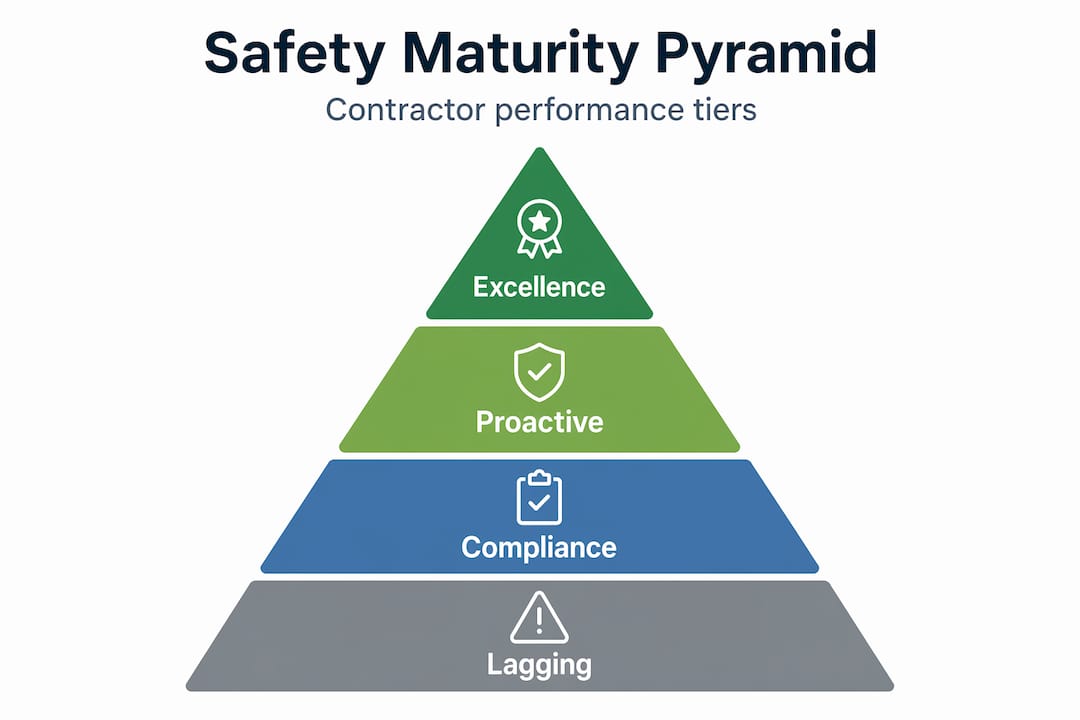
A distinction that often escapes project teams is the difference between compliance and maturity. Compliance means a contractor has satisfied the minimum regulatory requirements. Maturity means the contractor has internalized safety as an organizational value and demonstrates it through management commitment, worker empowerment, and continuous improvement. Traditional safety metrics fail to reveal true safety maturity, which is why risk management now requires evaluation tools that measure culture alongside administrative documentation.
Under OSHA’s multi-employer worksite policy, the controlling employer bears liability even for hazards created by contractors operating on the same site. That regulatory reality makes contractor oversight not a best practice but a legal obligation for every project owner and general contractor.
Pro Tip: Review your contractor safety management guide annually against current regulatory updates, and specifically verify that your prequalification criteria capture both compliance documentation and leading indicators of safety culture before each contract cycle.
Contractor screening: beyond the lowest bid
Selecting contractors based solely on cost or schedule availability is one of the most consequential errors a project developer can make. Choosing contractors by availability or lowest bid increases safety risks and creates ethical and legal exposure for the hiring organization. Rigorous screening, by contrast, identifies contractors who not only carry the right credentials but have demonstrated that their safety systems hold up under real operational pressure.

The Experience Modification Rating, commonly referred to as EMR, is the most widely used quantitative screening benchmark in the construction sector. An EMR of 1.0 represents the industry average; values above that indicate a claims history worse than the norm. Industry guidance for 2026 recommends that an EMR above 1.25 should require a written corrective action plan from the contractor before any contract is awarded, along with documented proof of progress against that plan.
The contrast between high-performing and average contractors is instructive. Leading construction firms treat EMR as a genuine operational metric rather than a pre-qualification formality. As a current benchmark, F.H. Paschen achieved a 0.70 EMR during 2025 to 2026, well below the industry average, driven by disciplined risk control protocols and a documented culture of worker accountability. That gap between 0.70 and 1.25 is not incidental. It reflects organizational decisions about training investment, supervision ratios, and incident reporting culture.
The following table illustrates the practical decision framework for EMR-based contractor screening:
| EMR Range | Risk Interpretation | Required Action |
|---|---|---|
| Below 0.85 | Demonstrated safety excellence | Standard prequalification approval |
| 0.85 to 1.00 | At or near industry average | Approve with standard oversight plan |
| 1.01 to 1.25 | Elevated risk; monitoring required | Enhanced supervision and safety audits |
| Above 1.25 | High risk; corrective action required | Written corrective plan before contract award |
EMR alone, however, captures only historical lagging data. Prequalification that examines leading indicators of safety culture, including management commitment, supervisor competency, and worker empowerment programs, provides a more complete picture of what to expect when that contractor is operating on your site. Reviewing a contractor’s approach to site safety management systems during prequalification adds a further structural dimension to that assessment.
Pro Tip: When evaluating contractor experience, request documented evidence of safety stand-downs, toolbox talks, and corrective actions taken over the previous 24 months. This behavioral evidence reveals safety culture more reliably than certificates alone.
Operational oversight: managing safety in the field
Effective contractor safety management does not end at the site gate. The transition from pre-contract screening to active field oversight is where the most significant protection gaps tend to develop, particularly on complex sites with multiple contractor tiers operating simultaneously. A structured operational oversight framework addresses this through five interconnected mechanisms.
-
Site-specific inductions: Every contractor and subcontractor entering the site should complete an induction that covers site-specific hazards, emergency evacuation procedures, reporting protocols, and behavioral expectations. Generic corporate inductions do not substitute for location-specific briefings. A structured subcontractor safety onboarding checklist provides the operational scaffolding for this process.
-
High-risk work permits: Permit-to-work systems impose a formal authorization layer on activities with elevated injury potential. Permits require hazard identification, control verification, and supervisor sign-off before work begins, and they create an auditable record of hazard management decisions.
-
Tiered supervision: Supervision intensity should scale with task risk. Routine operations may need periodic inspection. High-risk confined space work or work at height may require continuous supervisor presence. Supervision is most effective when it includes genuine safety conversations rather than observation only.
-
Stop-work authority: Every worker on site must understand they have the authority and the expectation to halt operations when an unsafe condition is observed. This authority should be communicated explicitly during induction and reinforced by supervisors throughout the project.
-
Safety stand-downs and training interventions: When persistent hazards are identified, proactive stand-downs provide an opportunity to address behavior and conditions before an incident occurs. March Construction’s fall prevention stand-downs demonstrate how pausing work to discuss hazards directly reduces ladder misuse and fall-related incidents on active jobsites. Proactive safety engagement of this nature is now recognized as one of the most cost-effective risk reduction interventions available to site management.
Pro Tip: Integrate a formal stop-work authority acknowledgment into your site induction sign-off process. When workers physically confirm they understand and are empowered to stop work, utilization of that authority increases measurably.
Digital platforms and continuous performance tracking
The administrative model of contractor safety management, characterized by annual document reviews, static compliance checklists, and post-incident reporting, has reached the limits of its effectiveness. Organizations that continue to rely solely on periodic audits are operating with a significant temporal blind spot. By the time lagging data surfaces a problem, the conditions that caused it have often persisted for weeks or months.
Digital safety tracking platforms address this by connecting field-level observations with centralized project controls in near real-time. The operational advantage is substantial. Platforms that integrate field-level safety data with centralized controls allow safety managers to adjust training programs and hazard interventions based on live site conditions rather than static annual plans.
The following table illustrates the functional difference between traditional and digital safety management approaches:
| Capability | Traditional approach | Digital platform approach |
|---|---|---|
| Hazard identification | Periodic site walks | Real-time mobile reporting |
| Incident trend analysis | Monthly or quarterly | Continuous with automated alerts |
| Contractor performance tracking | Annual EMR review | Dynamic dashboards with leading indicators |
| Training gap identification | Post-incident or audits | Predictive, based on behavioral data |
| Management review cycle | Annual or biannual | Ongoing with triggered reviews |
The most successful contractor safety programs use these platforms not as reporting tools but as intervention engines. When field data reveals a pattern, whether it is a concentration of near-misses in a particular work zone or repeated PPE non-compliance by a specific contractor, the platform enables targeted corrective action before a recordable event occurs. That shift from reactive to predictive safety management represents the defining operational advantage of mature digital programs.
Legal duties and shared accountability
The legal framework governing contractor safety management in most jurisdictions places explicit, non-delegable duties on hiring organizations. Under OSHA’s multi-employer worksite rules, the controlling employer is liable for hazards that exist on the site regardless of which contractor created them, provided the controlling employer knew or could reasonably have known about the condition. This standard applies irrespective of contract language that attempts to transfer all safety responsibility downstream to subcontractors.
Understanding shared accountability requires recognizing the distinct duty layers that operate simultaneously on any construction project:
- Owners and developers carry the highest-order duty to select competent contractors, specify safety requirements in contract documents, and verify that safety systems are in place and functioning.
- General contractors and principal contractors are responsible for site-wide hazard coordination, contractor supervision, and maintaining a safe common working environment.
- Subcontractors and specialist contractors are responsible for their own workers, their own work methods, and their compliance with site safety rules and applicable regulations.
- All parties share a duty to report identified hazards, cooperate with incident investigations, and support corrective action processes.
Contract language is the legal mechanism through which these duties are formalized and enforced. Contract language must explicitly empower on-site personnel with stop-work authority and should include financial disincentives, such as penalties or contract termination provisions, for safety violations. Contracts that lack these clauses create enforcement ambiguity that experienced contractors will exploit. Beyond liability, the ethical dimension is straightforward. Organizations that prioritize safety competence in contractor selection and oversight protect workers who have no direct relationship with the project owner but whose safety is nonetheless the owner’s responsibility.
My take on contractor safety maturity
I’ve reviewed contractor safety programs across a range of project types and regulatory jurisdictions, and the pattern that consistently emerges is this: organizations that anchor their contractor oversight to lagging metrics alone, specifically Total Recordable Incident Rates and EMR, are measuring the aftermath of safety failure rather than its precursors. Relying solely on lagging safety indicators can mask the underlying culture issues that will eventually produce a serious incident.
What I’ve found actually works is treating contractor safety management as a continuous assessment process rather than a procurement gate. The contractors who perform best over the duration of a project are those who arrive already equipped with worker empowerment practices, supervisor accountability structures, and an organizational reflex toward hazard reporting. You see that maturity in the first week of site mobilization. No EMR score tells you that directly.
The integration of digital field tools and human accountability mechanisms is not optional for programs that aspire to industry-leading performance. Technology surfaces the data; culture determines what you do with it. My recommendation is to invest as much deliberate effort in developing contractor safety culture as you invest in pre-qualification documentation. The documentation tells you where a contractor has been. Culture tells you where they are going.
— Aman
How MOSAIC can strengthen your contractor safety program
For safety managers and project developers operating within Singapore’s regulatory framework, translating contractor safety management principles into audit-ready, compliant programs requires specialized expertise and locally calibrated tools. MOSAIC Ecoconstruction Solutions provides precisely that.

MOSAIC’s safety audit tools are designed specifically for Singapore construction compliance requirements, providing structured audit examples that identify contractor safety gaps before they become incidents or regulatory findings. The team supports organizations across prequalification framework design, safety culture assessments, BizSAFE certification support, and ongoing contractor performance monitoring. Whether you are building a contractor safety management guide from the ground up or strengthening an existing program, MOSAIC offers the technical depth and regulatory alignment to accelerate that process. Contact MOSAIC to discuss how their audit methodology and consultancy services can close the gap between your current contractor oversight practice and genuine safety maturity.
FAQ
What is contractor safety management?
Contractor safety management is the structured system an organization uses to screen, onboard, supervise, and evaluate contractors to protect workers and reduce project risk throughout the contract period.
Why is compliance alone insufficient for contractor safety?
Analysis of over 13,000 contractors found that only 26% were both compliant and safety-mature, meaning the majority of compliant contractors still carried significant unaddressed safety culture risks.
What EMR score should disqualify a contractor?
An EMR above 1.25 is considered high risk and should require a written corrective action plan with documented progress before any contract is awarded.
What should contractor safety contracts include?
Contracts should explicitly grant stop-work authority to on-site personnel and include financial penalties or termination provisions for safety violations to make enforcement practically and legally enforceable.
How do digital platforms improve contractor safety oversight?
Digital platforms connect real-time field observations with centralized safety controls, enabling safety managers to identify hazard trends and deploy targeted interventions before a recordable incident occurs rather than after.