Singapore’s construction sector operates under one of the most rigorous workplace safety and health statutory frameworks in Southeast Asia, yet a persistent misconception undermines how firms approach compliance: the assumption that safety consultancy is simply another form of training. A BizSAFE-focused safety consultancy typically supports the implementation of a workplace safety and health capability framework and associated risk management plans, rather than merely delivering classroom instruction. This article systematically addresses what safety consultancy actually involves, how it interfaces with BizSAFE and ISO certification pathways, and what construction firms and project managers must understand to apply it effectively.
Table of Contents
- Defining safety consultancy in Singapore construction
- Core functions of safety consultants: From risk management to certification
- BizSAFE and ISO pathways: Compliance tips every firm should know
- How safety consultants support documentation and ongoing compliance
- Why the real challenge of safety consultancy is cultural alignment, not just paperwork
- Next steps: Connect with safety experts for your Singapore construction project
- Frequently asked questions
Key Takeaways
| Point | Details |
|---|---|
| Consultancy is not training | Safety consultancy delivers operational guidance, not just classroom instruction. |
| Supports compliance | Consultants help firms achieve BizSAFE and ISO certification by structuring evidence and processes. |
| Risk management focus | Effective consultancy centers on structured risk assessment and continual improvement for workplace safety. |
| Official recognition is key | Only regulatory audits formally grant BizSAFE or ISO status, not consultancy alone. |
| Cultural alignment matters | True safety comes from a risk-aware team and leadership, not just consultant paperwork. |
Defining safety consultancy in Singapore construction
Safety consultancy, in the context of Singapore’s construction industry, is a hands-on, operationally driven discipline that goes well beyond scheduling lectures or administering competency assessments. A qualified safety consultant embeds within a firm’s operational processes to apply risk management principles directly to construction activities, site conditions, and organizational workflows. The distinction between consultancy and training is not merely semantic; it is structural. Training equips individuals with knowledge. Consultancy transforms how an organization functions.
The operationalization of risk management within safety consultancy involves reviewing existing hazards and work processes, structuring appropriate controls and records, and preparing the audit submissions required for BizSAFE applications. This is precisely the work that separates a certified consultant from a course facilitator. For construction firms navigating Singapore’s compliance landscape, understanding this difference is the foundational prerequisite for selecting the right support.
Safety consultants operating in Singapore’s construction sector typically fulfill several discrete categories of function:
| Function | Description | Relevance to Certification |
|---|---|---|
| Hazard identification | Site and process-level hazard mapping | BizSAFE Level 3 and above |
| Risk management planning | Structuring risk registers and controls | BizSAFE, ISO 45001 |
| Documentation structuring | SOPs, audit artifacts, incident records | All certification levels |
| Audit preparation | Gap analysis and pre-audit readiness | BizSAFE Star, ISO 45001 |
| Regulatory alignment | Ensuring WSH Act and subsidiary compliance | Ongoing statutory compliance |
Key tasks that distinguish genuine safety consultancy from training-only engagements include:
- Developing and maintaining a firm’s risk register with documented hazard controls
- Structuring safety management systems aligned to effective WHS management systems requirements
- Conducting pre-audit walkthroughs and rectification support
- Reviewing Method Statements and Safe Work Procedures for regulatory compliance
- Facilitating incident investigation and corrective action documentation
- Supporting firms through the workplace safety guide cycle from initial assessment to certification submission
Pro Tip: Do not treat a safety consultant as a shortcut to certification. The formal BizSAFE and ISO processes remain mandatory and non-negotiable. A consultant’s value lies in ensuring your firm arrives at the official audit fully prepared, with documentation that accurately reflects your safety management reality.
Core functions of safety consultants: From risk management to certification
With the definitional foundation established, the specific functional contributions of safety consultants within Singapore’s construction compliance ecosystem warrant detailed examination. Consultants execute work across two primary domains: process alignment and documentation governance. Both are indispensable to achieving and maintaining BizSAFE Star status or ISO 45001 certification.

ISO 45001 certification requires that safety consultancies implementing occupational health and safety management systems align all organizational processes and documentation to the standard’s requirements, including leadership commitment, worker participation, hazard identification, legal compliance, and performance evaluation. This is not a one-time documentation exercise; it is a systematic realignment of how a firm approaches safety at every operational level.
The logical framework underpinning effective safety consulting is structured risk management logic: identify, analyze, evaluate, treat risks, then control, monitor, and improve. Each phase of this cycle generates documentation that simultaneously serves operational and compliance functions.
“Identify hazards, manage risks, continual improvement” is not a slogan for posters. It is the operational mandate that underpins every BizSAFE and ISO 45001 audit expectation, and consultants are responsible for translating that mandate into demonstrable, auditable evidence.
The numbered sequence below reflects how a competent safety consultant structures engagement with a construction firm pursuing certification:
- Initial gap analysis: Assess current safety management practices against BizSAFE or ISO 45001 requirements to identify deficiencies.
- Risk assessment framework development: Build or restructure the firm’s construction risk assessment process to satisfy statutory and certification criteria.
- Documentation architecture: Develop the full suite of required documents, including risk registers, control hierarchies, emergency response plans, and safe work procedures.
- Process integration: Embed safety controls into construction workflows, procurement processes, and subcontractor management systems.
- Internal audit facilitation: Conduct pre-certification audits to verify readiness and identify residual gaps before the formal certification audit.
- Corrective action management: Track and close all non-conformances identified during internal reviews or by external auditors.
- Continuous improvement planning: Establish review cycles and performance metrics that satisfy the safety management system guide requirements for ongoing compliance.
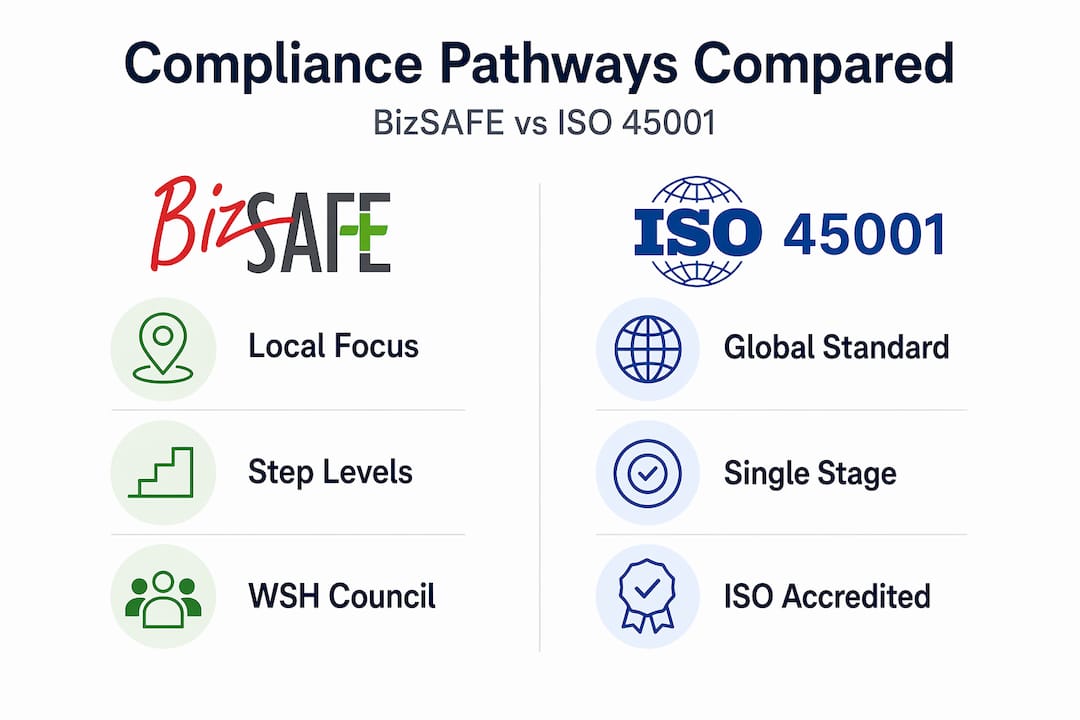
A key analytical comparison that construction managers should internalize distinguishes the scope of BizSAFE from ISO 45001:
| Dimension | BizSAFE (Levels 1 to Star) | ISO 45001:2018 |
|---|---|---|
| Scope | Singapore-specific WSH capability framework | International OHS management system standard |
| Regulatory body | Ministry of Manpower / WSH Council | International Organization for Standardization |
| Primary focus | Risk management plans and capability building | System-wide OHS integration and certification |
| Audit type | WSH Council-approved auditors | Third-party accredited certification bodies |
| Renewal cycle | Typically 3-year cycles for Star | Annual surveillance audits plus 3-year recertification |
| Consultant role | Supports RMP development and audit preparation | Aligns system documentation and process design |
Both pathways demand rigorous documentation and demonstrable process alignment. Consultants who understand both systems can facilitate dual-pathway strategies, enabling construction firms to achieve BizSAFE Star recognition while simultaneously pursuing ISO 45001 certification, thereby satisfying both domestic regulatory expectations and international client requirements.
BizSAFE and ISO pathways: Compliance tips every firm should know
Project managers who have attempted to navigate Singapore’s BizSAFE pathway without structured support frequently encounter the same category of problems: incomplete documentation, misaligned risk management plans, and poorly prepared audit submissions. These failures are not attributable to lack of effort; they reflect a structural gap between what firms believe is required and what auditors actually expect to see.
A critical compliance reality that every firm must internalize: external consultants cannot replace the formal regulatory and certification pathway. They support compliance and evidence submission for BizSAFE, but official recognition relies exclusively on formal audits conducted by WSH Council-approved auditors. Firms that misunderstand this distinction may invest heavily in consultancy while neglecting the mandatory formal steps, resulting in certification delays or outright failure.
Specific compliance considerations that safety consultants help firms address include:
- Regulatory timeline management: BizSAFE progression from Level 1 through to Star involves sequential capability-building steps with specific timelines. Consultants map these timelines against project schedules to ensure compliance milestones are met without disrupting operational delivery.
- Evidence structuring for audits: Auditors do not simply check whether documents exist; they verify that documents accurately reflect actual practice. Consultants align documentation to operational reality, preventing the common failure mode of paper compliance without practical implementation.
- Risk management plan quality: The Risk Management Plan is the cornerstone of BizSAFE Level 3 and above. Consultants ensure that risk registers are sufficiently granular, control measures are practical and verifiable, and residual risk ratings are defensible under audit scrutiny.
- ISO documentation coherence: ISO 45001 auditors apply clause-by-clause verification. Consultants familiar with ISO structure ensure that the documented system is internally coherent and that no clause requirements are orphaned from the operational evidence base.
- BizSAFE renewal preparedness: Firms that allow their BizSAFE status to lapse face reputational and contractual consequences. Consultants establish renewal cycles and maintain documentation currency to prevent lapses.
- Subcontractor compliance management: Main contractors bear regulatory responsibility for their subcontractors’ safety performance. Consultants help firms build subcontractor management frameworks that satisfy the compliance steps guide requirements.
Common pitfalls that consultants specifically help firms avoid include neglecting to update risk registers following scope changes, failing to maintain incident investigation records in formats acceptable to auditors, and submitting BizSAFE applications with risk control measures that are generic rather than activity-specific.
Pro Tip: Always reference the most current version of MOM and WSH Council regulatory guides when structuring compliance submissions. Regulatory requirements evolve, and consultants should be proactively monitoring changes to certification criteria on your firm’s behalf. Never assume that what passed in a previous audit cycle will satisfy the current standard.
How safety consultants support documentation and ongoing compliance
Documentation governance is frequently the dimension of safety consultancy that construction firms most underestimate. The instinct among project teams is to treat documentation as an administrative burden, a byproduct of the real work of building. In reality, within Singapore’s regulatory framework, the documentation is a primary evidence artifact, and its quality directly determines audit outcomes.
Consultants who operationalize risk management principles, review hazards, structure controls and records, and drive audit submissions are, in effect, functioning as the document architecture for a firm’s safety management system. This is not a peripheral role. For firms seeking BizSAFE Star or ISO 45001 status, documentation quality is frequently the primary differentiator between firms that achieve certification on first attempt and those that require multiple cycles.
The specific documentation support functions that safety consultants typically provide include:
- Risk register development and maintenance: Building granular, activity-specific risk registers that map hazards to control measures and residual risk ratings, updated continuously as project scope and conditions evolve.
- Safe Work Procedure (SWP) authorship: Drafting and reviewing SWPs for high-risk construction activities, ensuring alignment with the firm’s broader safety management system and construction safety standards.
- Incident and near-miss documentation: Structuring incident investigation records to capture root cause analysis, corrective actions, and systemic learning in formats acceptable to regulatory auditors.
- Emergency Response Plan (ERP) development: Creating site-specific ERPs that satisfy both MOM requirements and ISO 45001 clause 8.2 emergency preparedness obligations.
- Management review facilitation: Supporting the formal management review process required under ISO 45001, including agenda structuring, input compilation, and output documentation.
- Regulatory submission support: Preparing and reviewing the technical submissions required for WSH Act compliance, including notifications, permits, and audit evidence packages.
- Ongoing compliance monitoring: Establishing internal audit schedules, key safety performance indicators, and review triggers aligned with site safety tips and regulatory expectations.
- Design for Safety integration: For construction projects with DfS obligations, consultants coordinate with design for safety professionals to ensure that safety considerations embedded at the design stage are traceable through construction documentation.
The cumulative effect of structured documentation support is a safety management system that does not merely survive an audit but functions as an operational asset. Firms that invest in rigorous documentation governance find that their incident rates decrease, their subcontractor management improves, and their organizational capacity to respond to regulatory changes strengthens over time.
Why the real challenge of safety consultancy is cultural alignment, not just paperwork
Having mapped the operational and documentation functions of safety consultancy with precision, it is appropriate to acknowledge a dimension that technical guidance alone cannot fully resolve: the cultural imperative. Across Singapore’s construction sector, firms that achieve BizSAFE Star status or ISO 45001 certification exclusively through consultant-driven documentation exercises frequently discover that their safety performance plateaus, or deteriorates, once the immediate certification pressure subsides. The documentation exists. The audits are passed. The risk-management mindset does not persist at the operational level.
This is the fundamental limitation of externally driven safety compliance that the industry must confront. Consultants are indispensable partners in the certification process. They bring technical expertise, regulatory fluency, and documentation governance capacity that most construction firms cannot develop internally within the timeframes that certification requires. However, as effective risk management logic confirms, safety consulting must be rooted in continuous improvement, not quick fixes. Lasting compliance requires internal leadership commitment, not just external expertise.
The firms that extract the greatest long-term value from safety consultancy are those that treat the engagement as a capability transfer. They require their project managers, safety officers, and site supervisors to actively participate in risk register development, audit preparation, and corrective action management, rather than delegating these functions entirely to the consultant. The consultant’s role shifts from executor to coach, and the firm’s internal capacity grows proportionally.
The uncomfortable truth in Singapore’s construction compliance landscape is this: no certification endures beyond the organizational culture that sustains it. Firms that build internal risk-awareness alongside their external certification pursuit will outperform, on every safety metric, those that treat consultancy as a compliance outsourcing arrangement. Practical compliance advice consistently reinforces that the most resilient safety cultures are built through genuine internal engagement, not consultant-dependent documentation cycles.
Next steps: Connect with safety experts for your Singapore construction project
Safety consultancy, properly engaged, is the operational backbone of a construction firm’s certification and compliance strategy in Singapore. It structures risk management, governs documentation, and guides audit preparation with a rigor that internally resourced teams rarely achieve alone.

MOSAIC Ecoconstruction Solutions provides QES consultancy services specifically designed for Singapore’s construction sector, supporting firms through BizSAFE, ISO 45001, and statutory compliance requirements. Review safety audit examples to understand what audit readiness looks like in practice, and explore the environmental compliance guide to address the increasingly integrated QES requirements that project managers face. For firms seeking structured, expert-led support tailored to Singapore’s regulatory environment, contact Singapore safety consultants who understand both the technical and cultural dimensions of lasting compliance.
Frequently asked questions
Is safety consultancy required for BizSAFE or ISO certification in Singapore?
Safety consultancy is not mandatory, but it significantly strengthens a firm’s ability to meet the evidence and process requirements for BizSAFE and ISO certification, particularly for firms without dedicated internal safety management expertise.
What tasks do safety consultants handle for construction firms?
Consultants assist with risk assessment, hazard review, structuring controls, preparing documentation, and guiding audit preparation, operationalizing the full risk management cycle required for compliance.
Can consultants grant BizSAFE or ISO recognition directly?
No. Official certification comes exclusively from regulatory audits conducted by WSH Council-approved or ISO-accredited third-party auditors; consultants prepare firms for those audits but have no authority to grant certificates.
How does safety consultancy differ from safety training?
Safety consultancy delivers operational guidance, implements safety management systems, and structures compliance documentation, while training focuses primarily on individual knowledge acquisition in a classroom or structured learning setting, as established by consultancy practice.