
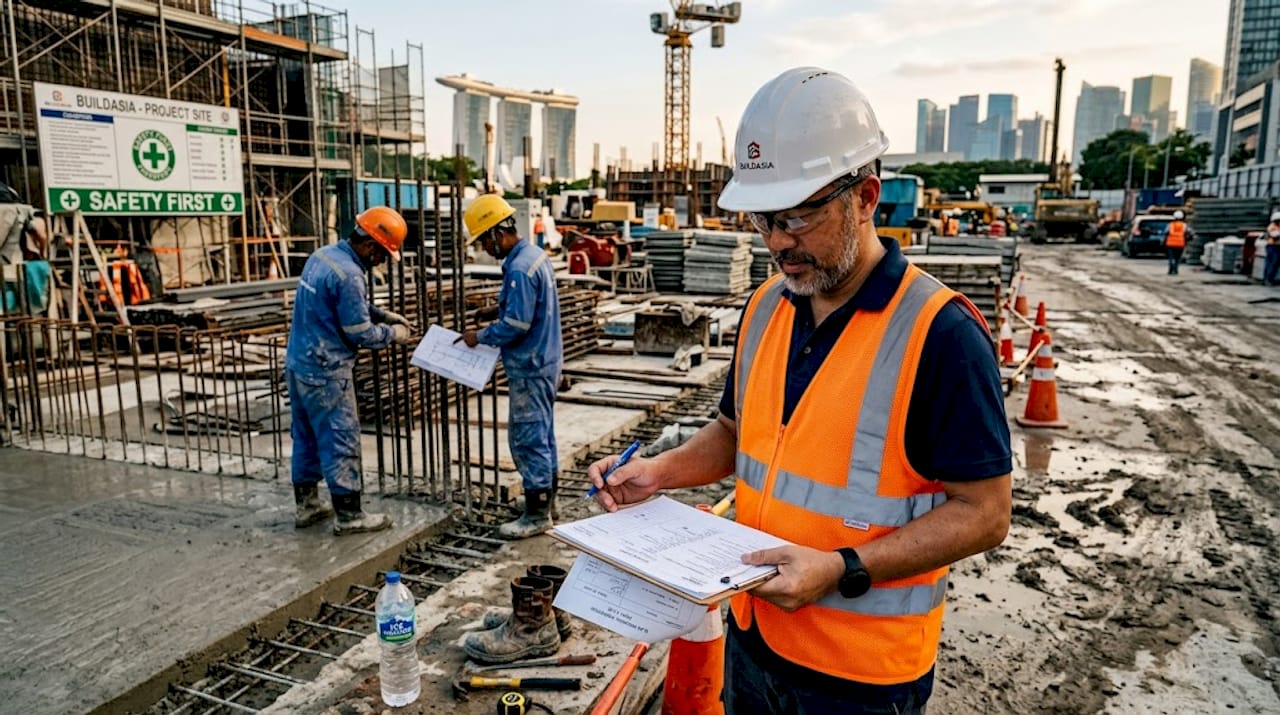
Rework in construction is not simply an operational inconvenience — it is a measurable financial liability, with industry data indicating that rework can consume 5% to 12% of total project cost when quality management systems are inadequate or poorly enforced. For Singapore construction companies and project developers operating within a regulatory environment that integrates safety, quality, and environmental compliance into a unified statutory framework, this financial exposure is compounded by reputational risk, delayed regulatory approvals, and diminished contract competitiveness. Certifications such as bizSAFE and ISO 9001 are not bureaucratic formalities — they are strategic instruments that signal systemic capability and unlock access to higher-value project opportunities.
Table of Contents
- Why quality management is essential in Singapore construction
- What quality management looks like on-site: From specs to inspections
- Navigating bizSAFE and ISO: How safety and quality systems interact
- Driving improvement: How to measure and manage quality continuously
- The uncomfortable truth most construction leaders miss about quality management
- Achieve lasting compliance with certification support tailored to you
- Frequently asked questions
Key Takeaways
| Point | Details |
|---|---|
| Quality lapses cost more | Rework can add 5% to 12% to project costs, making robust quality management essential. |
| Integrate safety and quality | Singapore certifications like bizSAFE expect operational alignment, not just paper compliance. |
| Practical tools prevent rework | Turning specifications into measurable acceptance criteria and ITPs catches errors early. |
| Monitor key metrics | Tracking defect rates and inspection results supports ongoing improvement and audit readiness. |
| Expert support accelerates success | Certification consultants and real-world frameworks help firms meet compliance goals faster. |
Why quality management is essential in Singapore construction
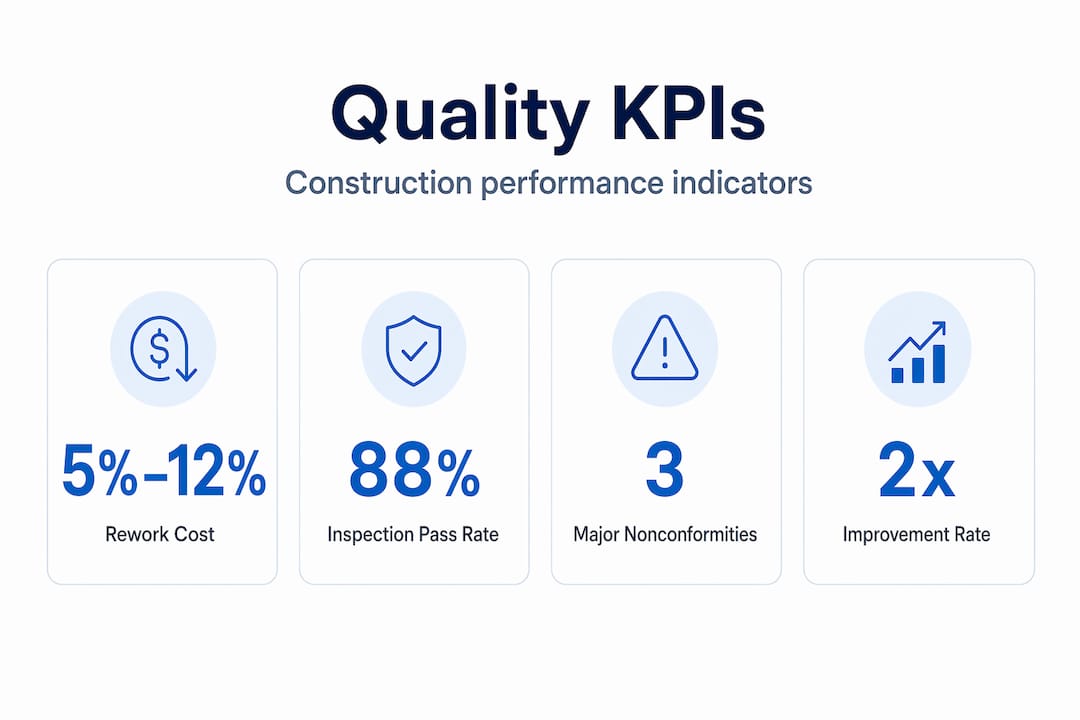
The financial case for rigorous quality management is unambiguous. Rework rates drive up project costs by 5% to 12%, and on a mid-sized Singapore residential development valued at SGD 50 million, that translates to a potential SGD 2.5 million to SGD 6 million in avoidable expenditure. These figures do not account for the cascading consequences — schedule overruns, subcontractor disputes, regulatory penalties, and the erosion of client confidence that follows a high-profile defect or safety incident.
The non-financial consequences of poor quality management are equally significant. Projects that fail interim inspections by the Building and Construction Authority (BCA) face mandatory re-inspections, which delay Temporary Occupation Permit (TOP) applications and trigger penalty clauses embedded in most development agreements. Reputational damage, once incurred, is notoriously difficult to reverse in Singapore’s relatively compact construction market, where professional networks are dense and procurement decisions are heavily influenced by track record.
Market expectations have evolved considerably. Government-linked developers, institutional clients, and international joint-venture partners now routinely require demonstrated quality system maturity as a pre-qualification condition:
- Certification as a contract prerequisite: Many public sector tenders explicitly require bizSAFE Level 3 or Star certification, alongside ISO 9001 registration.
- ConQUAS scoring as a differentiator: Singapore’s ConQUAS framework assesses construction quality against independent benchmarks, with higher scores directly influencing award decisions.
- Buyer confidence and asset value: Residential and commercial buyers increasingly scrutinize ConQUAS ratings, as research confirms that superior scores correlate with enhanced project value and buyer confidence.
- Insurance and bonding requirements: Underwriters assess quality management system maturity when pricing professional indemnity and contractor’s all-risk policies.
“Quality management in Singapore construction is no longer a back-office function. It is a front-line competitive instrument, embedded in procurement, regulatory approval, and market positioning.”
The firms that recognize this reality and invest in structured quality management systems — rather than reactive defect rectification — consistently outperform their competitors on cost, schedule, and client satisfaction metrics.
What quality management looks like on-site: From specs to inspections
Translating contract documents and design specifications into measurable, enforceable quality outcomes is the foundational discipline of construction quality management. Quality leaders convert specifications into measurable acceptance criteria and deploy Inspection and Test Plans (ITPs) systematically to intercept quality failures before they progress to costly rework or regulatory non-conformances.
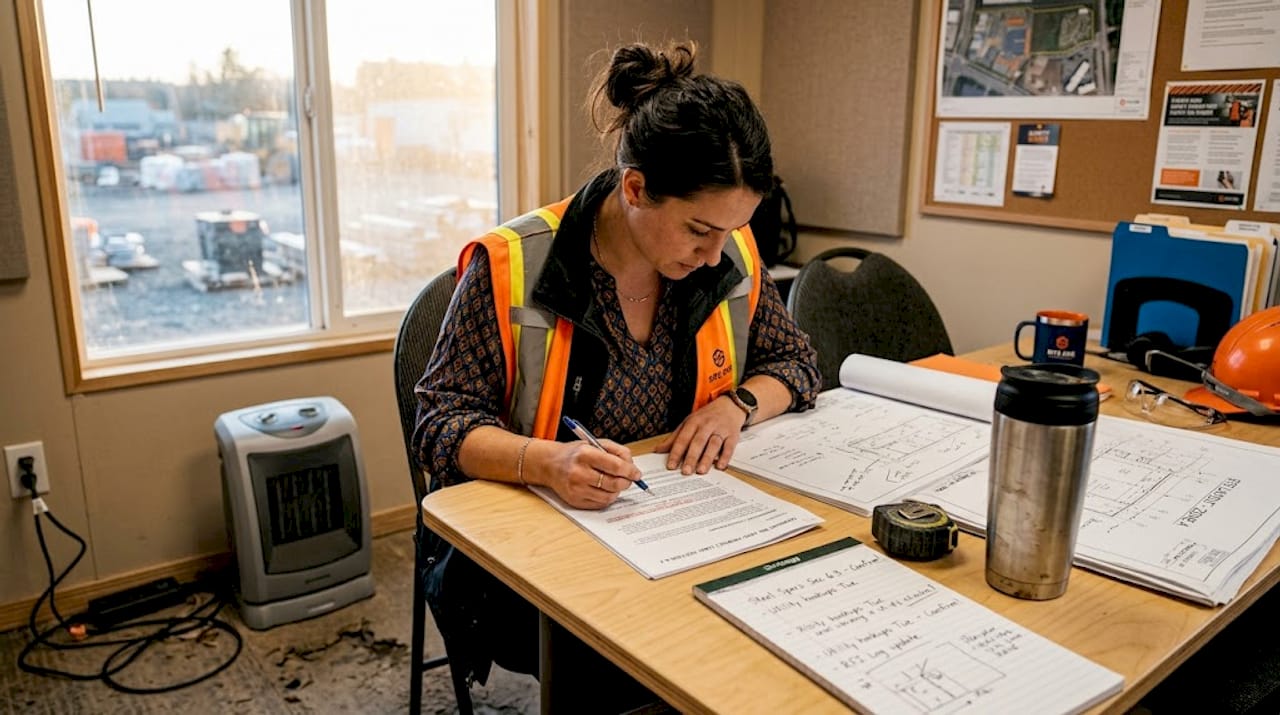
The single most consequential pitfall observed across Singapore construction projects is treating quality management as an administrative afterthought — a set of checklists completed retrospectively rather than a workflow discipline embedded from mobilization. When ITPs are developed after work has commenced, acceptance criteria are ambiguous, and early-stage verifications are skipped, the downstream cost of rectification escalates exponentially relative to the cost of prevention.
The table below illustrates the distinction between vague and measurable quality criteria across common works categories:
| Works category | Vague criteria | Measurable acceptance criteria |
|---|---|---|
| Structural concrete | “Good finish, adequate strength” | Min. 28-day compressive strength 35 MPa per SS EN 12390; slump 75mm ±25mm |
| Waterproofing membrane | “No visible defects” | Min. thickness 1.5mm; spark test continuity at 1kV per ASTM D4787 |
| Reinforcement placement | “Correct as per drawing” | Cover ±10mm tolerance; lap length per structural engineer’s specification |
| Curtain wall glazing | “Properly installed” | Air infiltration ≤1.5 m³/h·m² at 50Pa per SS 212; deflection ≤L/175 |
| Tiling works | “Even, no hollow tiles” | Hollow area ≤5% per unit; lippage ≤1mm; grout joint ±1mm |
Embedding measurable criteria of this specificity into ITPs allows site supervisors, inspectors, and subcontractors to operate with objective clarity. Disputes are minimized because acceptance or rejection decisions are no longer subject to interpretation.
The essential components of an effective on-site quality management system, aligned with Singapore construction quality standards, include:
- Pre-activity inspection: Verify materials, plant, and personnel qualifications before work commences.
- In-process inspection: Conduct hold points and witness points at critical stages, documented on ITPs.
- Post-activity inspection: Confirm finished works meet acceptance criteria before concealment or handover.
- Non-conformance reporting (NCR): Record every deviation formally, track root cause analysis, and close out with corrective action verification.
- Material traceability: Maintain delivery dockets, test certificates, and batch records for all structural and safety-critical materials.
Pro Tip: Require all subcontractors to submit their own ITPs before mobilization and review them against your master ITP. Subcontractor-generated quality documentation creates accountability at the source and significantly reduces the inspection burden on your primary quality team.
Navigating bizSAFE and ISO: How safety and quality systems interact
Many Singapore construction firms manage their bizSAFE certification and their ISO 9001 quality management system as separate, parallel compliance tracks. This structural separation is both operationally inefficient and strategically sub-optimal. Understanding how these frameworks interlock — and exploiting that integration — is where sophisticated construction organizations generate measurable competitive advantage.
bizSAFE is a 5-step workplace safety and health program administered by the Workplace Safety and Health Council (WSHC), designed to build organizational safety capability progressively. Each level demands demonstrably higher system maturity:
- Level 1 (bizSAFE Entry): Senior management attends a WSH management system course — establishing leadership commitment as the foundation.
- Level 2: Develop a Risk Management Implementation Plan (RMIP) with a certified Risk Management Champion.
- Level 3: Implement the RMIP and have it audited by a MOM-approved auditing organization — this is the minimum level required for most Singapore public sector subcontractor appointments.
- Level 4: Develop a WSH Management System (WSHMS) with external advisory support.
- Level Star: Implement the WSHMS and achieve certification through independent audit — the gold standard for main contractors and preferred suppliers.
The comparison below maps bizSAFE requirements against ISO 9001 quality management system expectations and ConQUAS compliance benchmarks:
| Compliance dimension | bizSAFE (Level Star) | ISO 9001:2015 | ConQUAS assessment |
|---|---|---|---|
| Leadership commitment | Top management WSH policy | Quality policy, top management review | Project team QA/QC accountability |
| Risk identification | Hazard identification and risk assessment | Risk and opportunity analysis | Defect and non-conformance tracking |
| Documented system | WSHMS manual and procedures | Quality Management System (QMS) documentation | Quality plan and ITP suite |
| Internal audit | Internal WSH audit | Internal quality audit | Independent ConQUAS assessment |
| Corrective action | Incident investigation and CAPA | Non-conformance and corrective action | Defect rectification and re-inspection |
| External verification | WSH Council-approved auditor | ISO accredited certification body | BCA-appointed assessors |
The operational integration opportunity lies in aligning these parallel documentation and audit cycles. Safety and quality system maturity should be integrated rather than maintained as separate compliance exercises. Practical integration steps include:
- Align the internal audit schedule so that WSH system audits and quality management system audits are conducted concurrently or in coordinated sequence.
- Incorporate workplace incident data and near-miss reports into the quality management system’s corrective action register — incidents frequently reveal quality failures in method statements or material selection.
- Use a unified risk register that captures both safety hazards and quality risks, enabling management review meetings to address both dimensions simultaneously.
- Cross-train quality officers and safety officers in each discipline’s documentation requirements to reduce administrative duplication and improve system coherence.
Pro Tip: Before your next bizSAFE or ISO audit, map your risk register entries against your quality non-conformance records. Shared root causes — such as inadequate subcontractor supervision or missing pre-activity checks — appear in both, and resolving them simultaneously improves audit outcomes across both certification tracks. For a detailed walkthrough of Singapore’s compliance expectations, the safety compliance guide and the firm’s dedicated BizSAFE guide provide structured, Singapore-specific frameworks.
Driving improvement: How to measure and manage quality continuously
Achieving certification is not the terminal objective — it is the entry point to a continuous improvement discipline that generates compounding returns in cost control, schedule reliability, and organizational capability. The firms that sustain certification and outperform their competitors are those that treat quality metrics as management intelligence rather than audit evidence.
Rework and defect rates, alongside inspection pass rates, are the most cost-relevant leading indicators available to construction quality managers. Tracking these metrics systematically enables early intervention — identifying deteriorating trends before they crystallize into expensive rectification campaigns or regulatory non-conformances.
The quality dashboard below illustrates a practical monitoring framework:
| Metric | Target | Why it matters |
|---|---|---|
| Rework cost as % of project value | Less than 1.5% | Directly measures the financial cost of quality failures |
| Inspection pass rate (first-time) | Greater than 90% | Indicates whether workmanship and pre-activity preparation are adequate |
| NCR closure rate within 14 days | Greater than 95% | Measures the organization’s corrective action responsiveness |
| Subcontractor ITP submission compliance | 100% before mobilization | Leading indicator of subcontractor quality culture |
| ConQUAS score (where applicable) | Greater than 70 points | External benchmark of overall construction quality |
| Safety observations linked to quality failures | Downward trend monthly | Monitors the intersection of WSH and quality risk |
Establishing the feedback loops that make this data actionable requires organizational discipline. A structured approach includes:
- Weekly site quality review: Supervisors and quality officers review NCR status, inspection pass rates, and any material test failures, with corrective actions assigned and dated.
- Monthly management quality review: Project directors review dashboard metrics against targets, identify systemic trends, and authorize resource allocation for remediation.
- Quarterly system audit: Internal auditors assess compliance with documented procedures, reviewing a sample of ITPs, NCRs, and corrective action records.
- Post-project review: Capture lessons learned against each quality metric category, feeding improvements into the next project’s quality plan before mobilization.
Beyond the mechanics of measurement, the cultural dimension of continuous improvement deserves deliberate attention. Firms that recognize and celebrate milestone achievements — a month without NCRs, a subcontract package achieving 100% first-time inspection passes — reinforce the behaviors that generate quality outcomes. The effective safety and health management principles applicable to WSH culture apply with equal force to quality culture: visible leadership commitment, meaningful recognition, and open reporting systems are the organizational prerequisites for sustained performance.
The quality dashboard is not a reporting instrument for auditors. It is the management nervous system of a quality-driven construction organization — and the firms that read it fluently are the ones consistently delivering projects on budget, on program, and to specification.
The uncomfortable truth most construction leaders miss about quality management
The prevailing misconception in Singapore’s construction sector is that certification completion equals compliance achievement. Firms invest considerable resources in achieving bizSAFE Star or ISO 9001 registration, then allow the underlying systems to calcify into static documentation that exists primarily to satisfy the next audit cycle. This is paper compliance — and it leaves the most valuable returns from quality and safety investment entirely unrealized.
The organizations that genuinely outperform their competitors do not simply pass audits. They operationalize the management systems that underpin certification, empowering site teams to interpret quality and safety data and act on it with speed and authority. When a formwork supervisor can read an NCR trend and independently identify a systemic pre-activity check failure without waiting for a management directive, the quality system is functioning at its intended level. That capability cannot be manufactured on the eve of an audit.
The second dimension most leaders miss is the strategic connection between quality monitoring, staff incentive structures, and open reporting culture. When workers and supervisors perceive that quality reporting triggers punitive responses rather than system improvements, near-miss data, incipient NCRs, and early defect observations are suppressed. The result is that management receives a flattering but misleading picture of project health — right up until a formal audit or client inspection reveals accumulated non-conformances that have been invisible in internal reporting.
The firms that create genuine competitive advantage link quality performance metrics to meaningful recognition, provide project teams with real-time visibility into dashboard data, and treat every NCR as an organizational learning opportunity rather than an individual failure. Extending this discipline to environmental compliance guidance creates a unified QES (Quality, Environment, and Safety) management culture that positions the organization for sustained performance across all regulatory dimensions.
The uncomfortable reality is that the gap between high-performing and average construction firms in Singapore is not primarily a gap in technical capability. It is a gap in management system discipline and organizational culture. Certification provides the framework; leadership provides the vitality.
Achieve lasting compliance with certification support tailored to you
Singapore construction firms that treat bizSAFE and ISO 9001 as integrated management disciplines — rather than sequential compliance checkboxes — achieve demonstrably superior project outcomes, audit readiness, and contract competitiveness. Making that integration operational requires structured expertise and sustained implementation support.

MOSAIC Ecoconstruction Solutions provides hands-on consultancy, training, and audit preparation support specifically calibrated for Singapore’s construction regulatory environment. Whether your organization is pursuing bizSAFE Star certification support, preparing for external assessment through safety audit examples, or seeking to build organizational resilience through ISO 22301 consultancy, the team provides end-to-end guidance grounded in proven Singapore project experience. Contact MOSAIC to explore how integrated quality and safety management support can strengthen your firm’s certification standing and project performance.
Frequently asked questions
What is the bizSAFE program and why does it matter for construction firms?
bizSAFE is a 5-step safety and health program in Singapore that builds organizational WSH capabilities progressively, with higher levels requiring engagement of MOM-registered auditing organizations and formal risk management implementation. For construction firms, achieving bizSAFE Level 3 or Star is frequently a mandatory pre-qualification requirement for public sector and government-linked project appointments.
Which quality metrics are most important to track in construction?
Rework and inspection pass rates are the most cost-relevant leading metrics, with rework often consuming 5% to 12% of total project costs when quality management gaps are present. NCR closure rates and subcontractor ITP compliance are equally important leading indicators for systemic quality risk.
How are quality and safety systems integrated for Singapore certifications?
By aligning audit schedules, unifying risk and quality registers, and cross-referencing NCR data with incident investigation records, organizations create a single integrated management system that satisfies both bizSAFE and ISO 9001 audit requirements simultaneously, reducing administrative duplication and improving overall compliance posture.
Does ISO 9001 replace the need for bizSAFE certification?
No. ISO 9001 addresses quality management system requirements, while bizSAFE is focused on workplace safety and health management. Singapore project requirements routinely mandate both certifications independently, and they address distinct but complementary dimensions of organizational capability.
What’s the fastest way to prepare for a Singapore construction quality audit?
Align your inspection and risk registers to ensure all acceptance criteria are current and documented, review your NCR backlog for any overdue corrective actions, and engage an external consultant to conduct a mock audit against your quality management system procedures before the formal assessment date.