The 2026 Roadmap to bizSAFE STAR: A Step-by-Step Guide for Singapore SMEs
SEO Metadata and Configuration
Focus Key Phrase: 2026 Roadmap to bizSAFE STAR for Singapore SMEs
SEO Title: The 2026 Roadmap to bizSAFE STAR: A Step-by-Step Guide for Singapore SMEs
Meta Description: Discover the ultimate 2026 roadmap to bizSAFE STAR. This comprehensive step-by-step guide empowers Singapore SMEs to achieve exceptional workplace safety compliance.
Tags: bizSAFE STAR, Singapore SMEs, 2026 Roadmap, Workplace Safety, Step-by-Step Guide, ISO 45001, WSH Council, Risk Management.
The Strategic Imperative for Singapore SMEs
The pursuit of workplace safety excellence requires highly structured methodologies. Consequently, the bizSAFE framework provides a definitive regulatory pathway. The bizSAFE STAR level represents the absolute pinnacle of achievement. It signifies total compliance with global occupational health benchmarks. Furthermore, the 2026 roadmap introduces stringent new regulatory updates. Therefore, mastering this step-by-step guide is absolutely crucial.
Singapore SMEs face a rapidly evolving compliance environment today. The Ministry of Manpower (MOM) continuously enhances safety legislation. Consequently, achieving bizSAFE STAR ensures strict legal compliance.1 Moreover, it actively unlocks lucrative government tenders and contracts.1 This certification is an incredibly transformative business initiative.3 It builds organizational resilience against unforeseen operational disruptions.3
This exhaustive research report details the entire certification progression. Singapore SMEs will discover highly actionable strategies herein. Furthermore, the report analyzes essential financial grants thoroughly. It extensively details the Enterprise Development Grant (EDG) mechanics.4 Additionally, it examines the Productivity Solutions Grant (PSG).5 This 2026 roadmap to bizSAFE STAR guarantees systematic success.
Decoding the 2025 and 2026 Regulatory Landscape
Singapore SMEs must adapt their internal safety frameworks proactively. The 2026 roadmap to bizSAFE STAR targets emerging risks. The legislative framework surrounding worker health expanded significantly recently. Specifically, the Workplace Safety and Health (WSH) Council updated checklists.6 Therefore, understanding these complex systemic shifts is highly mandatory.
The Evolving Employment Framework
The broader employment landscape became significantly more employee-friendly recently. With effect from January 1, 2025, new protections emerged.8 The Platform Workers Act officially came into effect.8 This allows platform workers to obtain vital financial compensation.8 They receive protection if injured during their course of work.8
Furthermore, platform workers now receive strengthened Central Provident Fund protections.8 Simultaneously, the minimum qualifying salary for Employment Passes increased.8 It rose from S5,600 outside financial services.8 Additionally, hiring guidelines for non-PMET workers expanded significantly.8
Since June 2025, businesses can hire from new countries.8 These include Bhutan, Cambodia, and Laos.8 This supplements traditional sources like Bangladesh and India.8 Employers must integrate these diverse workers into safety programs. The 2026 roadmap demands culturally inclusive safety training explicitly.
Critical MOM Regulatory Circulars
The Ministry of Manpower issued several critical regulatory circulars recently. These circulars directly impact bizSAFE Risk Management audit criteria. Singapore SMEs must integrate these directives into their operations. Otherwise, they risk failing their bizSAFE STAR audits completely.
In January 2025, MOM mandated forklift operator refresher training.9 Following this, circular 2025-02 addressed suspended scaffolds.9 It mandated safe design and installation of outriggers.9 Furthermore, it required secure overhead supports for these structures.9
In February 2025, MOM released an advisory on emergency response.9 This focused specifically on protocols for injured workers.9 June 2025 saw enhanced licensing conditions for scaffold contractors.9 August 2025 updated statutory lifting equipment examination requirements.9 Finally, November 2025 targeted chemical disinfection in aquatic facilities.9
| Circular Reference | Issue Date | Key Regulatory Subject | Impact Area |
| MOM / OSHD / 2025-01 | Jan 10, 2025 | Forklift operator refresher training | Machinery Safety |
| MOM / OSHD / 2025-02 | Feb 12, 2025 | Outriggers for suspended scaffolds | Working at Heights |
| MOM / OSHD / 2025-03 | Jun 23, 2025 | Emergency response for injured workers | Incident Management |
| MOM / OSHD / 2025-04 | Aug 29, 2025 | Enhanced scaffold contractor licenses | Contractor Management |
| MOM / OSHD / 2025-05 | Aug 29, 2025 | Statutory lifting equipment tests | Equipment Integrity |
| MOM / OSHD / 2025-06 | Nov 19, 2025 | Chemicals for aquatic facilities | Chemical Handling |
Table 1: Critical MOM WSH Circulars impacting the 2026 roadmap.9
Mandatory Speed Limiters for Lorries
Transportation safety rules escalated dramatically in the 2026 roadmap. Starting January 1, 2026, lorries require mandatory speed limiters.10 This impacts vehicles weighing 3,501kg to 12,000kg.10 Singapore SMEs must comply with these rigid statutory deadlines. Furthermore, the devices strictly cap vehicle speeds at 60 km/h.11
Heavier goods vehicles already required limiters since 1999.12 The new laws simply expand this critical safety mandate.11 Lorries under 3,500kg must carry Speed Warning Devices instead.11 The limiter mechanism relies on hard physical restriction.11 The engine management system simply stops responding past 60 km/h.11
Enforcement and bizSAFE Revocation
This regulation heavily impacts the bizSAFE certification process directly. From January 2026, auditors actively verify speed limiter installations.13 Consequently, non-compliant companies automatically fail the Risk Management audit.11 Without a successful audit, bizSAFE STAR renewal is completely impossible.15
Moreover, Traffic Police enforcement actions are extremely severe today. Companies caught speeding face a mandatory Remedial Order (RO).15 This severe RO falls under the Workplace Safety and Health Act.16 Subsequently, companies must install limiters across their entire fleet.11
They must do this ahead of their normal statutory deadlines.15 Non-compliance with the RO triggers massive financial penalties. Specifically, companies face unprecedented fines of up to $50,000.11 Furthermore, the Ministry of Home Affairs will raise standard penalties.16 Non-compliance fines will jump from $1,000 to $10,000 shortly.16
Implementation Timeline for Speed Limiters
Singapore SMEs must check their Maximum Laden Weight (MLW).11 This information resides on the LTA One Motoring portal.11 Alternatively, owners can check their vehicle registration cards directly.11 Only police-appointed Authorised Agents (AA) can install these limiters.10
| Vehicle Criteria | MLW Range | Statutory Compliance Deadline |
| Newly imported lorries | 3,501kg to 12,000kg | January 1, 2026 10 |
| Existing lorries (Pre-2018) | 5,001kg to 12,000kg | January 1, 2026 10 |
| Existing lorries (Pre-2018) | 3,501kg to 5,000kg | July 1, 2026 10 |
| Newer lorries (Post-2018) | Varies by weight | Jan 1 or Jul 1, 2027 12 |
Table 2: Statutory deadlines for lorry speed limiters.10
Psychosocial Hazards and Emotional Regulation
Workplace stress now constitutes a highly critical legal compliance issue. The 2026 roadmap targets psychosocial hazards extremely aggressively. Singapore SMEs must manage employee emotional regulation formally.17 Furthermore, the WSH (Risk Management) Regulations demand this inclusion explicitly.17
Psychosocial hazards relate to both work content and context.18 Content involves task design, workload, and the pace of work.18 Conversely, context involves organizational culture and interpersonal relationships.18 Employers must thoroughly assess stress, burnout, and customer-facing aggression.17
Omitting these psychosocial risks leads to severe audit non-conformities.17 Achieving bizSAFE STAR requires a mature psychological safety approach.17 Singapore legislation increasingly aligns with progressive global mental health standards.19 Employers undeniably possess a clear duty of care here.19
Utilizing the iWorkHealth Assessment Tool
To facilitate this, the government introduced the iWorkHealth tool.20 This online psychosocial health assessment tool is completely free.21 The WSH Institute developed it alongside several medical institutions.21 These include the Institute of Mental Health and Changi General Hospital.22
It features a comprehensive 71-question stress-factor survey.22 Employees participate anonymously to identify common workplace stressors effectively.22 The survey covers job demands, control, recognition, and harassment.22 Consequently, companies receive aggregated, anonymized departmental reports automatically.22
However, a minimum of eight respondents is strictly required.22 This minimum threshold actively protects individual employee privacy.22 Singapore SMEs must integrate these analytical findings strategically. Specifically, identified psychosocial risks must enter the Risk Management Plan.17 Employees also receive personalized mental well-being reports individually.22
Dynamic Heat Stress Management Protocols
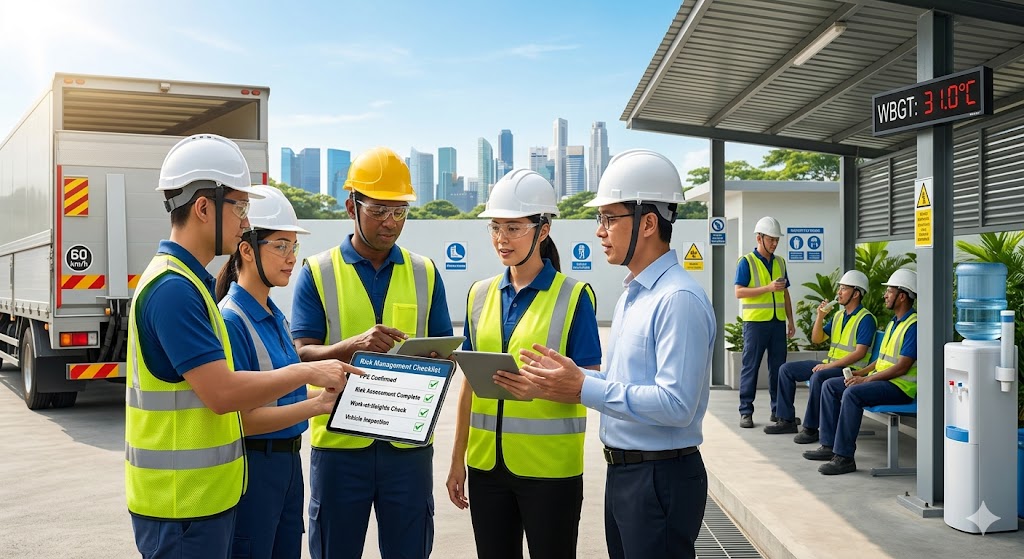
Climate change necessitates incredibly robust heat stress interventions today. The WSH Council provides explicit guidelines for outdoor work.23 High ambient temperatures severely impact a worker’s bodily heat.24 Singapore SMEs must monitor Wet Bulb Globe Temperatures (WBGT) constantly.25
This monitoring must occur hourly during peak heat periods.25 The 2026 roadmap dictates highly dynamic work-rest schedules universally. Heavy physical work dramatically increases an employee’s metabolic demand.24 Furthermore, impermeable Personal Protective Equipment (PPE) restricts evaporative cooling.24
At WBGT levels of 30–32°C, specific work cycles apply.26 Workers require a 45-minute work and 15-minute rest cycle.26 If temperatures exceed 33°C, heavy outdoor work must stop.26 Alternatively, companies must reschedule tasks to cooler morning hours.26
Acclimatization and Hydration Requirements
Moreover, employers must provide adequate hydration and shaded areas.27 Workers must consume at least 300ml of water hourly.25 Good hydration prevents severe dehydration and fatal heat strokes.24 Heat stroke carries a massive fatality rate if untreated.26
It becomes critical when core body temperatures exceed 40°C.26 Furthermore, acclimatization programs for new workers are absolutely mandatory.25 New workers should start at 50% of full workloads.26 Their workloads should incrementally increase over seven to fourteen days.26
Supervisors must recognize early warning signs of heat stress.26 These include excessive sweating, dizziness, severe nausea, and confusion.26 If symptoms appear, supervisors must remove workers from heat immediately.26 Therefore, bizSAFE STAR audits scrutinize heat management plans rigorously.
Updated Occupational Diseases Schedule
The medical framework surrounding worker health expanded significantly recently. The Second Schedule of the WSH Act was heavily amended.8 This amendment took effect on December 1, 2025.28 Consequently, it enhances occupational health surveillance across all industries.8
Doctors hold a strict legal responsibility to report ODs.30 Singapore SMEs must track these legislative changes meticulously. The updated list includes various cancers and dangerous biological diseases.28 Moreover, it covers musculoskeletal and severe respiratory disorders extensively.28
Categorization of Reportable Diseases
A robust notification system provides crucial data for authorities.30 It helps identify highly vulnerable persons and at-risk industries.30 Furthermore, doctors can refer suspected cases to OM specialist clinics.30 The most common ODs involve noise-induced hearing loss historically.30
The new schedule explicitly targets aggressive biological agents today. For instance, anthrax and glanders are legally reportable diseases.28 Leptospirosis and its sequelae also join the official list.28 Furthermore, chemical poisonings feature heavily in the updated schedule.28
These include poisoning by lead, manganese, mercury, and organophosphates.28 Additionally, toxic anaemia and toxic hepatitis require mandatory reporting.28 Respiratory disorders include asbestosis, byssinosis, silicosis, and occupational asthma.28 Finally, malignant mesothelioma and occupational liver angiosarcoma are listed.28
The Step-by-Step Guide: Navigating the 5 Levels
The progression to bizSAFE STAR involves five highly distinct phases. Each phase requires specific training and precise implementation milestones. Therefore, Singapore SMEs must follow this step-by-step guide carefully. Skipping developmental levels is not permitted in this structured framework.
Phase 1: bizSAFE Level 1 – Leadership Commitment
The journey begins at the absolute top of the organization. Top management must demonstrate unwavering commitment to workplace safety.1 Consequently, the CEO or Managing Director must participate personally.1 They must attend a half-day bizSAFE Level 1 workshop.1
This Top Executive WSH Program (TEWP) covers essential duties.31 It teaches the absolute fundamentals of statutory risk management.1 Following the workshop, the executive signs a formal commitment letter.1 This officially endorses the company’s comprehensive WSH policy.32
The bizSAFE Level 1 certificate is valid for six months.2 Moreover, this specific entry-level certificate is entirely non-renewable.2 Therefore, Singapore SMEs must progress to Level 2 rapidly. The 2026 roadmap demands immense momentum from the very outset.
Phase 2: bizSAFE Level 2 – Risk Management Capability
After securing leadership commitment, active internal capacity building begins. Singapore SMEs must formally appoint a Risk Management (RM) Champion.1 This individual takes full ownership of all safety initiatives.1 Furthermore, the RM Champion must complete rigorous formal training.1
They must attend the two-day RM Implementation Plan Course.1 This certifiable course covers hazard identification and classification methodologies.33 Moreover, it teaches critical risk control measures and ALARP concepts.33 ALARP stands for “as low as reasonably practicable”.33
Additionally, the training incorporates vital SGSecure elements thoroughly.13 Following certification, the RM Champion develops the Risk Management Plan.2 Therefore, Level 2 establishes the necessary internal intellectual capital. It prepares the organization for complex operational safety implementation.
Phase 3: bizSAFE Level 3 – Implementation and Audit
Level 3 represents a massive, highly significant operational milestone. It is the minimum standard for most government tenders.1 Singapore SMEs must implement the developed RM Plan entirely.1 This implementation must cover all routine and non-routine activities.35
Next, an external, independent verification process is strictly required. The company must engage a MOM-approved Auditing Organization (AO).2 The AO conducts a comprehensive RM Implementation Audit completely.1 From 2026, this audit includes strict speed limiter verification.13
Furthermore, auditors check for proper psychosocial hazard documentation thoroughly.17 The AO utilizes the bizSAFE Level 3 RM Audit Checklist.7 Upon successful auditing, the prestigious Level 3 status is granted.2 It remains valid for three years before requiring formal renewal.1
Phase 4: bizSAFE Level 4 – Systematic Management
Transitioning from Level 3 to Level 4 increases organizational complexity.3 Singapore SMEs must evolve beyond basic, isolated risk assessments. They must develop a full Workplace Safety and Health Management System.1 Consequently, the company appoints a dedicated WSHMS Programme Lead.2
This representative must attend a specialized four-day training course.3 The course focuses heavily on systemic safety management implementation.3 Furthermore, the WSHMS integrates all previous risk assessments coherently.1 It covers emergency preparedness, incident investigation, and staff training requirements.1
Developing this massive system typically takes three to six months.1 Following development, a MOM-approved auditor must review the framework.1 The 2026 roadmap emphasizes embedding sustainable safety practices deeply.32 Therefore, Level 4 acts as the critical bridge to STAR status.
Phase 5: bizSAFE STAR – Global Excellence
The bizSAFE STAR level is the absolute pinnacle of achievement.1 It signifies that Singapore SMEs meet rigorous global safety benchmarks.2 To achieve this, companies cannot rely on internal systems alone. They must obtain an internationally recognized OHS management system certification.38
Specifically, they must achieve ISO 45001:2018 certification officially.1 Alternatively, chemical industry players can utilize the SS 651:2019 standard.39 This certification involves a massive, highly comprehensive full-system audit.1 Furthermore, a Singapore Accreditation Council (SAC) accredited body must conduct it.1
This demanding process typically spans six to twelve months entirely.1 Once ISO 45001 is secured, the STAR application process begins.38 The company submits the ISO certificate and an RM Audit Report.3 The STAR status is directly tied to the ISO validity.2
| bizSAFE Level | Key Certification Requirement | Required Personnel | Audit Mechanism | Status Validity |
| Level 1 | Half-day workshop completion | CEO / Top Management | None required | 6 Months (Non-renewable) |
| Level 2 | 2-day RM Course & Plan | RM Champion | None required | Ongoing validity |
| Level 3 | Implement RM Plan fully | Entire Organization | MOM-approved AO | 3 Years (Renewable) |
| Level 4 | Develop complete WSHMS | WSHMS Champion | MOM-approved AO | 3 Years (Renewable) |
| STAR | ISO 45001 / SS 651 certification | Entire Organization | SAC-accredited Body | 3 Years (Tied to ISO) |
Table 3: The 5-Step Progression Framework for Singapore SMEs.1
Code of Practice on WSH Risk Management 2.0
To pass the RM Audit, companies must follow the Code.41 The Code of Practice on WSH Risk Management 2.0 is foundational.35 It outlines general requirements, assessment processes, and meticulous record-keeping.41 This step-by-step guide highlights its most critical organizational directives clearly.
Firstly, employers must form dedicated, multidisciplinary risk assessment teams.35 These teams should include management, engineers, supervisors, and maintenance staff.35 Multidisciplinary diversity ensures all operational blind spots are effectively identified.35 Secondly, completing risk assessments before commencing any work is mandatory.41
The Hierarchy of Controls
Furthermore, companies must utilize the established hierarchy of controls.35 This dictates the specific order of risk mitigation consideration.42 Elimination of the hazard is always the highest priority.42 If elimination is impossible, substitution is the next logical step.42
Following substitution, organizations must implement robust engineering controls.42 Administrative controls follow closely behind these engineering solutions.42 Finally, the provision of suitable personal protective equipment (PPE) applies.42 The Code mandates this strict sequence for all risk mitigation.42
Moreover, the Code dictates strict internal safety communication protocols. Employers must inform all exposed persons about the identified risks.41 They must also explain the implemented safe work procedures clearly.41 Furthermore, if control measures prove inadequate, the assessment requires immediate revision.41
Employee Recruitment and Orientation
The Code of Practice also governs organizational human resources heavily. Employers must ensure a robust recruitment process is in place.42 They must choose suitable candidates capable of safe work execution.42 Furthermore, job descriptions must specify safety and health responsibilities explicitly.42
All new employees require appropriate and sufficient WSH orientation training.42 Managers must ensure that all WSH training records are documented.42 Additionally, HR must consider safety outcomes during employee performance appraisals.42 Singapore SMEs must embed this continuous feedback loop into their culture.
SGSecure Integration: Preparing for Asymmetric Threats
Workplace safety in Singapore extends far beyond traditional industrial accidents. The 2026 roadmap emphasizes national security preparedness extremely heavily. Consequently, the SGSecure national movement integrates directly into the bizSAFE programme.13 Singapore SMEs must protect their workforces against potential terror threats.43
A terror attack is not a matter of if, but when.44 During the Level 2 course, RM Champions study SGSecure extensively.34 They learn to incorporate anti-terror protocols into the WSH Policy.34 Furthermore, they formulate risk assessments specifically targeting asymmetric terror threats.34
Evacuation, Lockdown, and First Aid
This includes establishing robust emergency evacuation routes and hiding locations.34 Moreover, formulating a precise workplace lockdown procedure is highly mandatory.34 Companies must also appoint dedicated SGSecure Representatives internally.34 These representatives communicate key tenets to all employees effectively.43
Employees must internalize the “Run, Hide, Tell” emergency protocol.43 Furthermore, they must learn improvised first aid skills thoroughly.43 This includes the “Press, Tie & Tell” method for severe injuries.43 Ultimately, demonstrating SGSecure readiness is non-negotiable for passing bizSAFE audits.34
The Convergence of ISO 45001 and SS 651
Achieving bizSAFE STAR requires external, globally recognized safety certification. Singapore SMEs must choose the appropriate standard for their specific industry. The 2026 roadmap highlights two primary, mutually exclusive pathways. These are the ISO 45001:2018 and the SS 651:2019 standards.38
ISO 45001: The Global Standard
ISO 45001 is the definitive international standard for occupational health.38 Over 70 governments globally have adopted it as a benchmark.45 Singapore adopted it locally as SS ISO 45001 in June 2018.45 It completely replaced the older, outdated OHSAS 18001 framework.45
This standard requires a proactive approach to hazard identification completely. Furthermore, it mandates heavy worker participation and systemic continual improvement. For Singapore SMEs, ISO 45001 offers immense international corporate credibility.45 It feeds directly into the bizSAFE STAR application process seamlessly.2
SS 651: The Chemical Industry Standard
For companies in the chemical sector, SS 651 is preferred.39 SS 651:2019 is a heavily modified adoption of ISO 45001.39 It specifically addresses both occupational safety and process safety management.39 Consequently, it caters directly to the unique needs of chemical plants.39
This standard officially replaced the older SS 506 Part 3.40 Organizations certified to SS 651 automatically meet ISO 45001 requirements.40 Therefore, they seamlessly qualify for bizSAFE STAR status immediately.38 Singapore SMEs in petrochemicals or wafer fabrication must utilize this framework.47
Mastering the SAC Auditing Framework
The audit phase often intimidates companies pursuing bizSAFE STAR status. However, the 2026 roadmap clarifies these auditing mechanics precisely. Singapore SMEs must navigate the Singapore Accreditation Council (SAC) protocols. Furthermore, they must satisfy MOM’s distinct auditing requirements simultaneously.
The CT 17 Assessment Checklist
Auditors do not evaluate companies arbitrarily or without strict guidelines. Instead, they utilize strict, heavily standardized assessment criteria. The SAC mandates the use of the CT 17 Assessment Checklist.49 This checklist defines the exact requirements for Management System audits.49
Auditing Organizations (AOs) must adhere to these rigorous rules strictly. For instance, the SAC mark must appear on audit reports.7 Moreover, AOs must maintain robust complaint-handling procedures internally.49 Consequently, Singapore SMEs are guaranteed a fair, highly standardized audit experience.
Auditors verify extremely specific physical safety implementations on-site. For example, they check Lock Out Tag Out (LOTO) systems.50 They also verify the issuance of safety shoes for workers.50 Furthermore, fall prevention plans and anchorage points undergo strict scrutiny.50
The Risk Management (RM) Audit Report
A common misconception exists regarding bizSAFE STAR requirements today. Many believe achieving ISO 45001 alone guarantees STAR status automatically. However, this is entirely incorrect under current WSH regulations. Even with ISO 45001, companies must submit an RM Audit Report.1
This is because the RM Audit covers Singapore-specific risks exclusively. The Code of Practice on WSH Risk Management mandates this thoroughly.3 It evaluates localized threats like terrorism and infectious disease outbreaks.3 Furthermore, from 2026, it specifically verifies lorry speed limiter installations.13
Therefore, a SAC-accredited Certification Body conducts the ISO 45001 audit.47 Simultaneously, a MOM-approved AO conducts the RM Implementation Audit.3 Often, the same accredited organization provides both services seamlessly.47 Singapore SMEs must prepare meticulous documentation for these dual assessments.
Financial Support Mechanisms for Singapore SMEs
Executing the 2026 roadmap to bizSAFE STAR requires substantial capital investment. Consultancy fees, external audit costs, and equipment upgrades add up quickly. However, the Singapore government provides extremely robust financial assistance schemes. Therefore, Singapore SMEs must leverage these lucrative grants strategically.
Enterprise Development Grant (EDG)
The EDG is a premier enterprise capability development scheme.51 Administered by Enterprise Singapore, it funds highly qualifying project costs.51 These include third-party consultancy fees, new software, and internal manpower.52 For ISO 45001 certification projects, the EDG is incredibly applicable.4
Singapore SMEs can receive up to 50% funding support.52 Furthermore, sustainability-related projects may receive up to 70% financial support.53 To qualify, the company must be registered and operating locally.4 Additionally, it needs at least 30% local shareholding definitively.4
The application process requires a highly detailed project proposal submission.54 Companies submit this via the unified Business Grants Portal (BGP).54 Furthermore, businesses must demonstrate financial viability to complete the project.4 Ultimately, EDG makes achieving bizSAFE STAR highly affordable for smaller enterprises.4
Productivity Solutions Grant (PSG)
The PSG helps companies automate and upgrade existing operational processes.5 It provides up to 50% funding for pre-approved IT solutions.5 Singapore SMEs receive up to $30,000 to improve operational productivity.5 Furthermore, the PSG currently supports a critical 2026 compliance requirement.
Specifically, EnterpriseSG provides PSG support for lorry speed limiters.16 This specialized financial support is strictly time-limited.16 It is available solely between October 2025 and March 2027.16 Therefore, companies must utilize this grant before deadlines expire entirely.
Applicants must not make prior payments before submitting the application.5 Retrospective applications are strictly prohibited and will be rejected instantly.5 Consequently, careful financial planning is vital in this 2026 roadmap. The PSG lowers the barrier to adopting essential safety technology.56
SkillsFuture and Skills Development Fund
Extensive training is a cornerstone of the bizSAFE STAR progression. Consequently, significant course fees for RM Champions and WSHMS Leads exist. However, SkillsFuture Singapore (SSG) provides extensive course fee subsidies.33 Singapore Citizens and Permanent Residents enjoy massive financial relief.57
Under the Enhanced Training Support for SMEs, funding is substantial. Eligible SMEs receive up to 70% funding for certifiable courses.33 Furthermore, mid-career individuals over 40 receive similar high-tier subsidies.33 Eligible citizens can also use their SkillsFuture Credit.58
Additionally, Post-Secondary Education Account (PSEA) funds can offset remaining fees.58 NTUC members enjoy 50% unfunded course fee support via UTAP.58 Employers can also claim Absentee Payroll funding during training hours.58 Trainees must achieve at least 75% attendance to qualify.60
| Grant / Funding Scheme | Administering Authority | Maximum Financial Support | Primary Application Area |
| Enterprise Development Grant | EnterpriseSG | Up to 50% (70% for sustainability) | ISO 45001 Consultancy & Audits |
| Productivity Solutions Grant | EnterpriseSG | Up to 50% (Capped at $30,000) | Speed Limiters & Pre-approved Tech |
| SkillsFuture SME Enhanced Support | SkillsFuture Singapore | Up to 70% course fee subsidy | bizSAFE Level 2 & Level 4 Courses |
| Union Training Assistance (UTAP) | NTUC | 50% of unfunded fees (Capped) | Individual WSH Training Relief |
Table 4: Comprehensive Funding Ecosystem for Workplace Safety Upgrades.5
Expanding Business Opportunities with bizSAFE STAR
The rigorous journey outlined in this step-by-step guide yields immense dividends. Achieving bizSAFE STAR transforms Singapore SMEs fundamentally and permanently. The benefits extend far beyond basic, mandatory regulatory compliance. They actively generate new revenue streams and enhance corporate profitability.
Securing Lucrative Contracts and Tenders
In Singapore, business opportunities heavily favor highly safety-certified organizations. Major developers and massive construction firms demand high bizSAFE levels.61 Furthermore, government agencies strictly enforce bizSAFE as a non-negotiable baseline.61 Agencies like HDB and NEA mandate it for contract tenders.2
Achieving bizSAFE STAR places a company in an elite, privileged tier. It fulfills and exceedingly surpasses all baseline contractual safety requirements.61 Consequently, procurement officers view STAR-certified companies as low-risk partners. This dramatically increases the probability of winning massive, high-value contracts.
Operational Resilience and Insurance Benefits
A structured management system identifies hazards before they cause injuries.2 Consequently, bizSAFE STAR companies experience far fewer workplace accidents statistically.2 This reduction in incidents prevents extremely costly operational disruptions and legal liabilities.
Moreover, the insurance industry recognizes this lowered risk profile explicitly. Many insurers offer preferential, heavily discounted rates to bizSAFE-certified companies.2 Over time, these premium savings offset the costs of maintaining certification. Furthermore, employee morale improves when workers feel genuinely protected.62 This directly reduces staff turnover and boosts overall productivity metrics.62
The WSH Performance Awards 2026
Excellence in workplace safety also brings high-level national recognition today. The WSH Council hosts the prestigious WSH Performance Awards annually.63 Singapore SMEs achieving bizSAFE STAR are prime candidates for these awards.64 The awards recognize stellar practices safeguarding employees and sub-contractors.63
The evaluation process for the 2026 awards is highly rigorous. It requires impeccable incident report records with the Ministry of Manpower.64 Any discrepancies identified result in immediate, non-negotiable disqualification.64 Furthermore, industry associations often nominate companies for national evaluation.64
There are three primary types of WSH Performance Awards available. The Silver Award requires meeting minimum evaluation criteria consistently.63 The Gold Award requires receiving the Silver Award for three consecutive years.63 Finally, the Excellence Award requires receiving the Gold Award for three consecutive years.63 Winning elevates a corporate brand massively.63
Sustaining Compliance: The Renewal Process
Achieving the bizSAFE STAR level is not a permanent endpoint. The 2026 roadmap requires continuous vigilance and proactive periodic renewal. bizSAFE STAR status is valid for a maximum of three years.1 However, it is explicitly tied to the underlying ISO 45001 certificate.2
To renew, Singapore SMEs must maintain their external ISO certification strictly.38 This requires passing annual surveillance audits by the SAC-accredited body.38 Furthermore, a full recertification audit occurs every three years.38 Simultaneously, the company must submit a brand new RM Audit Report.38
Crucially, companies must submit renewal applications extremely proactively. The WSH Council mandates submission two months before the expiry date.13 Failing to renew on time results in an immediate loss of status. Consequently, this can instantly disqualify a company from ongoing government tenders. Therefore, appointing a dedicated compliance manager is a strategic necessity.
Actionable Conclusions for Singapore SMEs
The 2026 roadmap to bizSAFE STAR is highly comprehensive and demanding. Singapore SMEs must navigate extremely complex regulatory changes with extreme precision. The integration of lorry speed limiters is an immediate, non-negotiable priority. Non-compliance invites severe financial penalties and massive operational disruptions.
Similarly, addressing psychosocial hazards through tools like iWorkHealth is absolutely essential. Mental well-being is now a highly scrutinized statutory requirement. Furthermore, strict adherence to hourly heat stress monitoring prevents catastrophic workforce injuries. Employers must utilize WBGT data to dictate safe outdoor work schedules.
To succeed, companies must follow the step-by-step guide meticulously. Securing top management commitment through Level 1 is the critical catalyst. Following this, empowering an RM Champion at Level 2 builds internal capacity. Implementing the system for Level 3 satisfies basic tender requirements rapidly.
Next, constructing a full WSHMS at Level 4 provides deep structural integrity. Finally, achieving ISO 45001 and securing STAR status ensures global competitiveness. Singapore SMEs should aggressively utilize all available government funding schemes. The EDG and PSG grants reduce massive financial burdens significantly.
Moreover, SSG subsidies ensure critical workforce training remains affordable and accessible. By embracing this exhaustive 2026 roadmap, forward-thinking businesses protect their people. Ultimately, they create a highly resilient, extremely profitable, and exceptionally safe workplace.
Works cited
- bizSAFE Singapore 2026 | Complete Guide to Levels 1-4 & Star |…, accessed June 1, 2026, https://sageshield.com/bizsafe-guide/
- BizSAFE Singapore: All Levels, Requirements & Certification (2026) – AnjouHealth, accessed June 1, 2026, https://www.anjouhealth.com/bizsafe-singapore-complete-guide/
- Roadmap to bizSAFE STAR: Guide to Elevating Your WSH …, accessed June 1, 2026, https://mosaicsafety.com.sg/roadmap-to-bizsafe-star-singapore/
- EDG Grant for ISO Certification Singapore 2026 — Complete Application Guide, accessed June 1, 2026, https://sageshield.com/edg-grant-for-iso-certification-singapore-2026-complete-application-guide/
- Productivity Solutions Grant (PSG) – Enterprise Singapore, accessed June 1, 2026, https://www.enterprisesg.gov.sg/financial-support/productivity-solutions-grant
- New Requirements for bizSAFE Level 3, 4 and STAR, accessed June 1, 2026, https://www.tal.sg/wshc/media/announcements/2020/new-requirements-for-bizsafe-level-3-4-and-star
- bizSAFE Level 3 Risk Management audit checklist, accessed June 1, 2026, https://www.tal.sg/wshc/-/media/tal/wshc/programmes/files/risk-mgt-audit-checklist-wef1jan2026.xlsx
- 2025 Year in Review / 2026 Outlook – Singapore Employment Law | Seyfarth Shaw LLP, accessed June 1, 2026, https://www.seyfarth.com/news-insights/2025-year-in-review-singapore-employment-law.html
- WSH circulars – Singapore – MOM, accessed June 1, 2026, https://www.mom.gov.sg/workplace-safety-and-health/wsh-circulars
- SPF | Speed Limiter Announcement – Singapore Police Force, accessed June 1, 2026, https://www.police.gov.sg/Knowledge-Hub/Traffic/Traffic-Matters/Speed-Limiter-Announcement
- Speed Limiter Singapore 2026: The Complete Guide for Lorry Owners — Deadlines, Fines & Installation | ABLINK, accessed June 1, 2026, https://ablink.sg/blogs/news/speed-limiter-singapore-2026-lorry-deadline-installation-guide
- Police to crack down on lorry owners who fail to install speed limiters by deadlines, Singapore News – AsiaOne, accessed June 1, 2026, https://www.asiaone.com/singapore/heavy-vehicles-speed-limiter-1jan2026-stern-enforcement
- About bizSAFE, accessed June 1, 2026, https://www.tal.sg/wshc/programmes/bizsafe/about-bizsafe
- Additional Verification Checks for Speed Limiters During Risk Management Implementation Audit From Lessons to Leadership, accessed June 1, 2026, https://www.tal.sg/wshc/-/media/tal/wshc/resources/newsletters/wsh-bulletins/files/20251024_wsh_bulletins.pdf
- Enforcement Of Speed Limiter Requirement For Lorries From 1 January 2026 – Singapore Police Force, accessed June 1, 2026, https://www.police.gov.sg/Media-Hub/News/2025/12/20251223_enforcement_of_speed_limiter_requirement_for_lorries_from_1_january_2026
- SPF | Mandatory Installation Of Speed Limiters On Lorries – Singapore Police Force, accessed June 1, 2026, https://www.police.gov.sg/media-hub/news/2025/10/20251024_mandatory_installation_of_speed_limiters_on_lorries
- MOM Emotional Regulation: Workplace Compliance Guide Singapore, accessed June 1, 2026, https://sageshield.com/mom-emotional-regulation-workplace-compliance-singapore/
- About iWorkHealth and Workplace Stress, accessed June 1, 2026, https://www.tal.sg/wshc/programmes/iworkhealth/about-iworkhealth-and-workplace-stress
- Psychosocial Hazards in the Workplace – A Guide for Organisations, accessed June 1, 2026, https://diversity.sg/psychosocial-hazards-in-the-workplace-a-guide-for-organisations/
- iWorkHealth, accessed June 1, 2026, https://www.iworkhealth.gov.sg/
- Overview, accessed June 1, 2026, https://www.tal.sg/wshc/programmes/iworkhealth/overview
- Helping Companies and Employees Identify and Manage Workplace Stressors – MOM, accessed June 1, 2026, https://www.mom.gov.sg/-/media/mom/documents/budget2021/factsheet-iworkhealth.pdf
- WSH Guidelines on Managing Heat Stress at the Workplace, accessed June 1, 2026, https://www.tal.sg/wshc/resources/publications/wsh-guidelines/wsh-guidelines-on-managing-heat-stress-at-the-workplace
- WSH Guidelines on Managing Heat Stress in the Workplace (PDF), accessed June 1, 2026, https://www.tal.sg/wshc/-/media/tal/wshc/resources/publications/wsh-guidelines/files/managing_heat_stress_in_the_workplace.pdf
- Heat Stress Management, accessed June 1, 2026, https://www.tal.sg/wshc/topics/heat-stress/heat-stress-management
- Heat Stress Construction Singapore: Risks, Rules & Best Practices, accessed June 1, 2026, https://sageshield.com/heat-stress-construction-singapore-risks-rules-best-practices/
- Heat stress measures for outdoor work – MOM, accessed June 1, 2026, https://www.mom.gov.sg/heat-stress-measures-for-outdoor-work
- Workplace Safety and Health Act 2006 (Amendment of Second Schedule) Order 2025 – Singapore Statutes Online, accessed June 1, 2026, https://sso.agc.gov.sg/SL-Supp/S754-2025/Published/20251128?DocDate=20251128
- Singapore Revises List of Occupational Diseases under Workplace Safety and Health Law, accessed June 1, 2026, https://enviliance.com/regions/southeast-asia/sg/report_14787
- WSH Guidelines – Diagnosis and Management of Occupational Diseases, accessed June 1, 2026, https://www.tal.sg/wshc/-/media/tal/wshc/media/pdf/for-consultation—draft-wsh-guidelines-on-diagnosis-management-of-ods-20250701.pdf
- bizSAFE Certification Levels Guide (Level 1 to Star) – Greensafe International, accessed June 1, 2026, https://www.greensafe.com.sg/bizsafe-certification-levels-guide/
- bizSAFE Certification Consultancy (Levels 1–4 & STAR) – Ensure Safe Consultancy Pte Ltd, accessed June 1, 2026, https://www.safetysecurityasia.com/the-health-safety-event-asia-products/bizsafe-programme
- bizSAFE Level 2 Course | WSQ Risk Management Implementation Plan, accessed June 1, 2026, https://www.greensafe.com.sg/courses/wsq-develop-a-risk-management-implementation-plan-bizsafe-level-2-as-wsq-workplace-safety-and-health-control-measures/
- bizSAFE SGSecure Course – Bond International Consultants, accessed June 1, 2026, https://bond-intl.com/course/bizsafe-courses/bizsafe-sgsecure-course/
- Risk management – MOM, accessed June 1, 2026, https://www.mom.gov.sg/workplace-safety-and-health/safety-and-health-management-systems/risk-management
- bizSAFE Level 3 Risk Management Audit Checklist, accessed June 1, 2026, https://www.tal.sg/wshc/resources/publications/checklists-and-articles/bizsafe-level-3-risk-management-audit-checklist
- What is bizSAFE: Certifications, Processes, Benefits and Requirements – SCAL Academy, accessed June 1, 2026, https://scal-academy.com.sg/courses/course_detail/What-is-bizSAFE-Certifications-Processes-Benefits-and-Requirements
- What is bizSAFE? A Comprehensive Guide for Singapore Businesses (Levels 1-Star), accessed June 1, 2026, https://mosaicsafety.com.sg/what-is-bizsafe-a-comprehensive-guide-for-singapore-businesses-levels-1-star/
- SS 651:2019 Safety and Health Management System for the Chemical Industry – Consultancy & Training – ISRC Pte Ltd, accessed June 1, 2026, https://isrc.com.sg/ss-651-2019-safety-and-health-management-system-for-the-chemical-industry/
- SS 651:2019 Safety & Health Management System for the Chemical Industry – SOCOTEC Certification Singapore, accessed June 1, 2026, https://www.socotec-certification-international.sg/management-systems-certification/occupational-health-safety/ss-651-safety-health-management-system-chemical-industry
- WSH Risk Management Code of Practice | PDF – Scribd, accessed June 1, 2026, https://www.scribd.com/document/264571221/CP-on-Risk-Management
- Published in February 2011 by the Workplace Safety and Health Council in collaboration with the Ministry of Manpower. All rights, accessed June 1, 2026, https://www.tal.sg/wshc/-/media/tal/wshc/topics/files/codeofpractice_riskmanagement_secondrevision.pdf
- SGSecure: Safeguarding through BizSAFE – SISO Academy, accessed June 1, 2026, https://www.siso.edu.sg/product/310
- SGSecure for The Workplaces – Singapore – SCAL Academy, accessed June 1, 2026, https://scal-academy.com.sg/courses/course_detail/SGSecure-for-The-Workplaces
- bizSAFE Vs ISO 45001 Which Safety Standard Suits You Best – Wong Fong Academy, accessed June 1, 2026, https://wfa.edu.sg/blog/index/bizSAFE-Vs-ISO-45001-Which-Safety-Standard-Suits-You-Best
- SS 651 : 2019 Safety and Health Management System for the Chemical Industry – CCIS Singapore Pte Ltd, accessed June 1, 2026, https://www.ccis.com.sg/consulting/singapore-standards-ss/651-shms/
- Requirements for a safety and health management system – MOM, accessed June 1, 2026, https://www.mom.gov.sg/workplace-safety-and-health/safety-and-health-management-systems/safety-and-health-management-system-requirements
- Safety and health management system for the chemical industry — Requirements with guidance for use – Singapore Standards, accessed June 1, 2026, https://www.singaporestandardseshop.sg/Product/GetPdf?fileName=200106170639SS%20651-2019%20Preview.pdf&pdtid=83002d21-5d61-43b3-bba9-2d4aed728225
- Assessment-Checklist-(CT-17)-01-October-2018.docx, accessed June 1, 2026, https://www.sac-accreditation.gov.sg/files/Documents/Management%20system%20and%20products%20certification/Assessment-Checklist-(CT-17)-01-October-2018.docx
- bizSAFE Audit Criteria / Checklist, accessed June 1, 2026, https://learnershub.com/resources/bizsafe-resources/bizsafe-audit-criteria
- Impact Evaluation of Enterprise Singapore’s Enterprise Development Grant (EDG) and Enterprise Development Grant-Industry (EDG-I) | Ministry of Trade and Industry, accessed June 1, 2026, https://www.mti.gov.sg/resources/economic-survey-of-singapore/economic-survey-of-singapore-and-feature-articles/impact-evaluation-of-enterprise-singapore-s-enterprise-development-grant–edg–and-enterprise-development-grant-industry–edg-i-/
- Enterprise Development Grant (EDG) – Service Excellence, accessed June 1, 2026, https://www.sqcentre.com/funding-overview/enterprise-development-grant-edg-service-excellence/
- Enterprise Development Grant (EDG) – Enterprise Singapore, accessed June 1, 2026, https://www.enterprisesg.gov.sg/financial-support/enterprise-development-grant
- ISO 45001 in Singapore – ISO Consultants Pte. Ltd., accessed June 1, 2026, https://isoconsultants.sg/service/iso-45001-in-singapore/
- Business Grants Portal, accessed June 1, 2026, https://www.businessgrants.gov.sg/
- How Singapore SMEs Accelerate Growth With Productivity Solution Grants – Salesforce, accessed June 1, 2026, https://www.salesforce.com/ap/blog/singapore-smes-growth-productivity-solutions-grant/
- Funding for Individuals – SkillsFuture Singapore, accessed June 1, 2026, https://www.ssg.gov.sg/funding-and-levy/funding-for-individuals/
- WSHMSI: DEVELOP A WORKPLACE SAFETY AND HEALTH MANAGEMENT SYSTEM IMPLEMENTATION PLAN (SYNCHRONOUS ELEARNING) – NTUC LearningHub, accessed June 1, 2026, https://www.ntuclearninghub.com/-/course/develop-a-workplace-safety-and-health-management-system-implementation-plan-2
- Risk Assessment for a Safe Workplace (Code of Practice on WSH Risk Management) | Siso, accessed June 1, 2026, https://www.siso.edu.sg/product/132
- bizSAFE Level 2 | WSQ Develop a Risk Management Implementation Plan – SCAL Academy, accessed June 1, 2026, https://scal-academy.com.sg/courses/course_detail/bizSAFE-Level-2-Course/9369
- Best Bizsafe Consulting Services in Singapore – Greensafe International, accessed June 1, 2026, https://www.greensafe.com.sg/services/bizsafe-consulting/
- Everything You Need to Know About the BizSafe Programme and Its Impact on Workplace Safety, accessed June 1, 2026, https://www.safetysecurityasia.com/all-exhibitor-news/everything-need-know-bizsafe-programme-impact-workplace-safety
- Workplace Safety and Health Awards 2026 WSH Performance Awards Application Guidelines, accessed June 1, 2026, https://www.tal.sg/wshc/-/media/tal/wshc/awards-and-competitions/files/wsh-performance-awards-2026—application-guidelines.pdf
WSH Awards 2026, accessed June 1, 2026, https://www.tal.sg/wshc/wsh-awards