Safety monitoring is defined as the continuous, systematic tracking of workplace conditions, worker health indicators, and environmental hazards to prevent accidents and maintain regulatory compliance. Construction sites rank among the most hazardous work environments globally, where falls, airborne contaminants, and equipment failures converge daily. Safety managers and compliance officers who implement structured monitoring programs gain measurable advantages: earlier hazard detection, auditable compliance records, and reduced incident rates. This article explains the core reasons to deploy safety monitoring across construction operations, drawing on OSHA and NIOSH guidance, wearable technology research, and real-time work health and safety frameworks.
Why use safety monitoring to improve worker safety?
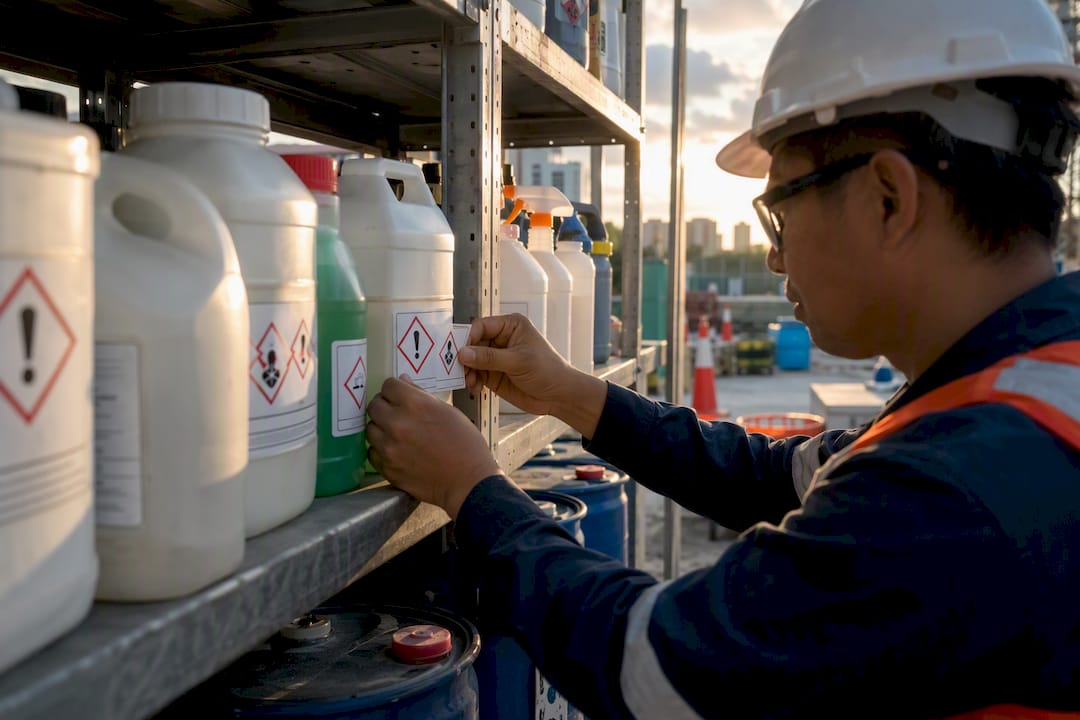
Safety monitoring gives construction teams the ability to detect hazards before they cause harm. Traditional visual inspections identify obvious physical dangers, but they miss the invisible threats that cause chronic illness and acute injury. Exposure monitoring transforms safety from guesswork to certainty by scientifically measuring worker contact with hazardous agents such as silica dust, volatile organic compounds, and excessive noise levels.
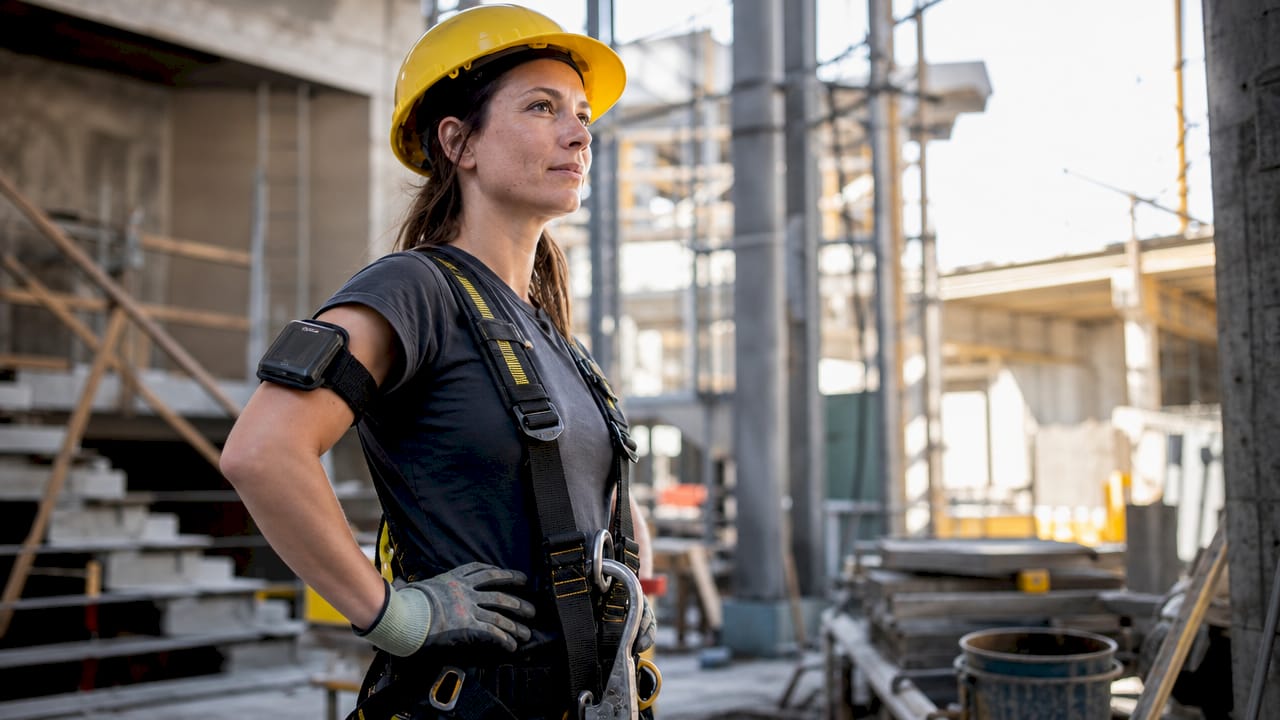
Wearable technology has expanded what monitoring can achieve on active construction sites. A May 2026 systematic review of 60 studies confirmed that wearable devices are promising for continuous biomechanical, physiological, and environmental hazard detection. That body of evidence shows that wearables can flag musculoskeletal strain patterns before a worker sustains a back injury, and can alert supervisors when a worker’s heart rate signals heat stress in real time. Com’s work with Singapore construction firms reflects this shift toward technology-assisted hazard identification.
Key hazard categories that monitoring addresses on construction sites include:
- Biomechanical risks: Wearable sensors detect repetitive motion and awkward postures that precede musculoskeletal injuries.
- Physiological risks: Heart rate and core temperature data identify heat exhaustion before collapse occurs.
- Environmental risks: Air quality sensors measure particulate matter, carbon monoxide, and noise decibels continuously. Industrial hygiene specialists note that ignoring exposure monitoring risks chronic illness and costly litigation.
- Fall hazards: Regulations require safety monitors to remain within vocal distance of workers at unprotected edges, enabling prompt hazard warnings before unsafe behavior escalates.
Pro Tip: Deploy wearable sensors on high-risk trades first, such as scaffolders and roofers, then expand the program once supervisors are trained to act on the data alerts.
How does compliance with OSHA and NIOSH standards drive monitoring adoption?
Regulatory compliance is the paramount driver of safety monitoring adoption in construction. OSHA and NIOSH frameworks do not simply recommend monitoring. They require documented evidence that hazard identification, assessment, and control occurred in a timely manner. Firms without contemporaneous records face fines, operational shutdowns, and multi-million dollar class-action lawsuits when workers develop occupational illnesses.
The compliance case for monitoring follows a clear sequence:
- Identify applicable standards. OSHA’s construction standards under 29 CFR 1926 specify exposure limits for silica, lead, and noise. Monitoring generates the measurement data needed to demonstrate compliance with those limits.
- Collect auditable records. Modern work health and safety frameworks reward contemporaneous electronic records that show timely responses to detected hazards. Paper logs do not meet the evidentiary standard that regulators and courts now expect.
- Demonstrate corrective action. A monitoring system that logs a hazard but shows no follow-up action is a liability, not an asset. The record must show that a responsible person received the alert and acted within a defined timeframe.
- Build worker trust through transparency. Documenting what data is collected, why it is collected, and when monitoring is active fosters employee acceptance and legal compliance. Workers who understand the safety purpose of monitoring are more likely to wear devices correctly and report near-misses voluntarily.
Firms that treat monitoring as a compliance tool rather than a surveillance mechanism consistently achieve higher worker participation rates. That participation is itself a compliance advantage, because regulators assess safety culture as part of enforcement decisions. Construction firms pursuing contractor safety assessment programs find that documented monitoring records significantly reduce audit exposure.
What advantages does holistic safety monitoring offer over traditional approaches?
Traditional safety monitoring focused exclusively on physical injury prevention. The holistic model, aligned with NIOSH’s Total Worker Health® principles, integrates physical, mental, and environmental health into a single monitoring framework. That integration produces measurably better outcomes because construction workers face simultaneous stressors that compound each other.
OSHA and NIOSH guidance confirms that ignoring environmental stressors such as chronic noise exposure and poor air quality contributes directly to mental fatigue and safety performance decline. A worker managing noise-induced cognitive load is more likely to misjudge distances, skip PPE steps, or miss a supervisor’s warning. Monitoring that captures only physical injury data misses that causal chain entirely.
The table below compares traditional and holistic monitoring across four operational dimensions:
| Dimension | Traditional monitoring | Holistic monitoring |
|---|---|---|
| Hazard scope | Physical injuries and equipment failures | Physical, mental, and environmental health factors |
| Data sources | Visual inspections and incident reports | Wearables, air quality sensors, noise meters, fatigue indicators |
| Intervention timing | Post-incident investigation | Pre-incident alert and corrective action |
| Compliance output | Incident logs | Auditable, real-time electronic records |
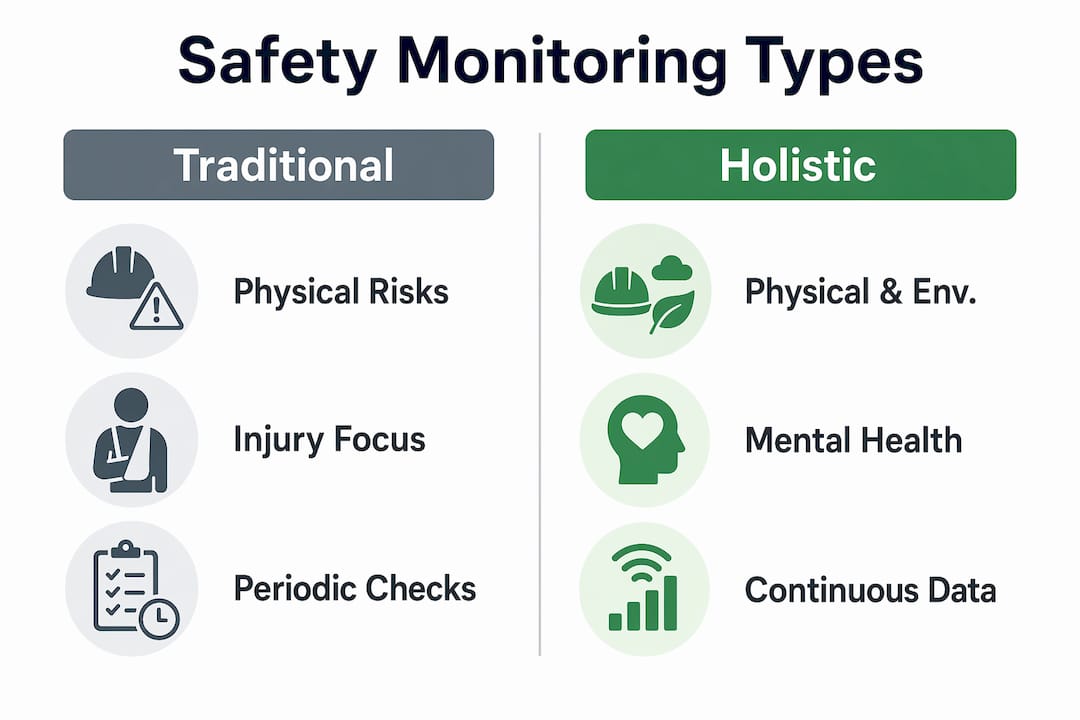
Holistic monitoring also reduces absenteeism. When air quality and noise levels are tracked continuously, site managers can rotate workers out of high-exposure zones before cumulative limits are reached. That rotation prevents both acute injury and the chronic conditions, such as noise-induced hearing loss and occupational asthma, that drive long-term absence. Holistic safety strategies that combine multiple risk factors produce more resilient safety programs. Construction firms that adopt this model report improvements in morale alongside measurable reductions in lost-time incidents.
How do real-time systems improve incident response and operational efficiency?
Real-time monitoring converts raw sensor data into assigned safety tasks within seconds. That speed is the defining advantage over periodic inspection regimes. The biggest value of real-time monitoring is the ability to assign clear responsibilities and enforce timely corrective actions. Without that assignment mechanism, alerts become noise rather than direction.
Effective real-time systems operate on event-driven workflows. When a sensor detects a threshold breach, such as particulate matter exceeding the OSHA permissible exposure limit, the system triggers an alert to a named responsible person, logs the event with a timestamp, and tracks the corrective action to closure. That chain of custody is what regulators examine during audits. It is also what defense attorneys require when a firm faces occupational illness litigation.
Key operational benefits of real-time monitoring systems include:
- Immediate hazard response: Supervisors receive location-specific alerts rather than end-of-shift reports, enabling intervention while the hazard is still active.
- Contractor governance: Monitoring data provides objective performance records for subcontractors, removing the ambiguity that typically complicates multi-party construction projects.
- Evidence trail: Electronic records with timestamps and named responders satisfy the evidentiary requirements of modern work health and safety frameworks.
- Reduced alert fatigue: Effective monitoring uses event-driven workflows with clear escalation rules, so staff receive only the alerts that require their specific action rather than a continuous stream of low-priority notifications.
Understanding how safety programs meet compliance standards helps safety managers configure alert thresholds that match both regulatory limits and site-specific risk profiles.
Pro Tip: Set escalation rules so that unacknowledged alerts automatically route to a secondary responsible person within five minutes. That single rule eliminates the most common gap in real-time monitoring programs: the alert that was received but not acted upon.
The operational efficiency gains extend beyond incident prevention. Sites with active monitoring programs spend less time on reactive investigation and more time on planned preventive maintenance. That reallocation of supervisory effort is a direct productivity benefit, not merely a safety one.
Key Takeaways
Safety monitoring is the most defensible investment a construction firm can make against regulatory liability, occupational illness, and operational disruption.
| Point | Details |
|---|---|
| Hazard detection beyond visual inspection | Wearables and air quality sensors identify biomechanical, physiological, and environmental risks that visual checks miss entirely. |
| Compliance documentation is non-negotiable | Contemporaneous electronic records showing timely corrective action are what OSHA audits and litigation defense both require. |
| Holistic monitoring reduces absenteeism | Tracking noise, air quality, and mental fatigue alongside physical risks prevents chronic conditions that drive long-term worker absence. |
| Real-time alerts require assigned ownership | An alert without a named responsible person and a closure record is a liability, not a safety control. |
| Worker transparency drives program success | Documenting what data is collected and why increases device compliance and voluntary near-miss reporting. |
What I’ve learned about making safety monitoring actually work
Safety monitoring programs fail far more often from implementation gaps than from technology limitations. The firms I have seen struggle with monitoring adoption share a common pattern: they deploy the hardware, configure the dashboards, and then neglect to tell workers what is being measured and why. That omission destroys trust faster than any privacy concern ever could.
The most effective programs I have observed treat the policy document as a foundational deliverable, not an afterthought. Workers need to know which data points are collected, who can access them, and what the data will never be used for. That clarity is not just good ethics. It is a legal requirement in most jurisdictions and a practical prerequisite for getting workers to wear sensors correctly throughout a shift.
Balancing privacy concerns with safety needs is genuinely difficult in construction, where workers often move between multiple employers and sites. The answer is not to collect less data. The answer is to be explicit about data governance from day one. Firms that publish clear monitoring policies before deployment consistently achieve higher device compliance rates than those that introduce monitoring without explanation.
My experience also shows that monitoring data is most valuable when it is reviewed weekly, not just during incidents. Weekly review cycles allow safety managers to spot trend deterioration before it reaches a threshold breach. That proactive posture is what separates firms with strong safety cultures from those that only respond after something goes wrong. Integrating wearable safety technology into a structured review cadence is the single change that produces the fastest improvement in site safety performance.
— Aman
How Com supports construction firms with safety monitoring implementation
Com, operating as MOSAIC Ecoconstruction Solutions, provides construction firms with the consultancy infrastructure needed to move from ad hoc safety checks to structured, auditable monitoring programs. The firm’s safety auditing services generate the baseline hazard data that monitoring systems require to set meaningful alert thresholds.

For Singapore construction firms navigating BizSAFE, ISO, and MOM regulatory requirements, Com’s safety audit examples demonstrate exactly how monitoring records translate into compliance evidence. The firm also provides data-driven safety consultancy that connects monitoring outputs to corrective action workflows, ensuring that every alert generates a documented response. Construction firms that want to build defensible safety programs rather than reactive ones will find Com’s integrated approach directly applicable to their compliance obligations.
FAQ
Why use safety monitoring instead of periodic inspections?
Safety monitoring provides continuous hazard detection, while periodic inspections capture only a snapshot in time. Wearables and environmental sensors identify risks between inspection cycles, when most incidents actually occur.
What regulations require safety monitoring in construction?
OSHA’s 29 CFR 1926 construction standards and NIOSH guidance both require documented evidence of hazard identification and control. Monitoring systems generate the contemporaneous electronic records that satisfy those evidentiary requirements.
How does safety monitoring reduce legal liability?
Firms with auditable monitoring records showing timely corrective actions are significantly better positioned in regulatory audits and litigation. Ignoring exposure monitoring can result in multi-million dollar class-action lawsuits and facility closures.
What is the Total Worker Health® approach to monitoring?
Total Worker Health® is a NIOSH framework that integrates physical, mental, and environmental health factors into a single safety program. Applied to monitoring, it means tracking noise, air quality, and fatigue indicators alongside traditional injury metrics.
How do you prevent alert fatigue in real-time monitoring systems?
Configure event-driven workflows with clear escalation rules so that staff receive only alerts requiring their specific action. Unacknowledged alerts should automatically route to a secondary responsible person within a defined timeframe to close the response gap.