
Safety documentation is the formal collection of policies, procedures, checklists, and incident reports that proves a workplace has established and enforced its health and safety processes. For construction professionals and safety officers, this body of records functions simultaneously as legal evidence and as a live risk management system. Regulatory frameworks such as OSHA define minimum documentation requirements, and the absence of required written programs is itself a citable violation. Understanding what is safety documentation, and maintaining it correctly, separates compliant, high-performing sites from those exposed to fines, repeat incidents, and project shutdowns.
What is safety documentation and how is it defined?
Safety documentation is defined as the formal evidence of compliance including policies, procedures, checklists, and incident reports that demonstrate health and safety processes are in place and being followed. The term “safety documentation” is widely used in practice, while the recognized industry term within formal safety management systems is “occupational health and safety records” or “HSE records.” Both terms describe the same body of material, and construction professionals should be comfortable using either when engaging with regulators or auditors.
The scope of safety documentation extends well beyond a binder of forms on a site office shelf. These records constitute the evidentiary backbone of a safety management system, providing proof that hazards were identified, controls were applied, workers were trained, and incidents were investigated. Without this paper trail, a site cannot demonstrate compliance to the Ministry of Manpower, OSHA, or any equivalent statutory authority during an inspection or audit.

What are the key types of safety documentation used in construction?
Safety documentation spans five categories: postings and notices, written programs and procedures, operational forms and checklists, incident and near-miss records, and recordkeeping logs. Each category serves a distinct compliance and operational function on a construction site.
| Document type | Primary purpose | Construction examples | Regulatory relevance |
|---|---|---|---|
| Postings and notices | Inform workers of rights and hazards | Emergency contact boards, OSHA poster | Mandatory display under statutory law |
| Written programs and procedures | Define how safety is managed | Confined space entry program, fall protection plan | Required written programs under OSHA standards |
| Operational forms and checklists | Verify tasks are performed safely | Risk Assessments, Safe Work Method Statements | Must be completed before work begins |
| Incident and near-miss records | Document events for investigation | Incident report forms, near-miss logs | Required for regulatory reporting and trend analysis |
| Recordkeeping logs | Track compliance over time | OSHA 300 log, training attendance registers | Mandatory retention periods apply |
Construction projects carry specific obligations that other industries do not. Risk Assessments and Safe Work Method Statements must be completed before work begins, communicated to workers, and retained in the Health and Safety File passed to clients at project close. This handover requirement means documentation is not just a site-level obligation. It follows the project through its entire lifecycle.
The subcontractor safety onboarding checklist is another document category that construction safety officers frequently overlook. Subcontractors bring their own workforce onto a site, and without documented onboarding, the principal contractor cannot verify that those workers received site-specific safety inductions.
Why does safety documentation matter for compliance and risk management?
Effective safety documentation demonstrates legal compliance and functions as a risk management tool, directly correlating with improved safety outcomes and audit success. Regulators do not accept verbal assurances during inspections. They examine records. A site that cannot produce a signed Risk Assessment or a completed inspection log is treated as a site that did not perform those activities.
The operational value of good records extends beyond audit preparation. Detailed records of trainings, inspections, and incidents enable proactive safety management by identifying training gaps and program weaknesses before they produce injuries. A pattern of near-miss reports in a specific work zone, for example, signals a hazard that requires immediate intervention. Without those records, the pattern remains invisible.
Documentation also protects sites during worker turnover. Accessible and clear documentation prevents the unraveling of safety culture across shifts and teams. When a new crew arrives on site, the written procedures, posted notices, and completed checklists carry the institutional knowledge that departing workers take with them.
The consequences of poor or missing documentation are concrete:
- Regulatory fines for absent written programs, even when no actual hazard exposure occurred
- Repeat violation classifications that carry higher penalties on subsequent inspections
- Increased incident rates attributable to untracked hazards and unverified training
- Loss of BizSAFE certification or equivalent accreditation, which affects contract eligibility in Singapore
Pro Tip: Keep all safety documents in a single indexed location, whether physical or digital, so any authorized person can retrieve a specific record within two minutes during an unannounced inspection.
What are common mistakes in managing safety documentation?
Common documentation errors include incomplete incident reports, lack of inspection logs, unverified training records, and inconsistent hazard assessments. Each of these gaps creates a specific legal and operational liability for the construction organization.
-
Incomplete incident reports. An incident report that records the injury but omits the root cause analysis is legally and operationally useless. Regulators expect a documented investigation chain from event to corrective action.
-
Unverified training records. A training attendance register without signatures or competency assessments does not prove that workers understood the content. Verification is the difference between a record and evidence.
-
Missing inspection and maintenance logs. Plant and equipment inspections are mandatory under most statutory frameworks. A gap in the log creates the presumption that the inspection did not occur.
-
Invalid or absent signatures. The absence of valid signatures can cause documentation to be deemed legally invalid during inspections. Authorized approval is not a formality. It is a legal requirement.
-
Overreliance on paper systems. Paper records are vulnerable to loss, damage, and unauthorized alteration. Digital platforms such as SafetyCulture and Cority standardize forms and create secure, timestamped audit trails that paper cannot replicate.
-
No assigned accountability. When documentation responsibility is diffuse, records fall through the cracks. Every site needs a named individual accountable for each document category.
Pro Tip: Schedule a monthly internal documentation audit using a fixed checklist. Assign a safety officer to verify that every required record is present, signed, and current before the end of each calendar month.
How to implement effective safety documentation practices on construction sites
Construction sites that treat documentation as a live operational system, rather than a compliance exercise, consistently outperform those that do not. The following practices build that system from the ground up.
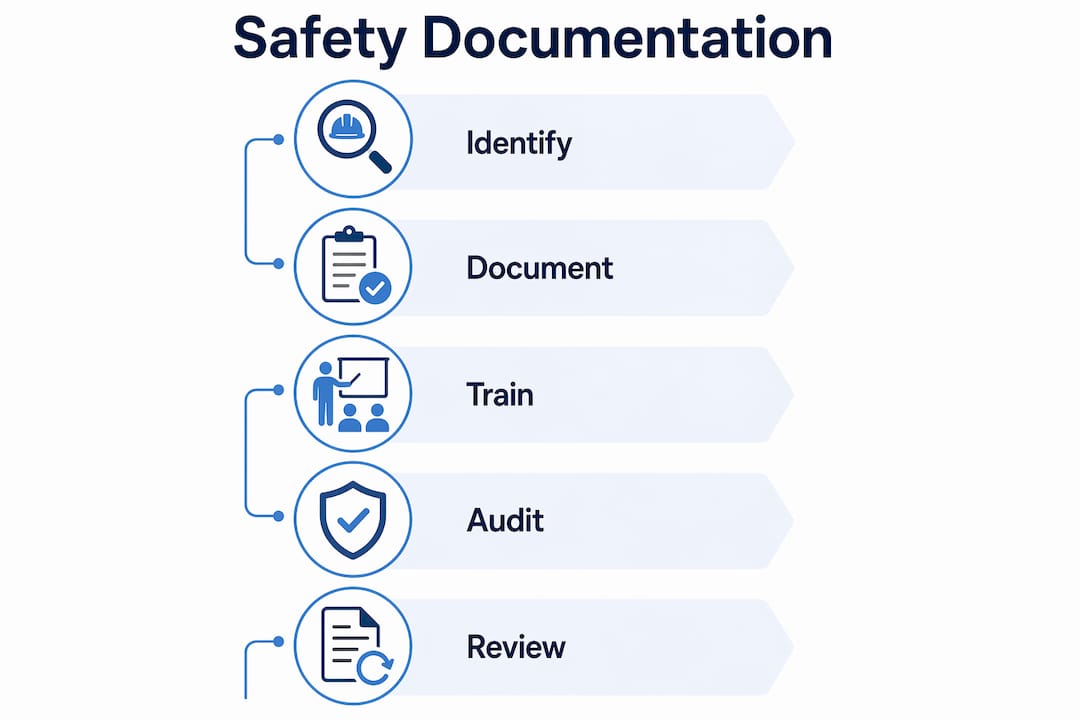
Establish clear roles and responsibilities. Every document category needs a named owner. The site safety officer typically owns incident reports and inspection logs. Supervisors own pre-task checklists. Project managers own the Health and Safety File. Ambiguity in ownership produces gaps.
Use standardized, user-friendly templates. Forms that are difficult to complete are forms that get completed incorrectly or not at all. Standardized templates reduce cognitive load and ensure that every required field is captured consistently across the project. A construction safety program built on standardized documentation is far easier to audit and defend.
Incorporate digital tools for consistency and audit trails. Platforms such as SafetyCulture and Cority eliminate version control problems and ensure that completed forms are stored securely with timestamps and user identifiers. Electronic signatures with audit trails are becoming best practice for verifying the legal validity of safety records.
Train all personnel on documentation procedures. Workers who understand why a checklist matters complete it more accurately than workers who view it as administrative overhead. Training should cover not just how to fill out a form, but what happens when the form reveals a hazard.
Review and update documents regularly. A Safe Work Method Statement written at project inception may not reflect current site conditions six months later. Scheduled reviews, triggered by scope changes, incidents, or regulatory updates, keep documentation accurate and defensible.
Transfer documentation at project handover. The Health and Safety File must be passed to the client at project close. This transfer is a regulatory requirement, not a courtesy. Missing documentation at handover creates liability for both the contractor and the client.
Pro Tip: When onboarding subcontractors, require them to submit their own Risk Assessments and Safe Work Method Statements before mobilization. Review these against your site-specific construction hazard requirements and reject any document that does not meet the standard.
Key takeaways
Safety documentation is the evidentiary foundation of every compliant construction site, and gaps in that foundation produce regulatory, financial, and human consequences that no project can afford.
| Point | Details |
|---|---|
| Definition is precise | Safety documentation covers policies, procedures, checklists, incident reports, and recordkeeping logs. |
| Five document categories | Postings, written programs, operational forms, incident records, and logs each serve distinct compliance functions. |
| OSHA written programs are mandatory | The absence of a required written program is a citable violation, independent of actual hazard exposure. |
| Signatures carry legal weight | Missing or unauthorized signatures can render a safety record legally invalid during an inspection. |
| Digital tools reduce risk | Platforms like SafetyCulture and Cority create timestamped audit trails that paper systems cannot provide. |
Documentation as the backbone of site safety culture
The most persistent misconception I encounter in construction safety is that documentation is a bureaucratic obligation separate from actual safety performance. That view is wrong, and it is expensive. Every major site incident I have analyzed traces back to a documentation failure: a Risk Assessment that was never updated after a scope change, a training record that showed completion but not comprehension, an inspection log with a three-week gap that nobody noticed until after the equipment failed.
The sites that perform best on safety audits are not the ones with the thickest binders. They are the ones where every supervisor can explain what each form is for and where to find it. Documentation without understanding is just paper. The combination of clear records and a workforce that knows how to use them is what actually prevents incidents.
Construction safety officers should resist the temptation to treat documentation as a project-end activity. Records created in real time, at the point of task execution, are more accurate, more defensible, and more useful for identifying emerging hazards than records reconstructed after the fact. Build the habit of contemporaneous documentation into every site routine, and the compliance outcomes follow naturally.
— Aman
How Com supports construction safety compliance

Com, operating as MOSAIC Ecoconstruction Solutions, specializes in helping construction companies build and maintain the documentation systems that regulators expect and auditors examine. From written safety programs and Risk Assessment templates to full BizSAFE certification support, the consultancy provides structured guidance at every stage of a project’s safety lifecycle. Construction professionals who need expert support with safety consultancy for compliance can engage Com’s team directly. For organizations preparing for formal reviews, Com’s safety audit examples provide a practical benchmark for what compliant documentation looks like in practice.
FAQ
What is the definition of safety documentation?
Safety documentation is the formal collection of policies, procedures, checklists, and incident records that proves a workplace has established and enforced its health and safety processes. It serves as both legal evidence of compliance and an operational risk management tool.
What types of safety documents are required on construction sites?
Construction sites require postings and notices, written safety programs, operational checklists such as Risk Assessments and Safe Work Method Statements, incident and near-miss records, and recordkeeping logs such as the OSHA 300 log. These documents must be maintained and transferred to the client in the Health and Safety File at project close.
Why does OSHA require written safety programs?
OSHA mandates written safety programs under specific standards because the absence of a required written program is itself a citable violation, regardless of whether a hazard actually caused harm. Written programs define minimum required elements and create an enforceable standard for site safety management.
What happens if safety documentation is incomplete or missing?
Incomplete or missing safety documentation leads to regulatory fines, repeat violation classifications, and increased incident rates from untracked hazards. It can also result in the loss of certifications such as BizSAFE, which directly affects a contractor’s eligibility for projects in Singapore.
Are electronic signatures valid on safety records?
Electronic signatures with audit trails are legally valid and are becoming best practice for safety documentation management. They provide verifiable timestamps and user identifiers that paper signatures cannot, making them more defensible during regulatory inspections.