
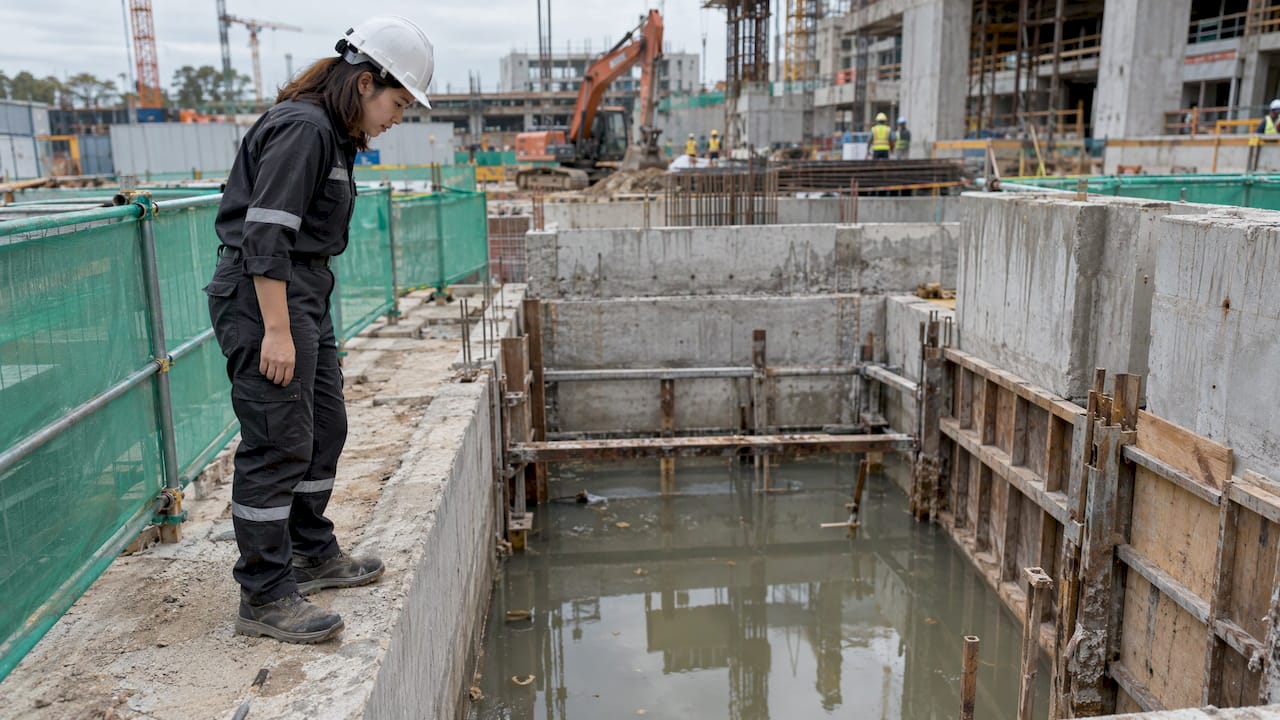
Vector control on a Singapore construction site means one thing in practice: finding and removing mosquito breeding every week, treating what cannot be removed, engaging an NEA-registered Vector Control Operator from the start of the project, and keeping records that show it. A site that cannot show this risks fines and a Stop Work Order. Below is what the National Environment Agency (NEA) requires, where breeding hides on a live site, how to run the weekly routine, and how to keep the documentation inspection-ready. Our EHS advisory and WSH audit teams work on exactly this kind of site-level compliance.
TL;DR
- NEA requires weekly checks for mosquito breeding and weekly treatment of stagnant water, with reapplication after rain.
- Comprehensive vector control must be engaged from the start of the project, through a competent NEA-registered Vector Control Operator, at least once a week.
- Source reduction and drainage come first. Larvicide and anti-mosquito oil supplement them. Fogging is not mandatory.
- Lapses bring fines of $3,000 for a first offence and $5,000 for repeat offenders, and can lead to Stop Work Orders and court action.
- Records of the programme and of every operator service report are part of compliance, not an afterthought.
Table of Contents
- Why NEA watches construction sites closely
- What NEA requires of a contractor
- Who is responsible, and what they must be able to show
- Where breeding hides on a construction site
- A weekly routine that works
- What happens when the routine slips
- Fitting vector control into the site safety system
- How we support the programme
- Frequently asked questions
- Sources
Why NEA watches construction sites closely
NEA states that construction sites can easily become foci of dengue transmission and that the industry has an important role in curbing it, for the sake of workers and of residents around the site. A site produces what Aedes mosquitoes need: standing water in excavations, formwork, sheeting, drums and left-over containers, often untouched for days.
The numbers show the pressure on contractors. In 2025, NEA took about 810 fines and 37 Stop Work Orders against construction sites, and 73 contractors were charged in court for repeat offences. The year before, it issued about 748 fines and 61 Stop Work Orders, with 79 contractors charged for repeat offences.
There is also good news. Sites share of breeding has fallen: NEA reported that, with industry effort led together with the Singapore Contractors Association Ltd, the proportion of sites found with mosquito breeding dropped from 11 per cent in 2013 to six per cent in 2019. In dengue cluster areas in 2025, about 4 per cent of Aedes breeding detected was at construction sites, against about 65 per cent in homes. A disciplined site stays in the low-risk group, and the weekly routine is how it gets there.
Transmission is seasonal. NEA notes that the warmer months from May to October usually see higher dengue transmission, because the mosquito develops faster and the virus multiplies faster in it. The programme must be running before that period, not started when it begins.

What NEA requires of a contractor
The requirements come from two NEA documents: the construction-site guidance and the Code of Practice for Environmental Control Officers. Taken together, they ask for the following.
- Weekly inspection. NEA requires weekly checks for mosquito breeding in the site areas it lists and in all water-holding places.
- Weekly treatment. Insecticide or anti-malaria oil goes onto stagnant water and water-bearing containers at ground level and on upper floors every week, and again after rain.
- A competent operator from day one. The Occupier must engage a competent NEA-registered Vector Control Operator (VCO), and comprehensive vector control services must run from the start of the project at least once a week.
- Fogging only when needed. Fogging is not mandatory. It is for a mosquito nuisance problem or a disease outbreak.
- Residual spraying in specific cases. Walls of site offices and bangsals are sprayed in malaria-sensitive areas or when NEA instructs.
If your site works with Land Transport Authority (LTA) projects, the bar is explicit. LTA requires contractors to submit a vector control plan before starting work. The plan covers an in-house vector control team, an external operator, source reduction and effective drainage as the main controls, zoning, larvicide or anti-mosquito oil, a mass carpet combing of the site at least once a week, and close monitoring of dengue and Zika case status.
Who is responsible, and what they must be able to show
The Code of Practice puts the duty on two parties: the Environmental Control Officer (ECO(SCS)) and the Project Manager or Occupier. They should identify high-risk areas and operations at each project stage and draw up and implement an effective vector control programme. The Project Manager or Occupier keeps records of the programme and the operator’s service reports, and evaluates the operator’s performance regularly. The scheme sits under the Environmental Public Health Act 1987, and failing to comply with the Act or its subsidiary legislation is an offence for either party.
The contractor also needs to know who may legally do the work. NEA’s code for operators states that companies undertaking vector control works must be registered as Vector Control Operators, and the employees doing the work must be licensed as Vector Control Technicians or certified as Vector Control Workers. Registration requires ACRA registration, at least one dedicated technician with three consecutive years of recent experience, and a $99 registration fee. Engaging a registered operator is a step the regulation assigns to the occupier, so it is part of the process, not an option. What stays with you is everything around that engagement: the programme design, the site routine between visits, the records and the performance review.
Where breeding hides on a construction site
NEA lists the places to check. Use the list as the spine of your inspection form.
| Area | What to look for |
|---|---|
| Worksite, bangsal area and site offices | Unused containers and building waste |
| Materials and plant | Building materials, canvas sheets, equipment and machinery that hold water |
| Floors | Puddles on the ground and on upper-level and basement concrete floors |
| Water storage | Drums, tanks and containers |
| Waste | Bulk waste containers |
| Excavation and structure | Trenches, lift wells, safety barriers |
| Roof level | Rooftops and water tanks |
| Other | Treatment plants and any other container |
Most of these appear in the NEA guidance for construction sites. One item is routinely missed at the perimeter. LTA’s guidebook points out that water-filled barricades outside the site are often neglected during inspections, that openings in them collect water and breed mosquitoes, and that barricades damaged beyond repair must be replaced by the contractor.
Perforated bricks are another trap. The Code of Practice says sand granular insecticide should go onto water collected in perforated bricks, and exposed brick holes should be sealed with cement.
Breeding sources are a housekeeping matter first. Our guide to construction hazard examples shows how the same habits that control falling objects and tripping hazards also keep water from pooling.
A weekly routine that works
A routine has to survive a busy week of concrete pours, deliveries and subcontractor turnover. This is how to structure it.
1. Set the programme before mobilization
Draw the site plan and mark the high-risk areas for each project stage: excavation, substructure, superstructure, fit-out. The risk moves as the building rises, so the programme is reviewed at each stage. Appoint the person accountable and the registered operator at the same time, since NEA wants the operator in place from the start.
2. Divide the site into zones
The Code of Practice recommends splitting the worksite into zones by number of workdays: a maximum of 6 zones for a 6-day week or 7 for a 7-day week, with the in-house Environmental Control Team covering one zone each day. The result is that every zone is walked once a week, and nobody has to clear the whole site in one afternoon.
3. Put source reduction first
LTA states that source reduction and effective drainage shall be the main forms of mosquito control, and that environmentally friendly applications such as Bacillus thuringiensis israelensis (Bti) shall be used as far as possible to supplement it. In practice: grade surfaces so puddles drain, tip and turn over containers, cover or invert drums, remove waste, flatten sheeting so it does not pool, and clear gutters and rooftop depressions.
4. Treat what you cannot remove
Water that must stay, such as storage tanks you cannot empty or sumps, is treated with NEA-registered larvicide or anti-mosquito oil at least weekly and after wet weather. Rain resets the clock, so build a rule: after heavy rain, the next morning’s first task is a re-walk of the low-lying zones.
5. Match manpower to site size
NEA gives a useful planning figure: a team of two can inspect and spray an area within a 30-metre radius in a day, including all upper floors, and bigger sites may need more than one operator to cover the whole footprint. Use that figure when you scope the operator contract and decide whether your in-house team can cover its own zones.
6. Brief the workforce
Most breeding on site is created by ordinary work: a cut-off bucket, a tarpaulin fold, a drum left out. NEA has produced educational materials in various languages for foreign workers, distributed to construction sites and dormitories, to help supervisors educate workers about dengue. Fold this into toolbox meetings, and use the B-L-O-C-K steps and S-A-W actions that NEA promotes in the dengue season.
7. Record everything
Keep the inspection sheets by zone and date, the operator’s service reports, treatment logs, corrective actions and your own evaluation of the operator. These are exactly the records the Code of Practice expects the Project Manager or Occupier to hold.
What happens when the routine slips
NEA says it takes stringent action on poorly maintained sites that favor mosquito breeding, including Stop Work Orders and court prosecutions. During a Stop Work Order, only corrective actions are allowed. The contractor must review the effectiveness of the site’s sanitation and vector control programmes, and the order is lifted only when NEA is satisfied the measures are complete. Every day under an order is a day of idle labor, plant and sequencing delays.
The financial penalties are the smaller cost. Construction sites face $3,000 for a first offence and $5,000 for repeat offenders. Court charges for repeat offences are the next step, and the NEA figures above show that dozens of contractors reach it each year. NEA has also stepped up construction site inspections and publishes information on areas with higher Aedes populations, so a site in a high-density area is more likely to be visited.
A site is often inspected for several things at once. Vector control sits within the broader environmental obligations covered in our environmental compliance guide for Singapore construction projects, and the regulatory context is laid out in the WSH construction sector regulation guide.

Fitting vector control into the site safety system
Vector control fails when it lives as a separate chore. It works when it is a line in the safety management system: a named owner, a weekly slot in the inspection schedule, a form that sits beside the housekeeping checklist, and an escalation path when a finding is not closed. That is the logic of an integrated workplace safety and health management system, and it is also the logic of a good risk assessment, where standing water and vector-borne disease are listed as site hazards with controls, owners and review dates.
Heavy rain, flooding and emergency scenarios also change the picture, since a flood leaves pooled water across several zones. Your emergency preparedness plan should include a post-event re-inspection.
How we support the programme
Our EHS Advisory and Documentation service helps structure the site programme, inspection forms and record-keeping so they fit your wider safety system. Our WSH Audit and Inspection service reviews how the site is actually run against its documented procedures, which is where weekly routines tend to drift. For sites that lack in-house capacity, we also offer EHS manpower outsourcing and training for supervisors and workers. If you want to see where your site stands before the next inspection season, contact us through our EHS Advisory and Documentation page.

With more than 20 years of experience and a multi-industry consultant team, we tailor each engagement to the site rather than hand over a generic template.
Our view: treat vector control as a management system, not a spray schedule
In our work with construction firms, the pattern we expect to see in any compliance program is the same: the technical measure is rarely the weak point. The weak point is ownership. A registered operator can treat water every week, yet a site still fails when nobody has closed out the barricade that holds water, nobody has recorded the corrective action, and the next stage of construction creates new risk the programme never anticipated.
For that reason we argue that vector control belongs inside the same statutory framework that governs the rest of site safety and environmental management. The hierarchy that safety professionals apply to falls and lifting also applies here: eliminate the source first through drainage and housekeeping, then control what remains, and keep evidence of both. NEA and LTA say the same thing when they put source reduction ahead of chemical treatment.
Documentation is the second argument. The Code of Practice assigns the Project Manager or Occupier a clear duty to hold records and to evaluate the operator. A contractor who can open a folder and show zone-by-zone inspections, treatment logs and closed actions is in a different position at inspection from one who relies on the operator’s invoice. That is the discipline our advisory, audit and training services are built to support.
The sites that avoid Stop Work Orders are the ones that plan for the rainy weeks before they arrive.
Aman
Frequently asked questions
Do we have to hire a registered Vector Control Operator for every construction site?
NEA’s Code of Practice states that the Occupier must engage a competent NEA-registered Vector Control Operator and that comprehensive vector control services must be engaged from the start of the project and carried out at least once a week. Only companies registered with NEA as VCOs can be engaged for vector control works.
Is fogging required on a construction site?
No. NEA says fogging is not mandatory and should be done only when there is a mosquito nuisance problem or a disease outbreak. Weekly checks, source removal and treatment of stagnant water are the baseline requirement.
How often must stagnant water be treated?
At least once a week, and again after rain. NEA asks for insecticide or anti-malaria oil on stagnant water and water-bearing containers at ground level and on upper floors, and the Code of Practice repeats the weekly and after-wet-weather rule.
What happens if NEA finds mosquito breeding on my site?
The site can face fines, a Stop Work Order and, for repeat offences, a court charge. Reported fines for construction sites are $3,000 for a first offence and $5,000 for repeat offenders. Under a Stop Work Order only corrective work is allowed until NEA is satisfied.
Which areas of a site are most often missed?
Water-filled barricades outside the site, rooftops and water tanks, lift wells, trenches, and puddles on upper-level and basement slabs. Build each into the weekly inspection form for its zone.
Sources
- NEA: Mosquito Control in Construction Sites
- NEA: Code of Practice for Environmental Control Officers (5th edition)
- NEA: Code of Practice for Vector Control Operator, Technician and Worker
- NEA: Vector Control Operator, Vector Control Technician and Vector Control Worker
- NEA: Stop Work Orders
- NEA: Construction sites and good housekeeping against mosquito breeding
- NEA: Singapore enters peak dengue season
- NEA: Dengue outbreaks averted in 2023 and 2024
- The Straits Times: Dengue cases drop in Singapore
- LTA: Environmental Protection
- LTA: Vector Control at LTA Sites
- LTA: Guidebook for Best Environmental Practices