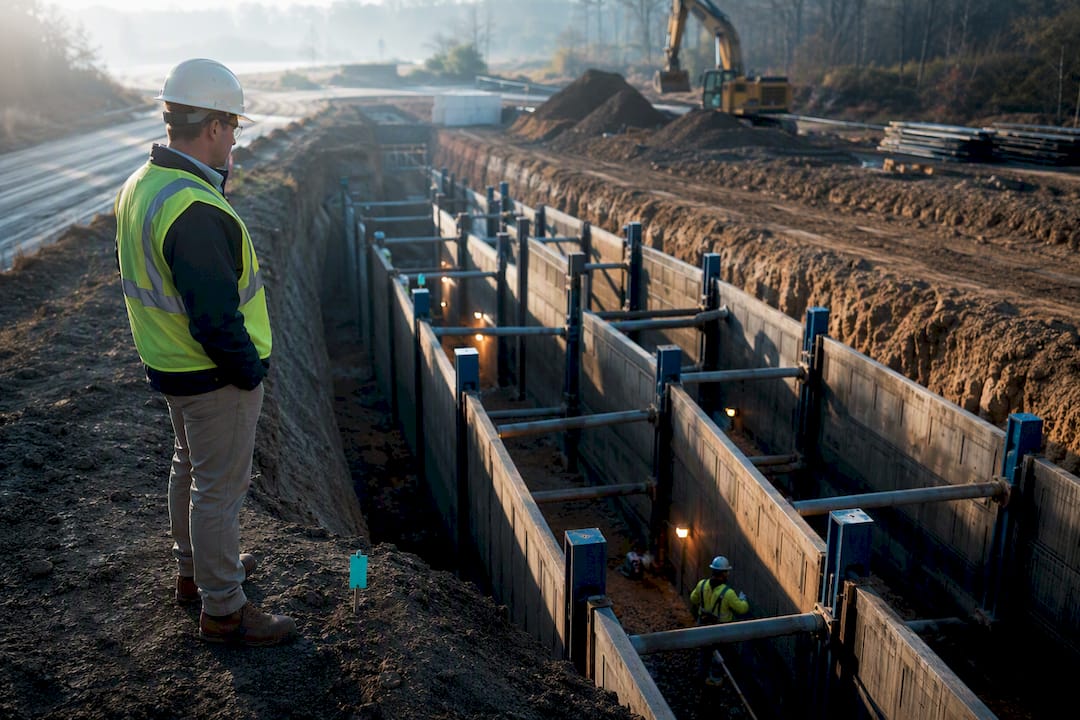
Any scaffold work in Singapore falls under the Workplace Safety and Health (Scaffolds) Regulations 2011 and the technical benchmark of SS 659:2020. Before a single frame goes up, confirm three things: whether the contractor holds valid Approved Scaffold Contractor (ASC) registration, whether a Professional Engineer’s design and sign-off exist for any scaffold that requires one, and whether the structure carries a current inspection tag backed by an active register. If any of those three is missing or unverifiable, work stops until it is resolved.
TL;DR:
- Contractors must verify that scaffold structures have valid inspection tags, are designed or signed-off by a PE when required, and carry current registration and certification before work begins.
- The Approved Scaffold Contractor registration is mandatory for most non-trivial scaffolding jobs, requiring evidence of staff training and BizSAFE Level 3 certification, which must be maintained to keep the registration active.
- SS 659:2020 provides detailed technical standards for materials, connections, platform dimensions, and load limits, and must be strictly followed or certified by a PE for complex or tall structures.
- Inspection and tagging must be performed at regular intervals, especially after severe weather or modifications, with inspector details and dates clearly recorded in a register; expired inspection tags mark a scaffold as unsafe.
- Personnel performing scaffold work must hold valid competency certificates, use appropriate PPE with properly rated anchor points, and follow approved erection and dismantling sequences documented in method statements to prevent failures and violations.
Table of Contents
- Quick Compliance Checklist for Safety Officers and Contractors
- Approved Scaffold Contractor (ASC) Registration: Requirements and Process
- SS 659:2020 Code of Practice: Key Technical Points That Support the Regulations
- Inspection, Labelling, and Record-Keeping: What to Verify
- Design Rules and PE Requirements for Metal and Suspended Scaffolds
- Training and Competency for Scaffold Supervisors and Erectors
- Enforcement, Common Noncompliances, and Penalties
- Practical On-Site Compliance Checklist and Templates
- How Com Supports Scaffold Compliance in Singapore
- Safety Measures for Bamboo and Other Non-Metal Scaffold Types
- Guidelines on Scaffold Erection and Dismantling Methodologies
- PPE Requirements for Scaffolding Work
- Roles and Responsibilities Across the Scaffolding Chain
- What to Prioritize on Singapore Sites
- MOSAIC Compliance Support: Audits, Training, and BizSAFE Readiness
- Primary Laws, Standards, and MOM Circulars to Consult
- Sources
Quick Compliance Checklist for Safety Officers and Contractors
Every mobilization should start with paperwork, not scaffolding poles. Before crews touch a single coupler, safety officers should have these items in hand.
- ASC certificate: verify registration number and confirm it is current, not expired or under review.
- Supervisor and erector certificates: check names against the crew actually on site, not just the tender submission.
- PE drawings and certification: required for tall metal scaffolds and all suspended scaffold outriggers.
- Inspection tags and register: every scaffold in use needs a visible tag stating its status and the register entry that matches it.
- SOPs and method statements: erection, use, and dismantling sequences should be documented, not assumed.
On the technical side, check tower scaffold tie points against height and base ratio limits, and confirm base plates or sole boards are rated for the load and ground conditions described in the WSH (Scaffolds) Regulations 2011 and SS 659:2020. Anything that doesn’t add up gets escalated to the Ministry of Manpower (MOM) through the project’s WSH coordinator, and every document reviewed should be filed, not just glanced at.
Pro Tip: Keep a photo log of every inspection tag you check on site visits. When MOM asks for evidence of due diligence months later, a dated photo beats a memory every time.
Approved Scaffold Contractor (ASC) Registration: Requirements and Process
Any company erecting or dismantling scaffolds in Singapore, other than simple tower or trestle scaffolds under 4 meters, must register as an Approved Scaffold Contractor. That exemption catches out a surprising number of small subcontractors who assume “just a small tower” means no registration at all; the 4 meter threshold is measured precisely, not estimated on site.
The application itself is a five-step process:
- Submit the application to MOM with a processing fee.
- Provide staffing evidence: a minimum number of scaffold supervisors and scaffold erectors meeting regulatory training requirements, each holding acceptable training certificates.
- Attach an auditor declaration covering risk assessments and standard operating procedures.
- Demonstrate bizSAFE Level 3 or higher certification, since ASC validity is conditional on maintaining it.
- Wait for the official processing period for processing before the registration is confirmed.
Once granted, ASC status remains valid subject to maintaining required bizSAFE certification and ongoing compliance. That’s a meaningful commitment, not a one-time hurdle: a contractor with BizSAFE Level 3 lapse loses ASC standing along with it. MOM can also reject or revoke an application where the contractor has accumulated a certain number of scaffold or work-at-height related fines within a regulatory timeframe, or has prosecutions pending.
Safety officers vetting a contractor should ask for the ASC certificate number directly, not just a claim of registration, and cross-check the staffing minimums against who is actually deployed on site. A contractor that meets the paper minimum on their application but sends fewer supervisors to the job is already out of compliance before the first scaffold goes up.
SS 659:2020 Code of Practice: Key Technical Points That Support the Regulations
SS 659:2020 is Singapore’s recognized technical benchmark for scaffold design, materials, and erection practice, and it works alongside the Regulations rather than replacing them. The Regulations set the legal duties; SS 659 tells you how to satisfy them. The 2020 edition replaced the older CP 14:1996 and expanded scope to include aluminium mobile towers, aligning local practice with references from SS 311 and various BS/EN standards.
What the code actually specifies matters more to a site audit than its history:
- Material and connection standards: tube, coupler, and board specifications must meet stated load and corrosion tolerances.
- Platform requirements: working platforms need minimum width, toe boards, and guardrail heights depending on fall risk.
- Tower scaffold limits: height-to-base ratio restrictions govern when a freestanding tower requires additional stability measures.
- Tie, transom, and spigot/jointpin requirements: every connection point has a specified method, not an improvised one.
In MOM investigations following an incident, following SS 659 is often treated as evidence that reasonable precautions were taken. That is not a guarantee against liability, but it shifts the burden of the argument considerably in the contractor’s favor.
Proprietary and mobile towers are acceptable under SS 659 when used within the manufacturer’s rated limits and the code’s height and base parameters. Once a scaffold exceeds those parameters, whether through height, loading, or unconventional configuration, the requirement shifts from “follow the code” to “get a Professional Engineer to certify the specific design.” Contractors who treat SS 659 as optional guidance rather than the working standard tend to be the ones caught short during an audit.
Inspection, Labelling, and Record-Keeping: What to Verify
Regulation 26 of the WSH (Scaffolds) Regulations requires inspection before a scaffold is first used, and thereafter at intervals not exceeding the legally defined maximum inspection interval. Inspection is also mandatory after any weather exposure severe enough to affect stability, or after any modification to the structure. Miss that 7 day window and the scaffold is technically noncompliant even if nothing looks wrong to the eye.
Labelling is where enforcement gets practical fast:
- A scaffold tag should state whether the structure is safe for use, incomplete, or unsafe.
- The tag needs the inspecting officer’s name and the date of inspection, not a blank template left over from the last job.
- An unlabelled scaffold is treated by MOM inspectors as off limits by default, regardless of how it actually looks.
The inspection register is the paper trail behind every tag: it should record the scaffold’s location, inspection date, inspector’s name, findings, and any corrective action taken. During an audit, safety officers should pull the register and cross-check every active scaffold on site against a corresponding entry, not just trust that the tags are up to date.
Pro Tip: If a scaffold’s tag date is more than the legally defined maximum inspection interval old, treat it as unsafe on sight, not “probably still fine.” That single habit catches the majority of lapses before an inspector does.
Design Rules and PE Requirements for Metal and Suspended Scaffolds
Metal scaffolds above a certain height trigger mandatory Professional Engineer design and certification, with the threshold set differently depending on the workplace category (general workplaces sit at a different height trigger than shipyards, reflecting the added structural and load demands of marine work). Occupancy and load also factor in: a scaffold carrying heavy material storage or supporting other trades may need PE sign-off well below the height trigger.
Suspended scaffolds carry a separate and stricter set of obligations. Under a 2025 MOM circular, outriggers and overhead supports must be Professional Engineer designed, referencing SS 598:2014, with authorized examiner (AE) testing and a site-specific layout plan completed before first use. Don’t accept a verbal assurance that “the design is standard” on a suspended rig; the circular exists precisely because failures traced back to improvised outrigger setups without proper design review.
What to check on the drawings themselves:
- PE name, registration number, and signature date on the design document.
- AE test certificate matching the specific installation, not a generic template reused across sites.
- Site layout plan showing anchor points and load paths particular to that location.
- Confirmation that PE inspection frequency matches the risk category, particularly for suspended scaffolds subject to repeated repositioning.
A useful benchmark for judging urgency: MOM’s circular guidance ties directly to documented accident cases where missing PE design or improper outrigger installation caused structural failure, which is why the outrigger requirement now sits above general scaffold rules rather than folded into them.
Training and Competency for Scaffold Supervisors and Erectors
Certificates matter more than years on the job when it comes to satisfying MOM’s competency requirements. Acceptable qualifications include the WSQ Perform Metal Scaffold Erection course, WSQ Supervise Metal Scaffold Erection, and separate courses covering suspended scaffold supervision and rigging.
- Supervisors need documented experience and current WSQ certification; ASC applications require named supervisors, not generic staffing numbers.
- Erectors must be directly employed by the ASC-registered contractor, not subcontracted labor working under someone else’s registration.
- Foreign workers need certificates that are verifiable and linked to a valid NRIC or Work Pass, since an overseas qualification alone does not satisfy MOM’s competency standard.
Verification should be routine, not occasional. Request copies of every certificate before the crew starts, check names against MOM’s worker training record system, and flag any mismatch between the person on the certificate and the person actually on the platform. A skilled scaffolder with an expired or unlinked certificate is, on paper, no different from an untrained one.
Enforcement, Common Noncompliances, and Penalties
The contraventions that draw MOM’s sharpest response are rarely exotic. They are the basics done poorly: an unlabelled or improperly tagged scaffold, missing PE documentation on a structure that required it, and erectors or supervisors who can’t produce valid training certificates when asked.
- Unlabelled scaffolds are among the most common findings during site inspections and typically trigger immediate stop-work orders.
- Missing PE evidence on tall metal or suspended scaffolds can lead to fines and, in serious cases, prosecution.
- Untrained personnel on site exposes both the contractor and the principal employer to liability.
ASC-registered contractors face an added layer of scrutiny: accumulating multiple scaffold-related fines within a 12-month window puts registration itself at risk, which then affects a contractor’s eligibility for future tenders. Project owners increasingly check ASC standing before award, so a compliance lapse on one job can cost work on the next.
Mitigation comes down to habit more than heroics. Proactive internal audits, documented corrective actions with dates and names attached, and a clear internal reporting line for near misses catch problems before MOM does.
Pro Tip: Document every corrective action the moment it happens, even minor ones. A pattern of self-reported fixes is one of the strongest things a contractor can show an inspector during a dispute.
Practical On-Site Compliance Checklist and Templates
A pre-mobilization document sets the tone for the entire job. Before scaffolding materials arrive on site, request a short compliance packet from the contractor covering these fields.
- ASC certificate number and expiry (confirm bizSAFE Level 3+ standing is still active).
- Supervisor and erector names with certificate numbers, cross-checked against who is actually assigned.
- PE drawings and certification, where the scaffold height or type requires it.
- SOPs and risk assessment method statements (RAMS) covering erection, use, and dismantling.
- Inspection protocol, including who tags the scaffold and how often the register gets updated.
Daily and weekly checks are simpler but easy to let slip: confirm the inspection tag is present and dated within the last legally defined maximum inspection interval, verify the register entry matches, and spot-check tie points, base stability, and load limits against the SOP.
At handover, the packet should include final inspection certificates, PE sign-off documentation if applicable, a maintenance log covering any repairs made during use, and a named contact responsible for remedial works after dismantling.
Pro Tip: Build this into your tender evaluation criteria, not just your site audit. Contractors who can’t produce this packet before mobilization rarely produce it cleanly once work starts.
How Com Supports Scaffold Compliance in Singapore
A consultancy may provide QES consultancy, certification support, safety audits, training verification, and manpower outsourcing services to help construction firms confirm ASC readiness and pre-mobilization compliance before MOM requests it.
Safety Measures for Bamboo and Other Non-Metal Scaffold Types
Bamboo scaffolding still appears on smaller renovation and heritage restoration projects in Singapore, and it falls under the same Regulations even though its materials look nothing like a metal frame system. The core obligations don’t change: inspection cadence, tagging, and structural stability all apply regardless of what the scaffold is built from.
What differs is the material check itself. Bamboo poles need visual and physical inspection for cracking, splitting, insect damage, and moisture degradation before each use, since bamboo’s failure mode is often less predictable than metal fatigue. Lashings and ties, typically rattan or synthetic rope rather than couplers, need tension checks at intervals that match or exceed the standard 7 day inspection cycle, since natural fiber connections degrade faster under Singapore’s humidity and rain exposure.
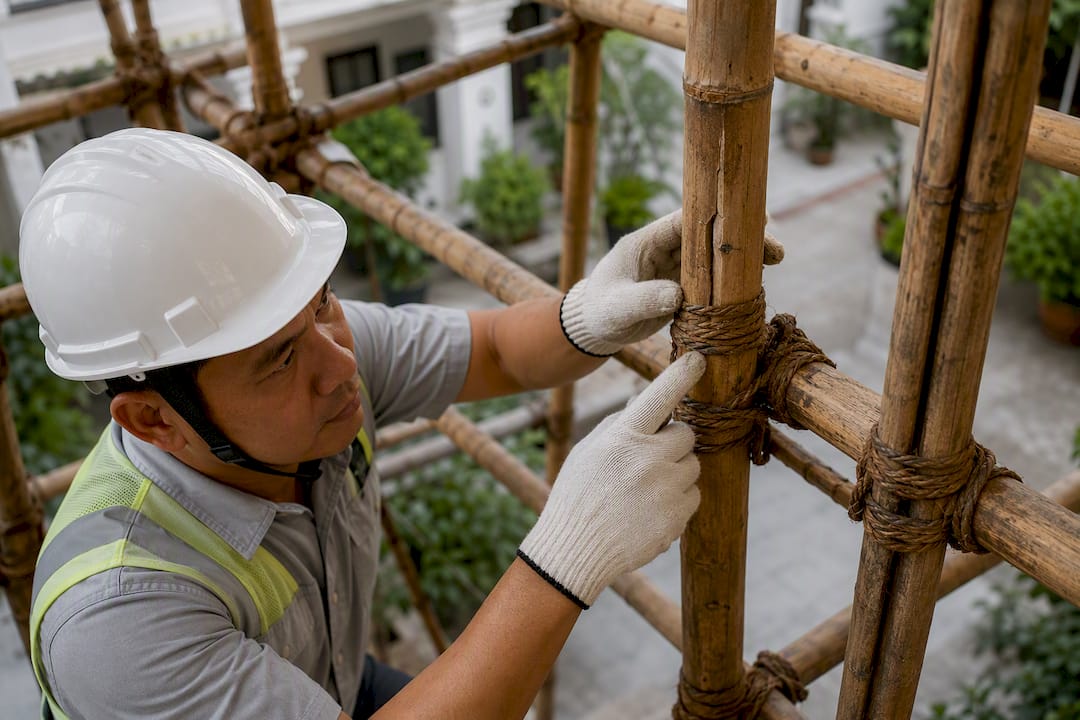
Height and load limits for bamboo scaffolds tend to sit lower than comparable metal structures, reflecting the material’s variable strength. Any contractor proposing bamboo scaffolding for work above modest heights should be treated with the same scrutiny as a tower scaffold near its height-to-base ratio limit: ask for the specific load calculations, not just an assurance that “it’s always been done this way.”
Safety officers reviewing a bamboo scaffold job should apply the same three core checks used for metal systems: contractor competency, inspection tag currency, and documented SOPs, adapted to account for the material’s specific degradation risks rather than assuming a lighter compliance burden simply because the structure looks less industrial.
Guidelines on Scaffold Erection and Dismantling Methodologies
Erection sequencing is where most structural scaffold failures originate, not in the finished structure itself. A scaffold that ends up stable can still have been erected in a sequence that left it unsupported at a critical stage, and SS 659:2020 spells out sequencing requirements precisely because partially erected scaffolds are often the least stable state a structure goes through.
Standard method statements should specify the order of base plate placement, standard and ledger assembly, tie installation as height increases, and platform boarding, with ties going in as the structure rises rather than being added retroactively once the scaffold reaches full height. Retroactive tying is a common shortcut that leaves a scaffold structurally unsound during the exact period workers are most likely to be on it.
Dismantling follows the reverse logic but carries its own risks: removing ties too early, before the sections above have been taken down, is one of the more common causes of partial collapse during dismantling work. The method statement should specify dismantling order explicitly, generally top-down, with ties removed only as the corresponding level comes down, not stripped out in bulk at the start to save time.
Erectors and supervisors should hold a documented, signed-off method statement before starting either process, and safety officers reviewing site documentation should treat “we’ll figure out the sequence as we go” as an immediate red flag rather than normal site flexibility. A scaffold under active erection or dismantling should also be cordoned and clearly signed to prevent other trades from working beneath it during the most unstable phase of its life cycle.
PPE Requirements for Scaffolding Work
Scaffold work sits squarely in the work-at-height category, and PPE requirements reflect that risk profile rather than general construction site standards. Every worker erecting, using, or dismantling a scaffold needs a properly fitted safety harness with a shock-absorbing lanyard, anchored to a point rated for fall arrest, not tied off to a convenient tube or ledger that happens to be nearby.
Head protection, non-slip footwear rated for the platform surface, and high-visibility clothing round out the baseline. On scaffolds near live traffic, overhead crane operations, or ongoing structural work, additional controls such as hard barricades or netting may be required alongside standard PPE, since personal protective equipment addresses individual fall risk but doesn’t substitute for physical safeguards against falling objects or overhead hazards.
Harness anchor points deserve particular attention during site audits, since a harness clipped to an unrated point offers a false sense of security that’s arguably worse than no harness at all. Safety officers should verify that anchor points are specified in the SOP, not left to individual worker discretion, and that lanyard length matches the platform height to prevent a fall from exceeding safe arrest distance.
PPE compliance checks should happen at the point of access, not after work has started. A worker who reaches the platform without a harness, or with a lanyard clipped incorrectly, represents a failure that should stop the job on the spot rather than get noted for later correction.
Roles and Responsibilities Across the Scaffolding Chain
Compliance breaks down fastest when everyone assumes someone else is covering a given duty. The Regulations assign specific responsibilities to specific parties, and knowing where those lines sit prevents the gaps where accidents happen.
Employers and principal contractors bear the overall duty to ensure scaffold work is carried out safely, which includes engaging only ASC-registered contractors where required and ensuring PE documentation exists before any triggering scaffold goes up. That duty doesn’t transfer away simply because the scaffold work is subcontracted.
Workers carry a narrower but still real duty: use PPE correctly, report defects or damage rather than working around them, and avoid modifying a scaffold without authorization from a qualified supervisor.
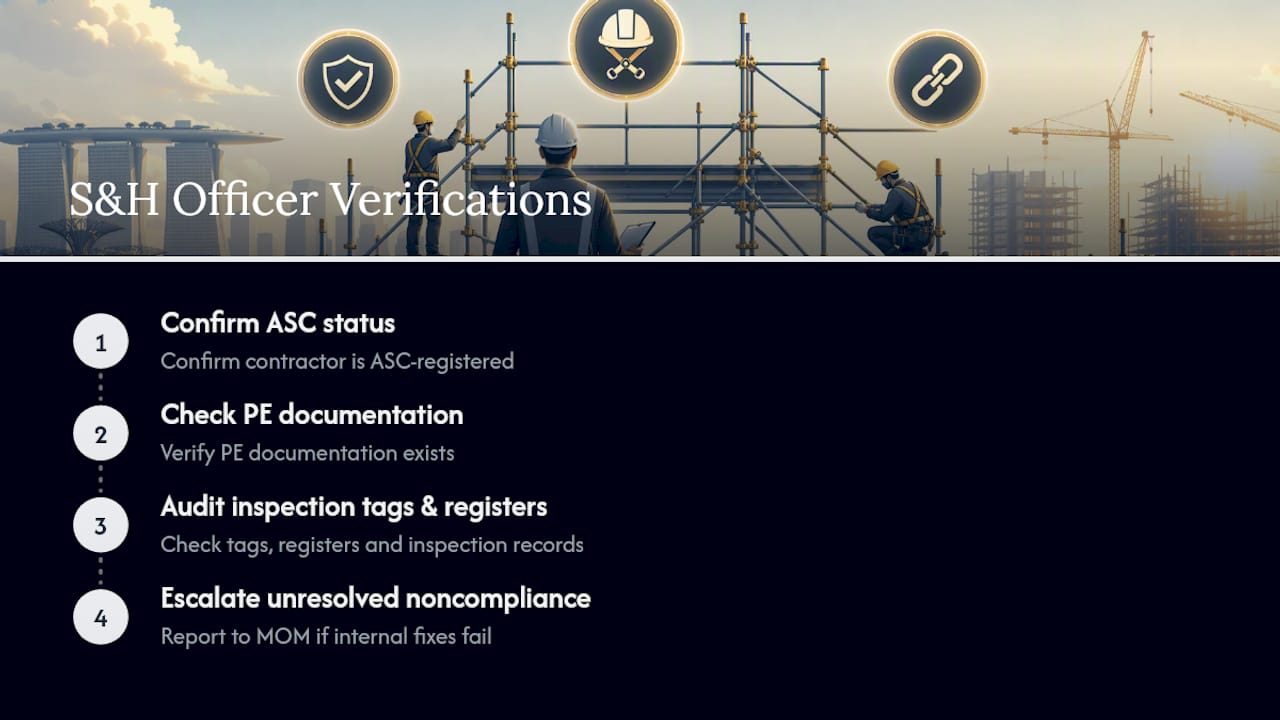
Safety and Health Officers occupy the verification role across all of the above: confirming ASC status, checking PE documentation, auditing inspection tags and registers, and escalating noncompliance to MOM when internal corrective measures fail. That verification role is what this entire guide has been building toward, since every checklist item earlier in the article exists because someone in this role needs to check it before a scaffold gets used.
What to Prioritize on Singapore Sites
Five checks separate a compliant site from a liability: ASC status, PE certification for high-risk scaffolds, current inspection tags, verified training records, and documented SOPs. The most common failure isn’t a technical one. It’s overseas-only certificates nobody verified locally, an unlabelled tower nobody flagged, or a PE change made verbally and never documented. When any of those five feel uncertain, bring in a qualified auditor before, not after, work starts.
— Aman
MOSAIC Compliance Support: Audits, Training, and BizSAFE Readiness
Paid consultancy services, rather than free advice, can be critical when a scaffold job is at stake. Where the checklists above raise a question mark—whether it’s an ASC application that keeps stalling, a training record nobody can verify, or a suspended scaffold design missing PE sign-off—site audits and readiness checks can help close that gap before MOM does.

A typical engagement covers a pre-mobilization audit against the exact items outlined earlier: ASC registration, PE documentation, inspection protocols, and training verification for supervisors and erectors. Com also supports BizSAFE Star certification, which matters directly for ASC validity, and liaises with Professional Engineers where design certification is required for tall or suspended scaffolds. For firms managing broader compliance across a site, Com’s environmental compliance guidance covers the wider regulatory picture beyond scaffolding alone.
If any of the checks in this guide turned up a gap you can’t close internally, request a compliance audit and get a clear list of what needs fixing before your next inspection.
Primary Laws, Standards, and MOM Circulars to Consult
- Workplace Safety and Health (Scaffolds) Regulations 2011, Singapore Statutes Online
- Apply to be an approved scaffold contractor, MOM
- SS 659:2020 Code of Practice for Scaffolds, Singapore Standards
- Safe design and installation of outriggers or overhead supports (2025 circular), MOM
- Scaffold contractor FAQ, MOM
- Commercial contractor licensing checklist, for a broader view of contractor licensing obligations
Sources
- Apply to be an approved scaffold contractor
- Workplace Safety and Health (Scaffolds) Regulations 2011
- Safe design and installation of outriggers or overhead supports for suspended scaffolds (MOM circular 2025)
- Scaffold contractor FAQ (MOM)