

What are the top alternatives to orisonqehs.com for QESH consultancy?
Construction companies and developers evaluating orisonqehs.com substitutes will find the strongest options fall into two distinct categories: large global testing, inspection, and certification firms with multinational infrastructure, and specialized regional consultancies with deep regulatory fluency in local statutory frameworks. The right choice depends on whether your project demands international certification breadth or precise, localized compliance navigation.
SGS and Intertek represent the enterprise tier, offering extensive quality, environment, health, and safety management portfolios across dozens of jurisdictions. Regional specialists, by contrast, tend to deliver more direct client engagement, faster response cycles, and sharper expertise in jurisdiction-specific requirements such as BizSAFE certification levels and ISO management systems tailored to construction operations.
| Provider Category | Service Specialization | Regulatory and Certification Support | Geographic Coverage | Company Size and Stability | Client Engagement Options |
|---|---|---|---|---|---|
| Global TIC firms (e.g., SGS, Intertek) | Broad QESH, testing, inspection | ISO, international standards | Multinational | Large, institutionally stable | Formal account management |
| Regional specialist consultancies | Localized QESH, audit, training | BizSAFE, local WSH frameworks | Country or region-specific | Small to mid-size | Direct consultant access |
| Com (MOSAIC Ecoconstruction Solutions) | Full QESH, DfS, ConSASS, manpower outsourcing | BizSAFE, ISO, WSH Act compliance | Singapore and regional | Established specialist firm | Case-managed, client-centered |

Table of Contents
- How do orisonqehs.com alternatives differ in services, expertise, and coverage?
- How to select the right QESH consultancy for a construction company
- Why Com is a trusted QESH partner for construction projects
- Key Takeaways
- Com delivers QESH consultancy built for construction compliance
- The case for prioritizing regulatory depth over brand recognition
How do orisonqehs.com alternatives differ in services, expertise, and coverage?
The most consequential distinction among QESH consultancy providers is not brand recognition. It is the depth of regulatory relationships and the history of successful certification approvals within a specific jurisdiction. A firm that has navigated Singapore’s Workplace Safety and Health Act repeatedly, for example, brings a qualitatively different capability than one applying generic ISO frameworks to every engagement.
Service specialization: certification facilitation vs. audit-only models
Global TIC firms typically offer standardized compliance services calibrated for multinational clients. Their processes are thorough but not always optimized for the granular requirements of a single-country construction project. Smaller, specialized firms often provide tailored regulatory navigation that fits localized or project-specific needs, including hands-on support through BizSAFE Star progression or Design for Safety integration.
- Certification facilitation: Full-service consultancies guide clients from gap assessment through submission and approval, often maintaining direct relationships with accreditation bodies.
- Audit-only services: Some providers limit scope to pre-certification audits, leaving clients to manage submission and remediation independently.
- Training and manpower outsourcing: A subset of consultancies, including Com, extend beyond advisory work to provide on-site safety officers and workforce training programs.
Comparing key operational dimensions
| Dimension | Global TIC firms | Regional specialist consultancies |
|---|---|---|
| Regulatory depth | Broad, multi-jurisdiction | Deep, jurisdiction-specific |
| Certification scope | ISO, international standards | BizSAFE, WSH Act, ISO |
| Client communication | Structured, account-managed | Direct, consultant-led |
| Response time | Variable, process-dependent | Typically faster |
| Operational continuity signals | Publicly listed, audited | Verify active trading status independently |
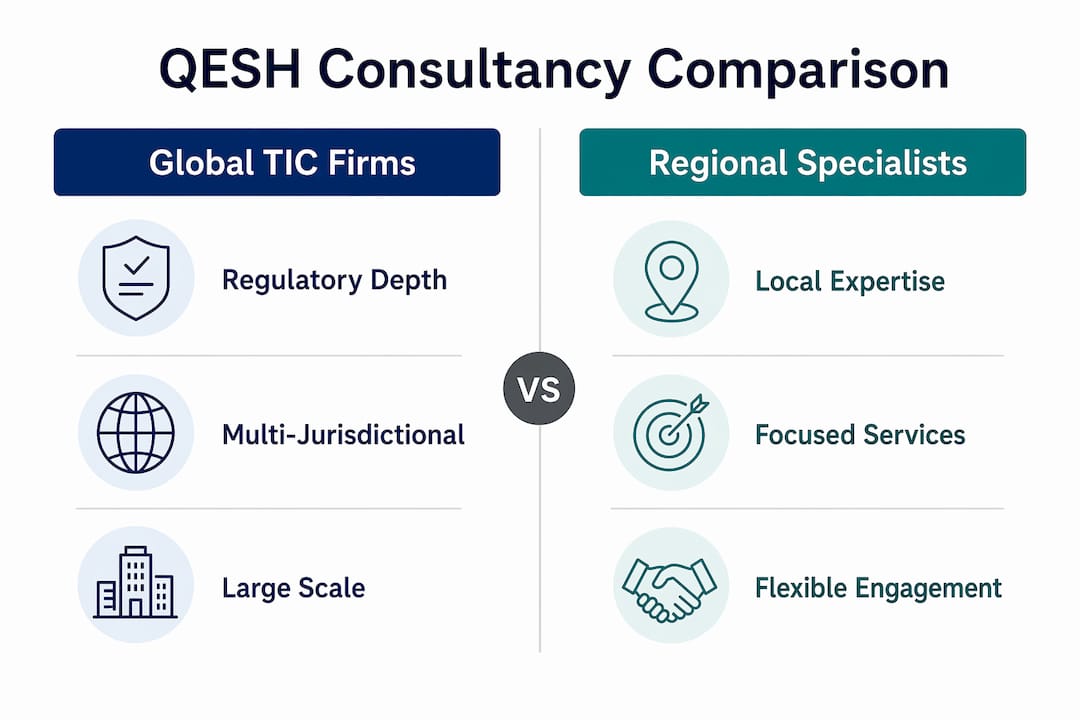
Clients must differentiate between needing multinational certification support and needing focused local compliance expertise before issuing any request for proposal. A global firm’s breadth can be an asset or an inefficiency, depending entirely on project scope.
How to select the right QESH consultancy for a construction company
Selecting among orisonqehs.com replacement options requires applying structured evaluation criteria, not simply comparing service lists. The following factors carry the most weight for construction companies and developers operating under statutory safety obligations.
Essential evaluation criteria
- Accreditation status: Verify that the consultancy holds current accreditation from the relevant national body. For Singapore-based projects, this means confirming standing with the Singapore Accreditation Council (SAC), since accreditation legally validates any certification the firm issues.
- Regulatory track record: Prioritize firms with documented approval histories under the specific frameworks governing your project, whether that is the WSH Act, BizSAFE, or ISO 45001.
- Service scope alignment: Confirm whether the provider offers end-to-end facilitation or only partial services such as auditing, and whether that matches your internal capacity.
- Client testimonials and case studies: Published project outcomes and verifiable client references provide the clearest evidence of practical competence.
- Operational continuity: An inactive or default website landing page, such as a hosting placeholder page, signals possible operational disruption and warrants direct verification of active trading status before any engagement.
Questions to ask QESH providers during evaluation
- What is your current accreditation status, and with which national body?
- How many BizSAFE or ISO certifications have you facilitated in the past 24 months?
- What is your typical timeline from initial engagement to certification submission?
- Who specifically will manage our account, and what is their regulatory background?
- How do you handle remediation if a certification submission is rejected?
Typical engagement timelines for construction QESH consultancy run from initial scoping through certification submission over a period that varies with project complexity and the client’s compliance baseline. Firms that cannot provide a clear project timeline at the proposal stage should be treated as a red flag.
Pro Tip: Before signing any consultancy agreement, cross-reference the firm’s claimed accreditation directly with the relevant national accreditation body’s public registry. Self-reported credentials are not a substitute for verified standing.
Construction projects carry significant injury risk, and the cost of engaging an unaccredited or operationally unstable consultancy extends well beyond a failed audit. Understanding key construction risks before selecting a QESH partner helps frame the consultancy brief with appropriate specificity.
Why Com is a trusted QESH partner for construction projects
Com, operating as MOSAIC Ecoconstruction Solutions, delivers a full-spectrum QESH service portfolio purpose-built for the construction sector. Its scope extends from safety audits and Design for Safety consultancy through ConSASS assessments, manpower outsourcing, and workforce training, covering the complete compliance lifecycle rather than isolated service segments.
Com’s certification facilitation expertise is particularly relevant for construction clients pursuing BizSAFE Star certification, a designation that carries direct procurement and tendering implications in Singapore’s construction market. The firm’s consultants maintain active knowledge of the WSH Act’s statutory requirements, enabling clients to move through certification stages with fewer remediation cycles. Published case studies on Com’s website document specific project outcomes, including risk mitigation results and safety culture improvements, providing the kind of verifiable evidence that generic service descriptions cannot replicate.
Client engagement at Com follows a transparency-first model. Clients receive direct access to the consultants managing their accounts, clear documentation of each compliance milestone, and ongoing support through the post-certification period. For construction companies that have previously worked with large TIC firms and found communication routed through account management layers, this direct model represents a material operational difference. Com’s WSH consultancy approach also addresses the cultural dimension of safety management, not only the procedural one, which is where most construction firms see the longest-term compliance gains.
Key Takeaways
Selecting the right QESH consultancy requires matching provider capabilities to your project’s specific regulatory framework, not defaulting to the largest or most familiar name.
| Point | Details |
|---|---|
| Accreditation is non-negotiable | Verify current national body accreditation before any engagement; self-reported credentials are insufficient. |
| Regulatory depth beats firm size | Proven approval histories under your specific statutory framework matter more than a provider’s global footprint. |
| Global vs. regional fit | Global TIC firms suit multinational certification needs; regional specialists deliver sharper local compliance navigation. |
| Red flags require action | An inactive website or unverifiable accreditation warrants direct verification of active trading status before issuing an RFP. |
| Com’s differentiated position | Com provides end-to-end QESH facilitation, including BizSAFE Star support, DfS consultancy, and direct client engagement, for construction-specific compliance. |
Com delivers QESH consultancy built for construction compliance
Com is not a generalist advisory firm that happens to offer safety services. Every engagement is structured around the specific regulatory obligations, certification pathways, and site-level risk profiles that construction companies and developers actually face. Where large TIC firms apply standardized frameworks, Com applies construction-sector expertise, from BizSAFE Star facilitation to ConSASS assessments and Design for Safety integration.
For construction firms that have been evaluating orisonqehs.com comparison options and need a consultancy with a documented track record in certification facilitation and WSH Act compliance, Com offers a direct path forward. Review Com’s BizSAFE certification support services and contact the team to discuss your project’s compliance requirements.
The case for prioritizing regulatory depth over brand recognition
The instinct to default to a globally recognized TIC firm when selecting a QESH consultancy is understandable. Large firms project institutional stability, and their ISO credentials are internationally legible. But for construction companies operating under jurisdiction-specific statutory frameworks, that instinct frequently produces a mismatch between what the firm delivers and what the project actually requires.
The firms that consistently produce the best certification outcomes for construction clients are those with active, current relationships with the relevant accreditation bodies and a granular understanding of how those bodies evaluate submissions. That knowledge is not a function of firm size. It is a function of sustained, focused practice within a specific regulatory environment. A consultancy that has guided twenty BizSAFE Star applications through the SAC process in the past three years carries more practical value for a Singapore construction project than a multinational firm that has processed the same certification twice across its entire global network.
The other underweighted factor is operational continuity at the account level. Construction projects run on tight timelines, and a compliance gap created by a consultant transition or a communication breakdown can cascade into tendering delays or statutory penalties. Verifying that a consultancy’s key personnel are stable, that its website and communication channels are active, and that its accreditation is current are not administrative formalities. They are the due diligence steps that separate a productive engagement from a costly one.