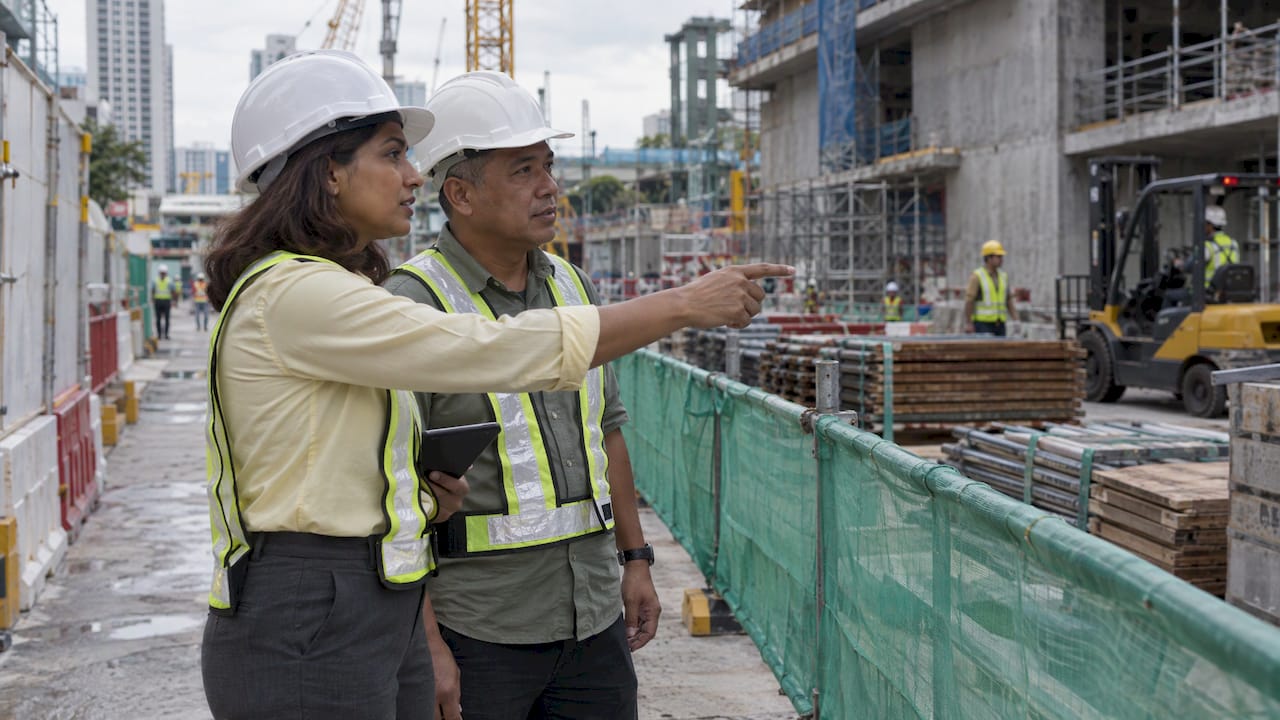

ISO 14001 is the international standard for an environmental management system (EMS), and for a Singapore contractor it is the most direct way to show that noise, waste, runoff and resource use on every site are controlled by a documented, audited system. Certification is voluntary, but tender requirements are making it a working prerequisite. A contractor that builds the system around its real site routines, rather than around a binder of paperwork, passes the certification audit and also runs cleaner projects. MOSAIC Eco-construction Solutions Pte Ltd supports contractors through ISO certification from gap review to audit.
TL;DR
- ISO 14001 is a voluntary standard, certified by independent certification bodies, and it applies to any organization regardless of size, type or nature.
- Public-sector and private tenders increasingly ask for an EMS to ISO 14001 as a condition of taking part, so certification affects who can bid.
- ISO 14001:2026 has been published. Certified organizations transition within their certification cycle, typically around three years.
- Enterprise Singapore’s EDGE support can cover professional service and certification costs, provided the certification body is accredited.
- Site-level records (aspects register, legal register, monitoring logs, audit and review minutes) are what auditors test, and they are built from daily site practice.
Table of Contents
- What ISO 14001 means for a contractor
- Why tenders push contractors toward certification
- The Singapore legal and client context
- What has changed: ISO 14001:2026
- The implementation path, step by step
- Records an auditor will ask to see
- Cost and funding in Singapore
- Where MOSAIC fits
- Our perspective
- FAQ
- Sources
What ISO 14001 means for a contractor
ISO 14001 specifies the requirements of an environmental management system. The 2015 edition, adopted in Singapore as SS ISO 14001:2015, provides a framework to enhance environmental performance, fulfill compliance obligations and achieve environmental objectives. The same document states that it covers the environmental aspects of an organization’s activities, products and services that it can control or influence, viewed from a life cycle perspective.
For a builder, that wording translates into concrete subjects:
- Site activities: excavation, piling, demolition, concrete works, cutting, painting and temporary works, each with its own dust, noise, waste, runoff and energy profile.
- Materials and subcontractors: what is specified, how it is delivered, stored and disposed of, and how subcontracted works are held to the same controls.
- Design decisions: choices made before the site opens that decide how much waste and energy the project will consume.
The standard does not fix numerical limits. Limits come from Singapore law and from the client’s contract. ISO 14001 requires that the contractor identify those obligations, build them into procedures, check that they are met and correct failures. That is why a contractor with a sound environmental record can still fail an audit: the system, not the outcome alone, is what is certified.
Certification, self-declaration and who certifies
The Singapore Standard recognizes three routes to demonstrate conformity: self-declaration, confirmation by interested parties such as clients, or certification by an external organization. Tender evaluators and main contractors generally want the third. ISO does not certify organizations itself. Certification is carried out by independent certification bodies, which may be accredited by national accreditation bodies, and it may be required by customers, supply chains or public tenders where environmental performance is part of the selection criteria.
Why tenders push contractors toward certification
A 2023 systematic review by Horry, Booth, Mahamadu and Ball covering 46 publications since 1999 found that the most frequently cited benefits of ISO 14001 in engineering and construction were an improved green corporate and public image (44% of articles), better environmental performance (39%), regulatory compliance (39%), cost savings (37%) and long-term competitive advantage (35%).
The same review observes that more companies now require an EMS to ISO 14001 as a prerequisite for the tender process. In practice, this means demand from clients is increasingly doing the work that government pressure once did not. For a Singapore contractor the commercial question has shifted from “is it worth it?” to “how soon can we hold the certificate when the next tender opens?”
A survey study of construction firms that had adopted the standard reported regulatory compliance as the strongest driver (mean score 4.9), followed by internal environmental goals and competitive advantage (4.3 each) and client demand (3.7). After implementation, firms rated waste management and overall sustainability improvement at 4.3, and energy consumption and carbon emissions improvement at 4.1.

The Singapore legal and client context
ISO 14001 does not replace statutory duties. It organizes them. Two Singapore examples show what an EMS must absorb.
Land Transport Authority (LTA) projects. For LTA projects identified as having significant environmental impacts, an Environmental Study is conducted at the design stage, and contractors must provide an environmental management plan that includes its recommendations before work starts. The same LTA page sets out noise pollution control requirements: baseline noise surveys, Noise Management Plans and continuous noise monitoring. An ISO 14001 system gives these plans a permanent home: the aspects register flags noise as significant, the operational controls point to the Noise Management Plan, and the monitoring clause captures the data.

Environmental Control Officers. The National Environment Agency launched its Environmental Control Officer scheme for specified construction sites on 1 April 2000. Occupiers of those sites must appoint a part-time or full-time officer depending on the contract sum, with sites of $10 million and below not required to appoint one. The officer’s remit covers vector control, noise control, food hygiene and waste management, and the code also points to the Environmental Protection and Management Act 1999 and the Control of Vectors and Pesticides Act. An EMS that already tracks these obligations makes the officer’s weekly work evidence for the auditor.
Contractors who also pursue workplace safety recognition will recognize the pattern. The management-system logic of BizSAFE and ISO 45001 for contractors is the same plan, do, check, act cycle, which is why integrating environmental and safety systems removes duplicated procedures.
What has changed: ISO 14001:2026
Singapore’s national adoption, SS ISO 14001:2015, incorporates Amendment No. 1:2024. ISO has since published the ISO 14001:2026 edition. According to ISO, certified organizations will transition within the timeframe set by their certification cycle, typically around three years, and the new edition is designed for smooth integration with existing management systems.
What this means for a contractor starting now:
- Build to the current edition your certification body will audit against. Confirm with the certification body which edition and transition schedule apply to your first audit and ask for it in writing.
- Design the system modularly. Procedures tied to site activities survive a clause renumbering. Procedures copied clause by clause do not.
- Avoid separate environmental silos. The 2026 edition is intended to sit comfortably beside quality and safety systems, so one integrated manual and one internal audit program reduce the transition workload.
The implementation path, step by step
The route from decision to certificate follows a consistent order. At each step the weak points for contractors are different from those of an office-based business.
Step 1: Scope and context
Decide which entities, sites and activities the certificate covers, and who your interested parties are: main contractors, developers, LTA or other agencies, neighbors of your sites, subcontractors. Contractors frequently scope too narrowly, covering the head office only, and then discover that a tender asks for the certificate to cover site operations. Where this goes wrong: the scope statement says “design and construction” but no project site has ever been audited.
MOSAIC’s consultants, who bring more than 20 years of experience to the sector according to the company, work with the client to settle scope before any documents are written.
Step 2: Environmental aspects and legal obligations
List each site activity, its environmental aspects (the elements that interact with the environment, such as noise, dust and waste) and the impacts that follow. Rank them by significance with a criterion that is written down. Then build a legal register: statutes, regulations, agency conditions and contract clauses, each with the person responsible and the evidence of compliance. The LTA and NEA requirements above belong here.
Where this goes wrong: a generic register copied from another industry. Auditors look for entries that match your actual projects, for example a site with piling near occupied residences should show noise as a significant aspect.
Step 3: Policy, objectives and operational controls
Top management signs the environmental policy. Objectives must be measurable, such as a waste diversion percentage per project or reduced diesel consumption per month. Operational controls then assign who does what: waste segregation points, chemical storage, silt control, dust suppression, noise limits and emergency spill response. For subcontractors, the control is contractual: they agree to the same site rules on mobilization.
Step 4: Training and competence
Barriers reported in research include lack of expertise and lack of training. The Horry review lists cost (61%), lack of expertise (30%) and lack of training (28%) among the highest reported barriers, with lack of stakeholder support at 26%. Targeted toolbox briefings for supervisors and workers, with attendance records, answer the competence clause directly, and structured training closes the expertise gap before the audit.
Step 5: Monitoring, internal audit and management review
After the system has run on live sites for a period, an internal audit tests it against both the standard and your own procedures. Findings go to a management review where top management reviews performance, resources and objectives. The certification body’s auditors expect to see that this cycle has happened at least once before they arrive.
Step 6: Certification audit
The certification body audits in two stages: a documentation and readiness review, then an on-site assessment that samples projects, interviews site staff and tests records. Nonconformities must be closed with corrective actions before a certificate is issued. Certification is then maintained through surveillance audits during the cycle.
Records an auditor will ask to see
The standard distinguishes between documents you maintain (procedures, policy) and records you retain as evidence. For a Singapore contractor, the working set normally includes:
| Evidence | What it proves | Typical site source |
|---|---|---|
| Scope and environmental policy | Management commitment and boundaries | Signed policy, displayed at site offices |
| Aspects and impacts register | Significant risks identified per activity | Project-specific worksheets |
| Legal and other requirements register | Obligations known and tracked | Agency conditions, contract clauses |
| Objectives and action plans | Measurable improvement targets | Monthly project dashboards |
| Training and competence records | People are able to do the work | Toolbox briefing sign-in sheets |
| Monitoring logs | Controls work in practice | Noise readings, waste manifests, fuel use |
| Emergency drills and incident reports | Preparedness and learning | Spill drill records |
| Internal audit and management review minutes | The system checks itself | Audit reports, action trackers |
Contractors with many sites find that keeping this evidence current is a task-tracking problem as much as an environmental one. A practical construction task management guide shows how assigned tasks, documents and progress photos can be kept in one place per project, which is the same discipline an EMS audit rewards.
Cost and funding in Singapore
Cost is the barrier most often named: 61% of the articles in the Horry review cite it, and the KUEY survey scored it at a mean of 4.0. Total cost depends on the number of sites in scope, the maturity of your existing systems, internal time and the certification body’s audit days. MOSAIC publishes no price for its services, so a scoped proposal follows a review of your operations.
Funding can reduce the burden. Enterprise Singapore’s EDGE support for ISO 14001 covers professional service and certification and testing costs when the conformity assessment body is accredited by the Singapore Accreditation Council or by an internationally recognized body listed under the ILAC, IAF or APAC mutual recognition arrangements. The same page states that EDGE support counts toward a company’s annual grant cap of S$100,000 and that the project must be completed within 12 months from approval. Because of that 12-month window, plan the implementation timetable before you submit, not after. Our guide to claiming the Enterprise Development Grant for ISO certification walks through the application sequence, and you should confirm current scheme terms on the Enterprise Singapore page before applying.
Where MOSAIC fits
MOSAIC Eco-construction Solutions provides Quality, Environment and Safety consultancy to the construction sector. For ISO 14001, the ISO Certification service covers certification support, EHS advisory and documentation covers the records described above, and training prepares site teams. The company states that it offers continuous support after an engagement and a consultant team spanning multiple industries.
Contractors who have not yet decided can read the ISO 14001 contractor guide and the implementation example for contractors. To discuss your scope, contact the team through the Consultancy page.

Our perspective
Contractors in Singapore rarely lack environmental controls. They lack a system that proves those controls exist, on every project, at the moment a client or auditor asks.
We approach ISO 14001 as an extension of the safety systems that construction firms already operate. A contractor with BizSAFE discipline already understands risk registers, toolbox briefings and inspection cycles. The environmental management system reuses that architecture for noise, waste, runoff and energy, so the organization adds scope rather than a parallel bureaucracy.
Our consultancy is built on more than 20 years of experience in the sector and a client-centric approach in which solutions are tailored to the contractor’s actual project mix. We design the system around site activities, integrate it with quality and safety requirements where the client holds them, and continue to support the client after the engagement.
The certificate matters because tenders increasingly ask for it. The system matters because it makes each site quieter, cleaner and easier to defend when a regulator visits.
Aman
FAQ
Is ISO 14001 mandatory for construction companies in Singapore?
No. Certification is voluntary and is carried out by independent certification bodies. It becomes effectively necessary when a customer, supply chain or public tender lists it as a selection criterion, and research shows more tenders now require an EMS to ISO 14001.
How long does ISO 14001 certification take?
The timeline depends on the number of sites, existing systems and how quickly records accumulate. The system must run on live projects long enough to be audited internally and reviewed by management before the certification audit. If you apply for EDGE support, the project must be completed within 12 months from approval.
Does the 2026 edition mean I should wait before certifying?
No. Certified organizations transition within their certification cycle, typically around three years, and the new edition is designed to integrate with existing management systems. A system built now on site-based procedures adapts to the new edition without a rebuild.
Can small contractors get ISO 14001?
Yes. The Singapore Standard states that it applies to any organization regardless of size, type and nature. A small contractor scopes the system to its own activities and sites, and the documentation grows with the business.
Which Singapore agencies set the rules an ISO 14001 system must capture?
They depend on the project. LTA projects carry environmental management plan and noise monitoring requirements, and NEA runs the Environmental Control Officer scheme for specified construction sites. The legal register in your EMS should list each agency condition that applies to your contracts.
Sources
- SS ISO 14001:2015, Environmental management systems (Singapore Standards eShop)
- SS ISO 14001:2015 incorporating Amendment No. 1:2024
- ISO 14001 explained (ISO)
- ISO 14001:2026 Environmental management systems (ISO)
- LTA: Environmental Protection
- NEA: Code of Practice for Environmental Control Officers (Specified Construction Sites)
- Enterprise Singapore: ISO 14001 Environmental Management Systems (EDGE)
- Horry et al. (2023), Implementing ISO14001 in the engineering and construction sectors: a systematic review (UCL)
- Sustainable Development: Integrating ISO 14001 (KUEY, 2025)
- Construction task management: a practical guide for builders (Buildberry)