IoT and Wearables: Tracking Worker Health and Heat Stress in Singapore’s Climate
| SEO Element | Specification |
| SEO Title | IoT Wearables for Heat Stress Monitoring in Singapore |
| Focus Keyphrase | IoT wearables heat stress Singapore |
| Meta Description | Discover how IoT wearables and predictive AI protect outdoor workers from heat stress in Singapore’s warming tropical climate. |
| Tags | IoT Wearables, Heat Stress, Workplace Safety, Singapore MOM, Industrial IoT, Occupational Health, Smart PPE |
The Escalating Thermal Crisis in Singapore’s Industrial Landscape
Climate Projections and Localized Heat Discrepancies
Singapore is currently facing unprecedented climate challenges.1 Rising temperatures pose severe, long-term risks to outdoor workers.1 In January 2024, the Centre for Climate Research Singapore released critical findings.1 The Third National Climate Change Study projects significant temperature increases.1 Specifically, the annual average daily mean temperature will rise.1 The temperature will reach between and by 2050.1 This projection represents a steep increase from the historical baseline of .1
\text{Baseline Mean Temperature (2024)} = 27.9^\circ\text{C} \implies \text{Projected Mean Temperature (2050)} = 28.5^\circ\text{C} \text{ to } 30.1^\circ\text{C}
Afternoon heat builds up rapidly across the island.3 This peak heat occurs during the inter-monsoon period from late March to May.3 In 2025, Singapore recorded 29 high heat stress days based on official Wet Bulb Globe Temperature monitoring.3 This count was a sharp rise from the 21 days recorded in 2024.3 Therefore, the changing climate demands immediate attention from safety leaders.3
Industrial worksites often experience higher temperatures than domestic areas.4 Research from Project HeatSafe reveals a dangerous discrepancy.4 Specifically, the consistency between official weather stations and actual workplaces declines as heat stress rises.4 Microclimates in concrete yards and metal factories trap heat.5 Workers are exposed to much higher heat levels than national apps report.4 Therefore, localized monitoring is essential to prevent silent thermal injuries.4 Consequently, proactive companies are deploying IoT wearables heat stress Singapore solutions to monitor physical strain.7
| Year | Annual Average Daily Mean Temperature Projection | Recorded High Heat Stress Days |
| Historical Baseline | 1 | — |
| 2024 | — | 21 Days 3 |
| 2025 | — | 29 Days 3 |
| 2050 (Projected) | to 1 | Projected to increase significantly |
Traditional Safety Limits and the Fatalities Gap
The limits of traditional safety management are becoming clear.9 In 2024, Singapore experienced a rise in workplace fatalities.9 Total workplace fatalities rose from 36 in 2023 to 43 in 2024.9 This represents a 19.4% increase.9 Therefore, traditional compliance-driven safety management is reaching its operational limits.9 A paradigm shift toward dynamic, technology-enabled solutions is necessary.9
Historically, companies relied on static weather forecasts.10 However, static forecasts do not account for individual physiological differences.10 Factors such as age, fitness, and acclimatisation alter heat tolerance.10 Proactive companies are adopting IoT wearables heat stress Singapore systems.8 These systems provide real-time, personalized data on thermal strain.12 Consequently, employers can protect workers more effectively.12
| Metric | 2023 | 2024 | Percentage Change |
| Total Workplace Fatalities | 36 9 | 43 9 | +19.4% 9 |
| Fatalities Trend Analysis | Baseline | Escalated | Traditional safety limits reached 9 |
Epidemiological Evidence: The Impact of Moderate Temperature Fluctuations
The Joel Aik Epidemiology Study
A landmark study offers quantitative proof of heat risks.14 Adjunct Assistant Professor Joel Aik led this research at Duke-NUS Medical School.14 The study was published in the journal Urban Climate in March 2026.14 Specifically, it analyzed outdoor worker heat illnesses in Singapore from 2009 to 2023.14
The findings show that minor temperature fluctuations cause massive risk spikes.14 A rise in daily average temperature increases heat stroke risk by 250% on that day.14
\text{Risk Increase on Day 1} = \text{Baseline Risk} \times 2.50
Furthermore, the cumulative effect is even more severe.14 If this increase is sustained for three consecutive days, the risk nearly quadruples.14
\text{Risk Increase on Day 3 (Sustained } 1^\circ\text{C} \text{ Rise)} \approx \text{Baseline Risk} \times 4.00
Indeed, this trend does not require extreme temperatures like to trigger emergencies.14 Minor fluctuations in humid conditions are highly dangerous.14 Therefore, safety managers must track individual physiological responses continuously.14 Consequently, the implementation of IoT wearables heat stress Singapore devices is growing rapidly.16
| Daily Average Temperature Trend | Same-Day Heat Stroke Risk | Cumulative Three-Day Risk |
| Baseline (Sustained Temperature) | (Normal Risk) 14 | Normal Baseline 14 |
| Fluctuation | (More than double) 14 | Risk increases dynamically 14 |
| Sustained for Three Days | Risk remains elevated 14 | (Nearly quadrupled) 14 |
Demographics and Under-reporting Realities
The study mapped cases across different geographical regions in Singapore.14 More than half of the reported cases occurred in the central and eastern sectors.14 These regions had a slightly higher average temperature of around .14
Most cases involved construction workers, and two-thirds of them were foreign nationals.14 The construction, marine shipyard, and process sectors employ about 440,000 workers.14 These workers face constant exposure to changing weather conditions.14
\text{Total Exposed Worker Population (2025)} \approx 440,000 \text{ (Construction, Marine, Process)}
Furthermore, under-reporting of heat-related illnesses is a major challenge.5 Workers with moderate symptoms often do not seek medical care.14 Consequently, these cases are rarely captured in official statistics.14
To combat this, the Ministry of Manpower increased random audits in 2026.5 Employers are legally required to report all diagnosed heat illnesses.3 They must file reports via the online WSH Incident Reporting portal.3 Failure to report diagnosed workplace injuries is a serious offence.5 Therefore, dynamic tracking is essential.10 IoT wearables heat stress Singapore systems help companies identify and report these cases accurately.10
| Parameter | Study Finding Details |
| Analysis Period | 2009 to 2023 14 |
| Primary Sector Affected | Construction Sector 14 |
| Vulnerable Demographic | Foreign/Migrant Workers (Two-thirds of cases) 14 |
| Geographic Focus | Central and Eastern Singapore (~ average) 14 |
| Severity Classifications | 85% Severe (Heat stroke, heat exhaustion), 15% Moderate 14 |
Physiological Mechanisms of Occupational Heat Strain
Human Biomechanics Under Thermal Stress
Occupational heat stress occurs during physical labor in hot environments.12 Sweat evaporation is the primary mechanism for human thermoregulation.18 However, Singapore’s high relative humidity severely restricts sweat evaporation.14
As ambient temperatures rise, the body’s core temperature climbs.18 When the core temperature exceeds (), critical enzymes fail.10 This failure triggers systemic inflammation and muscle breakdown.18
The breakdown products can block the kidney tubules.18 This blockage leads to acute kidney injury.18 Dehydration also reduces blood volume.18 This reduction forces the heart to work much harder.18
\text{Dehydration} \implies \text{Decreased Blood Volume} \implies \text{Elevated Heart Rate (Tachycardia)}
In severe cases, the brain experiences heat stroke.5 Symptoms include delirium, seizures, and loss of consciousness.14 Without rapid cooling, heat stroke causes permanent organ damage or death.14
\begin{array}{ccccc}
\text{Heat Cramps} & \longrightarrow & \text{Heat Exhaustion} & \longrightarrow & \text{Heat Stroke} \\
\text{(Muscle spasms)} & & \text{(Nausea, fatigue)} & & \text{(Delirium, } CBT > 40^\circ\text{C)}
\end{array}
The physical demands of construction work generate high metabolic heat.10 Heavy personal protective equipment traps this internal heat.10 This trapped heat accelerates core temperature rise.10
Physiological signals are excellent predictors of heat strain.19 Key indicators include heart rate, heart rate variability, respiration rate, and oxygen saturation.19 Wearable sensors can continuously track these signals in real time.19
| Clinical Stage | Physiological Indicators | Systemic Consequences |
| Heat Cramps | Severe muscle spasms, mild sweating, normal consciousness 14 | Localized electrolyte depletion 14 |
| Heat Exhaustion | Heart rate elevation, heavy sweating, nausea, dizziness 6 | Moderate cardiovascular strain, dehydration 12 |
| Heat Stroke | , cessation of sweat, delirium, seizures 10 | Multi-organ failure, cerebral edema, potential death 14 |
Emergency Medical Protocols
First-line supervisors are the most critical link in heat stroke prevention.6 They must distinguish between heat cramps, exhaustion, and stroke.6 Suspected heat stroke is a medical emergency requiring immediate first aid.5
Supervisors must call emergency services (995) immediately.5 While awaiting the ambulance, they must move the worker to shade.5
\text{Suspected Heat Stroke} \implies \text{Call 995} + \text{Shade} + \text{Strip Clothing} + \text{Apply Ice Packs}
Excess clothing must be removed to facilitate cooling.5 Rapid cooling is the immediate priority.6 Ice packs should be applied to the neck, armpits, and groin.5 Cool water should be sprayed on the worker.5
Supervisors should fan the worker to enhance evaporation.5 Fluids must never be given to an unconscious worker.5
Proactive monitoring with IoT wearables heat stress Singapore systems provides early warning signs.7 These systems alert supervisors before a worker reaches critical thermal limits.10
| Emergency Step | Action Required | Clinical Purpose |
| 1. Call 995 | Activate SCDF emergency services immediately 5 | Secure advanced life support 6 |
| 2. Relocate Worker | Move to a cool, shaded, well-ventilated area 5 | Halt environmental heat gain 5 |
| 3. Strip Clothing | Remove heavy outer clothing, harness, and PPE 5 | Maximize exposed skin surface 5 |
| 4. Apply Ice Packs | Place on neck, armpits, and groin 5 | Cool large blood vessels rapidly 6 |
| 5. Fan & Spray | Spray cool water and fan continuously 5 | Promote convective/evaporative cooling 5 |
The Interdisciplinary Findings of Project HeatSafe
Economic and Productivity Losses
Project HeatSafe is a collaborative research project based in the National University of Singapore.21 Associate Professor Jason Lee leads this multi-disciplinary team.4 The research focused on the impacts of thermal strain in Southeast Asia.22
The findings show massive financial impacts on individual workers.4 On hot days, reduced productivity costs workers a median of S$21 daily.4 This loss represents 24% of their median daily salary.4 High physical and mental exertion directly correlates with greater economic losses.4
\text{Worker Daily Median Income Loss} = \text{S\$21} \quad (24\% \text{ of Daily Median Salary})
The macroeconomic losses are equally staggering.4 In 2018, heat stress caused an 11.3% reduction in productive working time across Singapore.4 This reduction cost the national economy S$1.18 billion in output.4
This productive time loss is projected to rise to 14% by 2035.4 This increase will drive annual economic losses to S$2.22 billion.4 Therefore, proactive deployment of IoT wearables heat stress Singapore systems offers significant economic protection.13
\text{National Economic Output Loss (2018)} = \text{S\$1.18 Billion} \implies \text{Projected Loss (2035)} = \text{S\$2.22 Billion}
| Economic Parameter | 2018 Baseline | 2035 Projection |
| Reduction in Productive Time | 11.3% 4 | 14.0% 4 |
| Economy-Wide Output Loss | S$1.18 Billion 4 | S$2.22 Billion 4 |
| Primary Sectors Impacted | Services, Manufacturing, Agriculture, Construction 4 | Services, Manufacturing, Agriculture, Construction 4 |
Physiological and Reproductive Research
Project HeatSafe also studied physiological strain in construction workers.4 The team monitored 79 indoor and 76 outdoor workers during nine-hour shifts.4
The overall physiological strain was low because workers self-paced.4 However, a subset of workers experienced prolonged extreme thermal strain.4 These individuals maintained core body temperatures above .4
The research team used virtual reality simulations to test worker performance.4 Healthy men completed welding and plank-walking tasks at different Wet Bulb Globe Temperatures.4
The combinations of elevated core temperature, high skin temperature, and fast heart rates caused severe impairment.4 The subjects suffered reduced postural balance and impaired decision-making.4 Their cognitive capacity dropped, which significantly increased their injury risk.4
Furthermore, extreme heat exposure poses serious reproductive risks.4 Men exposed to extreme heat 15 to 69 days before testing showed low sperm concentrations.4 Their overall sperm counts were also significantly lower.4
Additionally, Project HeatSafe analyzed over 30,000 pregnancy records.4 Extreme heat during the third trimester was linked to a lower risk of preterm birth.4
However, second-trimester exposure showed clear racial variations.4 Chinese women experienced lower risks of small-for-gestational-age births.4 In contrast, Malay women faced a higher risk.4
Therefore, individualized tracking using IoT wearables heat stress Singapore systems is crucial.8 This technology helps identify vulnerable workers before they suffer irreversible physiological damage.10
| Health and Biological Metrics | Research Findings | Clinical Implication |
| Cognitive Decline Trigger | WBGT range 4 | Impaired motor skills, elevated accident risk 4 |
| Male Reproductive Damage | Decline in sperm concentration and count 4 | Suppressed fertility 15-69 days post-exposure 4 |
| Pregnancy Risk (Malay Women) | Elevated risk of small-for-gestational-age births 4 | Heightened fetal vulnerability in second trimester 4 |
| Pregnancy Risk (Chinese Women) | Lower risk of small-for-gestational-age births 4 | Divergent physiological adaptation patterns 4 |
Regulatory Mandates and Compliance in Singapore
Ministry of Manpower Heat Stress Framework
Under the Workplace Safety and Health Act, employers must manage heat stress risks.5 The Ministry of Manpower enforces a clear regulatory framework.2 This framework centers on Wet Bulb Globe Temperature readings.5
When the WBGT reaches or above, baseline regulations apply.5 Employers must implement hourly rest breaks of at least 10 minutes for heavy outdoor work.1 Workers must consume at least 300ml of cool water every hour.5
Employers must also establish clear buddy systems.5 These buddies monitor each other for early symptoms of heat illness.5
\text{WBGT} \ge 32^\circ\text{C} \implies \text{Hourly rest } \ge 10 \text{ minutes} + \text{Hydration } \ge 300\text{ml/hour}
When the WBGT hits or above, maximum regulations apply.5 Heavy physical outdoor work requires hourly rest breaks of at least 15 minutes.5
Employers must redeploy vulnerable workers to non-outdoor roles.5 Vulnerable employees include those with a history of heat injury.5
Rest areas must be shaded, well-ventilated, and insulated.2 Employers should equip these areas with fans or air coolers.5
On-site WBGT meters are mandatory for large construction sites.5 This requirement applies to projects with a contract sum of S$5 million or more.5 It also applies to all shipyards and process industry plants.5
Other workplaces can use the National Environment Agency’s myENV app.5 Proactive deployment of IoT wearables heat stress Singapore systems automates compliance tracking.13 This technology ensures accurate, individualized monitoring across complex worksites.12
\text{Contract Sum} \ge \text{S\$5M} \implies \text{Mandatory On-site WBGT Meter}
| WBGT Trigger | Regulatory Classification | Mandatory Rest Period | Hydration Standard |
| Below 32°C | Baseline Monitoring | Standard industry breaks | Provide cool water near work areas 5 |
| 32°C to 32.9°C | Baseline Regulations 5 | minutes per hour 1 | Minimum 300ml per hour 5 |
| 33°C and Above | Maximum Regulations 5 | minutes per hour 5 | Minimum 300ml per hour, standby ice packs 5 |
Acclimatisation Requirements
Acclimatisation is another key regulatory requirement.5 New workers must undergo a structured 7-day acclimatisation program.5 This rule also applies to workers returning from leave of more than one week.5
Supervisors must gradually increase these workers’ daily thermal exposure.5 Specifically, new workers must start at no more than 50% of the full workload on day one.6
Supervisors must not assign new workers to heavy physical tasks during their first week.5 These structured steps prevent dangerous shock to unconditioned biological systems.6
\begin{array}{ccc}
\text{Day 1-2} & \longrightarrow & \text{Day 3-5} & \longrightarrow & \text{Day 6-7} \\
50\% \text{ Workload} & & 75\% \text{ Workload} & & 100\% \text{ Workload}
\end{array}
| Acclimatisation Day | Permissible Workload | Task Intensity Limit |
| Day 1 | Maximum 50% workload 6 | Light duties only, no heavy lifting 5 |
| Day 2 | Maximum 50% workload 6 | Light duties, continuous supervisor monitoring 5 |
| Day 3 | Maximum 75% workload 6 | Moderate duties, frequent rest breaks 5 |
| Day 4 | Maximum 75% workload 6 | Moderate duties, buddy system active 5 |
| Day 5 | Maximum 75% workload 6 | Moderate duties, ensure regular hydration 5 |
| Day 6 | Maximum 100% workload 6 | Full duties, avoid peak heat hours 5 |
| Day 7 | Full operational integration | Standard work-rest cycles 5 |
Advanced Biometric Wearables and Internet of Things Architecture
Biometric Markers and Sensor Technologies
Traditional safety protocols rely on macroclimatic assessments.10 However, these methods fail to account for individual differences.10 Factors like age, fitness, and sleep quality alter heat tolerance.10
IoT wearables solve this problem by tracking individual biometric markers.12 These devices capture physiological signals in real time.19
- Heart Rate (HR): Photoplethysmography sensors detect blood flow changes in wrist and arm bands.10 HR is the primary indicator of cardiovascular strain.10
- Heart Rate Variability (HRV): HRV indicates autonomic nervous system strain and physical exhaustion.11
- Skin Temperature (ST): Peripheral temperature sensors track skin heat levels.10 ST is highly sensitive to ambient temperature changes.26
- Core Body Temperature (CBT): CBT is the most critical metric for heat stroke risk.10 Advanced algorithms estimate CBT from heart rate and skin temperature data.10
- Electrodermal Activity (EDA): EDA measures skin conductance changes from sweat gland activity.25 This metric helps estimate physical demand.25
- Oxygen Saturation (): sensors track blood oxygenation during strenuous physical tasks.19
Different wearable form factors offer distinct advantages.16
- Smart Wristbands: Commercially available bands are highly popular.20 Devices like the Garmin Vivosmart 5 are comfortable and affordable.20 However, motion artefacts can sometimes reduce their accuracy.29
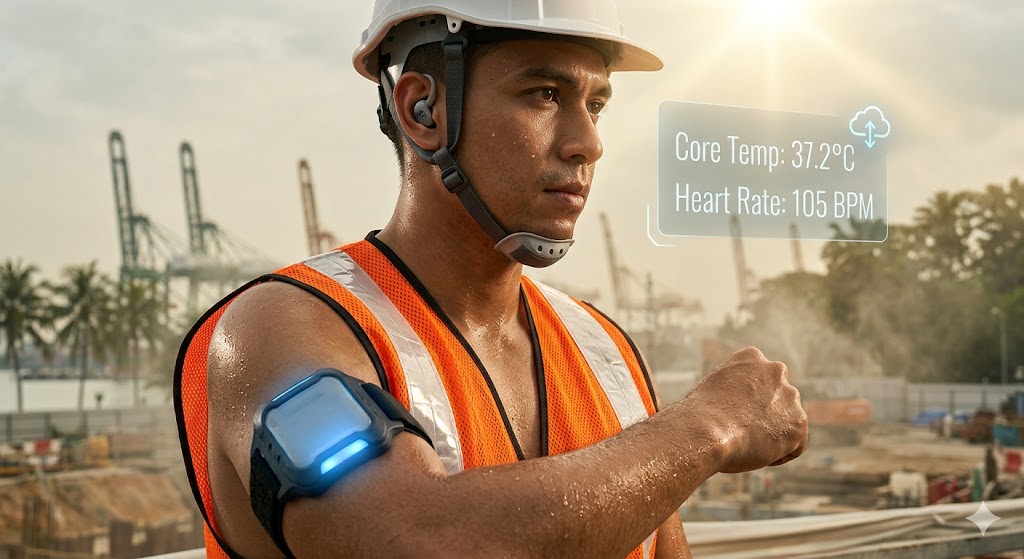
- Smart Armbands: Armbands like the SlateSafety Band V2 offer high durability.24 They measure real-time heart rate and estimated core temperature.24 These bands are comfortable for continuous eight-hour shifts.10
- In-Ear Devices: The Bodytrak earpiece sits securely in the ear concha.13 The ear is close to the hypothalamus, the body’s temperature control organ.13 Consequently, Bodytrak measures core temperature with high accuracy.13 The device has a mean absolute error of just compared to gastrointestinal pills.13
- Smart Helmets: The Proxgy SmartHat integrates biometric sensors into standard hard hats.15 The helmet tracks heart rate and head impacts.9 This integration avoids the need for additional gear.15
- Solid-State Epidermal Biomarker Sensors: NUS and A*STAR developed a novel stretchable hydrogel sensor.29 This device detects biomarkers like lactate, glucose, and cholesterol on dry skin.29 It operates without requiring sweat induction or blood draws.29 The bilayer hydrogel design reduces motion artefacts threefold.29
| Wearable Form Factor | Key Biometrics Tracked | Clinical/Operational Accuracy | Prototyping and Industry Deployment Status |
| In-Ear (Bodytrak) | Core Body Temperature, Heart Rate 13 | compared to GI pill 13 | Commercially available, active industrial adoption 13 |
| Smart Armband (SlateSafety) | HR, CBT, Exertion, Ambient Temp, Humidity 24 | High industrial standard, rugged design 24 | Deployed in heavy industry and military 30 |
| Smart Wristband (Garmin Vivosmart) | HR, HRV, Sleep Quality, 11 | High consumer-grade reliability 11 | Extensively used in research and trials 20 |
| Epidermal Patch (NUS/A*STAR) | Solid-state lactate, cholesterol, glucose 29 | Strong correlation with blood samples 29 | Active research, clinical correlation phase 29 |
Hardware and Power Management Specifications
Industrial wearables must manage power efficiently in various environments.32 The controller can switch from active to sleep mode dynamically.32 Active mode is used only during data acquisition and processing.32
Furthermore, asynchronous clockless logic removes the need for constant synchronization.32 Other power-saving techniques include voltage and clock scaling.32 These methods reduce power when processor demand is low.32 Clock and voltage gating remove supply rails from idle circuits.32
\text{Clock Gating} + \text{Voltage Gating} \implies \text{Minimized Static Power Consumption}
Additionally, devices must support multi-sensory fusion with low power.32 Low-power Bluetooth and Wi-Fi ensure secure, consistent connectivity.32
The mechanical design must also withstand Singapore’s highly humid climate.32 These specifications ensure that IoT wearables heat stress Singapore systems operate reliably during extended industrial shifts.10
| Power Management Technique | Operational Mechanism | Impact on Battery Life |
| Dynamic Sleep Modes | Switches main CPU to idle during inactive periods 32 | Reduces standby power consumption 32 |
| Clock and Voltage Scaling | Minimizes frequency and voltage during low processor demand 32 | Lowers active power consumption 32 |
| Clock and Voltage Gating | Removes clock signal and supply rails from idle circuits 32 | Eliminates static leakage power 32 |
| Asynchronous Logic | Uses handshake protocols instead of central clock lines 32 | Enables clockless low-power processing 32 |
Predictive Modeling and Edge-to-Cloud Data Flows
Real-Time IoT Data Transmission
Real-time data transmission forms the backbone of IoT safety systems.24 Biometric sensors continuously capture individual physiological data.10 These devices transmit data via low-power Bluetooth to edge gateways.25
Gateways process local alerts immediately.24 They also forward aggregated data to secure cloud platforms.24
\begin{array}{ccccc}
\text{Wearable Sensor} & \longrightarrow & \text{Mobile/Edge Gateway} & \longrightarrow & \text{Cloud Server AI} \\
\text{(Collects physiological data)} & & \text{(Processes local alerts)} & & \text{(Predicts heat stress trends)}
\end{array}
Cloud architectures must comply with security standards like SOC-2.30 These platforms securely store and process biometric data.30
Furthermore, web and mobile applications provide real-time dashboards for safety leaders.24 These dashboards show active alert levels and workforce status.24
\text{Environmental Loggers (WBGT)} + \text{Biometric Sensors (HR, CBT)} \implies \text{Cloud Machine Learning Model} \implies \text{Proactive Alerts}
This integrated data flow enables rapid, evidence-based decision-making.27 Consequently, IoT wearables heat stress Singapore systems provide comprehensive site protection.7
| Transmission Stage | Primary Protocol / Technology | Typical Data Payload | Key Security / Compliance Standard |
| Sensor to Gateway | Low-Power Bluetooth (BLE) 25 | Heart rate, skin temperature, raw acceleration 10 | Local hardware encryption 32 |
| Gateway to Cloud | Wi-Fi or Cellular networks 30 | Aggregated biometrics, GPS coordinates 24 | End-to-end TLS encryption 30 |
| Cloud Processing | Edge-based cloud architectures 24 | Multi-parametric historical profiles 20 | SOC-2 compliance 24 |
| Cloud to Dashboard | WebSockets, secure APIs 30 | Real-time alert states, workforce trends 24 | Role-based access control (RBAC) 30 |
Deep Learning and Predictive Modeling
Predictive modeling converts raw physiological signals into safety intelligence.19 A 2026 study developed deep learning models for predicting heat stress.20
Data was collected over five months from 19 construction workers in Saudi Arabia.20 Researchers utilized Garmin Vivosmart 5 smartwatches and Labfront software.20
The study compared a baseline Long Short-Term Memory network against an attention-based LSTM.20 The baseline LSTM model achieved a 93.34% accuracy rate.20
In contrast, the attention-based LSTM reached 96.38% training accuracy and 95.40% testing accuracy.20 Confusion matrix analysis showed a large reduction in false positives and false negatives.20 Precision, recall, and F1 scores all improved to 0.981, 0.982, and 0.982, respectively.20
\text{Attention-LSTM Accuracy} = 95.40\% \quad (\text{Precision} = 0.981, \, \text{Recall} = 0.982)
This predictive capability allows safety managers to intervene before symptoms manifest.15 Machine learning models can identify heat strain 15 to 30 minutes before visible symptoms appear.15
Therefore, attention-based deep learning models are highly valuable.20 These models help companies transition from reactive to proactive safety management.15 Consequently, IoT wearables heat stress Singapore systems are becoming standard PPE in high-risk sectors.8
| Model Architecture | Training Accuracy | Testing Accuracy | Precision | Recall |
| Baseline LSTM Model | — | 93.34% 20 | Lower baseline precision | Lower baseline recall |
| Attention-based LSTM | 96.38% 20 | 95.40% 20 | 0.981 20 | 0.982 20 |
| Model Improvement | Optimized convergence | +2.06% 20 | Reduced false positives 20 | Reduced false negatives 20 |
Industry Adoptions and Cutting-Edge Safety Interventions
Hwa Seng Builder: AI-Driven Predictive Safety
Hwa Seng Builder implemented an advanced heat stress trial in Singapore.23 The firm deployed the system at its Loyang Viaduct worksite in Pasir Ris.23 The project protects 400 outdoor construction workers.23
\begin{array}{ccccc}
\text{Weather Forecasts} & & \text{Automated WBGT Data} & & \text{MOM Guidelines} \\
& \searrow & \downarrow & \swarrow & \\
& & \text{AI Software Engine} & & \\
& & \downarrow & & \\
& & \text{Proactive Alerts via WhatsApp} & &
\end{array}
The AI software integrates daily weather forecasts and on-site WBGT data.23 It predicts the next day’s heat conditions hours in advance.23
The system updates its predictions several times a day to maintain accuracy.23 It automatically sends customized alerts and recommendations to supervisors via WhatsApp.23
For example, if the WBGT is forecast to reach at 2pm, the AI takes action.23 It reminds supervisors to schedule 15-minute rest breaks and enforce hydration.23
This automated system eliminates the need for manual hourly WBGT checks.23 Consequently, heat monitoring has become significantly more efficient.23
The company also introduced several physical cooling solutions.23 Supervisors covered the metal roofs of rest areas with insulated sheets.23
They installed roof misting sprinklers that spray recycled water to cool the shelters.23 Rest areas also feature industrial cooling fans and shower tents.23
Additionally, Hwa Seng Builder is developing advanced solar-powered cooling vests.23 These vests feature embedded fans and metallic cooling pads.23
Project Director Lim Eng Boon highlighted the economic benefits.23 The software cost only a few thousand dollars to implement.23 However, it has significantly boosted productivity and reduced downtime.23 This trial demonstrates that proactive heat technology is highly cost-effective.23
| Deployment Parameter | Hwa Seng Builder System Details |
| Location / Project | Loyang Viaduct Traffic Worksite, Pasir Ris, Singapore 23 |
| Workforce Scale | 400 Construction Workers 23 |
| Primary Core Engine | AI Predictive Software (Weather + Historical WBGT inputs) 23 |
| Communication Channel | Automated push alerts to supervisors via WhatsApp 23 |
| Physical Controls Installed | Insulated roof sheets, recycled water misting sprinklers, shower tents 23 |
| Active R&D Programs | Solar-powered cooling vests with integrated metallic pads 23 |
Balanced Engineering and Construction: Low-Cost Chilled Systems
Balanced Engineering & Construction trialled an innovative cooling system.34 The system was deployed at their Tuas demolition project in Singapore.34 Demolition tasks require full personal protective equipment.34 This heavy gear traps heat and rapidly exhausts workers.34
To manage this risk, BEC introduced the ICE SAFETY system.34 This is a low-cost, portable chilled-water hand immersion system.34 The setup uses an insulated cooler box, chilled circulating water, and a pump.34
\text{ICE SAFETY Setup} = \text{Insulated Cooler Box} + \text{Chilled Water} + \text{Circulating Pump}
The system is based on human vascular physiology.34 Human hands contain specialized blood vessel networks close to the skin.34 These networks act as efficient heat exchangers.34
When workers immerse their hands in cool water, heat transfers away from the body.34 This rapid transfer helps lower core temperatures and accelerates recovery.34
The ICE SAFETY system costs less than USD 300 to build.34 This low cost makes it highly accessible for industrial sites.34 It can be easily deployed across work zones with minimal setup.34 Early feedback shows the system has significantly improved worker recovery times.34
Sembcorp, Keppel, and Chevron: Biomarker and Hydration Tracking
The marine shipyard and oil refining sectors present extreme microclimate challenges.34 Workers in ship engine rooms operate in high ambient temperatures.35
Furthermore, they must wear heavy protective equipment.34 To manage these risks, leading maritime and energy firms are testing advanced wearable solutions.35
For instance, Sembcorp and Keppel shipyards enforce strict corporate heat stress programs.37 These programs align with NIOSH recommendations.37
Supervisors record the Wet Bulb Globe Temperature at the work location.37 Workers receive progressive rest breaks as the thermal index rises.37
Furthermore, energy major Chevron is evaluating a novel wearable sweat patch.36 This sweat patch continuously measures sweat loss and electrolyte depletion.36 It also tracks skin temperature to monitor hydration levels.36
The system notifies workers in real time of the required fluid and electrolyte replacement.36 This personalized feedback replaces rigid, time-based hydration schedules.36
Consequently, the technology significantly reduces the risk of acute dehydration.36 These industrial applications prove that IoT wearables heat stress Singapore systems are transforming occupational health.8
| Industry Sector | Company | Selected Technology Intervention | Primary Target |
| Process Refining | Chevron | Novel epidermal wearable sweat patch 36 | Continuous sweat loss and electrolyte tracking 36 |
| Marine Shipyard | Keppel Sembcorp | Dynamic WBGT meters, corporate work-rest protocols 37 | Localized thermal mapping, progressive breaks 37 |
| Civil Infrastructure | Hwa Seng Builder | AI-driven software, automated WhatsApp alerts 23 | Next-day predictive modeling, automated logistics 23 |
| Heavy Industrial | Balanced Engineering | Low-cost hand immersion chilled water cooling station 34 | Rapid physiological recovery, vasodilation exchange 34 |
Port Operations: PSA Singapore Context
As an essential service provider operating 24/7, PSA Singapore manages high safety risk environments.38 The organization emphasizes health and wellness through technology integration.38 Specifically, PSA Singapore mandates basic personal protective equipment for all port users.39
This basic PPE includes safety helmets with chin straps, high visibility vests, and safety footwear.39 These items must meet Singapore Standards such as SS 98 and SS 513.39
Furthermore, PSA Singapore leverages technology to minimize accidents.38 The port operator implements video analytics and advanced sensors.38
These systems detect safety infringements and unsafe conditions during lashing operations.38 They also monitor prime mover movements around the clock.38
This technical surveillance covers blind spots where human eyes cannot enforce procedures.38 Consequently, incorporating IoT wearables heat stress Singapore systems into port operations provides comprehensive worker protection.8
| Equipment Category | Singapore Standards / ISO Guidelines | Operational Application |
| Head Protection | SS 98 / EN 397 39 | Mandatory safety helmets with chin straps 39 |
| Enhanced Visibility | ISO 20471 39 | High visibility reflective vests for port users 39 |
| Foot Protection | SS 513 / ISO 20345 39 | Safety footwear in operational zones 39 |
| Water Safety | ISO 12402 / SOLAS 39 | Personal flotation devices in life jacket zones 39 |
Dormitory Recovery Environments
Workplace heat protection must extend to post-work recovery environments.23 Government initiatives in Singapore target the dormitory recovery environment.23 For example, the NESST Tukang Dormitory was designed to maximize natural ventilation.23
Rooms are North-South facing to optimize airflow.23 They also feature larger windows to increase daylight and natural cooling.23
\text{North-South Facing Rooms} + \text{Larger Windows} \implies \text{Optimized Natural Airflow and Heat Dissipation}
This structural design helps workers cool down and recover after physically demanding shifts.23 Ensuring proper thermal recovery reduces cumulative heat strain.23
Consequently, workers are better prepared for subsequent work shifts.23 Combining smart dormitories with IoT wearables heat stress Singapore systems creates a comprehensive safety framework.8
| Dormitory Design Element | Technical Specification | Operational Purpose |
| Room Orientation | North-South Facing 23 | Maximizes natural cross-ventilation 23 |
| Window Configuration | Enlarged window dimensions 23 | Boosts daylight and heat dissipation 23 |
| Recovery Strategy | Integrated post-work cooling environment 23 | Enhances physiological recovery after shifts 23 |
Economic Returns and Corporate Implementation Strategies
Government Funding and WSH Grants
The Singapore government promotes technology-enabled WSH under the national WSH 2028 Strategy.8 Multiple grants are available to help companies offset implementation costs.8
- Productivity Solutions Grant (PSG): The PSG offers funding for pre-scoped IT solutions and equipment.8 It includes a Workplace Safety and Health Tag.8 This tag helps companies search for pre-approved safety technologies.8 Local Small and Medium Enterprises can access this funding across all industrial sectors.8
- NTUC Company Training Committee (CTC) Grant: The CTC grant supports local entities that have formed training committees.8 It funds technology solutions that improve business capabilities.8 It also aims to improve employment outcomes for local workers and permanent residents.8
- Enterprise Development Grant (EDG): The EDG helps local enterprises scale and upgrade their operations.8 It supports projects that improve resource efficiency through automation.8 It also funds the integration of safety technologies into corporate workflows.8
- Business Improvement Fund (BIF): The BIF is tailored for local tourism and service businesses.8 It encourages adoption of technology to improve safety and productivity.8
| Government Grant Program | Eligible Business Entities | Supported Technology Applications |
| Productivity Solutions Grant (PSG) | Local SMEs 8 | Pre-scoped WSH IT solutions, biometric sensors 8 |
| NTUC CTC Grant | Local entities with CTCs 8 | Solutions improving business capabilities and employment 8 |
| Enterprise Development Grant (EDG) | Local SMEs and large enterprises 8 | Projects improving resource efficiency via automation 8 |
| Business Improvement Fund (BIF) | Local tourism/service businesses 8 | Technology adopting safety and productivity improvements 8 |
Financial Return on Investment Analysis
Adopting wearable health technologies offers clear financial benefits.10 Biometric systems shift safety management from reactive to proactive.13 This shift prevents costly medical emergencies and operational disruptions.10
The financial return on investment is highly compelling.10
- Injury Rate Reduction: Implementing the Bodytrak earpiece can reduce workplace injuries by up to 20%.13
- Injury Cost Savings: Preventing a single heat injury saves a company up to S9,364 per employee annually in injury costs.13
- Productivity Improvement: Continuous biometric monitoring reduces fatigue and improves focus.13 Bodytrak delivers an average of S$2,400 in enhanced productivity per employee annually.13
- Operational Performance: Kenzen’s heat risk management programs deliver significant operational gains.41 The systems can reduce overall workplace heat incidents by 40%.41 For every dollar invested in the program, companies see a threefold return.41 Additionally, overall operational efficiency improves by 30%.41
\text{Kenzen Program ROI} \ge 3 \times \text{Initial Capital Outlay}
\text{Total Annual Value Per Employee (Bodytrak)} = \text{S\$9,364 (Injury Savings)} + \text{S\$2,400 (Productivity Gains)} = \text{S\$11,764}
These financial metrics demonstrate that heat safety technology is a performance advantage.41 It helps companies prevent costly accidents while boosting operational efficiency.23
| Return on Investment Parameter | Quantitative Metric / Benefit | Financial / Operational Impact |
| Workplace Injury Reduction | Up to 20% decline in injuries 13 | Substantially lowers insurance claims 13 |
| Direct Cost Savings per Injury | Up to S$105,000 saved per incident 10 | Eliminates regulatory fines and legal fees 10 |
| Injury Cost Savings per Employee | S$9,364 saved per employee annually 13 | Enhances corporate capital retention 13 |
| Enhanced Productivity per Employee | S$2,400 gained per employee annually 13 | Boosts overall project delivery speed 13 |
| Heat Incident Reduction | 40% decrease in heat incidents 41 | Minimizes emergency operational stoppages 41 |
| Program Investment Return | Greater than 3x ROI 41 | Proves safety technology is highly profitable 41 |
| Operational Efficiency Gain | 30% operational improvement 41 | Optimizes workforce utilization 41 |
Ethical and Privacy Frameworks
Worker surveillance and privacy are prominent corporate concerns.27 Organizations must define how data is stored, shared, and used.27 Specifically, employers should adopt a human-centered and human-in-command approach.27
This means digital technologies support human control rather than replacing it.27 Employers must consult workers during the system design phase.27
\text{Ethics Framework} = \text{SOC-2 Compliance} + \text{Anonymized Databases} + \text{Human-in-Command}
Furthermore, companies must ensure complete transparency.27 Workers must understand how biometric devices operate.27 They should also know the benefits and limitations of the technology.27
Data security must comply with global standards like SOC-2.30 This compliance helps build trust and increases worker adoption rates.10
Consequently, ethical IoT wearables heat stress Singapore systems protect both health and privacy.8
| Ethical Principle | Actionable Corporate Implementation | Primary Goal |
| Human-in-Command | Ensure digital technologies support, not replace, human control 27 | Retain human oversight in safety decisions 27 |
| Data Transparency | Share clear information on how digital tools operate 27 | Educate workers on benefits and limitations 27 |
| Worker Consultation | Involve workers in the design and deployment phases 27 | Incorporate user feedback, build trust 27 |
| Information Security | Process and store data in compliance with SOC-2 30 | Protect sensitive biometric information 30 |
| Surveillance Mitigation | Restrict data use strictly to occupational health 27 | Prevent unauthorized performance monitoring 27 |
Actionable Deployment Roadmap for Safety Leaders
Implementing wearable safety technology requires a structured, human-centered approach.27 Safety leaders can follow this operational roadmap to ensure successful deployment.
\begin{array}{ccccccc}
\text{Phase 1} & \longrightarrow & \text{Phase 2} & \longrightarrow & \text{Phase 3} & \longrightarrow & \text{Phase 4} \\
\text{Risk Assessment} & & \text{Device Selection} & & \text{Pilot Trial} & & \text{Full Integration}
\end{array}
Phase 1: Risk Assessment and Baseline Mapping
- Conduct a detailed on-site heat risk assessment before work commences.6
- Identify highly vulnerable workers, including those with a history of heat injury.5
- Deploy local WBGT loggers to map environmental discrepancies across different work zones.4
Phase 2: Technology Evaluation and Selection
- Define clear safety monitoring goals, such as tracking heat stress or fatigue.10
- Select devices with high measurement accuracy.10 Temperature sensors should have a measurement bias of less than compared to medical standards.10
- Ensure the selected devices are comfortable and do not interfere with standard PPE.10 Use lightweight, low-power armbands or in-ear sensors.13
Phase 3: Pilot Trials and Worker Consultation
- Conduct on-site trials for at least three weeks to test device durability.10
- Involve workers and union representatives early in the decision-making process.27
- Address privacy concerns directly.10 Explain how biometric data is stored and secured in compliance with security standards.10
- Emphasize the safety benefits of the technology to encourage worker adoption.10 Ensure the system is used to protect health, not for surveillance.27
Phase 4: System Integration and Safety Culture
- Establish clear, automated alert thresholds based on physiological data.10
- Train supervisors to interpret alerts and take immediate cooling actions.6
- Integrate wearable data with physical controls, such as shaded rest areas and misting fans.23
- Embed the technology into the company’s overall safety management framework.3 Use predictive insights to adjust work schedules and improve safety culture.3
\text{Biometric Wearables} + \text{Shaded Rest Areas} + \text{Strong Safety Culture} \implies \text{Zero Heat Fatalities}
This structured roadmap helps companies build a safer, more resilient workplace.3 By combining advanced technology with strong safety practices, industrial leaders can protect their workforce from escalating climate risks.2
Conclusions and Strategic Outlook
Singapore’s rapid temperature rise is an undeniable reality.1 Average daily temperatures are projected to rise significantly.1 This warming trend creates severe health and economic risks.4
Traditional safety protocols are reaching their operational limits.9 Minor daily temperature fluctuations spike heat stroke risks.14 Consequently, relying solely on static, weather-based safety models is no longer sufficient.10
The deployment of IoT wearables heat stress Singapore systems offers a proactive solution.8 These devices provide real-time, individualized physiological monitoring.10
Specifically, advanced sensors track heart rate, core temperature, and hydration.10 This data allows safety managers to intervene before serious heat injuries occur.10
Furthermore, deep learning models provide highly accurate safety alerts.20 Attention-based LSTM networks can predict thermal strain with high accuracy.20
This predictive capability allows companies to optimize rest breaks and work schedules dynamically.7 These technological advancements significantly reduce workplace injuries.10
Additionally, the economic benefits of heat safety technology are clear.10 Biometric systems deliver a high return on investment.41
Preventing a single heat injury saves substantial corporate capital.10 To offset implementation costs, employers can access multiple government grants.8
These grants include the Productivity Solutions Grant and the Enterprise Development Grant.8 Therefore, financial barriers to technology integration are minimal.8
Furthermore, safety leaders must prioritize worker trust.27 Biometric monitoring requires strict data security and transparency.27
Employers must adopt a human-in-command approach.27 This ensures digital systems support human safety decisions.27 Workers must understand the health benefits of the technology.10
Ultimately, managing heat stress requires a comprehensive safety strategy.3 Wearable sensors must complement physical cooling controls.23
These controls include shaded rest areas and cooling vests.23 Proactive companies must integrate technology into their safety management frameworks.3
By combining advanced IoT devices with strong safety practices, industrial leaders can protect their workforces from escalating tropical climate risks.2
Works cited
- 0227 Written Answer to PQ on Extreme Weather Events on WSH – MOM, accessed June 1, 2026, https://www.mom.gov.sg/newsroom/parliament-questions-and-replies/2026/0227-written-answer-to-pq-on-extreme-weather-events-on-wsh
- 0408 Steps taken to mitigate exposure risks for outdoor workers – MOM, accessed June 1, 2026, https://www.mom.gov.sg/newsroom/press-replies/2026/0408-steps-taken-to-mitigate-exposure-risks-for-outdoor-workers
- Strengthening Workplace Preparedness for Heat Stress, accessed June 1, 2026, https://www.tal.sg/wshc/media/announcements/2026/strengthening-workplace-preparedness-for-heat-stress
- Heat stress causes lower fertility, productivity and reduced cognitive …, accessed June 1, 2026, https://medicine.nus.edu.sg/news/heat-stress-causes-lower-fertility-productivity-and-reduced-cognitive-capacity-project-heatsafe/
- Heat Stress in Singapore Workplaces: What Employers Must Know (2026) – AnjouHealth, accessed June 1, 2026, https://www.anjouhealth.com/heat-stress-singapore-workplace-guide/
- Heat Stress Construction Singapore: Risks, Rules & Best Practi…, accessed June 1, 2026, https://sageshield.com/heat-stress-construction-singapore-risks-rules-best-practices/
- Heat Stress Management in Singapore Construction with AI CCTV & IoT Wearables – viAct, accessed June 1, 2026, https://www.viact.ai/post/heat-stress-management-singapore-construction
- Workplace Safety and Health (WSH) Technology – Singapore – MOM, accessed June 1, 2026, https://www.mom.gov.sg/workplace-safety-and-health/wsh-technology
- WSH Tech Singapore: How Wearables, AI & Drones Are Revolutionizing Construction Safety, accessed June 1, 2026, https://mosaicsafety.com.sg/wsh-tech-singapore-how-wearables-ai-drones-revolutionizing-construction-safety/
- Case Study: Reducing Heat Stress with Wearable Tech – ablemkr, accessed June 1, 2026, https://ablemkr.com/case-study-reducing-heat-stress-wearable-tech/
- Unobtrusive stress detection using wearables: application and challenges in a university setting – Frontiers, accessed June 1, 2026, https://www.frontiersin.org/journals/computer-science/articles/10.3389/fcomp.2025.1575404/full
- Wearable device-based interventions in heat-exposed outdoor workers — a scoping review and an explanatory intervention model – PMC, accessed June 1, 2026, https://pmc.ncbi.nlm.nih.gov/articles/PMC12372262/
- Bodytrak: Heat Stress Monitors for Workplace Safety, accessed June 1, 2026, https://bodytrak.co/
- Just 1 deg C hotter but outdoor workers’ heat stroke risk spikes 250 …, accessed June 1, 2026, https://www.straitstimes.com/singapore/environment/a-1-deg-c-rise-in-daily-temperatures-more-than-doubles-the-danger-for-outdoor-workers-spore-study
- Construction Heat Safety Technology: Smart PPE & Wearables 2025, accessed June 1, 2026, https://ringland.com/construction-heat-safety-technology-smart-ppe-wearables-2025/
- Worker Heat Stress Monitoring Wearable Market Report 2026, accessed June 1, 2026, https://www.researchandmarkets.com/reports/6226906/worker-heat-stress-monitoring-wearable-market
- Wearable Technologies in Occupational Safety and Health: A Systematic Review and a Human-Centered Implementation Model – MDPI, accessed June 1, 2026, https://www.mdpi.com/2076-3417/16/10/4715
- Bracing to cool the literal burn-out| MEDICUS 2023 Issue 4 – Duke-NUS Medical School, accessed June 1, 2026, https://www.duke-nus.edu.sg/medicus/2023-issue-4/bracing-to-cool-the-literal-burn-out
- Enhancing Construction Worker Safety in Extreme Heat: A Machine Learning Approach Utilizing Wearable Technology for Predictive Health Analytics – arXiv, accessed June 1, 2026, https://arxiv.org/html/2604.19559v1
- Enhancing Construction Worker Safety in Extreme Heat: A Machine Learning Approach Utilizing Wearable Technology for Predictive H – arXiv, accessed June 1, 2026, https://arxiv.org/pdf/2604.19559
- About Us – Project Heatsafe, accessed June 1, 2026, https://www.heatsafe.org/about-us
- Home | HeatSafe | Project Heatsafe | Singapore |Scientific Research Project, accessed June 1, 2026, https://www.heatsafe.org/
- AI heat alerts for worksite safety | The Straits Times, accessed June 1, 2026, https://www.straitstimes.com/singapore/environment/worksite-trialling-ai-to-predict-heat-stress-warnings-has-sprinklers-cooling-vests-to-protect
- SlateSafety – Connected Worker Safety, accessed June 1, 2026, https://slatesafety.com/home/
- Investigation of the usage of machine learning to explore the impacts of climate change on occupational health: a systematic review and research agenda – Frontiers, accessed June 1, 2026, https://www.frontiersin.org/journals/public-health/articles/10.3389/fpubh.2025.1578558/full
- Impact of heat stress and protective clothing on healthcare workers: health, performance, and well-being in hospital settings – PMC, accessed June 1, 2026, https://pmc.ncbi.nlm.nih.gov/articles/PMC12262050/
- Smart wearables for workplace safety – RoSPA, accessed June 1, 2026, https://www.rospa.com/health-and-safety-news/smart-wearables-for-workplace-safety
- The Impact of Wearable Devices on the Construction Safety of Building Workers: A Systematic Review – MDPI, accessed June 1, 2026, https://www.mdpi.com/2071-1050/15/14/11165
- NUS and A*STAR researchers develop wearable, stretchable sensor for quick, continuous, and non-invasive detection of solid-state skin biomarkers, accessed June 1, 2026, https://www.a-star.edu.sg/imre/news-and-highlights/press-release/press-release/nus-and-astar-researchers-develop-wearable–stretchable-sensor-for-quick–continuous–and-non-invasive-detection-of-solid-state-skin-biomarkers
- SlateSafety: Real-Time Heat Stress & Safety Monitoring, accessed June 1, 2026, https://slatesafety.com/
- Wearables for Measuring Health Effects of Climate Change–Induced Weather Extremes: Scoping Review – PMC, accessed June 1, 2026, https://pmc.ncbi.nlm.nih.gov/articles/PMC9508665/
- The Role of Industrial Wearables in Ensuring Occupational Safety | element14 Singapore, accessed June 1, 2026, https://sg.element14.com/technical-resources/articles/the-role-of-industrial-wearables-in-ensuring-occupational-safety
- Safety Equipment Singapore: 10 Essential Insights for Workplace Safety & Protection, accessed June 1, 2026, https://psesafety.wixsite.com/psesafety/post/safety-equipment-singapore-10-essential-insights-for-workplace-safety-protection
- Heat Stress Management Innovation Trialled in Singapore | BEC, accessed June 1, 2026, https://be-con.com/heat-stress-management-innovation-trialled-at-tuas-project-singapore/
- Navigating New Waters with ARC | Wearable Personal Coolers, accessed June 1, 2026, https://www.arcooler.com/news-reads/navigating-new-waters-with-arc
- (Case Study) Real-time Wearable Heat Strain Monitoring Device – BrainXchange, accessed June 1, 2026, https://www.brainxchange.com/video-library/case-study-real-time-wearable-heat-strain-monitoring-device
- Wearable Heat Stress Monitors : r/SafetyProfessionals – Reddit, accessed June 1, 2026, https://www.reddit.com/r/SafetyProfessionals/comments/1toh13k/wearable_heat_stress_monitors/
- Health Safety & Security – PSA Singapore, accessed June 1, 2026, https://www.singaporepsa.com/our-commitment/health-safety-security/
- Basic Personal Protective Equipment (PPE) Requirements – PSA Singapore, accessed June 1, 2026, https://www.singaporepsa.com/wp-content/uploads/2026/02/CIRCULAR-Basic-PPE-Requirements-SHD01022026.pdf
- MARINE SECTOR – MOM, accessed June 1, 2026, https://www.mom.gov.sg/-/media/mom/documents/safety-health/wsh-tech-challenge/wshtech-resource-guide-marine.pdf
- Heat Stress & Illness Prevention – Kenzen, accessed June 1, 2026, https://kenzen.com/heat-stress-illness-prevention/
- WSH Tech for Facilities Management, accessed June 1, 2026, https://www.tal.sg/wshc/-/media/tal/wshc/resources/event-resources/presentation-slides/files/20211126-wshi-wsh-tech-for-facilities-management.pdf
Evaluating Heat Stress in Occupational Setting with No Established Safety Standards Using Collective Data from Wearable Biosensors – MDPI, accessed June 1, 2026, https://www.mdpi.com/1424-8220/25/6/1832