Storing dangerous goods legally in Singapore almost always requires an NEA Hazardous Substances Permit, an SCDF P&FM storage licence, or both, depending on the substance class and quantity involved. Before anything else, classify the substance under GHS, verify the intended storage location satisfies baseline fire-code criteria, and assemble your safety data sheets (SDS) and a layout plan. Those three actions determine which application you file first and how fast it clears review.
TL;DR:
- Ensuring compliance requires early classification of substances, accurate inventory, and submission of the correct permits and licences with complete supporting documents.
- Physical controls like bunding, ventilation, and fire safety measures are inspected on-site, making proper engineering controls critical for passing.
- Storage layouts must adhere to fire code and SS 532 standards, including compartment fire ratings, segregation, and accessible fire appliances, from the planning stage.
- Maintaining detailed, up-to-date records of labels, SDS, and audit logs is essential for renewal and inspection readiness.
- Ongoing safety audits, regular internal checks, and external support from specialists help sustain compliance beyond the initial permit approval.
Table of Contents
- Quick Compliance Checklist: What to Do First
- Which Licences and Permits Apply to Dangerous Goods Storage in Singapore?
- What Do the Fire Code and SS 532 Require for Hazardous Storage?
- Bunding, Ventilation, and Electrical Safety: The Engineering Controls That Actually Get Inspected
- How Should You Lay Out a Hazardous Storage Warehouse?
- What Records Do NEA and SCDF Expect You to Keep?
- What Belongs in an Emergency Response Plan for Dangerous Goods Storage?
- Can You Store Dangerous Goods at a Third-Party Warehouse?
- How Do You Apply for Dangerous Goods Storage Permits Step by Step?
- What Should Safety Officers Prioritize Beyond the Paperwork?
- A Safety Officer’s Take on What Actually Gets Compliance Right
- How MOSAIC Supports Dangerous Goods Storage Compliance in Singapore
- Sources
Quick Compliance Checklist: What to Do First
Getting the sequence right saves weeks of rework. Start with classification, then move through licensing and engineering checks in parallel where possible.
- Classify every substance against GHS categories and compare stored quantities to the Environmental Protection and Management (Hazardous Substances) Regulations thresholds.
- Open the right applications early — submit the NEA Hazardous Substances Permit through GoBusiness, apply for an SCDF P&FM storage licence if flammables or petroleum products are involved, and flag the Ministry of Manpower (MOM) if a quantitative risk assessment (QRA) is triggered by scale.
- Run engineering checks on day one: bund integrity, ventilation performance, clear means of escape, sprinkler coverage, and fire appliance access.
- Assemble your paper trail: SDS for every substance, a current inventory, an approved site layout, and a signed no-objection letter if you’re using a third-party warehouse.
Skipping any of these four steps is the most common reason applications stall at the review stage rather than getting rejected outright.
Which Licences and Permits Apply to Dangerous Goods Storage in Singapore?
Two agencies govern most dangerous goods storage in Singapore, and they answer different questions. NEA cares about what the substance is and how much of it you hold. SCDF cares about how the building around it behaves in a fire.
- NEA Hazardous Substances Permit vs. Licence. A Permit authorizes purchase, storage, and use of controlled substances at quantities below the licensing threshold; a full Hazardous Substances Licence applies once volumes or hazard categories exceed that threshold. Applicants must demonstrate the substance will sit in an approved, safe storage location, with third-party consent letters attached where relevant.
- SCDF P&FM storage licence. Required for petroleum and flammable material storage above exempt quantities. Applications need a Qualified Person (QP) to endorse the storage plan, and the licence is typically linked to a Fire Safety Certificate (FSC) for the premises.
- Transport and QRA coordination. Moving bulk hazardous cargo or storing above certain thresholds can trigger a QRA submission, which brings MOM into the approval chain alongside NEA and SCDF.
Processing for the SCDF P&FM licence generally runs around 19 working days once submissions and site inspections are complete. Most delays trace back to incomplete supporting documents rather than substance-specific objections.
What Do the Fire Code and SS 532 Require for Hazardous Storage?
The Fire Code appendix governing chemical and hazmat warehouses sets the physical boundaries your layout has to respect, and SS 532:2024 fills in the technical detail for flammable liquids specifically.
- Storage compartments generally need at minimum a two-hour fire rating, separating hazardous stock from the rest of the building.
- Basements are prohibited for hazardous material storage, full stop. Certain hazard classes must sit at ground floor level with direct external access.
- Sprinklered spaces allow greater stacking height and storage density than non-sprinklered ones. Know which category your warehouse falls into before you plan racking.
- Fire appliance access and hydrant water supply need to reach the storage compartment, not just the building perimeter.
- Hazardous storage must appear on the building plans submitted for Fire Safety Certificate approval. Retrofitting storage into a building without updating the FSC record is a frequent inspection failure.
- SS 532 clauses on compatibility grouping and containment volumes apply directly to how you separate flammable liquid classes within the same compartment.
Bunding, Ventilation, and Electrical Safety: The Engineering Controls That Actually Get Inspected
Regulators tend to spend more time on physical controls than paperwork during a site visit, because paperwork can be fabricated after the fact and a cracked bund cannot.
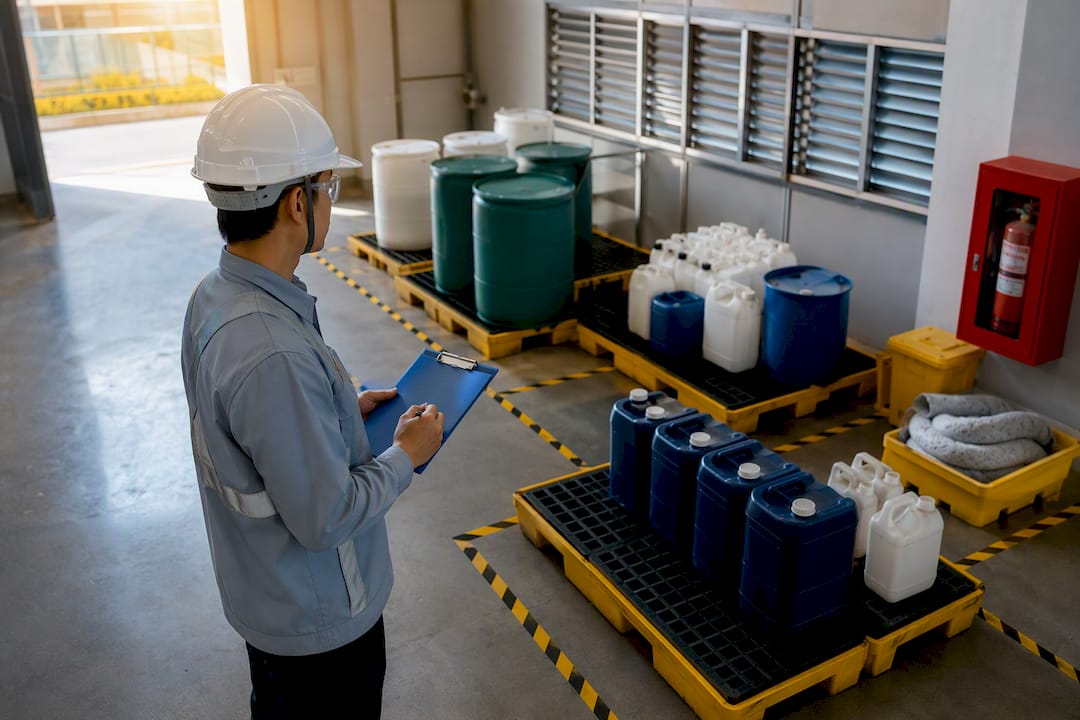
- Bunding and containment. Bund walls need enough volume to hold the largest single container plus a margin for firefighting water, and inspectors check for cracks, coating failure, and drainage that bypasses the containment area entirely.
- Mechanical ventilation. Vapor accumulation from flammable liquids demands active extraction, and the ventilation system’s interlocks must not conflict with the building’s smoke control sequence during a fire event.
- Electrical safety. Fittings within flammable storage zones need proper grounding and, in higher-risk zones, intrinsically safe electrical equipment rated for the hazard classification.
- Segregation by compatibility. Chemical groups that react dangerously together (oxidizers next to flammables, for instance) must be physically separated per the substance’s own SDS guidance, not just by convenience of shelf space.
Pro Tip: Walk your storage area with the SDS compatibility chart in hand, not from memory. Segregation mistakes usually happen when a new substance gets shelved by an employee who has never seen its data sheet.
How Should You Lay Out a Hazardous Storage Warehouse?
Layout decisions made early get baked into approved plans, and unwinding them later is expensive.
- Certain hazard classes are restricted to ground-floor storage with a defined external open space buffer around the building.
- Stacking heights and permissible floor-area storage density differ meaningfully between sprinklered and non-sprinklered compartments, per the Fire Code appendix.
- Hazardous area classification (HAC) becomes necessary wherever flammable vapors could form an explosive atmosphere, which drives your electrical equipment specification.
- Layout plans submitted to regulators need clear labeling of compartment boundaries, segregation zones, egress routes, and fire appliance access points.
What Records Do NEA and SCDF Expect You to Keep?
Documentation is where many otherwise compliant operations lose points at renewal.
- GHS labeling under SS 586 must be current on every container, with SDS accessible to both regulators and the workers handling the substance.
- Maintain a register of substance quantities, stock movements, and associated SDS versions, updated as new batches arrive.
- Digital tracking through a warehouse management system, barcode scanning, or automated storage and retrieval systems makes audit trails defensible and speeds up replenishment decisions.
- Retain records covering the full permit period plus renewal documentation, since NEA guidance notes specify exact fields regulators expect on the application form itself.
What Belongs in an Emergency Response Plan for Dangerous Goods Storage?
A generic ERP is one of the most common reasons an NEA application gets sent back for revision.
- Name specific neutralizing agents for each substance class stored, not generic spill kits, along with PPE requirements and evacuation roles assigned to named positions.
- Toxic gas storage needs documented detection and scrubbing system maintenance, since NEA reviewers look for evidence the equipment actually works, not just that it exists.
- Drill frequency and documentation matter as much as the plan itself. A drill that happened but was never logged carries no weight during an inspection.
- Coordinate with SCDF ahead of site inspections so your ERP demonstration matches what your team will actually do during a real incident.
MOM guidance reinforces that workplaces handling highly volatile chemicals must run a formal management programme rather than treating storage safety as a one-time setup task.
Can You Store Dangerous Goods at a Third-Party Warehouse?
You can, but the legal responsibility for the substance stays with you, not the warehouse operator, even when the goods sit on someone else’s floor.
- Obtain a signed no-objection letter from the warehouse stating the substance name, purity, and maximum quantity permitted on site.
- Verify the warehouse itself holds valid NEA and SCDF permits covering the substance class you intend to store, and ask to see the actual licence document rather than taking their word for it.
- Build contract clauses giving you audit access, immediate incident notification rights, and confirmation of adequate insurance coverage.
- Run periodic verification visits rather than a one-time check at contract signing, since permit conditions and warehouse operations both change over time.
How Do You Apply for Dangerous Goods Storage Permits Step by Step?
- Build the document pack first: SDS for every substance, current inventory, an approved site layout, QP or professional engineer certification for storage structures, your ERP, and any third-party consent letters needed.
- Submit through the right channel. File the NEA Hazardous Substances Permit or Licence through GoBusiness, and file the SCDF P&FM storage licence directly with SCDF.
- Engage a QP during the design phase, not after plans are drafted. Early QP involvement measurably reduces redesign cycles when plans move to SCDF for FSC approval.
- Pre-consult with both agencies where the application is complex, and double-check every form field before submission. Incomplete supporting documents are the leading cause of processing clock-stops.
What Should Safety Officers Prioritize Beyond the Paperwork?
Passing the initial application is the easy half of this process. Sustaining compliance is where operations tend to slip.
- Audit four things on a fixed cadence: inventory accuracy against your register, ERP drill logs, ventilation interlock function, and bund integrity.
- Treat digital tracking as a compliance tool, not a convenience. Barcode or WMS-based tracking creates an audit trail that holds up when NEA or SCDF asks for movement history on short notice.
- Bring in an external QP or consultant for plan approvals and FSC submissions; reserve internal upskilling for day-to-day inventory and inspection readiness.
- NEA’s own guidance recommends systematic safety audits that check stock records, ERP specificity, and training evidence before incidents occur, not after.
Pro Tip: Schedule your internal audit dates to fall roughly two months before permit renewal, giving you time to fix gaps rather than discover them at the worst possible moment.
A Safety Officer’s Take on What Actually Gets Compliance Right
Most operations treat the permit as the finish line. It isn’t. Classification and QP engagement need to happen before you draw a single layout line, and your ERP should read like a working document your team rehearses, not a file that satisfies a checklist. Never assume one licence covers every hazard class on site. Digital audit trails, not memory, are what get you through inspection cleanly.
— Aman
How MOSAIC Supports Dangerous Goods Storage Compliance in Singapore
Getting an NEA permit and an SCDF licence approved on paper is one thing. Keeping your storage facility inspection-ready every month afterward is where most safety teams run out of bandwidth. Safety officers and facility managers often need support with permit application processes, coordination with Qualified Persons for storage plan approvals, and safety audits based on criteria NEA and SCDF inspectors check.

An engagement typically produces an audit report against your current storage setup, a remediation plan for any gaps in bunding, ventilation, or documentation, and the supporting evidence package your permit application or renewal needs. Com’s safety audit service also covers ERP review, so your emergency response plan reads as working documentation rather than a file that only gets opened during inspection. If your storage setup needs a compliance readiness review before your next permit renewal, reach out to Com to scope the audit.
Sources
- Management of Hazardous Substances – Singapore
- P&FM storage licence — SCDF
- Guidance notes for Hazardous Substances application — NEA
- Fire safety requirements for chemical/hazmat warehouses (Fire Code Appendix)
- Code of practice for the storage of flammable liquids — SS 532:2024