
Construction safety accreditation in Singapore operates as far more than a regulatory formality. Many firms treat it as a last-minute checkbox to satisfy tender submissions, but that framing is fundamentally mistaken and strategically costly. The bizSAFE programme, a five-level capability-building certification administered by the Workplace Safety and Health Council (WSHC) under the Ministry of Manpower (MOM), determines whether a company can bid on high-value public contracts, access premium project pipelines, and demonstrate the institutional maturity that major clients and developers increasingly demand. This guide clarifies what accreditation means, how the main pathways work, and what firms must do to navigate them effectively.
Table of Contents
- What is construction safety accreditation and why does it matter?
- The main pathways: bizSAFE, BCA CRS, and ISO 45001 explained
- The bizSAFE journey: Steps, audits, and what to expect
- From compliance to opportunity: How accreditation impacts projects and growth
- The uncomfortable truth about safety accreditation: What most firms miss
- How Mosaic Eco-construction Solutions supports your accreditation journey
- Frequently asked questions
Key Takeaways
| Point | Details |
|---|---|
| bizSAFE is core | bizSAFE is Singapore’s main safety accreditation program and unlocks new project opportunities. |
| Multiple pathways exist | bizSAFE, BCA CRS, and ISO 45001 each serve different but overlapping compliance and capability needs. |
| Independent audits required | Only truly independent audits qualify toward accreditation—your consultant cannot audit their own work. |
| Accreditation drives growth | Earning and maintaining accreditation is essential to win major public and private sector construction tenders. |
What is construction safety accreditation and why does it matter?
Construction safety accreditation, in the Singapore context, is the formal recognition by statutory authorities, specifically MOM, WSHC, and the Building and Construction Authority (BCA), that a company has implemented structured, audited workplace safety and health (WSH) management aligned to national standards. This recognition is not purely symbolic. It directly determines project eligibility, grading thresholds, and client trust in an increasingly risk-conscious industry.
The bizSAFE programme serves as the primary vehicle for this recognition in Singapore. Designed for companies across industries, including construction firms, subcontractors, and project developers, it establishes a progressive five-level framework that guides companies from initial leadership commitment through to a fully audited, internationally aligned WSH management system.
The practical business implications of accreditation are significant and multi-dimensional:
- Tender eligibility: Most public-sector construction tenders valued above $1 million now require bizSAFE Level 3 or higher as a base threshold, making accreditation a prerequisite rather than an advantage.
- BCA grading access: Higher Construction Registration System (CRS) grades, which unlock larger contract values, are contingent on demonstrated WSH capability that aligns with bizSAFE standards.
- Incident risk reduction: Companies with structured WSH management systems experience measurably lower rates of workplace injuries, which translates directly into lower insurance premiums, fewer project delays, and reduced exposure to statutory penalties.
- Reputation capital: Accreditation signals institutional competence to clients, joint-venture partners, and subcontractors. In a sector where safety incidents attract public and regulatory scrutiny, this signal carries real commercial weight.
- Supply chain requirements: Main contractors increasingly require subcontractors to hold minimum accreditation levels before engagement, making accreditation an entry requirement for participation in major project supply chains.
Statistic callout: Public-sector tenders exceeding $1 million in contract value generally require bizSAFE Level 3 or above, a threshold that effectively bars non-accredited companies from a substantial portion of Singapore’s construction market.
Pro Tip: Begin your accreditation process well ahead of your target tender submission date. Firms that initiate bizSAFE progression at least six months before a major tender avoid the operational strain and cost inflation associated with rushed audits and compressed training schedules.
With a clear sense of why safety accreditation matters, let’s break down how the main pathways work in practice.
The main pathways: bizSAFE, BCA CRS, and ISO 45001 explained
Understanding the three principal accreditation frameworks operating in Singapore, and how they relate to one another, is critical to building an effective compliance strategy. Many construction firms conflate these systems or assume that achieving one automatically satisfies the requirements of another. That assumption is incorrect and carries material consequences.
The official bizSAFE program is a stepwise, company-level certification administered by WSHC. It is structured around five progressive levels, each requiring specific training, implementation, and audit activities. It is Singapore-specific, nationally recognized, and functions as the primary gateway to public-sector construction work.
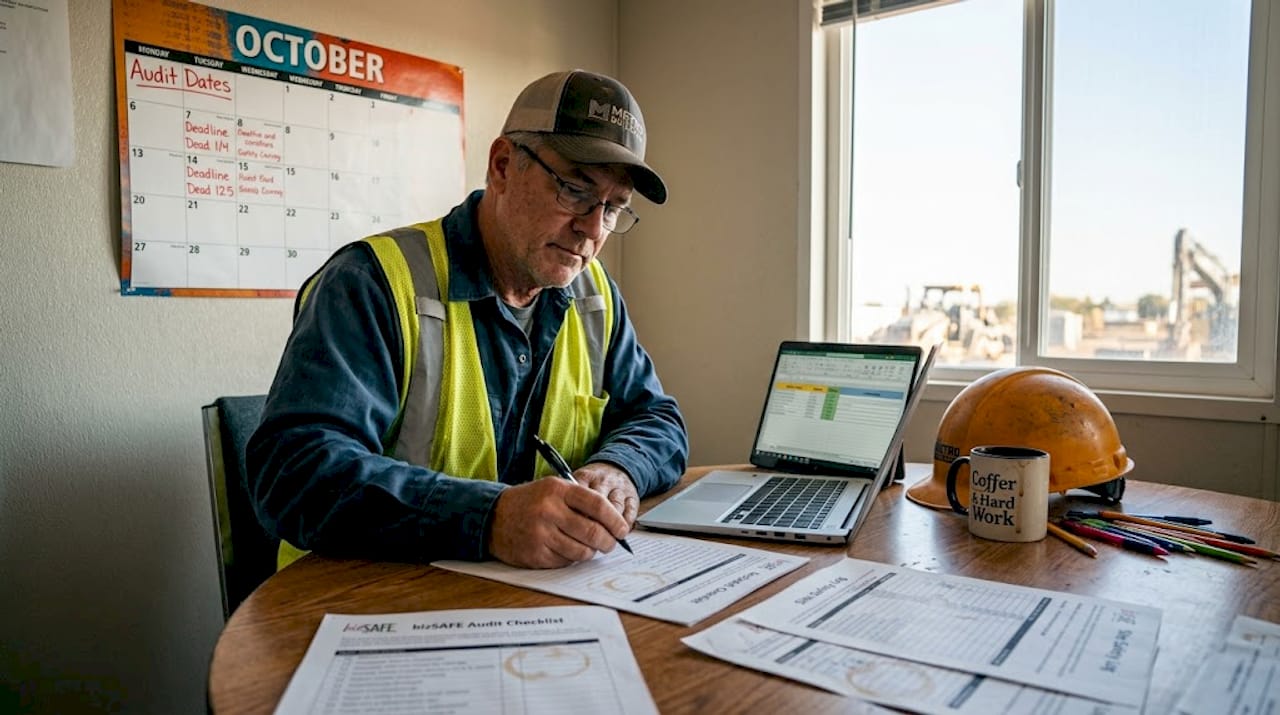
BCA’s Construction Registration System (CRS) is a separate framework that evaluates contractor capability across technical, financial, and WSH dimensions. CRS grading determines the maximum contract value a company can tender for with public-sector agencies. Achieving higher CRS grades requires demonstrating WSH capability that aligns with or builds upon bizSAFE vs ISO 45001 standards, but CRS is not a direct substitute for bizSAFE certification.
ISO 45001, the global standard for Occupational Health and Safety management systems published by the International Organization for Standardization, operates according to a Plan-Do-Check-Act (PDCA) framework and is recognized internationally. In Singapore’s construction context, ISO 45001 becomes mandatory at the bizSAFE Star level, where companies must hold both an independent WSH audit and ISO 45001 certification.
Many firms overlook that bizSAFE Star now requires BOTH ISO 45001 certification and a re-audit for renewal. Assuming your existing certification remains valid without formal renewal creates disqualification risk at exactly the moment you need accreditation most, namely, at tender submission.
The table below provides a structured comparison of the three frameworks:
| Framework | Administered by | Scope | Stepwise? | ISO 45001 required? | Project eligibility impact |
|---|---|---|---|---|---|
| bizSAFE | WSHC / MOM | Company-level WSH | Yes (5 levels) | At Star level only | Direct: Level 3+ for tenders >$1M |
| BCA CRS | BCA | Contractor capability | No (grade-based) | Indirectly, via WSH criteria | Determines max tender contract value |
| ISO 45001 | Independent certifier | OHS management system | No (continuous) | Self-referential | Enhances credibility; required for Star |
Key guidance on when to pursue each pathway:
- Pursue bizSAFE Levels 1 to 3 first, as these unlock the majority of public tender opportunities and are foundational to BCA CRS progression.
- Pursue BCA CRS grading concurrently or immediately after achieving bizSAFE Level 3, particularly if your firm targets public-sector infrastructure or building contracts.
- Pursue ISO 45001 when targeting the bizSAFE Star level, entering international project markets, or working with clients whose supply chain standards require global OHS certification.
As noted by industry experts, bizSAFE complements but fundamentally differs from BCA CRS in capability focus and from ISO 45001 in its non-stepwise structure. The Star level requires both, and renewal mandates re-audit to maintain tender eligibility. Do not conflate these systems or assume that progress in one automatically satisfies the requirements of another.
Understanding these options is critical. Next, let’s see what achieving each level in bizSAFE involves.
The bizSAFE journey: Steps, audits, and what to expect
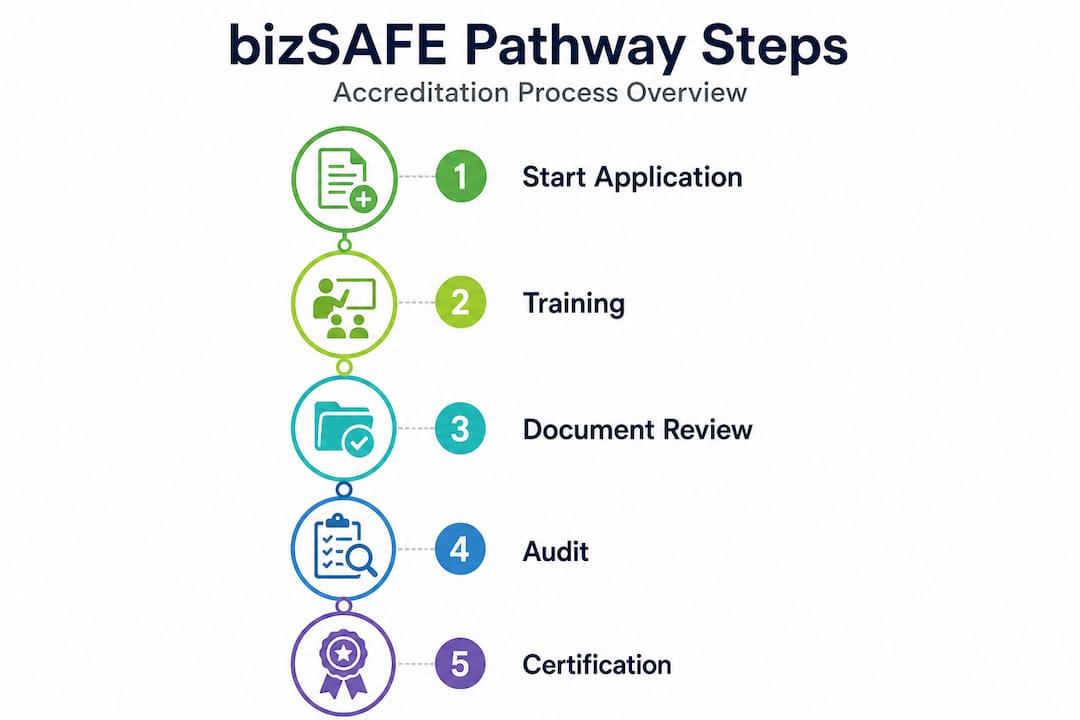
The bizSAFE framework progresses through five discrete levels, each building on the previous to develop increasingly sophisticated WSH management capability. The progressive audit methodology mirrors the PDCA cycle embedded in ISO 45001, and the Hierarchy of Controls underpins the risk management (RM) work required at Level 2 and above.
The five levels, in sequence, are:
- Level 1: CEO/top management commitment. The company’s senior leadership attends a half-day WSHC workshop and makes a formal WSH commitment. This step establishes organizational accountability and signals board-level prioritization of safety.
- Level 2: Risk management implementation. The company appoints a Risk Management Champion who completes an approved WSHC training course and then leads the development of a site-level risk management plan, applying the Hierarchy of Controls to identify, evaluate, and control workplace hazards.
- Level 3: WSH management system audit. An MOM-approved auditor conducts an independent audit of the company’s WSH management system against WSHC standards. This is the level that unlocks eligibility for public-sector tenders above $1 million and represents the most commercially critical threshold for most construction firms. Understanding bizSAFE Level 3 certification is therefore a strategic priority.
- Level 4: WSH management system implementation. The company deepens its WSH system implementation, demonstrating operational integration of safety management across project activities, documentation, and workforce behaviors.
- Star: International-standard audit. The company undergoes an independent audit against international WSH standards and must hold an active ISO 45001 certification. This level signals the highest tier of WSH capability and is often required for joint ventures on major infrastructure or government projects.
The table below summarizes key parameters for each level:
| Level | Core requirement | Who conducts audit/training | Typical timeline | Primary impact |
|---|---|---|---|---|
| 1 | CEO workshop attendance | WSHC-approved trainer | 1 day | Organizational commitment |
| 2 | RM Champion training and risk plan | WSHC-approved trainer | 2 to 4 weeks | Foundation RM capability |
| 3 | Independent WSH management system audit | MOM-approved auditor | 1 to 3 months | Tender eligibility for contracts >$1M |
| 4 | Deeper system implementation and review | Internal with auditor oversight | 3 to 6 months | Advanced WSH integration |
| Star | Independent audit + ISO 45001 certification | Accredited certification body | 6 to 12 months | International-level accreditation |
A critical operational constraint applies across all audit levels: the audit independence requirement mandates that the auditor or certification body conducting the audit must be entirely independent of any consultant who assisted in designing or implementing the system. Firms that engage a single provider for both implementation consultancy and audit services are in violation of this requirement and risk having their audit results invalidated.
Pro Tip: Engage your MOM-approved auditor as early as Level 2 to understand precisely what documentation and evidence standards will be expected at Level 3. Firms that review safety audit steps in Singapore before the audit date rather than after a failed attempt recover faster and at significantly lower cost.
With the bizSAFE pathway mapped out, let’s focus on how accreditation shapes your ability to win major tenders and drive business growth.
From compliance to opportunity: How accreditation impacts projects and growth
The relationship between safety accreditation and commercial performance in Singapore’s construction sector is direct, quantifiable, and increasingly non-negotiable. The WSH requirements for public-sector projects establish that bizSAFE Level 3 or higher is the threshold for public-sector construction and construction-related project tenders exceeding $1 million in value, with the SDQ (Safety Demerit and Qualification) framework empowering agencies to disqualify firms with poor safety performance records, regardless of price competitiveness.
The market advantages of strong accreditation extend well beyond satisfying minimum tender criteria:
- Enhanced credibility with private developers: Major private-sector clients, including real estate investment trusts (REITs), institutional developers, and multinational corporations commissioning fit-out or infrastructure works, routinely specify minimum bizSAFE levels in their procurement requirements, mirroring public-sector standards.
- Lower insurance premiums and fewer project delays: Companies with certified WSH management systems demonstrate reduced incident frequency, which actuaries recognize through more favorable premium structures and which project managers recognize through fewer stop-work orders and regulatory interventions.
- Stronger subcontractor engagement: Main contractors with robust accreditation attract more capable subcontractors who themselves seek to work within well-managed safety environments, creating a positive selection dynamic across the project supply chain.
- Reduced regulatory exposure: Firms with active construction safety management systems are better positioned to demonstrate due diligence under the Workplace Safety and Health Act (WSHA), reducing their exposure to enforcement actions, improvement notices, and prosecution.
Getting accredited is not just a legal hurdle. In Singapore’s construction market, it is a strategic asset that separates firms capable of competing for premium contracts from those confined to lower-value, higher-risk work.
One important distinction that firms must internalize is that product-level certifications, such as concrete conforming to BS EN 13369 or structural steel certified to relevant material standards, are categorically different from company-level safety accreditation. Material certifications address product quality. bizSAFE and related frameworks address organizational WSH capability. No quantity of product certifications substitutes for company-level accreditation when public agencies evaluate tender submissions against WSH criteria.
Now that you’ve seen the benefits and requirements, let’s step back and examine what most firms get wrong about accreditation and the hard truths.
The uncomfortable truth about safety accreditation: What most firms miss
The most persistent strategic error observed across construction firms seeking accreditation is the scramble model: waiting until a tender opportunity surfaces, then attempting to compress months of legitimate WSH system development into weeks. This approach is not merely suboptimal. It is systematically counterproductive, generating inflated consultancy costs, documentation gaps that experienced auditors identify immediately, and a workforce that has been briefed on procedures it does not understand or practice.
Accreditation frameworks, particularly at bizSAFE Level 3 and above, are designed to assess whether safety management is operationally embedded, not whether documentation can be assembled rapidly. An auditor examining a WSH system assembled in three weeks against one built and refined over twelve months will identify the difference in the first hour of the site walkthrough and document review.
The firms that consistently achieve and maintain accreditation at competitive cost are those that treat the process as an ongoing operational investment rather than a periodic administrative task. They assign internal ownership to WSH management at the management level, conduct regular internal reviews against audit criteria between formal audit cycles, and use audit findings as genuine operational improvement data rather than as pass-fail scores to be minimized.
There is also a deeper strategic dimension to this argument. The construction companies that leverage design for safety in projects as an integrated design discipline, rather than a post-design compliance review, consistently demonstrate stronger WSH management system performance because safety considerations are built into the project from the outset. That upstream integration is visible to auditors and signals genuine institutional commitment.
Pro Tip: Schedule a gap assessment against your target bizSAFE level at least six months before your intended audit date. Use that assessment to prioritize system development activities by risk and audit weight, rather than by ease of documentation. The gaps that are hardest to close on paper are usually the ones that create the greatest operational exposure on site.
True competitive advantage in Singapore’s construction market comes from companies that use the audit cycle to genuinely improve their WSH operations. Accreditation then becomes a natural outcome of operational excellence rather than an administrative end in itself.
How Mosaic Eco-construction Solutions supports your accreditation journey
Achieving and sustaining bizSAFE accreditation requires more than guidance documents and good intentions. It demands structured support from practitioners who understand both the regulatory framework and the operational realities of construction project delivery in Singapore.
Mosaic Eco-construction Solutions provides tailored audit readiness assessments, WSH management system implementation support, and training programs designed specifically for construction companies and project developers navigating the bizSAFE pathway. Whether your firm is initiating Level 1 or preparing for a Star-level re-audit, our consultancy team works alongside your internal WSH personnel to close gaps systematically, ensure audit independence requirements are met, and build the documentation and operational evidence that certified auditors require. Review safety audit examples for Singapore construction compliance to understand what robust audit evidence looks like, and explore our structured guidance on preparing for a safety audit to begin your readiness process with confidence.
Frequently asked questions
What are the main requirements for bizSAFE Level 3?
To achieve bizSAFE Level 3, your company must complete an independent audit of its WSH management system conducted by an MOM-approved auditor, demonstrating that your risk management practices meet Singapore WSH standards. The audit must be conducted independently of any consultant who designed your system.
Is ISO 45001 mandatory for Singapore construction safety accreditation?
ISO 45001 is not required for bizSAFE Levels 1 through 4, but bizSAFE Star mandates both ISO 45001 certification and an independent audit against international WSH standards. Some higher BCA CRS grades also effectively require this level of alignment.
How long does it take to complete the entire bizSAFE accreditation process?
The full progression from Level 1 to bizSAFE Star typically takes twelve to eighteen months for firms starting from scratch, though the timeline depends heavily on your organization’s readiness, internal WSH capacity, and how early audit preparation begins.
Can a safety consultant audit the same system they helped implement?
No. The audit independence requirement is explicit: the auditing body or individual must be entirely separate from any consultant involved in designing or implementing the WSH management system being assessed. Violations can invalidate the audit.
What happens if my company loses accreditation status?
Loss of accreditation immediately disqualifies your firm from public-sector tenders requiring that level, and may also affect your BCA CRS grade. As industry guidance confirms, renewal requires a re-audit, so address any outstanding audit findings and submit renewal applications well before your certification expiry date.