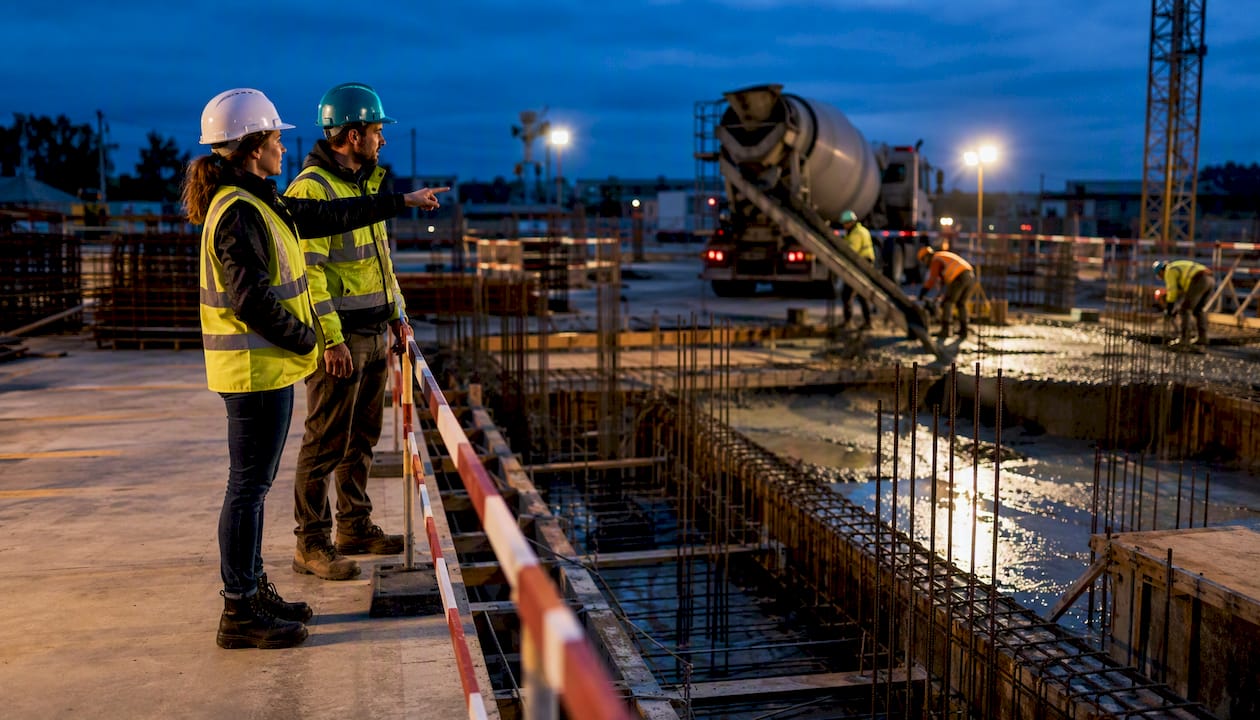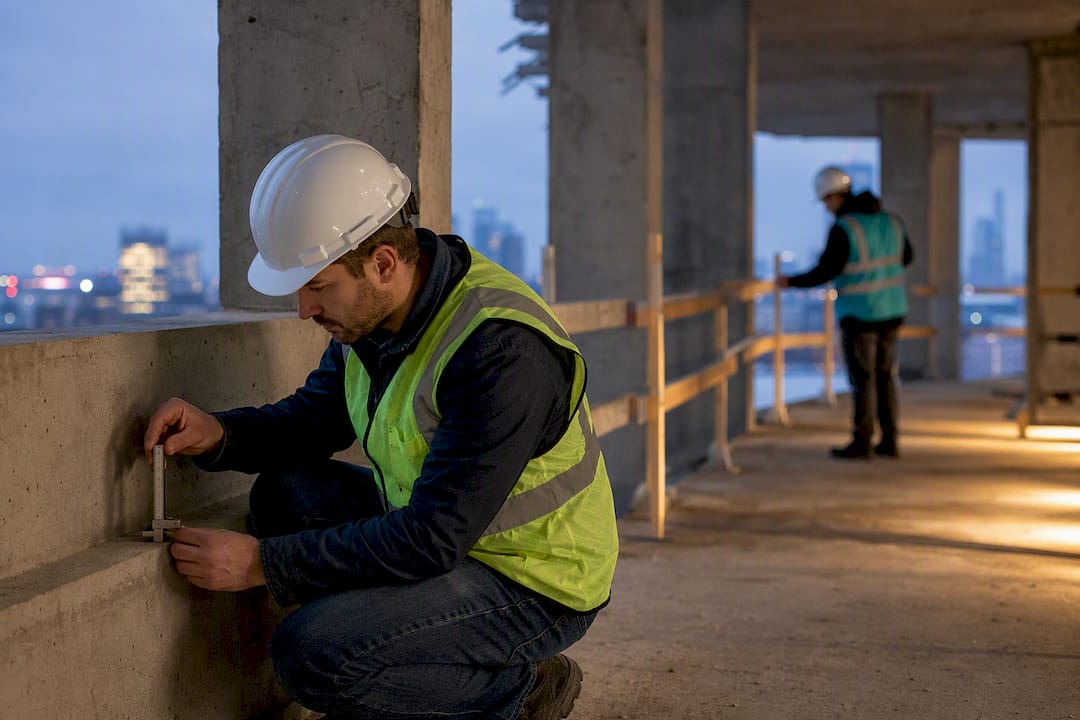

A combined ISO audit assesses two or more management system standards, such as ISO 9001, ISO 14001, and ISO 45001, in one coordinated audit session run by a single audit team. It works well when a construction organization wants fewer disruptions and a consolidated report, provided each standard’s requirements still get verified on its own merits. Professionals should choose this approach when timelines are tight and management systems already share common processes.
TL;DR:
- Combining ISO 9001, ISO 14001, and ISO 45001 audits reduces administrative effort but does not significantly lower total auditor hours required.
- Effective planning involves mapping clauses to processes, scheduling site walkthroughs by activity, and setting clear roles early to minimize site disruptions.
- Cross-discipline auditor competence and digital evidence systems are crucial, as scattered records cause delays and obscure compliance verification.
- Most efficiency gains depend on evidence management and process-based scheduling, not just audit scope, making preparation vital for real-time site conditions.
- External support for building audit matrices and training teams can streamline the process, especially when multiple standards are involved on dynamic construction sites.
Table of Contents
- What Combined and Integrated Audits Actually Mean
- Benefits, Real Limits, and Accreditation Rules
- Planning and Scoping a Combined Audit
- Staffing the Audit Team Correctly
- Execution Checklist and Sample Agenda
- Field Notes from QES Audit Work
- Get Hands-On Help Running Your Next Combined Audit
- Standards and Guidance Worth Consulting
- Sources
- FAQ
- The Gap Between Combined Audit Theory and Site Reality
What Combined and Integrated Audits Actually Mean
A combined audit uses one audit team to assess multiple management systems in parallel during the same visit. An integrated audit, by contrast, evaluates a single integrated management system (IMS) that has already merged quality, environmental, and safety requirements into one operating framework rather than three separate ones running side by side, according to ISO 19011 guidance on multi-standard audits.
The reason combining works at all comes down to Annex SL, the High-Level Structure that ISO now applies to nearly all its management system standards. Annex SL forces ISO 9001, ISO 14001, and ISO 45001 into the same ten-clause skeleton, covering context of the organization, leadership, planning, support, and so on, which means an auditor can walk through one clause and gather evidence relevant to all three standards at once.
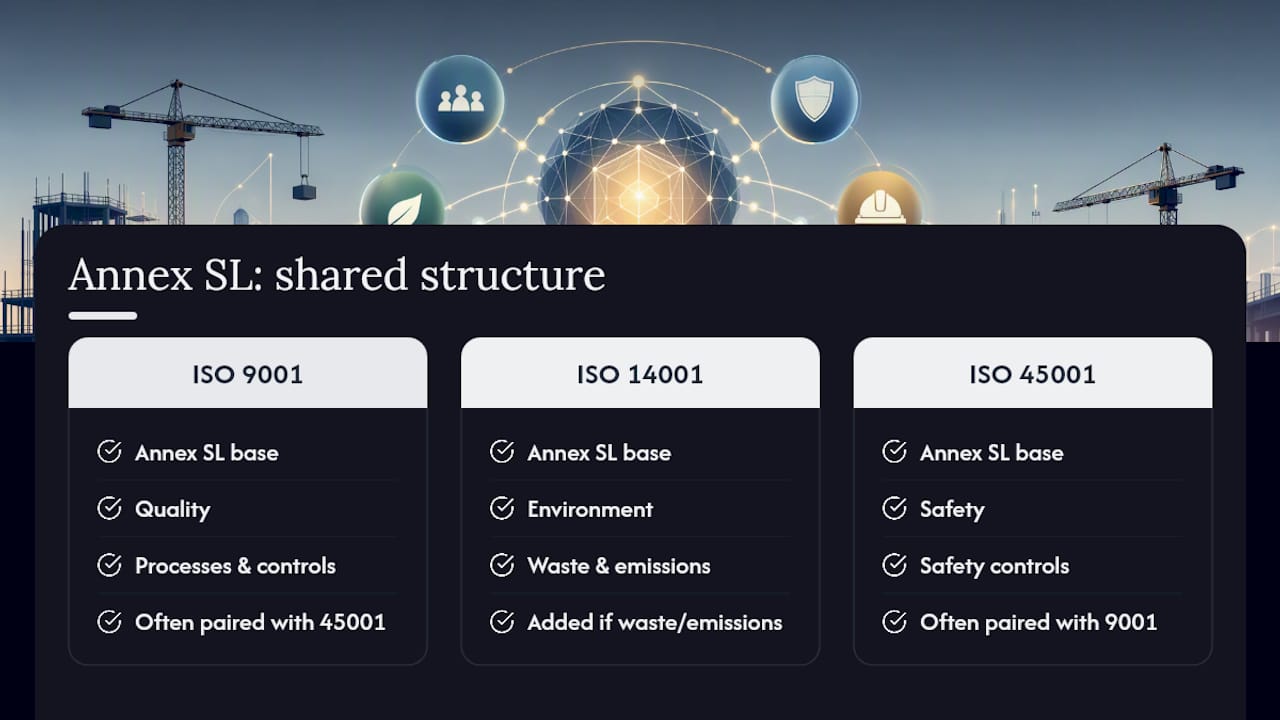
For construction firms, the most common pairing is quality (ISO 9001) with occupational health and safety (ISO 45001), often joined by environmental management (ISO 14001) once a project involves waste handling, emissions, or site restoration commitments. Our guide to how ISO 14001 and ISO 45001 differ breaks down where the evidence trails diverge even under a shared structure.
Benefits, Real Limits, and Accreditation Rules
The efficiency case for combining audits is genuine but narrower than most vendors imply. Fewer opening and closing meetings, one consolidated report instead of three, and clearer visibility into how a safety nonconformance links to a quality process are all real gains construction teams notice immediately.
The limit sits in accreditation. Bodies operating under ISO/IEC 17021 still require each standard’s clauses to receive independent verification, and total auditor time rarely shrinks in direct proportion to the number of standards added. Combining three standards does not mean one-third the audit hours. Most of the savings are administrative rather than a cut in actual verification work, a distinction Procore’s integrated compliance guide makes explicit.
Separate audits still make sense when a certification body requires independent surveillance cycles, when one management system is new and needs closer scrutiny, or when a client contract specifies standalone certificates.
Planning and Scoping a Combined Audit
Good combined audits start weeks before anyone sets foot on site. Skipping the planning stage is the fastest way to turn a combined audit into three uncoordinated visits wearing one badge.
- Agree objectives and scope for each standard. Write down what ISO 9001, ISO 14001, and ISO 45001 each need to demonstrate this cycle, not a generic combined objective.
- Build an audit matrix. Map clauses and processes across standards so auditors know which single site observation satisfies multiple requirements, an approach ISO 19011 recommends explicitly.
- Draft one audit plan organized by process, not by clause. A frequent mistake is scheduling by standard clause, which fragments site visits and inflates disruption; scheduling by process area, such as excavation, materials handling, or subcontractor management, lets one walkthrough cover multiple clauses at once, per Procore’s findings.
- Set a realistic timeline. A medium-sized site audit typically needs a half day for opening and document review, one to two days of fieldwork, and a half day for closing and reporting.
- Communicate roles and schedule early. Site supervisors, safety officers, and subcontractors all need to know who they’re meeting and when.
Our ISO certification checklist for construction professionals covers the document list auditors typically request before day one.
Staffing the Audit Team Correctly
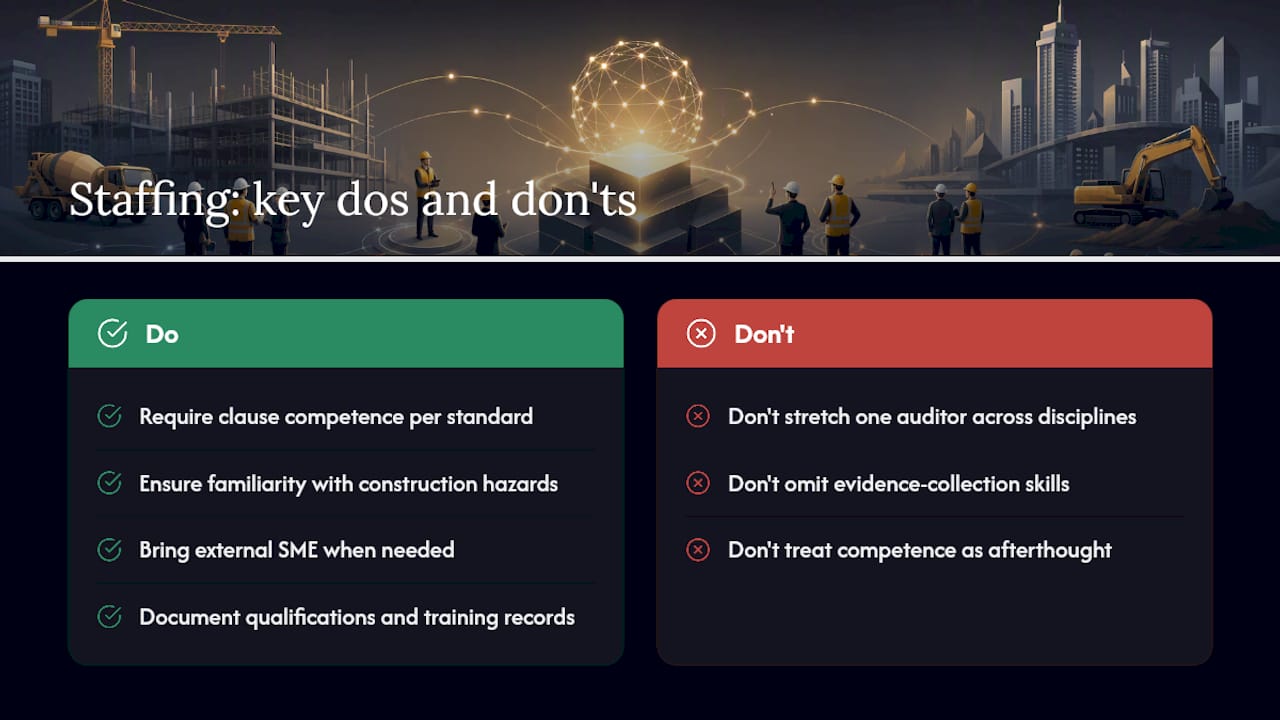
Cross-discipline competence is the single biggest determinant of whether a combined audit produces useful findings or a shallow pass. An auditor fluent in ISO 9001 clause language but unfamiliar with fall-protection requirements will miss things a construction-specific ISO 45001 auditor catches immediately.
At minimum, require competence in the clause structure of each standard being audited, familiarity with construction-specific hazards (working at height, confined spaces, heavy machinery), and solid evidence-collection skills. When internal capability falls short, bring in an external subject-matter expert rather than stretching one generalist auditor across three disciplines.
A workable staffing model for a medium-sized construction auditee is a lead auditor covering quality and general management clauses, plus one specialist each for safety and environmental compliance. Document each auditor’s qualifications, training records, and prior audit experience. Accreditation bodies will ask for this, and the IIA’s integrated auditing guidance treats auditor competence as a precondition for integration, not an afterthought.
Execution Checklist and Sample Agenda
A combined audit day runs on the same skeleton as a single-standard audit, just with more evidence types feeding into one report.
Opening meeting:
- Confirm attendees, including site management, safety officers, and subcontractor representatives.
- Restate scope and objectives for each standard being audited.
- Review document requests: permits, method statements, training records, incident logs.
Fieldwork:
- Walk the site by process area, not by standard, observing work activities directly.
- Interview workers about procedures, PPE use, and reporting channels.
- Cross-check records (toolbox talks, inspection logs, waste manifests) against what’s observed on site.
- Flag any finding that touches more than one standard and note each affected clause separately.
Reporting and closing:
- Group similar requirements across standards into single work papers to avoid retesting the same evidence twice.
- Write cross-impact findings once, referencing every relevant standard clause explicitly.
- Hold one closing meeting presenting a single consolidated report rather than three separate summaries.
Field Notes from QES Audit Work
Combined audits succeed or fail on evidence management long before anyone reaches the closing meeting. Construction sites generate paperwork across multiple subcontractors, shifts, and locations, and when that evidence lives in scattered folders instead of one common data environment (CDE), auditors waste hours reconciling version conflicts instead of verifying compliance. A single digital repository turns a combined audit from a scavenger hunt into a walkthrough.
The recurring surprise in QES consultancy work is how often a genuinely compliant site fails to prove it, simply because the safety log, the quality inspection record, and the environmental waste manifest live in three different systems maintained by three different people. Digital evidence platforms fix that at the source, which is why construction firms using a unified evidence system see smoother multi-standard audits than those juggling spreadsheets.
Get Hands-On Help Running Your Next Combined Audit
Planning a combined audit across ISO 9001, ISO 14001, and ISO 45001 takes real coordination, and getting the audit matrix, staffing, and evidence trail wrong costs more time than running the standards separately. QES audit support, training, and integrated management system consultancy are available that address the challenges construction sites face with scattered subcontractor records and shifting site conditions, which can make standalone audits more difficult.

Working with a team that understands how ISO 9001, ISO 14001, and ISO 45001 interact on an active construction site can cut audit prep time and reduce the back-and-forth from coordinating multiple standards without a shared plan. Consultants can assist in building an audit matrix, preparing teams for cross-discipline questioning, and providing on-site support during fieldwork. If your organization is preparing for its next certification cycle, review MOSAIC’s safety training programs for 2026 to see how targeted training closes the competence gaps auditors flag most often, and get a head start before your next audit window opens.
Standards and Guidance Worth Consulting
Formal requirements sit in a handful of core documents. ISO 9001, ISO 14001, and ISO 45001 define the clause structure your management systems must meet, all built on the shared Annex SL framework. ISO 19011 covers how to plan and execute audits across multiple standards, while ISO/IEC 17021 sets the accreditation rules certification bodies must follow. For practical implementation detail, our own explainer on integrated ISO management systems and Procore’s integrated compliance guide both go deeper into construction-specific application.
Sources
- Integrated auditing practice guide — The IIA
- Integrated Compliance: A Main Contractor’s Guide to ISO 9001, 14001, 45001, and 44001 | Procore UK
- Combined Audit: What It Is, Strategies, and How It Differs from a Joint Audit
FAQ
What Are the Different Types of ISO Audits?
ISO audits generally fall into first-party (internal self-assessment), second-party (supplier or client audits), and third-party (independent certification audits), and any of these can be run as single-standard, combined, or fully integrated audits depending on scope.
What Is the Combined Audit Approach?
The combined audit approach uses one audit team to assess two or more management system standards, such as ISO 9001 and ISO 45001, during a single coordinated visit, while still verifying each standard’s clauses independently.
What Is ISO 9001, ISO 14001, and ISO 45001?
ISO 9001 covers quality management, ISO 14001 covers environmental management, and ISO 45001 covers occupational health and safety, and all three share the same Annex SL clause structure, which is why construction firms commonly certify them together.
How Often Are ISO Audits Required?
Certified organizations typically undergo surveillance audits annually for the first two years after certification, followed by a recertification audit in the third year, though exact intervals depend on the certification body’s accredited program.
The Gap Between Combined Audit Theory and Site Reality
Most guidance on combined audits reads like it was written for a manufacturing plant with one entrance and stable processes. Construction sites don’t work that way. Crews rotate, subcontractors change weekly, and the evidence an auditor needs might be in a site trailer, a foreman’s phone, or a filing cabinet at head office. The technical case for combining ISO 9001, ISO 14001, and ISO 45001 audits is solid, but the operational case depends entirely on whether your evidence trail can keep up with a moving site.
The mistake I see most often isn’t a knowledge gap about Annex SL or clause mapping. It’s treating the audit matrix as a paperwork exercise instead of a scheduling tool. Teams that plan by process area, walking a single excavation zone once and pulling quality, safety, and environmental evidence from that one observation, get through audits faster and with fewer disputed findings than teams that still think in terms of “the safety auditor’s day” and “the quality auditor’s day.” The standards converged years ago. Site practices haven’t always caught up.
— Aman