
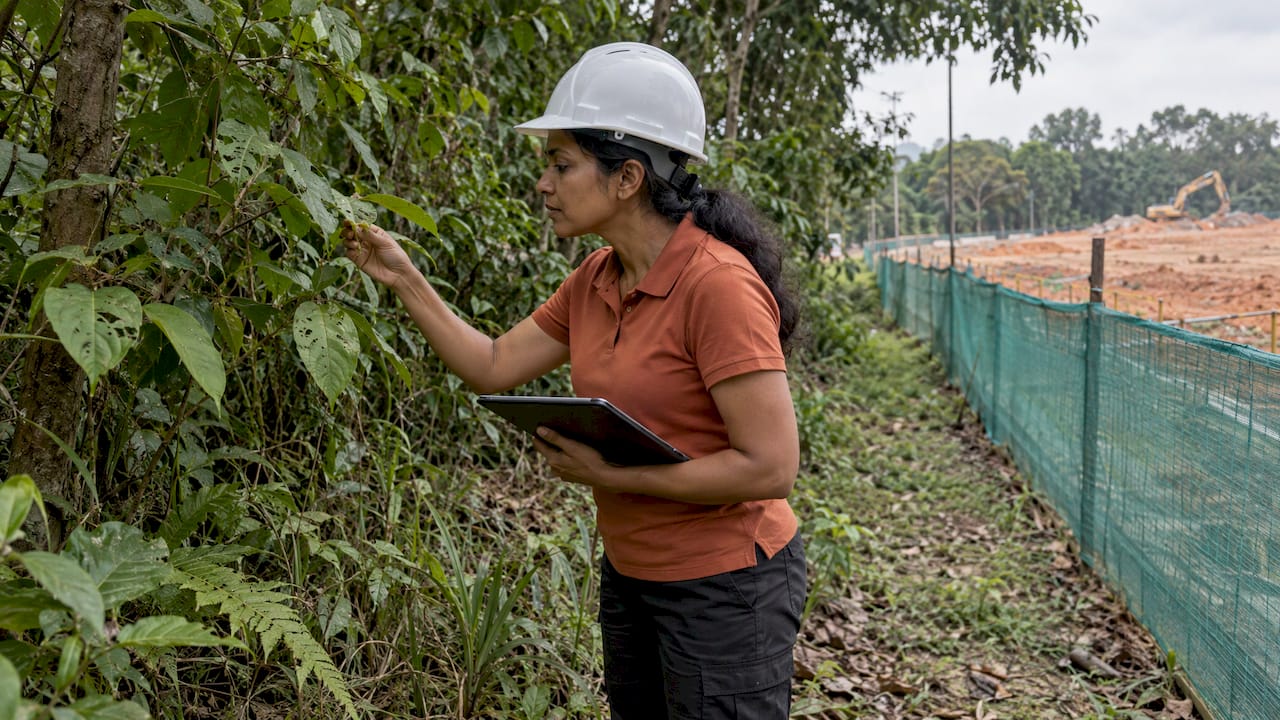
Singapore has no standalone law that makes an environmental impact assessment (EIA) mandatory for every development. Whether your project needs one is decided case by case through the planning process, led by the Urban Redevelopment Authority (URA) and the technical agencies it consults. Projects near sensitive areas such as nature reserves, nature areas and coastal waters are the most likely to be asked for a detailed study. If an agency does require one, you must have mitigation and monitoring in place before works begin.
TL;DR
- No Singapore statute sets out when an EIA is mandatory. The requirement comes from the planning evaluation process and the agencies’ discretion, not from a codified threshold.
- URA and the Ministry of National Development (MND) assess projects before planning approval. Agencies such as NParks, NEA, MPA and SFA advise on whether a more thorough study is needed.
- Location is the strongest trigger: sensitive areas, marine and coastal sites, and areas of significant biodiversity attract the greatest scrutiny.
- A study typically moves through screening, scoping, impact analysis with mitigation, and an Environmental Monitoring and Management Plan (EMMP) that the contractor implements.
- Even without a formal EIA, planning approval depends on meeting the requirements of regulators such as NEA, PUB and NParks.
Table of Contents
- Is an EIA legally required in Singapore?
- Who decides whether your project needs one
- What makes agencies ask for a study
- How the EIA process works
- What developers and contractors must do
- The debate over an EIA law
- Where site compliance meets the EIA
- Getting your site ready for agency requirements
- FAQ
- Sources
Is an EIA legally required in Singapore?
Not as a blanket rule. Singapore lacks a law that sets out when such studies are mandatory, and the Government has maintained that stand-alone legislation is unnecessary because the existing planning evaluation process “has worked well”. A framework to determine and mitigate the environmental impact of new developments was introduced in 2020, but it remains largely up to the Government to decide when an impact study is needed.
In practice, this means the question “do we need an EIA?” has no yes-or-no answer you can read from a statute. It has an answer you obtain by engaging the agencies early, with a clear description of what you intend to build, where, and by what methods.
The absence of a statute does not mean the absence of consequences. Planning approval is only granted when a proposal has met the requirements imposed by regulatory agencies. URA lists the NEA’s Environmental Protection and Management Act and Environmental Public Health Act, PUB’s Sewerage and Drainage Act, and NParks’ Wildlife Act among the instruments behind those requirements. For a developer or main contractor, the practical effect is the same as a legal obligation: a project that cannot satisfy the agencies does not proceed.

Who decides whether your project needs one
The decision is shared, and the entry point is the planning application.
- MND and URA assess the development against its potential impact before granting planning approval. URA states that projects undergo evaluation covering traffic, public health, heritage and the environment.
- Technical agencies such as NParks, NEA, the Maritime and Port Authority (MPA) and the Singapore Food Agency (SFA) are consulted more extensively where there is a possible impact, and they help determine whether a more thorough environmental study is needed.
- The Government as landowner matters too. Ecology consultant Ong Say Lin has observed that development of each plot is usually led by the Government, so there is no check from international bank funding standards of the kind seen elsewhere in South-east Asia.
Minister for National Development Desmond Lee explained to Parliament on 26 February 2021 that developers of projects near sensitive areas must engage in an in-depth consultation with multiple public agencies. Depending on the scope of works and potential impact, detailed studies such as an Environmental Baseline Study or a more detailed Environmental Impact Study may then be required.
The practical lesson: the agencies, not the developer, decide whether a study is called for and how broad it should be. Teams that treat consultation as a design-stage task, rather than a late approval hurdle, avoid redesign and programme disruption.
What makes agencies ask for a study
Several factors shape the decision. None is a published pass/fail threshold, so treat them as indicators of how much scrutiny to expect.
Location near sensitive areas
URA says projects near Nature Reserves, Nature Areas, marine and coastal areas, other areas of significant biodiversity, or areas with potential trans-boundary impact are subject to greater scrutiny and may require a more thorough environmental study. MND’s parliamentary reply on works near national parks and nature reserves says the same: such projects must undergo an in-depth consultation with the relevant technical agencies on the scope of works, the possible impact and the mitigating measures.
NParks’ guidance goes a step further for biodiversity: projects in or near nature reserves, nature areas and areas of biodiversity interest, and all coastal and marine development projects, require a more detailed Biodiversity Impact Assessment (BIA), a core component of a full EIA.

The works and the ecology
In Parliament on 2 August 2023, Minister Lee said the assessment takes into account development details such as construction methods, and ecological factors such as habitat types, floral and faunal diversity and ecological connectivity. NParks also draws on its island-wide Ecological Profiling Exercise and continually reviews its approach as scientific knowledge evolves. So the same footprint can attract different outcomes depending on the method of construction and what lives around it.
Scale and significance
MND has said that all projects with potential environmental impact are screened, and those likely to have significant impact undergo detailed EIA studies. Examples it cited include the Cross Island Line, the Tuas Port development and the Mandai project. Most private construction sites in built-up areas will sit far from this end of the scale, but they remain subject to the agency requirements described above.
How the EIA process works
An SFA and NParks workshop document outlines four stages:
| Stage | What happens |
|---|---|
| 1. Screening | The Form A/B process establishes whether a study is needed |
| 2. Scoping | The agencies and the project team agree which studies are required |
| 3. Impact analysis and mitigation | The EIA report assesses impacts and proposes mitigation |
| 4. EMMP follow-up | Monitoring confirms mitigation is applied and effective |
A full-scale assessment typically includes a baseline survey, noise, light, air quality, water quality, flora and fauna, Environmental Quality Objectives, impact assessment, mitigation measures and an EMMP.
What a report contains
The revised NParks BIA Guidelines, published in May 2024, are non-prescriptive: they explain how biodiversity-related impact assessments are carried out rather than setting rigid rules. A typical BIA report, according to those guidelines, contains:
- A non-technical summary
- A project description
- A literature review and baseline survey findings
- An impact assessment
- Mitigation measures
- An Environmental Monitoring and Management Plan
What real studies have examined
Published reports show the range. The Cross Island Line Phase 2 study assessed surface water and groundwater, noise and vibration, air quality, ecology and biodiversity, visual impact and cultural heritage, with each impact rated before and after mitigation. JTC’s Tengah report follows a sequence of scoping, baseline measurement, assessment using the Rapid Impact Assessment Matrix method, and management, with final decision-making by URA and MND.
Public engagement is also discretionary. According to The Straits Times in February 2026, the mode of engagement stays with the authorities: it typically involves consulting a select group from the nature community, then releasing reports on the URA website with a month-long feedback window.
What developers and contractors must do
When an agency requires a study, the obligations fall in three areas.
Have measures in place before works start. URA states that the developer must ensure mitigation measures and monitoring plans are in place to minimize environmental impacts before any works commence.
Follow the mitigation hierarchy. The NParks guidelines set a clear order of preference:
- Avoid impacts first.
- If avoidance is not practicable, reduce or minimize the total impact.
- Remedy, repair or restore.
- Where possible, compensate or offset.
This mirrors the hazard control logic that safety professionals already use on site: eliminate first, then reduce, and treat compensation as the last step.
Implement the EMMP through the contractor. The same guidelines state that the EMMP must be implemented by the developer’s contractor. It works as a checklist of monitoring measures, confirming that the mitigation recommended in the report is followed and effective. For a main contractor, this is where an EIA becomes a daily site responsibility rather than a document filed at approval.
Scope can be interpreted
Because no law prescribes the content, scope is negotiated. Ecologist Natalia Huang has noted that, without an EIA law, the consultant is free to interpret the scope, and studies tend to be done to meet the requirements in the tender. Writing a clear scope into the tender, and confirming it with the agencies, protects the project from later requests for additional work.
The debate over an EIA law
Singapore’s position is unusual internationally. Research by Yang Tseming in 2018 found EIAs legally mandated in at least 183 jurisdictions, with Singapore among six states without such a requirement. The Singapore Terrestrial Conservation Plan, published in 2024, renewed the call for legislation that clearly outlines when and how environmental studies are conducted.
Academic commentary has also argued for codification; one 2024 legal note reviews the administrative practice and makes the case for introducing legislation. We do not cite that note for any specific rule, and there is no enacted change to rely on. For planning purposes, assume the current discretionary system continues, and watch official announcements from MND, URA and NParks for any change.
Where site compliance meets the EIA
Most conditions that come out of an environmental study land on the construction site. Noise, air quality, water discharge and waste are the usual subjects, and each has its own regulatory track alongside any EIA.
- Noise limits and the 150m rule are covered in our guide to Singapore construction noise limits, including how to set up compliant noise monitoring and a noise management plan.
- Dust and emissions are addressed in air quality monitoring on construction sites.
- The wider picture of agency obligations is laid out in our environmental compliance guide for construction projects.
These are the same parameters, noise, air and water quality, that an EIA baseline survey measures. A site that already monitors them in a disciplined way is better placed to demonstrate that an EMMP is being followed.
Our perspective
An EIA is often discussed as a document. On a live site it is a set of commitments, and commitments fail at the interface between the consultant who wrote them and the team that must carry them out each day.
In our experience across more than 20 years in Quality, Environment and Safety work, the projects that handle environmental conditions well are those that integrate them into the same management system as safety. A monitoring checklist, a method statement and a risk assessment should speak to one another, rather than sit in separate files owned by separate people.
That is why we advise construction firms to treat environmental requirements as part of their EHS documentation, their audit programme and their Design for Safety thinking from the earliest stage, when avoiding an impact is still cheaper than repairing it. The mitigation hierarchy the agencies apply is, in essence, the hazard control hierarchy applied to the environment.
Our consultants work with contractors and developers on EHS advisory and documentation, WSH audits and inspections, and ongoing support after the engagement, so that obligations written at approval remain visible and verifiable on site.
Aman
Getting your site ready for agency requirements
If your project may attract an environmental condition, or you already hold one, we can help you turn it into an operating system your site team can follow. Our EHS Advisory and Documentation service structures plans, procedures and records, and our WSH Audit and Inspection service checks that they are applied on site.

For a broader view of how we can support your project, from certification to Design for Safety and ongoing manpower, see our consultancy services or contact us through our website.
FAQ
Is an EIA mandatory for every construction project in Singapore?
No. There is no law that makes EIAs mandatory for all projects. The Government decides when a study is needed through the planning evaluation process, and projects likely to have significant impact are the ones subject to detailed studies.
Who decides if an environmental study is required?
URA and MND assess the project before planning approval, and technical agencies such as NParks, NEA, MPA and SFA are consulted to determine if a more thorough study is needed. Engage them early, with a clear description of works and methods.
Which projects are most likely to need one?
Those near Nature Reserves, Nature Areas, marine and coastal areas, and areas of significant biodiversity. NParks says all coastal and marine development projects, and projects in or near sensitive nature areas, require a more detailed BIA.
What happens after the EIA report is accepted?
The developer must have mitigation measures and monitoring plans in place before works start. The contractor implements the EMMP, which acts as a monitoring checklist to confirm that mitigation is followed and effective throughout construction.
Does Singapore plan to introduce an EIA law?
Calls for legislation have been made, including in the 2024 Singapore Terrestrial Conservation Plan, but the Government has held that the current process works well. Check MND, URA and NParks announcements for the current position before planning a project.
Sources
- As nature awareness grows, S’pore can rethink its approach to developing green spaces, The Straits Times
- A better way to assess harm to environment, The Straits Times
- Environmental Impact Assessment, Urban Redevelopment Authority
- Desmond Lee explains how public agencies assess environmental impact of projects, The Straits Times
- Oral answer by the Ministry of National Development on EIAs for works near national parks or nature reserves
- Objective criteria and standards used by NParks, Singapore Parliament debate
- Enhancing biodiversity: guidelines and resources, NParks
- Biodiversity Impact Assessment Guidelines, NParks, May 2024
- Environmental Impact Assessment and EMMP, SFA and NParks workshop document
- Cross Island Line EIA non-technical summary, LTA
- Tengah HVP EIA Report, JTC