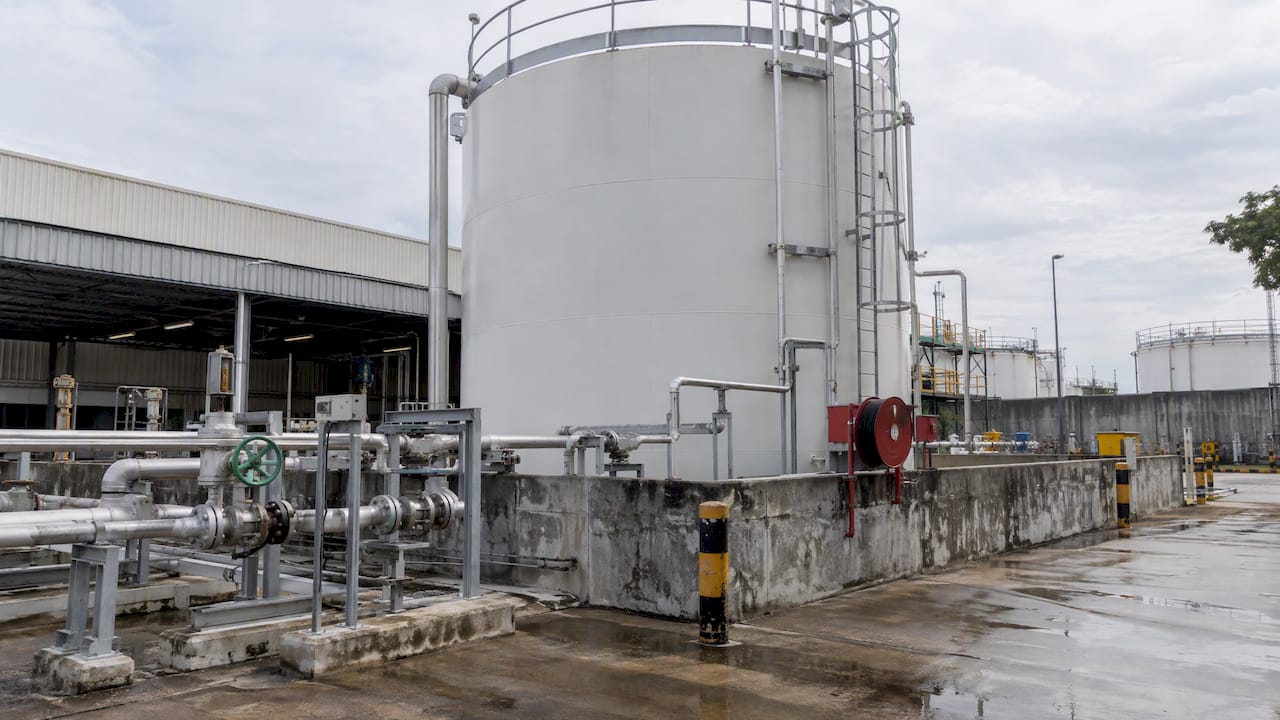
Any business storing petroleum or flammable materials above the exemption thresholds must hold a P&FM storage license issued by the Singapore Civil Defence Force. The immediate step is to confirm your exemption quantity under the Fire Safety (Petroleum and Flammable Materials) Regulations and, if you exceed it, engage a Qualified Person to begin plan preparation through a GoBusiness application.
TL;DR:
- Any scheduled chemical on site requires a license regardless of quantity; other exemptions depend on material class and storage method, so verify the exact threshold.
- SCDF typically issues outcomes within about 19 working days only when documents are complete and inspection passes; deficiencies can push approval beyond three weeks.
- Storage fees are $184 for up to 500 liters, $242 above 500 through 5,000 liters, and as high as $1,320 for larger quantities.
- Bulk tanks and pressure piping from 250 liters require certified test reports, so schedule professional engineer testing before filing to avoid revision delays.
- Licenses last up to three years; operators must renew before expiry, keep inventory and movement records, and report changes to ownership, capacity, or layout.
Table of Contents
- Who needs the license: P&FM classes, scheduled chemicals, and exemption quantities
- Step-by-step application checklist: GoBusiness, QP/RI, plans, ERP, inspection, timeline and fees
- Documents and technical requirements to prepare
- Using and maintaining the license: records, renewals, transfers, and compliance
- Common application bottlenecks and how experienced applicants avoid them
- How we help businesses move through P&FM licensing faster
- FAQ
- Sources
Who needs the license: P&FM classes, scheduled chemicals, and exemption quantities
Singapore’s fire safety framework classifies petroleum into Classes 0 through III by flashpoint, with Class 0 covering the most volatile products such as crude petroleum and certain light distillates. Flammable materials sit under a parallel classification, and scheduled chemicals occupy a special category: regardless of the quantity stored, a license applies the moment a scheduled chemical is present on site, according to GoBusiness guidance published alongside SCDF.
For everyday operators, the practical question is whether stored quantities sit below or above exemption thresholds. These thresholds vary by storage mode and material class, which is why checking the specific figure for your material before assuming exemption matters more than estimating from a competitor’s setup or a generic industry rule of thumb.
Who can apply also varies by business structure:
- Singapore-registered entities apply using their UEN through Corppass.
- Foreign businesses without local registration typically need a locally registered entity or an authorized local representative to file on their behalf.
- Third-party consultants and Qualified Persons can submit on an applicant’s behalf once authorized within the GoBusiness portal.
Getting this classification right at the outset avoids a rejected submission later, since SCDF assesses license type against declared quantities and material class from the first filing.
Step-by-step application checklist: GoBusiness, QP/RI, plans, ERP, inspection, timeline and fees
Since December 2024, P&FM storage license applications run through the GoBusiness portal rather than SCDF’s legacy system, a shift SCDF communicated directly to industry stakeholders in its transition circular. The sequence below reflects how a well-prepared application typically moves from registration to approval.
- Register or confirm Corppass access under your business UEN, or authorize a third-party filer such as a Qualified Person or consultancy to submit on your behalf.
- Engage a Qualified Person to assess your storage layout and prepare the building and storage plans SCDF requires for approval.
- Where fire safety works are involved, engage a Registered Inspector to certify the Fire Safety Certificate component of the submission.
- Compile supporting documents: approved plans, Emergency Response Plan, tank or piping test reports, and written consent from the property owner where the applicant does not hold the title.
- Submit the full application package through GoBusiness along with the applicable fee.
- Schedule and pass the SCDF site inspection, which verifies that physical conditions match the submitted plans.
- Receive the license outcome and display it at the licensed premises as required.
SCDF states that outcomes are typically provided within about 19 working days when the submission and site inspection are in order. That timeline assumes no missing documents and no failed inspection, both of which reset the clock and push approval well past three weeks.
Fees scale with quantity rather than following a flat rate. GoBusiness publishes fee bands for petroleum and flammable material storage: a liquid quantity not exceeding 500 liters costs $184, a quantity exceeding 500 liters but not more than 5,000 liters costs $242, and larger bulk quantities climb to bands as high as $1,320. Validity runs up to three years, after which renewal is required before the license lapses.

The fee structure rewards accurate quantity declarations. Overstating storage volume to build in a safety margin pushes an applicant into a higher fee band unnecessarily, while understating it risks a licensed capacity that cannot accommodate actual operations, forcing an amendment application later.
Documents and technical requirements to prepare
SCDF evaluates both the paperwork and the physical installation, so documentation has to match what a site inspector finds on the ground. The core package typically includes the following:
- An Emergency Response Plan that sets out incident notification procedures, evacuation routes, firefighting arrangements, and designated responsible persons, since the Fire Safety (P&FM) Regulations require licensees to prepare and maintain an up-to-date ERP under Regulation 27.
- A Quantitative Risk Assessment where storage quantities or site proximity to sensitive receptors trigger one, which generally calls for early consultation with the Ministry of Manpower’s Major Hazards Department before the application is lodged.
- Hydrostatic, radiographic, or equivalent test reports certified by a professional engineer for bulk storage tanks and pressure piping, a requirement that applies to tanks from 250 liters and above under SCDF’s application guidance.
- Approved building plans confirming ventilation, separation distances between storage and occupied areas, spillage containment, and fixed firefighting equipment with compliant signage.
- Fire Safety Certificate documentation coordinated by the Registered Inspector where structural fire safety works form part of the submission.
Pro Tip: Order tank and piping test reports before submitting your application rather than after, since certified reports can take longer to schedule than the GoBusiness review itself.
Operators handling chemical storage alongside petroleum products often find it useful to review broader chemical hazard management practices to confirm that storage segregation and labeling meet both WSH and fire safety expectations at once.
Using and maintaining the license: records, renewals, transfers, and compliance
Holding a P&FM storage license is not a one-time event. The Fire Safety (P&FM) Regulations require licensees to maintain records of stored materials, including inventory lists, quantities on hand, and movement records, so inspectors can verify actual storage against the licensed capacity at any point.
Ongoing obligations include:
- Displaying the license at the licensed premises and renewing it before the validity period, up to three years, expires.
- Filing amendment or transfer applications when ownership, storage quantity, or site layout changes materially from what was originally approved.
- Keeping the Emergency Response Plan current, since an outdated ERP is a common trigger for enforcement action during routine checks.
License revocation typically follows from exceeding licensed quantities, failing to complete required fire safety works, or neglecting record-keeping duties. Businesses that store petroleum at a third-party warehouse or bonded facility should also confirm that the facility operator’s own license and any TradeNet import declarations align with the quantities being brought on site, since a mismatch between declared imports and licensed storage capacity creates compliance exposure for both parties.
Common application bottlenecks and how experienced applicants avoid them
The most frequent cause of delay is not a missing signature but a missing Fire Safety Certificate or an approved plan that does not match the physical site. Incomplete Emergency Response Plans and test reports submitted without professional engineer certification also send applications back for revision, each cycle adding weeks to an already tight timeline.
The fix is sequencing, not effort. Engaging a Qualified Person before drafting the application, rather than after a rejection, lets plan discrepancies surface while they are still cheap to correct. Scheduling tank and piping tests ahead of submission, confirming property owner consent in writing, and running a pre-submission checklist against SCDF’s documentation list catches the gaps that otherwise surface during inspection. Consultancies that coordinate documentation, liaise directly with the QP and Registered Inspector, and verify audit readiness before the site visit tend to compress the distance between a first submission and a clean approval.
— Aman
How we help businesses move through P&FM licensing faster
We assist construction and facility operators in preparing the documentation and technical groundwork that SCDF expects before a site inspection, helping avoid issues flagged later. Our EHS Advisory and Documentation service drafts Emergency Response Plans and supports Quantitative Risk Assessment preparation, while our Design for Safety Professional service reviews storage layouts and plan submissions before they reach a Qualified Person for sign-off.

For operators also managing broader WSH obligations alongside P&FM compliance, our WSH Audit and Inspection service checks that storage, signage, and firefighting provisions hold up against both fire safety and workplace safety standards at once. Reach out through Mosaicsafety for a compliance assessment before you file.
FAQ
How do I obtain a flammable material storage license in Singapore?
You apply through the GoBusiness portal using your business UEN and Corppass credentials, submitting approved plans, an Emergency Response Plan, and relevant test reports prepared with a Qualified Person. SCDF reviews the application and conducts a site inspection, with outcomes typically provided within about 19 working days when the submission is complete.
What are the storage requirements for gas cylinders in Singapore?
Gas cylinder storage requirements depend on quantity and whether the gas falls under a scheduled chemical classification, which removes any exemption regardless of volume. Operators should confirm the applicable exemption threshold and fire safety separation distances with SCDF’s licensing guidance before assuming a small quantity falls outside licensing.
What are the storage requirements for P&FM?
Storage requirements cover separation distances from occupied areas, spillage containment, ventilation, fixed firefighting equipment, and certified tank or piping test reports for bulk installations. The Fire Safety (P&FM) Regulations also require an up-to-date Emergency Response Plan and ongoing record-keeping of stored quantities.
What is class 0 petroleum?
Class 0 petroleum refers to the most volatile category under Singapore’s fire safety classification, covering products with very low flashpoints such as crude petroleum and light distillates. Storage of Class 0 petroleum generally triggers stricter licensing and technical requirements than higher-flashpoint classes due to the greater fire risk.
Sources
- Fire Safety (Petroleum and Flammable Materials) Regulations
- P&FM Storage Licence – Singapore Civil Defence Force
- Petroleum or Flammable Materials Storage Licence | GoBusiness