Introduction
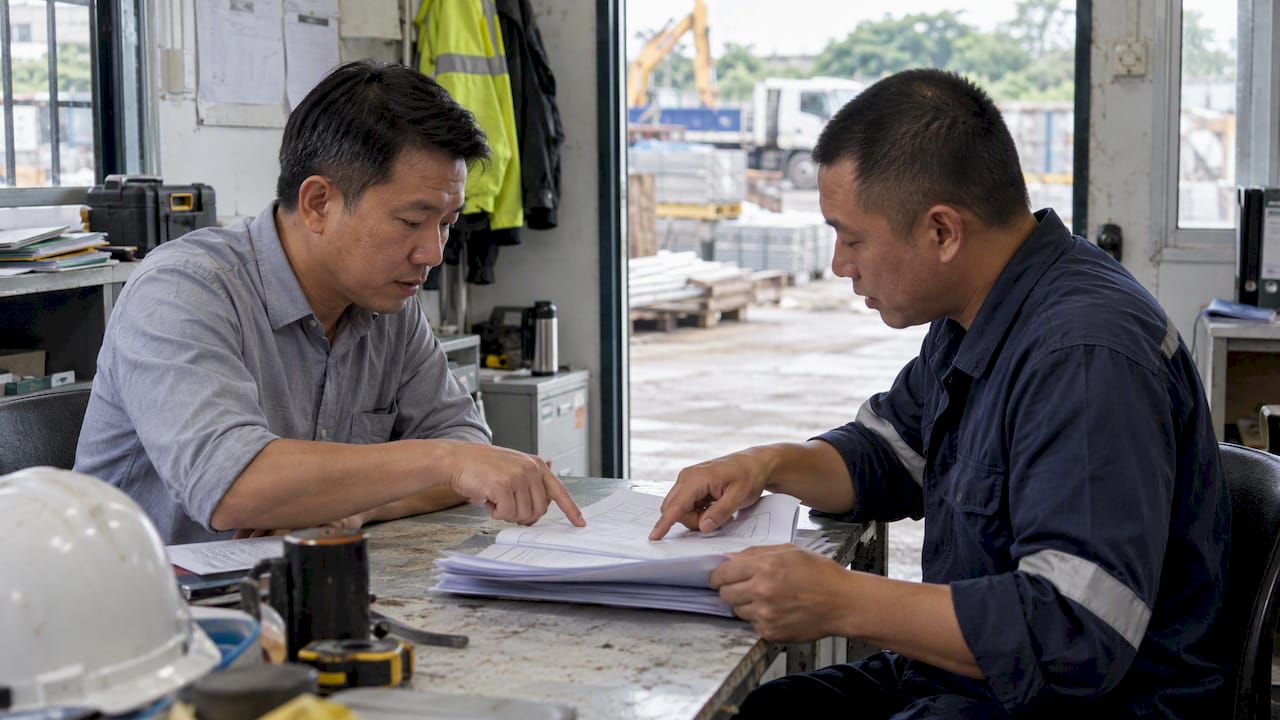
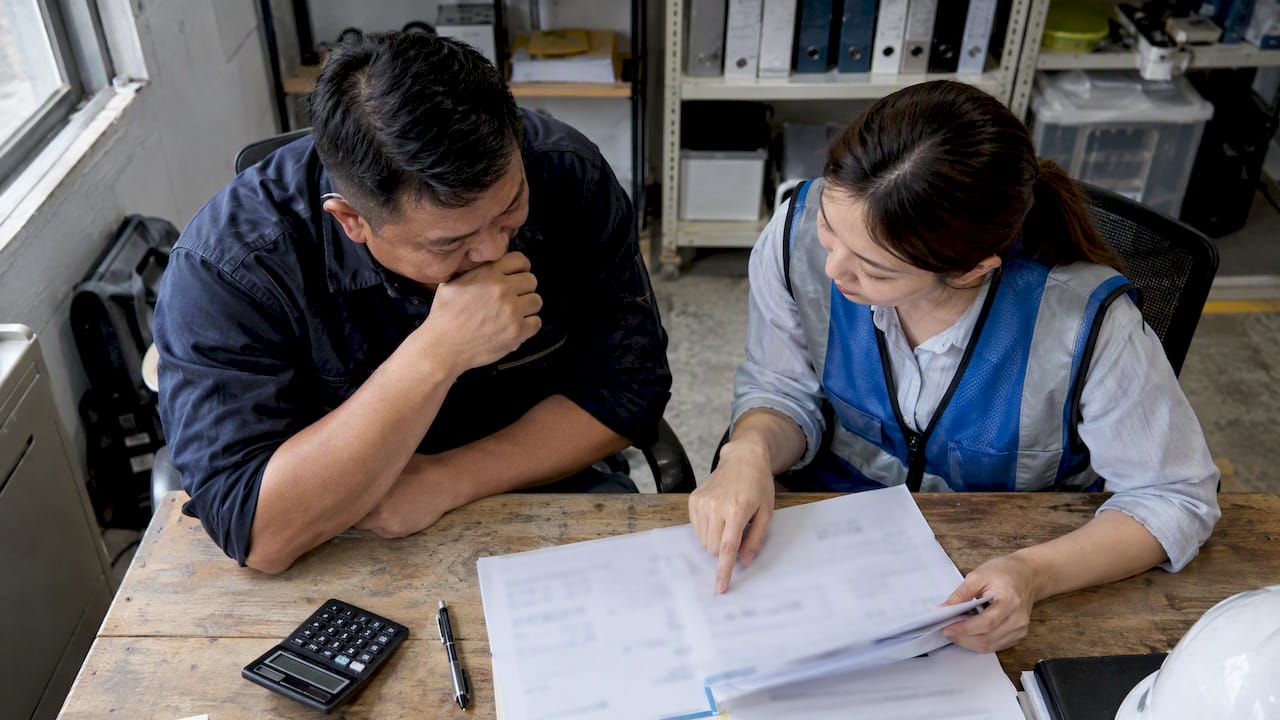
Warehouse safety in Singapore demands constant vigilance-especially when forklifts, heavy loads, and workers share the same floor space around the clock. With forklift safety MOM guidelines tightening and material handling WSH requirements evolving, warehouse managers and logistics operators across Singapore’s busiest hubs face growing pressure to get safety systems right. In the first half of 2026, vehicular incidents accounted for nine of 21 workplace fatalities nationally, underscoring how dangerous warehouses and logistics yards remain when controls fall short.
This guide is written for warehouse managers, logistics operators, and fleet supervisors running high-traffic facilities in areas like Tuas, Jurong, Changi, and Pioneer. Whether you manage a 3PL hub handling thousands of pallets daily or a cold storage facility with tight turnaround times, you face a common set of potential hazards: congested aisles, forklifts sharing space with pedestrians, multilingual teams, night shifts, and relentless unloading schedules. Good safety management in these environments is not just about compliance-it protects your workers, your business continuity, and your bottom line.
In short, safe warehouse logistics and compliant forklift operations in Singapore rest on four pillars: formal risk assessments under MOM’s framework, properly trained and authorised operators, disciplined traffic management inside your facility, and continuous monitoring that drives real improvement. This guide covers each pillar in detail-and shows you how to put them into practice.
By the end of this article, you will:
-
Understand the key MOM and WSH Council expectations for warehouse operations and forklift use
-
Know how to design safer traffic flows that segregate pedestrians from forklifts and large vehicles
-
Be able to implement forklift SOPs aligned with SS 573 and current safety regulations
-
Recognise how to prepare for bizSAFE audits and MOM inspections
-
Know when engaging a specialist consultancy like MOSAIC Ecoconstruction Solutions Pte Ltd adds value
Understanding Warehouse Logistics Safety in Singapore
Warehouse logistics safety in Singapore covers every internal operation within a warehousing or distribution facility-receiving, storing, sorting, staging, and loading bay activities-governed by the Workplace Safety and Health Act. It integrates traffic management for internal transport, material handling using forklifts and pallet jacks, safe stacking of materials in racking systems, loading bay procedures, and the management of employees across shifts and languages. Singapore’s WSH Act and its subsidiary regulations form the legal backbone, supported by Approved Codes of Practice and WSH Council guidelines that set the practical benchmarks inspectors use during enforcement.
The environment matters. Singapore’s logistics landscape includes 3PL hubs hosting multiple tenants with subcontracted labour, e-commerce fulfilment centres running intense picking and put-away cycles, cold storage warehouses where slippery floors and reduced visibility increase risk, and manufacturing plants where warehouse operations sit alongside production lines. Each of these settings introduces specific hazards. The Transportation & Storage sector’s fatal and major injury rate climbed to 23.8 per 100,000 workers in 2025, up from 18.4 in 2024-a clear signal that current practices in many facilities are not keeping pace with the risks.
Beyond compliance, good safety management directly affects efficiency and business performance. Accidents cause work stoppages, damage to material stored in racking, premium increases on insurance, and overtime costs to cover injured workers. Typical risk areas in Singapore warehouses include:
-
Pedestrian-forklift collisions at blind spots, docking areas, or mixed-use walkways
-
Forklift tip-overs or load falls caused by unstable loads, raised forks, or ramp use
-
Reversing accidents from operator blind spots and lack of mirrors or warning systems
-
Equipment failures involving brakes, steering, seat belts, or fluid levels
-
Poorly defined traffic flows with missing signage and no speed control
-
Inadequate lighting, especially during night shifts or deep within storage racks
-
Communication lapses in a multilingual workforce where instructions go misunderstood
Core Regulatory and Standards Framework
Several authorities and documents directly govern warehouse and forklift safety in Singapore. The Ministry of Manpower (MOM) enforces the WSH Act, conducts investigations, issues fines and stop-work orders, and holds employers, occupiers, and equipment suppliers accountable. The WSH Council develops Approved Codes of Practice (ACOPs), guidelines, and training frameworks-including the ACOP for Safe Operation of Forklift Trucks, which references Singapore Standard SS 573:2012 for the safe use of powered counterbalanced forklifts.
MOM enforces forklift safety through the WSH (General Provisions) Regulations and these ACOPs. Enforcement is real: Hoy San Stevedoring was fined S$240,000 after a worker’s leg was amputated in a forklift accident, with the company found lacking a traffic management plan and proper risk assessments. Asia Pacific Shipyard received a S$200,000 fine after a worker was killed when a forklift crashed through a guardrail. These cases demonstrate that MOM treats missing risk assessments, absent safe work procedures, and failure to segregate traffic as serious offences.
The bizSAFE programme is equally relevant. bizSAFE Level 3 requires companies to develop formal risk assessments-essential for any warehouse handling heavy equipment and powered industrial trucks. bizSAFE Star pushes further, demanding a strong risk management system and demonstrated safety culture. MOSAIC Ecoconstruction Solutions helps warehouses interpret and apply these requirements through audits, training design, and documentation that stands up to inspection.
Key regulations and standards to know:
-
Workplace Safety and Health Act (2006) and subsidiary regulations: General Provisions, Risk Management, Incident Reporting
-
Approved Code of Practice: Safe Operation of Forklift Trucks
-
Singapore Standard SS 573:2012 – safe use of powered counterbalanced forklifts
-
WSQ Accredited Courses: WSQ Operate Forklift, and Heavy Forklift courses (for forklifts above 5 tonnes)
-
bizSAFE framework requirements for risk assessment, safety ownership, and continuous improvement
Key Concepts: Risk Management, Safe Stacking and Safety Culture
Under Singapore’s WSH Risk Management Regulations, employers must identify hazards, evaluate risks by frequency and severity, implement control measures that are reasonably practicable, and periodically review their effectiveness. For material handling and forklift use, this means formally assessing the vehicle-pedestrian interface, equipment condition, load stability risks, ergonomic issues, and the potential dangers of operating in mixed-traffic zones. Controls follow a hierarchy of tiers: eliminate the hazard, substitute, isolate, apply engineering controls, use administrative controls, and finally provide personal protection equipment.
Safety culture is harder to build but equally essential, especially in the context of multi-language, shift-based logistics teams. Many warehouses in Singapore employ workers from Bangladesh, Myanmar, the Philippines, and other countries. Effective safety culture requires toolbox meetings at the start of every shift, multilingual signage and pictogram-based instructions, standard visual controls like floor markings and convex mirrors, and an environment where near-miss reporting is encouraged without reprisal.
Risk management and safety culture connect directly to forklift safety. For example, near-miss reports of almost-struck incidents at aisle junctions should trigger a review of intersection layout-perhaps installing mirrors, adding stop lines, or redesigning the traffic flow entirely. Regular audits should check that traffic rules are understood in multiple languages, not just posted in English.
Understanding these foundations sets up the detailed controls around forklift operations and traffic management design covered next.
Forklift and Powered Industrial Trucks Safety Fundamentals Aligned with MOM Guidelines
Forklifts are among the most dangerous vehicles in Singapore’s warehouses and loading bays. Close to one in four workplace fatalities between 2022 and 2023 involved forklifts, making them a persistent source of injuries and deaths. Typical incidents include tip-overs from unstable loads, pedestrian strikes at intersections, racking collisions from sharp turns in narrow aisles, and reversing accidents in congested areas. MOM’s expectations for forklift safety cover training, authorisation, pre-operation inspection, maintenance, and operational controls-all aligned with the ACOP and SS 573.
This section covers the core operational controls every warehouse should have in place. Advanced technology solutions such as automated mobile robots and telematics are discussed later.
Operator Competency, Training and Authorisation
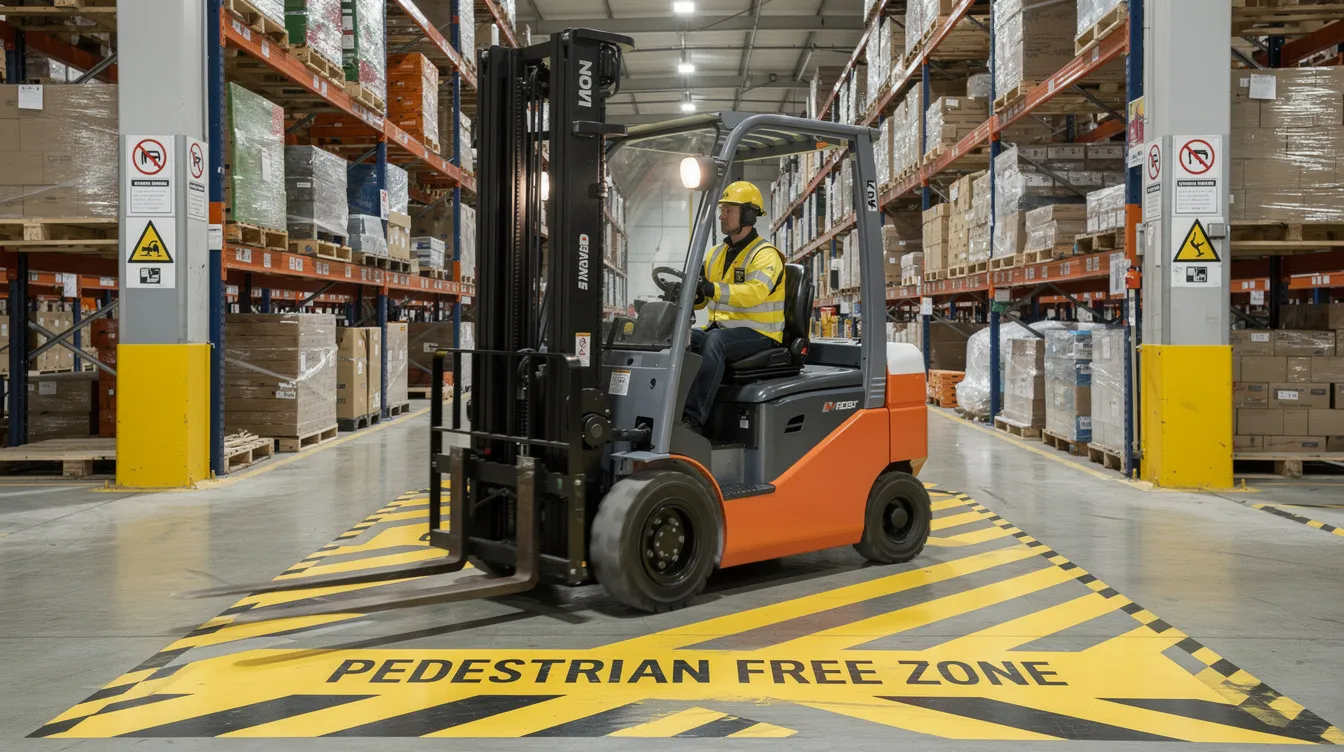
Forklift operators must be fully trained and certified before they operate any powered industrial truck in Singapore. The mandatory core course is the WSQ Operate Forklift course. Operators of forklifts above 5 tonnes capacity must also attend the Heavy Forklift course. From 1 January 2027, refresher training every three years becomes mandatory under WSH Act Section 31(4)-a significant change, given that MOM found close to 8 in 10 forklift-related contraventions involved operators who had not undergone refresher training within three years. Proper training reduces injuries associated with forklift operation, and training includes understanding machine capabilities and hazards specific to each site.
Only certified employees are allowed to operate forklifts, but a certificate alone is not sufficient. Employers must authorise each operator in writing after site-specific familiarisation, confirming the operator understands the facility’s layout, traffic rules, and equipment. Language proficiency must be considered-particularly for migrant workers who may not read English-only instructions.
A competency matrix helps manage authorisation across different equipment types: counterbalance forklifts, reach trucks, very narrow aisle (VNA) trucks, and pallet stackers. Each category requires distinct skills. Training content should include:
-
Load handling: understanding centre of gravity, load charts, weight distribution, and manufacturer specifications
-
Traffic rules: site-specific speed limits, right-of-way, one-way aisle rules
-
Emergency response: procedures for tip-overs, overturns, fire, and spills
-
Near-miss and incident reporting: how to report, what to document, no-blame culture
Pre‑Operation Inspections and Maintenance
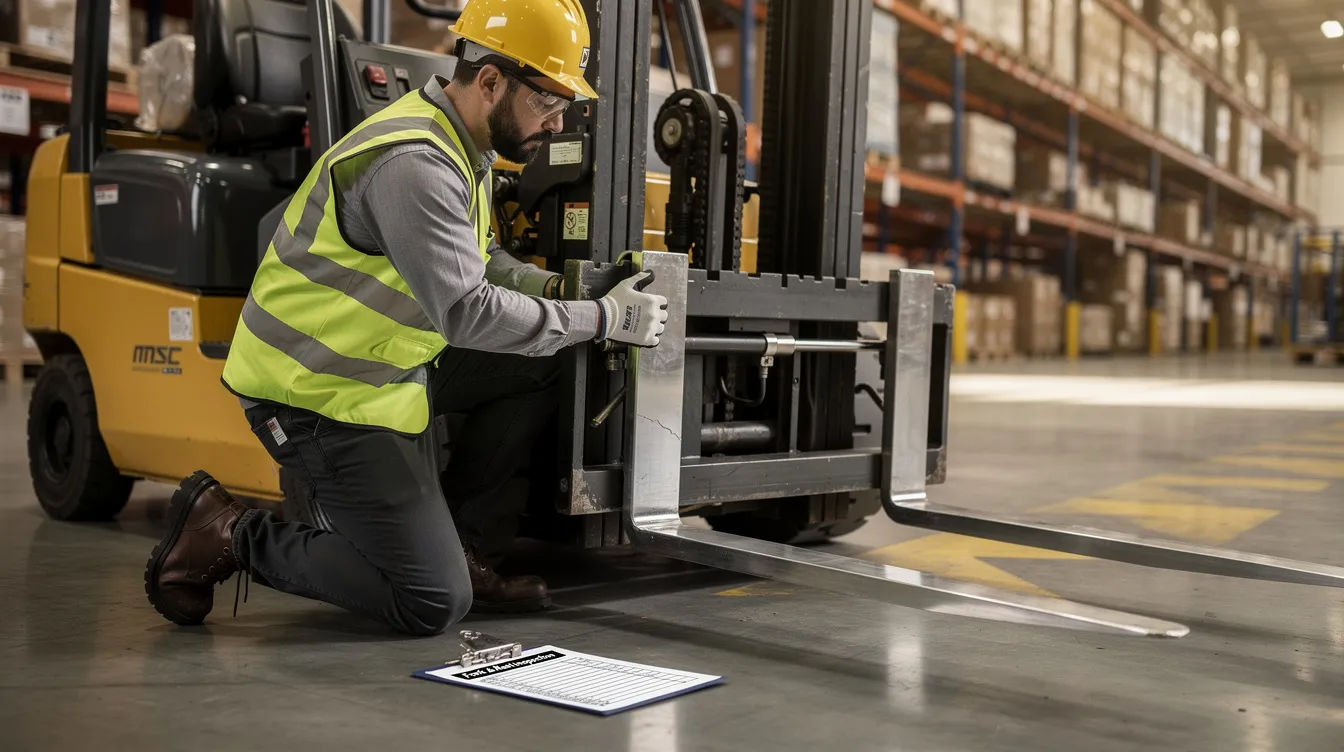
Daily inspections of forklifts prevent mechanical failures and are a core expectation under good WSH practice. Each forklift must have clear signage indicating its capacity and safe operating procedures. Before an operator starts a shift, they should complete a structured pre-use checklist covering:
-
Brakes (service and parking)
-
Horn, lights, and reverse alarm
-
Mast and forks for visible damage or cracks
-
Seat belt function and condition
-
Tyre condition and inflation
-
Fluid levels (hydraulic, engine oil, coolant)
-
Warning labels and capacity plates
-
Overall machine condition-no leaks, no loose parts
Record-keeping is essential. Whether using paper checklist forms or a digital app, inspection records must be retained and accessible for MOM WSH inspections and bizSAFE or ISO audits. Regular maintenance reduces equipment failure risks and should follow OEM intervals. Third-party inspection may be required for specific components, and any forklift used to lift people via a man-cage must comply with additional statutory inspection requirements. OSHA mandates forklift operators to meet inspection requirements, and while Singapore follows its own WSH framework, the principle of regular inspections of forklifts is equally enforced here through ACOPs and enforcement action.
Safe Forklift Operating Practices
Key behaviours for safe forklift operation are non-negotiable. Establishing speed limits is important for forklift safety in warehouses-typically 5–10 km/h for indoor aisles, slightly higher in outdoor yards but always moderated. Operators must travel with forks low (just above floor level), use the horn at every intersection, never carry passengers, and never allow anyone to stand under raised forks. Separate forks from people and never allow passengers on forklifts. Using seat belts on forklifts is mandatory to prevent operator injuries in the event of a tip-over.
Load stability and capacity management are critical for safe forklift operation. Operators must understand how centre of gravity shifts with mast tilt and lift height, read the load chart for every load, and never exceed rated capacity. Unbalanced loads risk tip-over or load spillage-a danger to the operator and anyone nearby. Each forklift must have clear signage indicating its capacity and safe operating procedures, and forklift operators should wear appropriate personal protective equipment (PPE) including safety boots and high-visibility vests.
Operating on ramps, dock levellers, and in wet or oily areas-common in Singapore’s humid environment and cold storage facilities-requires additional caution. Speed must be further reduced, loads should face uphill on inclines, and operators must watch for slippery floor conditions. Forklifts should be equipped with overhead guards for safety. In mixed-traffic zones where forklifts share space with trolleys, stackers, and automated mobile robots, clear visibility and adequate lighting are crucial in warehouse environments.
Golden rules for forklift use:
-
Only properly trained, authorised operators may operate forklifts
-
Complete daily pre-use inspection and report defects before operating
-
Follow defined traffic rules, speed limits, and segregation at all times
-
Keep load within rated capacity, stable and secured, and travel with forks low
Designing Safe Traffic Management in High‑Traffic Warehouses
Singapore’s busiest logistics hubs feature narrow aisles, high pallet throughput, and constant container unloading at multiple docks. In these environments, traffic management is one of the highest-impact control measures in the risk register. Separate pedestrian walkways and forklift paths improve safety dramatically-yet many facilities still rely on informal rules that break down under pressure. This section focuses on layout design, segregation, and flow planning rather than equipment details.
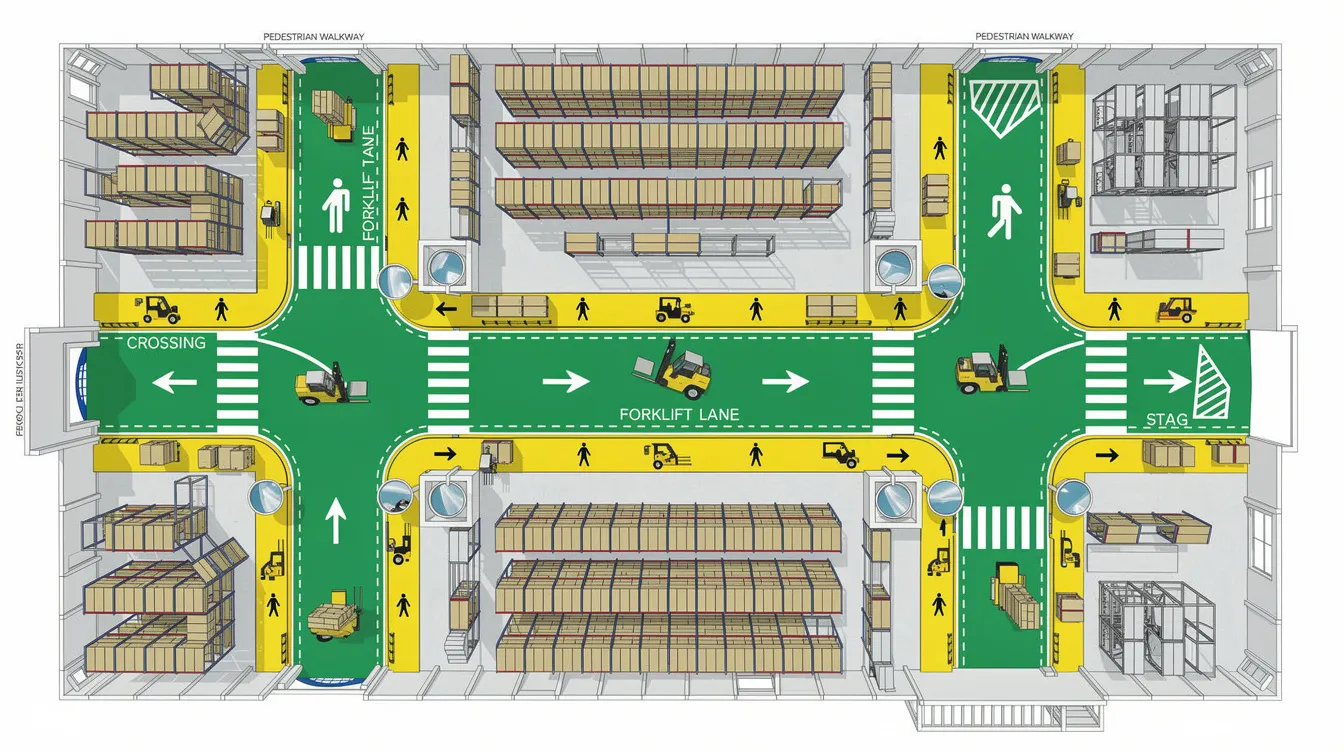
Segregation of Pedestrians and Forklifts
The preferred hierarchy of controls starts with physical barriers. Guardrails along forklift lanes, raised walkways for pedestrians, and designated crossings with zebra markings provide the strongest protection. Clear aisles and marked stacking areas enhance safety throughout the facility. Floor markings using different colours-yellow for forklift lanes, green for pedestrian routes-provide immediate visual cues. Safety zone buffers can mitigate risks at loading bays where vehicles and pedestrians converge.
Pedestrian-only routes should be designed around racking and docks, with emergency exits that never route workers through forklift zones. Muster points must be accessible without crossing active forklift lanes. During shift changes and break times, pedestrian density spikes-extra supervision, temporary barriers, or staggered break schedules help manage this risk. In typical Singapore warehouse layouts with narrow aisle racking and staging areas near roller shutters, even small design changes-relocating a pedestrian crossing by a few metres or adding a convex mirror at a blind corner-can make a meaningful difference.
Speed Management, Signage, Blind Spots and Right‑of‑Way Rules
Setting and enforcing speed limits requires both signage and accountability. Indoor aisles should have posted speed limits of 5–10 km/h, with outdoor yards moderated according to conditions. Essential markings include stop lines at intersections, “forklift crossing” signs, convex mirrors at blind spots, and one-way arrows in narrow aisles. Keep aisles clear of debris to maintain safe traffic flow-obstructions force forklifts into dangerous detours or sharp turns.
Right-of-way rules must be explicit: forklifts typically give way to pedestrians at crossings, while trucks give way to forklifts near docks. Priority rules near loading bays and emergency exits should be documented in the traffic management plan and communicated in multiple languages. Visual management tools are evolving-LED floor projection at intersections, flashing beacons on forklifts and trucks, and high-visibility vests for all pedestrians in the warehouse environment are now standard in well-run facilities. Signage should be in multiple languages and supplemented with pictograms to assist workers who may not read English.
Integrating Loading Bays, Loading Bay Equipment and Yard Movements
Loading bays are where trailers, dock levellers, and forklifts interact-often under time pressure. Loading bay equipment must be inspected and maintained regularly. Before any forklift enters a trailer, the vehicle must be secured with wheel chocks or dock vehicle restraint systems. The rule is simple: no movement without chocking or restraint engaged. Key control procedures should ensure only authorised operators engage forklifts at docks.
Communication protocols between forklift operators, banksmen (signalmen), and truck drivers are critical. Standard hand signals, clear verbal commands, and in some cases radio communication prevent the dangerous situation of a truck pulling away while a forklift is still inside. Loading bay traffic control checklist:
-
Trailer secured with chocks or restraints before any loading or unloading begins
-
Banksman present and using standard signals during all dock movements
-
Forklift operator confirms trailer is stable before entering
-
Traffic light dock control system or physical barrier prevents premature truck departure
Implementing a Practical Warehouse Safety Programme
With the regulatory framework and operational controls understood, the question becomes: how do you actually build a working safety programme? This section provides a step-by-step approach framed around a typical mid-size warehouse in Singapore-30 to 80 staff, 10 to 20 forklifts, 2 to 6 docks. MOSAIC Ecoconstruction Solutions can facilitate each step through WSH audits, training design, and outsourced EHS manpower.
Step‑by‑Step Safety Implementation Process
The following process moves from assessment through implementation to ongoing monitoring. Each step builds on the previous one.
-
Conduct a baseline WSH audit of warehouse and forklift operations, including incident history, recent near misses, and a physical layout review mapping all traffic and pedestrian flows.
-
Perform formal risk assessments for key activities-receiving, put-away, picking, replenishment, loading, and returns processing-following WSH Risk Management guidelines. Identify tasks, potential hazards, severity, and likelihood; produce a risk register.
-
Develop or update Safe Work Procedures (SWPs) for forklifts, pallet jacks, safe stacking, and loading bay operations. Ensure multilingual versions with pictograms are available for all workers.
-
Implement engineering controls: install barriers, floor markings, mirrors, and adequate lighting. Define PPE rules and document the traffic management plan.
-
Roll out training, toolbox talks, and drills: cover new hire induction, forklift operator certification, refresher programmes, and emergency response drills (tip-over, fire, spill).
-
Monitor via KPIs: track near-miss reporting frequency, unsafe condition reports, incident rates (major and minor), and audit findings. Schedule management reviews quarterly or semi-annually to drive continuous improvement.
Choosing Between Internal Oversight and Outsourced EHS Support
Warehouses must decide how to resource their safety management-through an internal WSH Officer or by outsourcing to a specialist EHS provider.
|
Criterion |
Internal WSH Officer |
Outsourced EHS Support |
|---|---|---|
|
Expertise |
Strong site knowledge; may lack specialised technical depth |
Brings audit, training, and regulatory expertise; stays current with legal changes |
|
Cost |
Lower long-term cost for single-site operations |
Higher per-engagement cost but prevents major fines and legal exposure |
|
Scalability |
Difficult to scale across multiple sites |
Easily scalable; consistent standards across locations |
|
Continuity |
Risk of knowledge loss if staff turnover occurs |
Continuity managed through consultancy processes and documentation |
For a fast-growing 3PL expanding to multiple sites, outsourcing to a Singapore-based consultancy like MOSAIC Ecoconstruction Solutions ensures consistent standards and access to specialists who understand MOM inspection expectations. MNC distribution centres often use a hybrid model: internal WSH officer for daily oversight, supported by outsourced specialists for audits and training. Single-site SMEs without in-house WSH expertise benefit most from full outsourcing, particularly during bizSAFE preparation or when responding to enforcement actions.
Common Warehouse & Forklift Safety Challenges in Singapore – And How to Solve Them
Every warehouse faces recurring safety challenges shaped by Singapore’s operating conditions. The following scenarios are drawn from common situations in high-traffic facilities and offer concise, actionable solutions.
Challenge 1: Mixed‑Language Workforce and Communication Gaps
Scenario: Forklift operators from Bangladesh and Myanmar, pickers from the Philippines, supervisors communicating in English. Written SOPs are in English only. Instructions given verbally are not always understood, and workers may hesitate to ask for clarification.
Solution: Replace text-heavy SOPs with pictogram-based versions supplemented by colour-coded signs. Conduct multilingual toolbox briefings at shift start. Implement buddy systems pairing experienced workers with new hires. Standardise hand signals at docks and intersections-these are universal regardless of language. Most importantly, conduct periodic comprehension checks through observation and simple quizzes rather than relying on signatures alone. This approach helps build a proactive WSH culture that reaches every worker.
Challenge 2: Congested Aisles and Unsafe Shortcuts
Scenario: High order volume leads to pallets staged in aisles temporarily, blocking paths. Forklift drivers take shortcuts through pedestrian zones to save time. Emergency exits become obstructed by boxes and damaged pallets.
Solution: Define clear staging zones with strict deadlines for removal. Implement housekeeping standards with timed sweeps-for example, every two hours during peak periods. Assign “aisle captain” responsibility to specific team leads who inspect their zones. Use visual triggers: red zones painted on the floor where no material stored or pallets may be placed. Track blocked-aisle findings in inspections and set monthly reduction targets. The stacking method used should ensure material type and stack height are appropriate for the space, and the ideal stacking height should be based on load stability, packaging, pallet condition, and applicable safety regulations; OSHA does not specify a maximum stacking height, so sites should set limits through risk assessments and site rules. Column stacking or block storage configurations should be used for safer stacking of materials. Regular inspections help identify unstable stacks or damaged pallets before they collapse, and pallets and packaging should be checked to ensure they are in good condition before stacking.
Challenge 3: Night Shifts and Fatigue Management
Scenario: The warehouse operates 24/7. Night shifts are understaffed, supervision is sparse, workers are fatigued, and lighting is weaker than during day operations. Incident data often shows a spike in accidents during late evening hours.
Solution: Design night lighting to the same standard as daytime operations-clear visibility and adequate lighting are crucial in warehouse environments regardless of shift. Introduce scheduled micro-breaks for forklift operators to combat fatigue. Rotate workers to avoid excessively long shifts on heavy equipment. Assign a senior supervisor specifically to night operations with authority to halt unsafe work. Increase the frequency of safety inspections during night windows, focusing on forklift pre-use checks and traffic compliance.
Challenge 4: Tight Turnaround Times for Trucks and Containers
Scenario: Trucks are queued at docks. Pressure to load and unload quickly leads operators to skip chocking procedures. Forklifts operate inside trailers while vehicles are unsecured. In extreme cases, trucks pull away while a forklift is still on the loading bay.
Solution: Enforce a strict “no movement without chocking or restraint engaged” rule-no exceptions. Implement traffic light dock control systems that physically prevent truck departure until the forklift operator confirms clearance. Standardise communication protocols between drivers and forklift operators, including documented handoff procedures. Include these controls in SWPs and contractor management policies so that external truck drivers are bound by the same rules. Stacked materials should be interlocked and secured to prevent sliding during transport, and weight distribution across the trailer should be verified before the vehicle departs.
Conclusion and Next Steps
Safe warehouse logistics and forklift operations in Singapore depend on four connected elements: robust risk assessments, compliant training and authorisation, disciplined traffic control, and continuous improvement driven by data. MOM guidelines and WSH expectations represent the minimum-high-traffic logistics hubs handling heavy loads across multiple shifts should consistently go beyond compliance to protect their workers and their business.
Concrete next steps you can take now:
-
Schedule a baseline safety walk of your warehouse, mapping every point where forklifts and pedestrians interact
-
Review forklift training records against the upcoming 2027 mandatory refresher requirement-identify operators overdue for retraining
-
Map your traffic flows and compare them to your documented traffic management plan; close any gaps
-
Update dock SOPs to include chocking, restraint, and communication protocols
-
Engage MOSAIC Ecoconstruction Solutions for a site-specific warehouse safety audit, bizSAFE preparation, or outsourced WSH manpower to accelerate your programme
Looking ahead, technologies like digital pre-use checklists, forklift telematics for real-time speed and overload alerts, and automated storage systems that reduce forklift interaction with personnel are making warehouses safer. Automated mobile robots can detect obstacles and adjust routes, further reducing the risk of collisions. But technology only works when built on a foundation of strong safety culture, proper procedures, and engaged leadership. Start with the fundamentals-the results will follow.
Additional Resources and Tools for Warehouse Logistics & Forklift Safety
The following resources support ongoing improvement for Singapore warehouses managing forklifts and material handling operations.
Public resources:
-
MOM’s WSH legislation portal – full text of the WSH Act, subsidiary regulations, and Approved Codes of Practice
-
MOM WSH Reports and Statistics – annual and semi-annual data on injury rates, enforcement actions, and sector-specific trends
-
WSH Council guidelines on forklift safety and traffic management in warehouses
Internal tools to develop:
-
Custom forklift pre-use checklist aligned with SS 573 and your specific fleet (counterbalance, reach trucks, pallet stackers)
-
Traffic management plan template covering pedestrian routes, forklift lanes, speed limits, right-of-way rules, and loading bay protocols
-
Incident and near-miss reporting form-available in multiple languages with pictograms
MOSAIC Ecoconstruction Solutions provides ready-made templates and digital checklists tailored to Singapore’s regulatory requirements, along with hands-on support for companies at every stage of their safety journey. As your warehouse operations scale or change-new racking configurations, additional docks, expanded shifts-your safety procedures must be reviewed and updated to match. Continuous learning and regular procedure reviews are not optional extras; they are the service that keeps your people safe and your operations running.