

An ISO internal audit is a disciplined, first-party assessment that checks whether a management system conforms to ISO requirements and actually functions as intended, rather than simply looking compliant on paper. The immediate action for any organization without a mature program is to build a risk-based audit schedule and confirm that every assigned auditor is independent of the process being reviewed and competent to evaluate it. What follows covers the governing standards, program design, field procedures, auditor qualifications, and the tools that separate a defensible audit trail from a folder of unverifiable checklists.
TL;DR:
- Auditors must be independent from the process and competent in both the standards and practical audit techniques, with training should include sector-specific knowledge.
- An effective internal audit prioritizes high-risk, recent, or nonconformity-prone processes and balances continuous versus annual audit cycles, reserving capacity for emergent issues.
- Findings should be classified as major or minor nonconformities, observations, or positives, with root cause analysis and verified, documented closure essential for credible closure reports.
- Transitioning from spreadsheets to audit management software improves follow-up, evidence collection, and reporting across multiple sites and standards, reducing manual oversight errors.
- Top management’s active participation in closing audits and resource allocation drives real system improvements, especially when audits integrate cross-standard processes like construction activities.
Table of Contents
- What Is an ISO Internal Audit and Why Run One?
- What Do ISO 9001 Clause 9.2 and ISO 19011 Actually Require?
- How Do You Design a Risk-Based Internal Audit Programme?
- How Do You Prepare for and Conduct an ISO Internal Audit?
- Who Should Conduct the Audit, and What Training Do They Need?
- How Are Findings Classified and Closed?
- Spreadsheets or Audit Software: When Should You Switch?
- What Construction Audits Get Wrong, and What Actually Works
- How MOSAIC Supports Your Internal Audit Program
- Where to Go Deeper on Standards and Programme Design
- Sources
- FAQ
What Is an ISO Internal Audit and Why Run One?
An internal audit differs from a certification audit in one critical respect: ownership. A certification body’s auditor decides whether you keep your certificate. Your own internal audit decides whether your management system is actually working between those external visits. Surveillance audits, conducted annually by the certification body, sample a narrow slice of your system. Your internal audit programme is the only mechanism that examines the whole system on your own schedule, against your own risk priorities.
The objectives go beyond conformity checking. A well-run internal audit verifies three things simultaneously: that documented procedures match ISO clause requirements, that people on the ground actually follow those procedures, and that the procedures produce the intended result. A site can pass a conformity check and still fail on effectiveness. A permit-to-work system might exist exactly as written, yet still let unqualified subcontractors sign off high-risk tasks.
That’s the distinction most organizations miss. Treating internal audits as a pre-certification chore misses their real value: they function as a strategic feedback loop that feeds management review with intelligence no dashboard can generate on its own.
What a mature internal audit program actually delivers:
- Early detection of process drift before an external auditor or a regulator finds it
- Documented evidence of due diligence for insurers, clients, and regulators
- A structured input for management review decisions on resourcing and risk
- A training mechanism that builds internal quality and safety literacy over time
- Cross-site comparability when the same checklist runs across multiple locations
What Do ISO 9001 Clause 9.2 and ISO 19011 Actually Require?
ISO 9001 Clause 9.2 is the mandatory anchor. It requires organizations to plan, establish, implement, and maintain an audit programme that accounts for the importance of the processes involved, changes affecting the organization, and the results of previous audits. The clause is prescriptive about outcomes, not methods: you must audit at planned intervals, define criteria and scope for each audit, select auditors who ensure objectivity, and report results to relevant management. It does not dictate how often, which checklist format to use, or how many auditors you need. That flexibility is intentional, and it is also where most programs go wrong by copying a template built for a different industry.
ISO 19011 fills that gap. It is guidance, not a certifiable requirement, but it is the closest thing the audit profession has to a shared rulebook. It sets out audit principles (integrity, fair presentation, professional care, confidentiality, independence, evidence-based approach), gives a structured methodology for managing an audit programme, and lays out the competence and evaluation criteria auditors should meet.
Key reconciliation points when running one programme across ISO 9001, ISO 14001, and ISO 45001:
- Use a single combined audit programme document, with separate scope lines for each standard’s clause-specific requirements
- Map common processes (procurement, training, document control) once, then layer standard-specific criteria on top
- Schedule combined audits at sites where the same operational activity is regulated by more than one standard, such as a fabrication yard covered by quality, environmental, and safety clauses simultaneously.
Statistic Callout: Recognized providers such as ASQ build their certified internal auditor courses around process-approach auditing, reflecting how ISO 19011 expects auditors to trace a process end to end rather than checking clauses in isolation.
How Do You Design a Risk-Based Internal Audit Programme?
Scope comes before schedule. Start by mapping every process in your management system, then decide which sites, functions, and shifts fall inside the audit boundary for the coming cycle. A multi-site contractor does not need every project audited every year. It needs a defensible rationale for which ones get audited and why.
Risk-based prioritization is the mechanism that makes that rationale defensible. Weight your audit frequency toward processes with a track record of nonconformities, high regulatory exposure, or recent change: new equipment, new subcontractors, a recent incident, or a process that has never been audited since certification. A confined-space entry procedure on an active demolition site warrants more frequent attention than a stable back-office document control process.
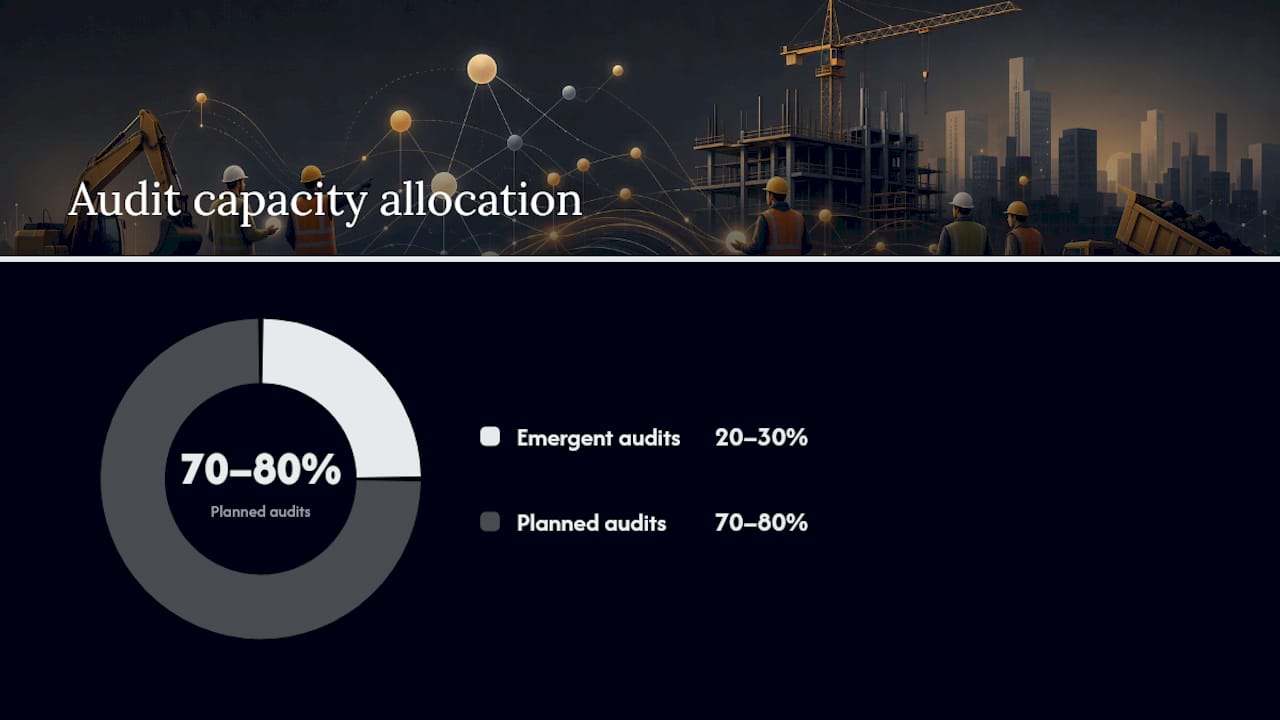
Cadence is a judgment call between two models. A rolling programme audits a portion of the system continuously throughout the year, which spreads workload and catches drift earlier. A single annual sweep concentrates effort into one intensive cycle, which suits smaller organizations but leaves eleven months of blind spots. Either way, reserve 20 to 30 percent of total audit capacity for emergent work: incident follow-ups, rapid audits triggered by a near-miss, or a spot check after a major process change.
Steps to build the documented programme:
- List every process and site in scope, with an owner named for each
- Assign a risk rating and set audit frequency accordingly, ranging from more frequent to less frequent intervals
- Estimate duration per audit realistically, since a head-office function might need one day while a complex manufacturing or fabrication cell needs two to three
- Name responsible auditors, confirming independence from the process being reviewed
- Set reporting deadlines, typically five to ten working days after fieldwork closes
- Reserve capacity for emergent audits and build in a review point mid-cycle
Pro Tip: Build your programme document as a living register, not a static PDF. When a nonconformity from a previous audit reopens a process for review, that update should be visible in the same document your management team reviews at year-end, not buried in a separate corrective action log nobody cross-references.
Contractors managing multiple concurrent projects can lean on a structured internal audit program built specifically for that scheduling complexity rather than adapting a single-site template.
How Do You Prepare for and Conduct an ISO Internal Audit?
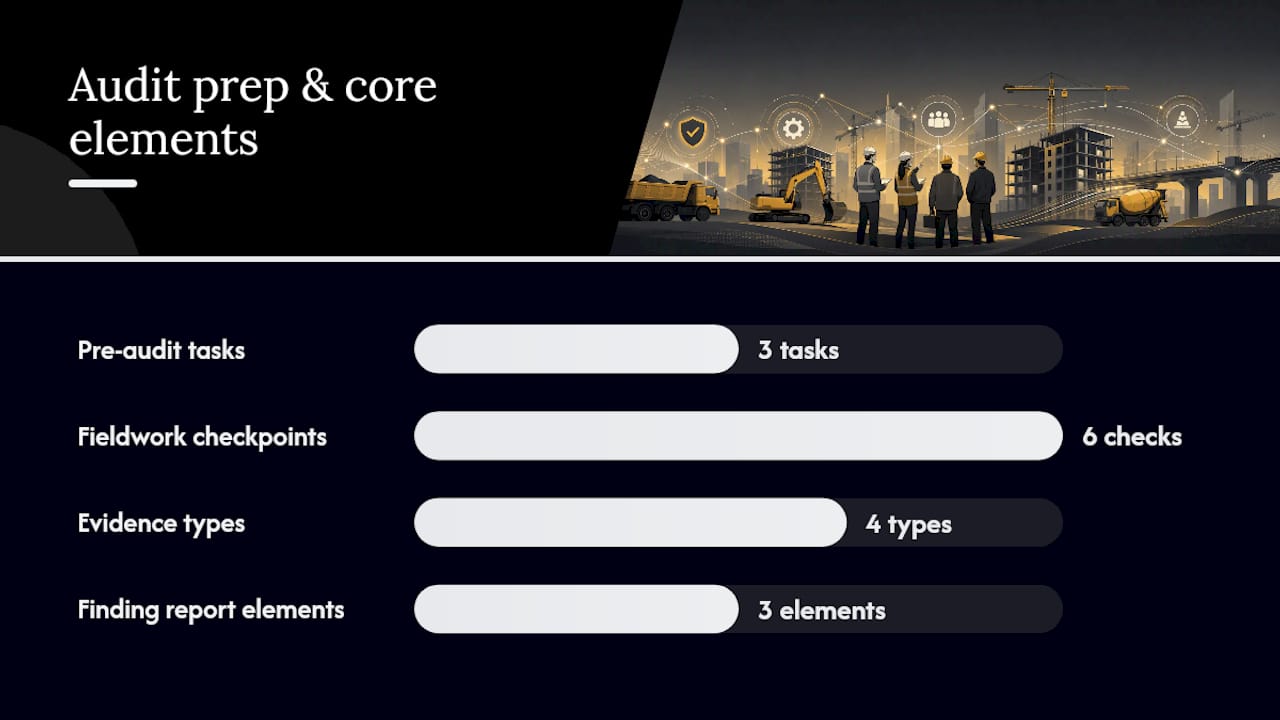
Preparation determines whether fieldwork runs smoothly or turns into a scramble for missing documents. Three things need to happen before the audit day: review the relevant procedures, prior audit reports, and any nonconformities logged since the last visit; build or adapt a checklist against the applicable clauses; and notify the auditee with enough lead time to have records and personnel available.
Fieldwork itself follows a consistent rhythm across most ISO audits:
- Open with a short kickoff meeting confirming scope, criteria, and timing
- Interview process owners and frontline staff, not just managers, since the gap between what a procedure says and what actually happens usually surfaces at the operator level
- Observe the activity directly wherever practical, rather than relying solely on records
- Review documents and records, sampling a representative subset rather than every file
- Cross-check evidence types against each other. A training record should match a competency matrix, which should match what the worker demonstrates on-site
- Capture objective evidence for every finding, whether conformity or nonconformity
Objective evidence needs to survive scrutiny from someone who wasn’t in the room. Evidence types include records, timestamped photos, interview notes, and system-generated logs, and each should be referenced clearly enough that an external certification auditor could trace the finding back to its source.
Drafting findings well is where many internal auditors fall short. A finding needs the requirement cited, the objective evidence observed, and a severity classification, not a vague impression. Compare these two write-ups:
- Weak: “Housekeeping was poor in the storage area.”
- Strong: “Three of five sampled chemical containers in the storage area lacked secondary labeling required under the site’s hazardous substance procedure (Clause 8.1.4), observed and photographed on [date].”
Close the audit with a formal closing meeting summarizing findings, agreeing on timelines, and confirming next steps.
Who Should Conduct the Audit, and What Training Do They Need?
Independence is non-negotiable, and it’s also the rule most small teams quietly break. An auditor cannot review a process they manage, perform daily, or have a direct stake in. On a small site with limited staff, that usually means bringing in a peer auditor from another department, rotating auditors between functions, or using a qualified external resource for processes too small to have an internal alternative.
Auditors must be independent of the activity under review and competent in both audit technique and the applicable standard, and organizations should document how they verify and monitor that competence over time, not just at initial appointment.
Competence has two layers that both need attention:
- Standard knowledge: understanding the specific clauses relevant to ISO 9001, ISO 14001, or ISO 45001, and how they translate into practical requirements on-site
- Audit technique: interviewing skills, sampling methods, evidence-based reasoning, and the ability to write a finding that stands up to challenge
- Sector context: a construction internal auditor needs to recognize what a compliant excavation permit or lifting plan actually looks like, not just that a document exists
Training routes range from internal peer mentoring, where an experienced auditor shadows a newer one through several cycles, to formal courses. External programmes such as ASQ’s certified internal auditor course combine standard theory with practical exercises, which matters because competence is judged on both technical standard knowledge and sector-specific understanding, not one at the expense of the other.
Pro Tip: Track auditor performance the same way you track process performance: log how many findings each auditor identifies per audit, how often their findings get challenged or overturned during corrective action review, and whether their reports are consistently readable by someone outside the audit team.
How Are Findings Classified and Closed?
Every finding falls into one of four categories, and mixing them up undermines the credibility of the whole report. A major nonconformity signals a systemic breakdown, such as a complete absence of a required procedure or a pattern of repeated failures. A minor nonconformity is an isolated lapse in an otherwise functioning system, like one missing signature on an otherwise complete permit. An observation flags a risk that hasn’t yet caused a failure but could. A positive finding recognizes something working better than the standard requires, which most audit reports skip entirely and shouldn’t.
The corrective action workflow that follows a nonconformity needs to move through defined stages, not stop at “fixed it”:
- Root cause analysis, going beyond the immediate symptom to why the failure happened
- A documented action plan with an owner and a deadline tied to the severity
- Implementation of the corrective action
- Verification that the action actually resolved the root cause, not just the immediate instance
- Formal sign-off closing the finding in the audit record
Verified closure requires documentary proof that the corrective action resolved the root cause, not just a checkbox marked complete. Evidence for closure might include updated procedures, retraining records, or a follow-up spot check confirming the new behavior held. Overdue or high-risk corrective actions should escalate automatically to a named manager rather than sitting quietly on a spreadsheet past their deadline.
Every closed and open finding should feed directly into management review. That’s where audit results stop being a compliance record and start driving decisions on resourcing, retraining, or process redesign.
Spreadsheets or Audit Software: When Should You Switch?
A spreadsheet works for a single-site organization running two or three audits a year. It breaks down once you’re managing multiple sites, multiple standards, or a corrective action backlog that needs escalation logic a cell formula can’t provide. The failure point isn’t the audit itself. It’s the follow-up: nobody notices a missed deadline until the next surveillance audit surfaces it.
Dedicated audit management platforms automate scheduling, evidence capture, and corrective action workflows, and that shift measurably reduces the manual chasing that eats up a QHSE manager’s week.
Capabilities worth prioritizing when evaluating audit software:
- Configurable checklists mapped to specific clauses across ISO 9001, ISO 14001, and ISO 45001
- Mobile capture for photos, signatures, and notes taken directly in the field
- Automated workflow routing for corrective actions, with escalation for overdue items
- Verified closure tracking that requires evidence attachment before a finding can close
- Report generation formatted for both management review and external auditor handoff
| Audit focus area | Typical evidence type | Checklist point example |
|---|---|---|
| Document control | Revision logs, sign-off records | Latest procedure version accessible on-site |
| Training and competence | Certificates, competency matrix | Operator certified for equipment in use |
| Permit-to-work | Signed permits, photos | Permit matches actual task and location |
| Incident management | Investigation reports, corrective logs | Root cause documented, not just outcome |
| Subcontractor management | Onboarding records, audits | Subcontractor competency verified before mobilization |
The most common adoption pitfall is treating software migration as a data-entry exercise instead of a process redesign. Before rolling out a platform, confirm who owns checklist configuration, how legacy findings get migrated, and whether field teams have been trained on mobile capture, not just office staff. Contractors evaluating this shift often benefit from reviewing how RAG-based systems parse existing evidence before committing to a full platform migration.
What Construction Audits Get Wrong, and What Actually Works
Most internal audit failures in construction trace back to one root cause: the audit programme was designed by someone who has never stood on a live site during a concrete pour or a structural lift. Clause-based checklists translate poorly to a working demolition or foundation site unless someone has mapped the standard’s language to what actually happens in the field.
Common evidence gaps on construction audits include incomplete permit-to-work trails, subcontractor competency records that exist on paper but were never verified against the actual crew mobilized, and Design for Safety considerations that were documented at tender stage but never revisited once the project scope changed. Cross-standard integration matters here more than in most sectors, since a single lifting operation can touch quality, environmental, and safety clauses simultaneously, and integrated management system audits catch that overlap far more efficiently than three separate single-standard audits run on different weeks.
Top management’s role goes beyond signing the audit programme document. Their visible participation in closing meetings, and their willingness to resource corrective actions rather than let them slip past deadline, is what determines whether an audit programme drives real change or becomes an annual paperwork ritual. Organizations preparing for a surveillance visit under tight timelines can work from a structured audit-ready checklist built around common construction gaps rather than starting from scratch under deadline pressure, and case evidence from prior ISO readiness improvement work shows how much a targeted pre-audit review can shift outcomes before the external auditor ever arrives on-site.
— Aman
How MOSAIC Supports Your Internal Audit Program
Running an internal audit program on top of live construction schedules is where most safety officers run out of hours, not expertise. MOSAIC’s ISO Certification service exists specifically for that gap: audit programme design, clause mapping across ISO 9001, ISO 14001, and ISO 45001, and hands-on support getting your evidence trail ready before a certification body ever schedules a visit.

Beyond certification support, MOSAIC’s broader Consultancy engagements cover outsourced internal audits for contractors who need an independent auditor without hiring one permanently, plus WSH Audit and Inspection work for organizations building out their safety audit cadence alongside their ISO programme. Typical engagements start with a scope conversation covering your current audit maturity, which sites and standards need coverage, and where your independence gaps sit today. From there, MOSAIC scopes a programme design engagement or a training schedule matched to your team’s certification timeline. If you’re ready to move past ad hoc spreadsheets and build an audit programme that survives external scrutiny, reach out through MOSAIC’s services page to schedule a scoping call.
Where to Go Deeper on Standards and Programme Design
Readers who want the normative text and additional planning frameworks behind this guide have a few reliable starting points beyond what’s cited throughout the article.
- ISO 19011 for the full audit principles and programme management guidance referenced across this piece
- The ISO-TC 176 Auditing Practices Group guidance for a clause-by-clause breakdown of Clause 9.2 expectations
- Audit Workshop’s programme planning guide for practical scheduling and duration-estimation examples
- ASQ’s certified internal auditor course for structured external training
- Practical guidance on evidence types for building a defensible objective-evidence trail
Sources
- Guidelines for auditing management systems
- ISO-TC 176 APG: Internal Audit guidance (ISO 9001/9004 context)
- How to plan an internal audit programme | Audit Workshop
- How to do an ISO 27001 internal audit (practical guide)
- ISO 9001:2015 Certified Internal Auditor — ASQ
FAQ
What Is the ISO Standard for Internal Audit?
There is no single certifiable standard dedicated only to internal audits. ISO 9001 Clause 9.2 sets the mandatory requirement to run an audit programme, while ISO 19011 provides the detailed guidance on how to plan, conduct, and staff that programme.
What Is ISO 9001, ISO 14001, and ISO 45001?
ISO 9001 governs quality management systems, ISO 14001 governs environmental management systems, and ISO 45001 governs occupational health and safety management systems. Many construction organizations run all three under one integrated management system, which lets a single internal audit programme cover overlapping processes like permits, training, and documentation across all three standards at once, as explained in MOSAIC’s guide to ISO 14001 vs 45001.
What Is the Difference Between ISO 9001 and ISO 19011?
ISO 9001 is a certifiable management system standard containing the mandatory requirement, under Clause 9.2, to run an internal audit programme. ISO 19011 is non-certifiable guidance that explains how to actually plan and execute that programme, covering audit principles, methodology, and auditor competence.
Is Internal Audit Required in ISO 9001 QMS?
Yes. Clause 9.2 makes the internal audit programme a mandatory requirement for any organization certified to ISO 9001, not an optional best practice. The audit must occur at planned intervals and account for process importance, organizational changes, and prior audit results.
How Often Should an Internal Audit Programme Run?
Frequency depends on process risk rather than a fixed calendar rule. High-risk or high-change processes typically warrant quarterly or semiannual review, while stable, low-risk processes may only need an annual or biennial check within the same programme.
Who Can Perform an ISO Internal Audit?
Anyone competent in the relevant standard and audit technique can perform an internal audit, provided they are independent of the process being reviewed. Organizations without enough internal staff for true independence often bring in a qualified external auditor or engage a consultancy such as MOSAIC’s Consultancy service to fill that gap.