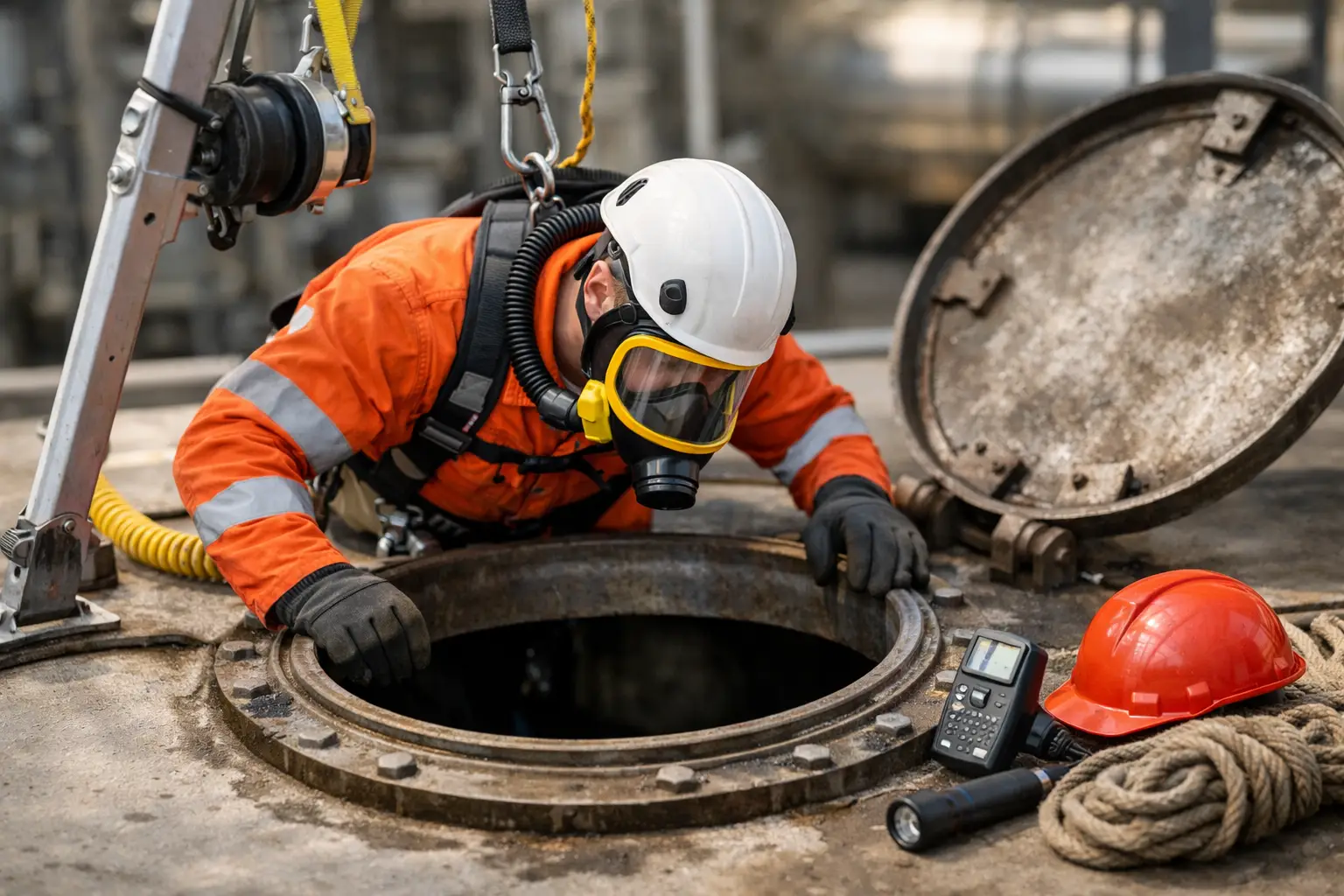
A vessel is opened for cleaning, a worker steps inside, and the job appears routine. Yet a change in oxygen level, a residual chemical release, or a failed communication line can turn that task critical within minutes. To manage confined space risks effectively, companies need more than a permit form. They need a controlled system that connects planning, isolation, testing, supervision, worker competence, and emergency rescue.
For construction and industrial organizations, confined-space work often occurs alongside schedule pressure, multiple contractors, changing work fronts, and incomplete information about the space itself. That is precisely why the controls must be deliberate, documented, and verified in the field.
Start With a Clear Confined Space Assessment
A confined space is not defined only by its size. It is generally a space with limited entry or exit, unfavorable natural ventilation, and potential hazards due to its configuration, contents, or work being performed. Tanks, pits, manholes, silos, ducts, crawl spaces, sewer lines, and process vessels are common examples.
Before authorizing entry, assess the space and the planned work together. A pit that is safe to inspect may become hazardous when welding, solvent cleaning, pressure washing, or chemical application begins. Similarly, work in a vessel may introduce hazards from heat stress, falling objects, energized equipment, moving components, or restricted escape routes.
The assessment should identify the source, likelihood, and consequence of foreseeable hazards. It should also establish the controls required before entry and the conditions that require work to stop. A generic assessment copied from a previous project rarely provides adequate protection. Site conditions, process history, and work activities must drive the controls.
Know What Can Change During the Job
Atmospheric conditions can change after entry. Sludge can release gases when disturbed. Adjacent operations may introduce fumes through connected lines. Oxygen can be displaced by inert gas, coatings, purging activities, or decomposition. Hot work may consume oxygen or create contaminants in a space where ventilation is inadequate.
This is why the entry team must treat the assessment as a live control, not a pre-job administrative task. If the scope changes, the atmosphere changes, ventilation fails, or a worker reports symptoms, stop work and reassess before proceeding.
Control Energy and Hazardous Materials Before Entry
Isolation is one of the most important safeguards in confined-space management. Where equipment, pipelines, or process systems are connected to the space, the team must prevent the unintended release of energy, material, or movement. Closing a valve alone may not be enough if the valve can leak, be reopened, or allow pressure to pass through another connection.
The appropriate isolation method depends on the process and the credible failure modes. It may include lockout and tagout, physical blanking or blinding, disconnection and capping, depressurization, draining, cleaning, or mechanical restraint. The method should be verified by a competent person, not assumed from a drawing or verbal handover.
Construction teams should also account for hazards created by nearby work. Excavation activity can affect a manhole or chamber. Mobile equipment can block an exit. A contractor working above an opening can create dropped-object exposure. Clear coordination between the permit issuer, entry supervisor, and other work parties prevents these interfaces from being missed.
Use Atmospheric Testing as a Decision Tool
Atmospheric testing is not simply a box to tick before a permit is signed. It confirms whether entry can begin and whether it can continue safely. Testing should be performed with calibrated, suitable equipment and by personnel who understand the instrument, its limitations, alarm settings, sampling method, and response actions.
A standard approach is to test for oxygen concentration first, then flammable gases or vapors, followed by toxic contaminants relevant to the space and planned task. Because gases can stratify, sample at different levels where conditions and space geometry warrant it. Remote sampling before entry reduces exposure to the person conducting the test.
One reading at the entrance is not proof that the entire space is safe. Continuous or periodic monitoring may be necessary, particularly where the atmosphere can change due to the work, poor ventilation, residual material, or nearby operations. The permit should state the required monitoring frequency, acceptable limits, responsible person, and action to take when readings are outside acceptable parameters.
Ventilation is often necessary, but it must be designed for the job. Forced air should reach the work area without recirculating contaminants or creating new risks. For example, ventilation ducting may obstruct movement in a narrow chamber, and incorrectly positioned equipment can make an exit more difficult. In some environments, the ventilation equipment itself must be suitable for the hazardous area classification.
Build a Permit System That Works in the Field
A confined-space entry permit should translate the risk assessment into clear, site-specific instructions. It should identify the space, work scope, authorized personnel, isolation status, atmospheric test results, ventilation arrangements, communication method, PPE, standby arrangements, permit validity, and emergency controls.
However, a detailed form cannot compensate for weak implementation. Supervisors need to confirm that conditions in the field match what is recorded. Entry personnel should understand the permit requirements and be able to challenge unsafe conditions. The permit issuer must have the authority to delay work when controls are incomplete, even when production or handover deadlines are tight.
Permit systems become unreliable when they are issued for overly broad periods, transferred between shifts without verification, or treated as a reusable template. A shift change, weather event, process change, or altered work scope should trigger a formal review. A fresh signature has value only when it follows a real check of the space and its controls.
Assign Competent People to Defined Roles
Confined-space entry relies on role clarity. The entry supervisor coordinates the job and confirms that permit conditions are met. Entrants carry out the work, follow the stated controls, and leave immediately if conditions become unsafe. The attendant or standby person remains outside the space, maintains communication, monitors the entry, and initiates the emergency response when required.
These roles should never be nominal. A standby person who is also operating equipment, managing deliveries, or supervising another activity cannot give the entry team the required attention. The attendant must not enter the space to attempt a rescue unless specifically trained, equipped, and authorized under the rescue plan. Many confined-space fatalities occur when unprepared coworkers enter to help and are overcome themselves.
Training should address the actual spaces and tasks workers encounter. Classroom awareness has a role, but practical instruction on gas monitors, harnesses, retrieval systems, communication devices, permit requirements, and stop-work expectations is what supports safe performance on site. Contractors and subcontractors require the same clarity, particularly on shared or client-controlled facilities.
Plan Rescue Before Anyone Enters
Emergency rescue is not a statement that emergency services can be called if something goes wrong. The plan must address how an incapacitated worker will be reached, recovered, and transferred to medical care within a realistic time frame. In a vertical entry, this may require a retrieval system positioned before entry. In a long tunnel, vessel, or complex structure, non-entry retrieval may not be possible and a trained rescue team may be needed.
The rescue arrangement should reflect the space, access route, expected hazards, number of entrants, and rescue equipment required. Test the plan through drills that reflect credible scenarios, not just an easy demonstration in an open area. If a worker is wearing respiratory protection, suspended on a harness, or located beyond a bend in the space, can the designated team actually recover them safely?
A practical rescue drill often reveals issues that documentation misses: insufficient equipment, unclear radio coverage, access blocked by stored materials, or confusion over who calls for help. Correcting these gaps before entry is a direct investment in life safety.
Audit the System and Improve Control Reliability
Companies that manage confined space risks well do not wait for an incident to test their process. They inspect permits, observe entries, check calibration records, verify isolations, review contractor competence, and examine whether corrective actions are closed effectively. The goal is not paperwork volume. It is evidence that critical controls work consistently at the point of use.
Trend findings across projects. Repeated omissions in atmospheric testing, weak shift handovers, incomplete rescue drills, or poorly defined isolation points usually indicate a system issue rather than a single worker error. Addressing the root cause may require revised procedures, supervisor coaching, improved permit design, or independent EHS support.
For organizations balancing compliance obligations with active project demands, specialist guidance can help turn confined-space requirements into workable site controls. MOSAIC Ecoconstruction Solutions supports clients with risk assessments, EHS documentation, audits, training, and implementation support tailored to construction and industrial operations.
The safest confined-space entry is one where every person understands a simple standard: if the conditions cannot be verified, the work does not begin. That discipline protects workers, strengthens compliance confidence, and keeps operational decisions anchored to what matters most.