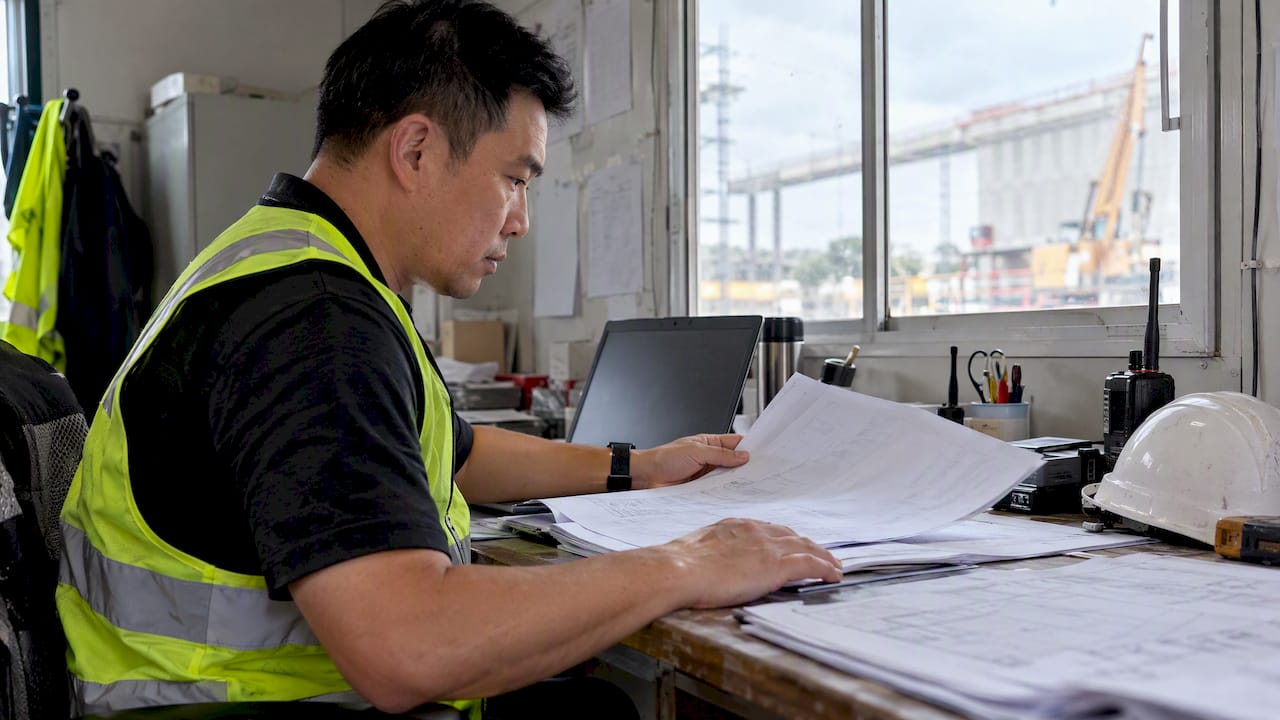
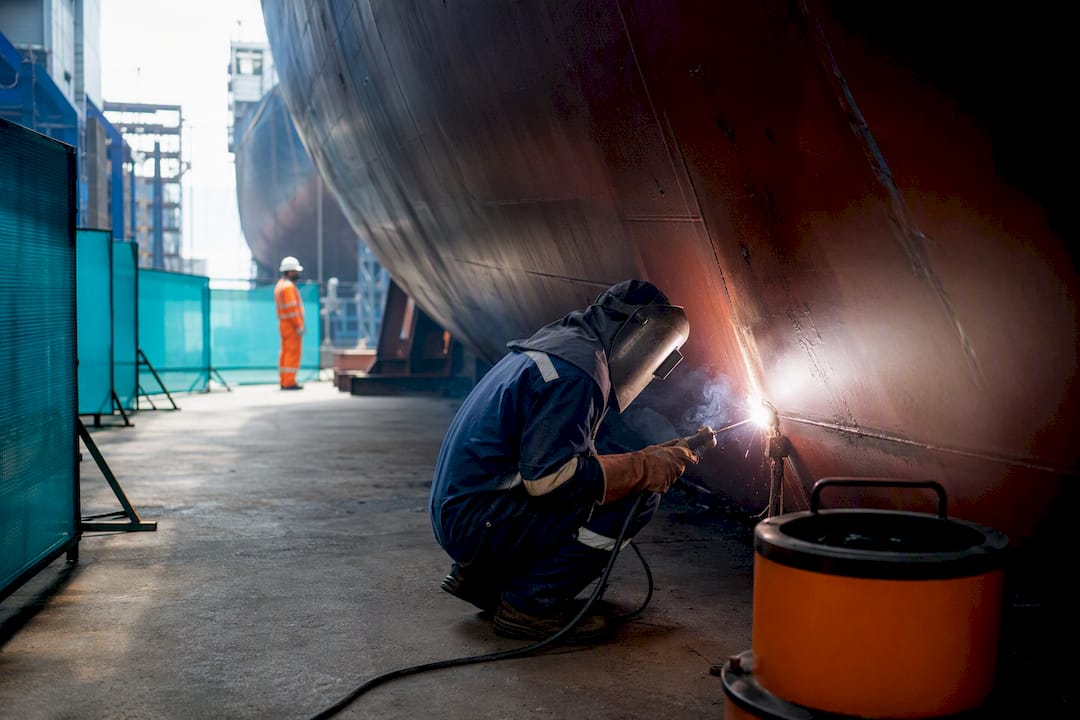
Welding, cutting, grinding, and brazing at any Singapore worksite or aboard a vessel legally require a serialized hot work permit under the Workplace Safety and Health (Shipbuilding and Ship-Repairing) Regulations. A competent safety assessor must endorse it before work starts. For vessels, that usually means applying through digitalPORT@SG for anchorage space, sometimes with gas-free certification attached. Start there: line up your safety assessor or file the anchorage application first, since both processes run on lead times you cannot compress at the last minute.
TL;DR:
- Applying for a hot work permit on a vessel requires submitting at least three working days in advance through digitalPORT@SG and verifying if gas-free certification is necessary based on cargo history.
- The permit process involves a safety assessor inspection, a location sketch, hazard notes, and continuous oversight, with authority to revoke if conditions change.
- Only authorized personnel such as the project manager, safety assessor, supervisor, and fire watcher have defined responsibilities, ensuring compliance at each step.
- Activities like grinding qualify as hot work and require the same controls as welding, including removing combustibles and maintaining a fire watch, especially in high-risk environments.
- Proper preparation before application includes detailed location sketches, cargo history, gas certificates if needed, and confirming the work scope to prevent delays or rejections.
Table of Contents
- What Singapore Law Requires for a Hot Work Permit
- How Do You Apply for a Hot Work Permit on a Vessel?
- What Are the Steps in a Hot Work Permit Application Process?
- Who Is Responsible for Each Part of the Permit Process?
- Which Activities Count as Hot Work, and What Controls Apply?
- What Should You Prepare Before Submitting a Hot Work Application?
- How Com Helps Teams Reduce Stop-Work Risk
- Where the Conventional Advice Falls Short
- Sources
What Singapore Law Requires for a Hot Work Permit
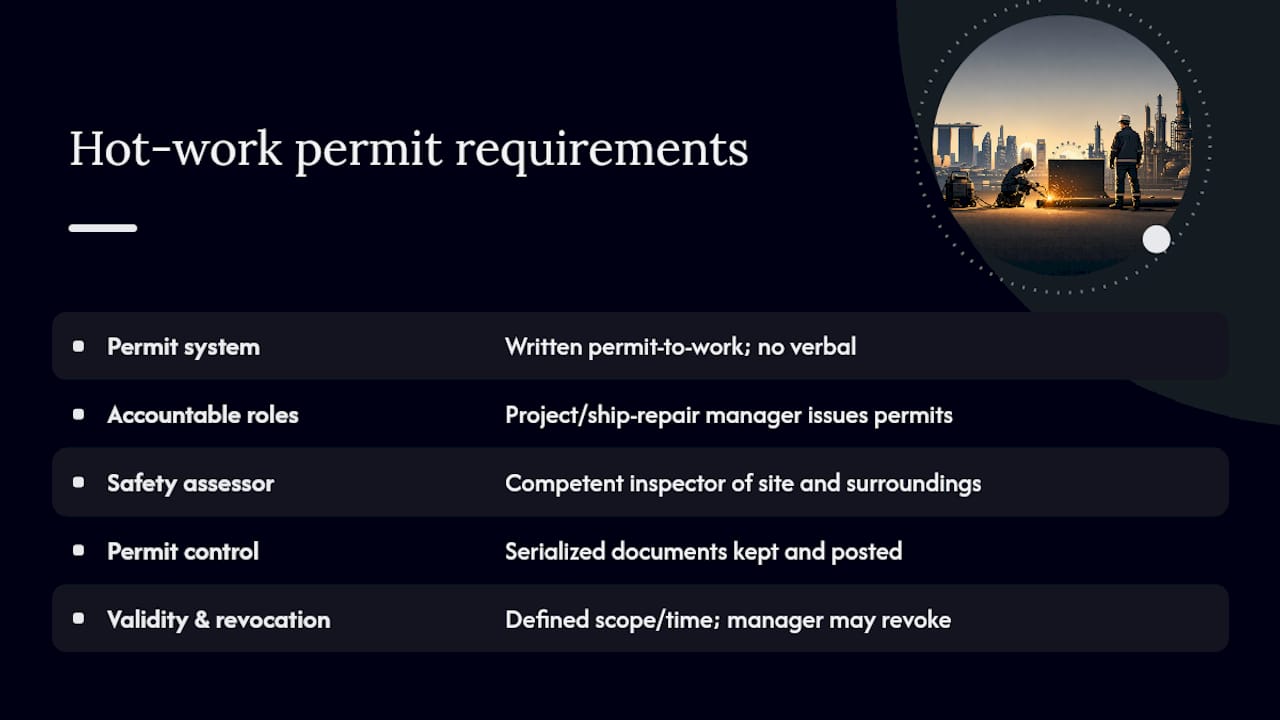
The statutory backbone here is the Workplace Safety and Health (Shipbuilding and Ship-Repairing) Regulations, which govern permit-to-work systems for hot work across ship-repair and related high-risk construction activities. The regulation is specific about what counts: welding, flame cutting, soldering, brazing, and grinding all trigger the permit requirement, because each generates heat, sparks, or open flame capable of igniting nearby materials or vapors, according to Singapore Statutes Online.
Employers carry three concrete obligations under this framework. First, implement a permit-to-work system rather than relying on verbal authorization. Second, appoint a project manager or ship repair manager who takes personal responsibility for issuing permits, along with a safety assessor competent enough to inspect the site and its surroundings. Third, serialize every permit as a controlled document, retained for record-keeping and posted visibly at the worksite while work is underway.
Validity is not indefinite. A permit covers a defined scope and time window, and the issuing manager retains authority to revoke it the moment conditions change, whether that is a shift change, a new ignition source appearing nearby, or a lapse in fire watch coverage. Retaining these records matters beyond compliance theater. Regulators and insurers alike will ask for the permit trail after an incident, and a business with no WSH management system behind its permits will struggle to demonstrate due diligence. For a broader view of how this regulation fits into wider construction-sector obligations, see this construction sector regulation guide.
How Do You Apply for a Hot Work Permit on a Vessel?
Vessel hot work runs through a different channel than a land-based worksite. Anchorage applications for hot-work repairs go through digitalPORT@SG, the Maritime and Port Authority’s e-Approval portal, and MPA recommends submitting at least three working days ahead of the planned work, according to its anchorage application guidance. That window exists because the review involves more than a paperwork check. MPA needs to confirm the vessel’s last cargo, since certain cargo histories carry residual vapor risks that make hot work unsafe until the space is certified gas-free.
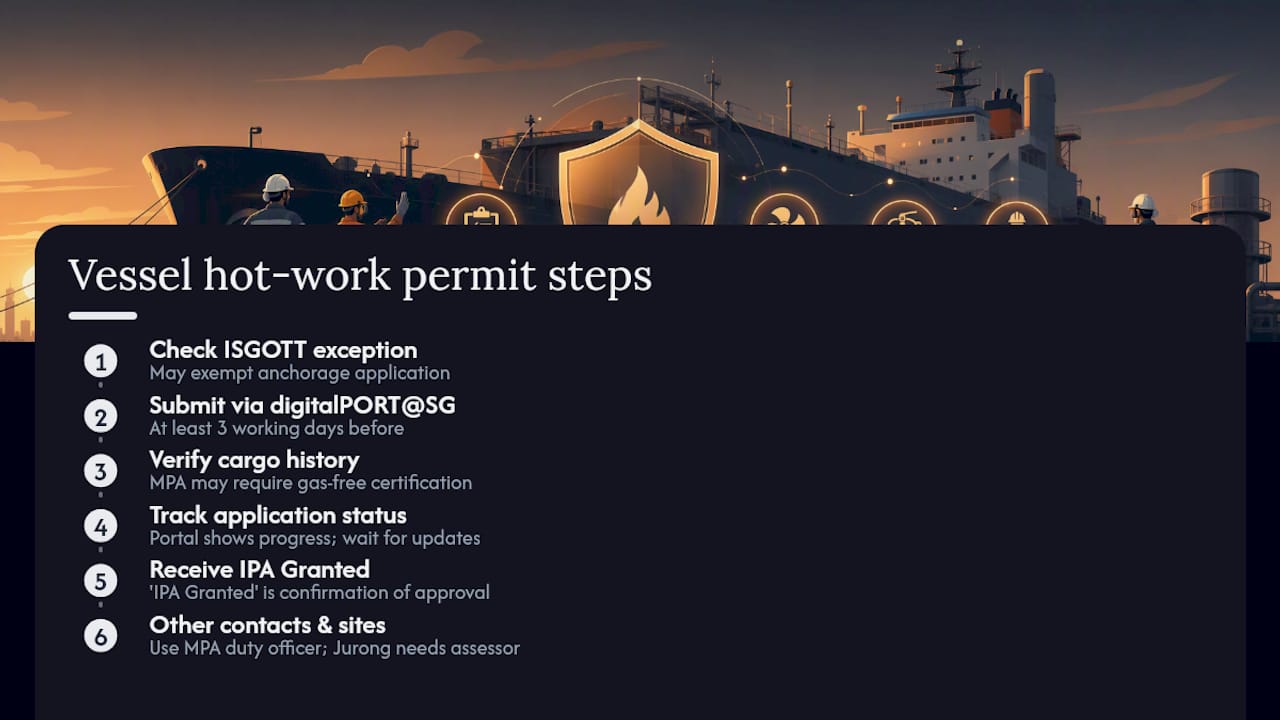
Gas-free certification is not automatic for every job. It becomes a requirement specifically when the vessel’s cargo history suggests flammable or explosive residue could remain in tanks, holds, or adjacent compartments. Skip this step, or assume your vessel is exempt without checking, and you risk a rejected application or, worse, a stop-work order once inspectors arrive on site.
Once submitted, applicants can track status through the portal, with an “IPA Granted” notification confirming approval. MPA maintains a duty officer contact for urgent matters outside standard processing, useful if a repair window suddenly shifts. One detail worth confirming before you even file: some engine-room hot works fall under ISGOTT-designated workshop arrangements that bypass the anchorage application entirely. Check whether your planned work qualifies before assuming you need to go through the full digitalPORT@SG process. Jurong Port applies a parallel requirement inside its own premises, where a designated Hotwork Assessor must inspect the work location and vicinity before endorsing the permit.
What Are the Steps in a Hot Work Permit Application Process?
The permit-to-work process follows a predictable sequence whether you are on a construction site or aboard a vessel undergoing repair. Skipping a step is usually what turns a routine application into a stalled job.
- Confirm the work genuinely needs to be hot. Before applying, document why no cold-cutting or mechanical alternative exists. Regulators expect this justification in writing, not as an afterthought, and it becomes part of the permit record.
- Prepare a location sketch and hazard note. Draw the exact work location, flag nearby combustibles, ventilation points, and any adjacent compartments or work areas that could be affected by sparks or heat transfer.
- Submit through your supervisor to the project manager or ship repair manager. This is the person legally accountable for issuing the permit, and they will not sign off without a safety assessor’s inspection first.
- Safety assessor inspects the site and its surroundings. The inspection covers more than the immediate work surface. Assessors check ventilation, isolation of hazards, and whether combustible materials sit anywhere within the danger radius.
- Permit is issued, serialized, and posted. Once endorsed, the permit lists every control measure required, gets a unique serial number, and is displayed at the worksite for the duration of the job.
- Fire watcher is assigned and standby equipment arranged. No permit should authorize work without a designated person monitoring for ignition, equipped with extinguishers appropriate to the hazard.
- Daily review and revocation authority remain active. The project manager or ship repair manager can pull the permit at any point if conditions change, a new hazard appears, or the scope shifts beyond what was originally endorsed.
- Records are retained after completion. The completed, closed-out permit becomes part of the site’s compliance file, useful for audits, insurance claims, and any future incident investigation.
Consulting a risk assessment guide before Step 1 helps teams build the hazard justification correctly the first time, rather than sending it back for revision.
Who Is Responsible for Each Part of the Permit Process?
Four roles carry distinct legal weight in this system, and confusing them is one of the more common compliance failures Com sees flagged during audits.
The project manager or ship repair manager holds final signing authority. They cannot issue a permit until satisfied, personally, that risks have been mitigated, which shifts legal responsibility onto management rather than leaving it with frontline workers. They also retain daily review and revocation power throughout the job.
The safety assessor, typically a competent person or a Workplace Safety and Health Officer, inspects the site and its immediate surroundings before endorsing the application. Their sign-off is a legal predicate. Without it, the permit cannot be issued at all.
The supervisor posts the permit at the worksite, monitors ongoing compliance with its listed controls, and must report any work that becomes incompatible with the permit’s original conditions. Once the job wraps, the supervisor notifies the project manager so the permit can be formally closed out.
The fire watcher stays stationed for the entire duration of hot work and for at least 30 minutes afterward, since smoldering material can ignite well after the torch is switched off. They carry the authority to stop work immediately if conditions turn unsafe, and they need extinguishers rated for the specific hazard on hand, not generic equipment.
Which Activities Count as Hot Work, and What Controls Apply?
Welding, flame cutting, soldering, and brazing are the obvious examples, but grinding also qualifies as hot work under Singapore’s regulations, because the sparks it throws off carry the same ignition risk as an open flame. Teams that treat grinding as a “minor” task outside the permit system are one of the more frequent compliance gaps Com encounters during site audits.
Once an activity is classified as hot work, a standard set of controls follows:
- Remove combustible material from the work area entirely where possible.
- Cover or shield combustibles that cannot be relocated.
- Ventilate enclosed spaces before and during the work.
- Obtain gas-free certification where cargo history or space history demands it.
- Station a fire watch with standby extinguishers for the full duration and afterward.
- Maintain minimum distance buffers, commonly a 3-meter clearance from safety nets and air return ducts in higher-risk settings.
Special environments raise the bar further. Airport airside operations, for example, apply strict isolation checklists and require coordination with fire stations before any hot work proceeds, reflecting the added consequence of an ignition event near aviation infrastructure, per Changi Airport’s hot work permit guidance. Port and critical-infrastructure sites frequently demand this same level of specialist coordination, going well beyond what a typical construction site permit requires.
Pro Tip: Treat every grinding task on a checklist the same way you treat welding. If your permit template has a separate, lighter-touch process for grinding, that inconsistency is exactly what an inspector will flag first.
What Should You Prepare Before Submitting a Hot Work Application?
Most delays and rejections trace back to missing documentation rather than genuine safety objections. A clear sketch of the exact hot-work location and a documented cargo history are the two items applicants forget most often, according to MPA’s own guidance.
Before applying:
- Draw a sketch of the exact hot-work location, including nearby structures and hazards.
- Write a description of the work and justification that no safer alternative exists.
- Compile the vessel’s last cargo history, if applicable.
- Secure gas-free certificates in advance if the cargo history requires them.
On-site, before work starts:
- Serialized permit displayed with the location sketch attached.
- Fire watcher assigned, named, and reachable.
- Firefighting equipment and isolation measures physically in place.
- Safety assessor’s endorsement signature on the permit itself.
At close-out:
- Supervisor signs off on completion and confirms no outstanding hazards.
- A copy of the completed permit is retained in the compliance file.
- Port or airside authorities are notified if the work fell under their jurisdiction.
How Com Helps Teams Reduce Stop-Work Risk
Com specializes in Quality, Environment, and Safety consultancy for Singapore’s construction sector, supporting businesses through the exact certifications and compliance frameworks this permit system sits inside, including BizSAFE and ISO certification support. That work spans consultancy, training, auditing, and manpower outsourcing rather than a single point-in-time service.
Beyond certification, Com runs safety audits and delivers specialist advisory work, including Design for Safety and ConSASS assessments, both of which directly touch the hazard identification and risk evaluation steps a hot work permit demands. Teams working through their hazard identification process before submitting a permit application typically face fewer inspection delays, because the groundwork an assessor expects is already documented.
Com’s continuous support model, built on a track record across the sector, aims to strengthen safety culture and reduce risk exposure long after a single permit closes out. For teams looking to formalize their broader regulatory compliance approach, that ongoing relationship is where the real value shows up.
Where the Conventional Advice Falls Short
Most guidance on hot work permits treats the paperwork as the finish line. Get the serialized permit signed, post it, done. That framing misses where the actual risk sits: the daily review obligation that follows issuance, not the approval moment itself. A permit endorsed on Monday morning can be invalid by Monday afternoon if a colleague moves combustible material into the work radius, and too many project managers treat revocation authority as theoretical rather than something they need to exercise routinely.
The maritime side gets underrated for a different reason. Teams fixate on the anchorage approval and forget that cargo history documentation, not the application form itself, is what actually determines timeline. File without it and you are not delayed by bureaucracy. You are delayed because MPA cannot verify the vessel is safe to work on yet.
If there is one priority worth acting on immediately, it is this: appoint and document your safety assessor before you need them, not during the application. That single step removes the biggest bottleneck in the entire process, on land or at sea.
— Aman
Sources
- Workplace Safety and Health (Shipbuilding and Ship-Repairing) Regulations 2008 – Singapore Statutes Online
- Applying for Anchorage Space to Conduct Hot-Work Repair | Maritime and Port Authority of Singapore
- What is required for the application for Hot Work Permit? – Jurong Port
- Fire Detection and Protection Systems / Hot Work Permit (Changi Airport PDF)