
Introduction
Specialized LLM prompts can now automate 70–80% of environmental aspects identification and impact assessment tasks while maintaining full ISO 14001 compliance – reducing what traditionally takes weeks of manual effort into a structured, repeatable process completed in hours. For organizations pursuing or maintaining certification under ISO 14001 (including the newly published ISO 14001:2026, released in April 2026), this represents a fundamental shift in how environmental management systems operate.
This article covers the practical application of Large Language Model (LLM) prompt engineering to environmental aspects analysis, targeting EHS professionals, sustainability consultants, and organizations seeking ISO 14001 certification – particularly those operating within Singapore’s regulatory landscape. It does not cover full life-cycle assessment (LCA) software or general AI strategy; instead, it focuses specifically on prompt design, significance scoring automation, and regulatory compliance verification for aspect-impact registers.
Readers will gain:
-
A clear understanding of how LLM technology applies to ISO 14001 environmental aspects and impacts identification
-
Proven prompt engineering techniques with ready-to-use templates for environmental analysis
-
A step-by-step implementation process suited to Singapore-based construction and manufacturing organizations
-
Practical solutions to common challenges including data quality, regulatory compliance, and EMS integration
-
A comparative framework for evaluating manual versus automated approaches across time, cost, and accuracy
Understanding Environmental Aspects and Impact Analysis
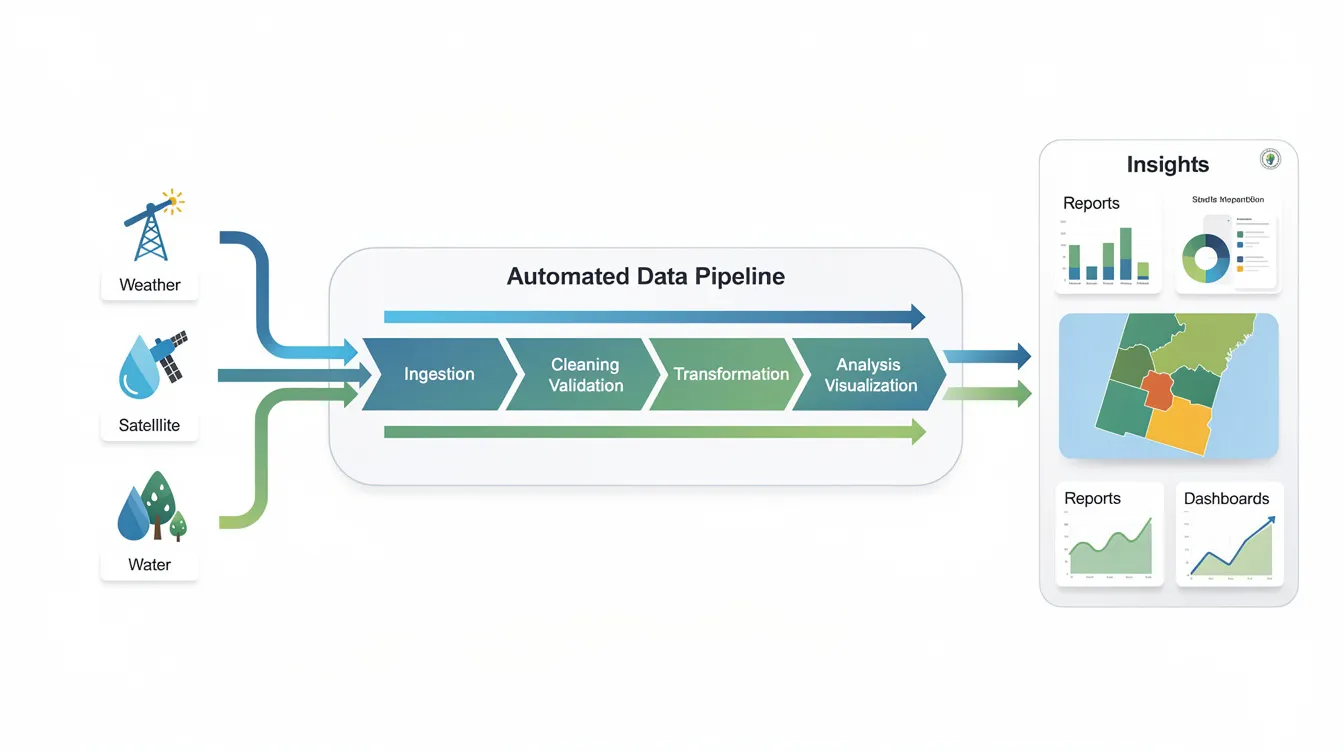
An environmental aspect is any element of an organization’s activities, products, or services that can interact with the environment. An environmental impact is any change to the environment resulting from those aspects, including positive outcomes and negative effects. Each environmental aspect can result in multiple environmental impacts; for example, a concrete batching operation on a construction site produces dust (air emissions), generates wastewater (water pollution), and consumes significant energy (resource consumption). Understanding this one-to-many relationship is foundational to building effective automated analysis.
Under ISO 14001 clause 6.1.2, organizations must identify organization’s environmental aspects within their defined scope, determine associated impacts using a life-cycle perspective, and establish documented criteria for evaluating which aspects are significant. ISO 14001 helps organizations minimize their environmental footprint by requiring systematic evaluation of the organization’s environmental aspects and their interactions, but the standard deliberately does not prescribe specific numeric thresholds or scoring methods – leaving that judgment to each organization.
Traditional Environmental Aspects Identification
Identifying environmental aspects traditionally involves site visits, document reviews, stakeholder interviews, and internal workshops. EHS teams walk through operations, catalogue inputs and outputs for each process, and cross-reference against regulatory requirements. For a medium-sized construction firm in Singapore, this process typically spans 2–4 weeks, depending on the number of sites, complexity of operations, and reviewer availability.
The manual approach is inherently time-intensive and susceptible to human oversight. Common gaps include missed supply-chain aspects, incomplete consideration of emergency conditions and maintenance activities, and life-cycle stages not under direct operational control. Identifying aspects across fuel consumption, waste generation, water consumption, and air pollution sources requires deep familiarity with every operational process – knowledge that often resides in the heads of a few individuals rather than in documented systems.
Environmental Impact Assessment Methods
Significance evaluation relies on structured criteria – typically magnitude, frequency, severity, scale/extent, regulatory exposure, and stakeholder concern. A widely used scoring matrix employs five criteria scored 1–5 each, with a total threshold (e.g., ≥15 out of 25) to designate significant environmental aspects. Override rules add a critical safety net: any aspect scoring maximum severity (5) is automatically classified as significant, regardless of other scores.
Traditional schemes often follow the Fine & Kinney model where risk equals probability multiplied by consequence, or simpler qualitative high/medium/low ranking categories. In Singapore, regulatory thresholds add another dimension – if emissions data shows a facility operating at ≥85% of its NEA-permitted limit, that aspect may warrant automatic classification as significant. ISO 14001 requires evaluating aspects based on severity and likelihood, creating the quantitative foundation that makes automation both possible and valuable.
The relationship between aspects and impacts – and the structured, criteria-based nature of significance evaluation – is precisely what makes this process suitable for LLM automation. Pattern recognition across defined criteria, consistent application of scoring rules, and regulatory cross-referencing are tasks where machine learning excels over manual analysis, helping organizations identify, score, and manage negative impacts more consistently across defined criteria.
LLM Technology for Environmental Analysis
Where traditional methods depend entirely on human expertise and time, LLM technology introduces capabilities that directly address the bottlenecks in environmental aspects analysis: inconsistent scoring, incomplete regulatory coverage, and the sheer volume of data that must be processed across complex operations.

Large Language Model Capabilities
LLMs bring three core capabilities to environmental management: pattern recognition across large document sets, natural language processing for unstructured environmental documentation, and the ability to integrate regulatory knowledge into analytical outputs. When augmented with Retrieval-Augmented Generation (RAG), these models can access domain-specific information – Singapore’s Environmental Protection and Management Act, PUB water regulations, NEA air quality standards – and ground their analysis in actual legal requirements rather than general knowledge.
A 2026 study on environmental impact analysis of structural steels demonstrated how LLMs paired with retrieved Environmental Product Declarations (EPDs) could compare products quantitatively across global warming potential and other life-cycle impact categories. The method embedded queries, retrieved relevant context, and constructed system/user prompts with explicit behavioral constraints – achieving speed and consistency significantly higher than manual literature searching. AI enhances accuracy in environmental data analysis by eliminating the variability inherent in human evaluation across different reviewers and time periods.
AI identifies inefficiencies in resource consumption effectively, and predictive analytics in AI forecasts future environmental impacts based on historical trends. These capabilities transform the environmental management system from a reactive documentation exercise into a proactive management tool. AI-powered chatbots can even provide instant access to environmental data, enabling real-time decision-making during operations.
Specialized Prompt Engineering for ISO 14001
Prompt engineering for aspect-impact analysis must include structured role-based prompts that define the LLM’s function, constraints, and output format. System prompts must clearly outline the role and tasks for effective guidance of the LLMs – for example, assigning the role of “ISO 14001 environmental analyst with expertise in Singapore environmental legislation” establishes the analytical framework.
Prompt templates should be example-driven and utilize domain-specific vocabulary to enhance output quality. Rather than asking an LLM to “list environmental issues,” a well-engineered prompt specifies: “Given the following construction activities with associated material inputs and waste outputs, identify all environmental aspects, map each to its associated environmental impacts across normal, abnormal, and emergency operating conditions, and score each on severity/frequency/scale/legal-exposure using a 1–5 scale.”
A controlled input schema enhances reproducibility of aspect-impact analysis results. This means standardizing how activity descriptions, material inventories, and regulatory references are fed into the model. Outputs from LLMs should include structured formats such as JSON or Markdown tables, ensuring the results can be directly imported into EMS registers and audit documentation.
Key prompt engineering patterns for ISO 14001 include:
-
Role-based system prompts defining the LLM as an environmental analyst with specific jurisdictional knowledge
-
Behavioral constraints preventing hallucination (e.g., “If data is insufficient, state ‘data missing’ rather than estimating”)
-
Conditional logic for operating conditions (“If the aspect occurs under emergency conditions, flag separately and apply emergency severity weighting”)
-
Override rules embedded in scoring instructions (“Any aspect scoring 5 on severity is automatically classified as significant regardless of total score”)
Benefits for Environmental Management Systems
Organizations implementing LLM-assisted environmental analysis report approximately 60% reduction in analysis time for initial aspect identification and scoring. The Turley–STFC Hartree Centre case study demonstrated how AI could extract and summarize data from technical environmental reports, freeing EHS staff to focus on strategic oversight rather than document retrieval. AI streamlines data management for ISO 14001 compliance, supports environmental compliance, and automates environmental data collection and reporting processes.
Consistency improvements are equally significant. When the same prompt template processes data across multiple sites or operations, every aspect receives identical scrutiny against identical criteria – eliminating the reviewer-dependent variability that plagues manual assessment. AI improves transparency in environmental performance communication and can automate environmental report generation for stakeholders. Identifying significant environmental aspects allows resource prioritization, enabling organizations to allocate resources where environmental performance improvements matter most.
Research into green prompt engineering shows that optimized prompts can reduce inference energy and associated CO₂ emissions by 32–48% across various models – meaning the automation tool itself can align with sustainable practices and organizational sustainability objectives.
These quantified benefits set the stage for practical implementation.
Practical Implementation of Automated Aspect Impact Analysis
Building on the technical foundations above, this section provides a concrete methodology for Singapore-based organizations – particularly construction and manufacturing SMEs – to implement automated environmental aspects analysis within their ISO 14001 environmental management system.

Step-by-Step Automation Process
Organizations should implement automated analysis during initial ISO 14001 development, annual management reviews, or whenever significant operational changes occur. The process follows four core stages:
-
Data preparation and organizational activity mapping: Catalogue all activities, products, and services within the EMS scope so the inventory captures the organization’s environmental aspects across activities, products, and services. Document operations including material inputs, energy use, waste streams, emissions sources, and water consumption. Collect relevant Singapore regulatory texts – EPMA provisions, NEA requirements, PUB regulations – and compile them into a retrievable knowledge base. LLMs can assist in generating initial inventories of activities and environmental aspects for ISO 14001, accelerating this foundational step considerably.
-
LLM prompt configuration for environmental aspects identification: Build role-based system prompts defining the LLM as an ISO 14001 environmental analyst. Configure user prompts that accept structured activity descriptions and return identified aspects mapped to impacts. The legal context of environmental obligations should be integrated into the analysis – compliance obligations must be identified based on actual local laws and regulations, not generalized assumptions. Include instructions for life-cycle consideration and emergency/abnormal condition analysis.
-
Automated impact assessment using significance criteria prompts: Define scoring criteria (severity, frequency, scale, legal exposure, stakeholder concern) with numeric scales and threshold rules. Risk evaluations must reference legal compliance when analyzing significant environmental aspects. Configure override rules – for example, catastrophic severity alone triggers significance classification. Environmental aspects include energy use and waste generation as standard categories, but prompts should also capture less obvious aspects like noise, vibration, and resource use in the supply chain, while identifying both positive and adverse impacts where relevant.
-
Results validation and regulatory compliance verification: Human validation is essential for outputs generated by LLMs to ensure accuracy and regulatory compliance. Subject-matter experts review automated outputs, verify regulatory mapping against current Singapore legislation, and confirm that no aspects have been missed. The outcome of an LLM-assisted ISO 14001 analysis should be auditable – meaning every scoring decision can be traced to defined criteria and input data. Auditor review challenges can improve the quality of aspect-impact assessments produced by LLMs by forcing additional scrutiny on edge cases.
Prompt Templates and Examples
Below is a practical system prompt template for environmental aspects analysis:
System Prompt: “You are an environmental analyst with expertise in ISO 14001:2015, ISO 14001:2026, and Singapore environmental legislation (EPMA, NEA regulations, PUB requirements, Wildlife Act). Analyze organizational activities to identify environmental aspects, map associated environmental impacts, including both positive and negative effects where applicable, and evaluate significance. Always consider normal, abnormal, and emergency operating conditions. Reference specific Singapore regulatory obligations. For any aspect where data is insufficient, state ‘data missing’ – never speculate. Output results as a Markdown table with columns: Activity, Aspect, Impact(s), Operating Condition, Severity (1-5), Frequency (1-5), Scale (1-5), Legal Exposure (1-5), Stakeholder Concern (1-5), Total Score, Significant (Yes/No).”
User Prompt: “Analyze the following construction site activities: [structured activity list with inputs/outputs]. Apply a significance threshold of ≥15 out of 25. Override: any aspect scoring 5 on severity is automatically significant. Include life-cycle stages where the organization has control or influence.”
The following comparison helps organizations determine their automation approach:
|
Criterion |
Manual Analysis |
Automated LLM Analysis |
|---|---|---|
|
Time Required |
2–4 weeks per site |
1–3 days including validation |
|
Consistency Level |
Variable across reviewers |
Uniform across all assessments |
|
Regulatory Coverage |
Dependent on reviewer knowledge |
Systematically mapped to legal database |
|
Cost Efficiency |
High consultant/labor costs |
Lower per-assessment cost at scale |
|
Life-Cycle Coverage |
Often limited to direct operations |
Prompted to include upstream/downstream |
|
Audit Traceability |
Manual documentation required |
Structured outputs with embedded rationale |
For organizations evaluating whether to adopt a hybrid or fully automated approach: a hybrid model – where LLMs generate initial drafts and human experts validate and refine – represents the most practical path for most organizations. Significant aspects require controls, objectives, and monitoring, and the determination of what constitutes “significant” ultimately carries legal and operational accountability that must rest with qualified humans.
AI identifies patterns in resource consumption to reduce waste, and AI can optimize energy consumption in manufacturing processes – but these analytical capabilities work best when paired with human judgment on the implications. Effective communication with stakeholders is essential for environmental stewardship, and AI enhances stakeholder engagement in environmental reporting by producing consistent, transparent documentation.
Common Challenges and Solutions
Implementing automated environmental aspects analysis across Singapore’s diverse industrial landscape – from construction sites to manufacturing facilities – introduces specific challenges that require deliberate solutions.
Data Quality and Completeness Issues
Automated systems depend on accurate, up-to-date data: process descriptions, emissions data, material inventories, and regulatory texts. Missing or poorly structured data produces unreliable outputs – the principle of garbage in, garbage out applies forcefully. The solution involves implementing structured data collection templates before engaging LLM analysis. Create standardized input forms for each process that capture material flows, energy inputs, waste outputs, and operating conditions. Validation prompts can be designed to flag incomplete entries: “If any required field is empty, list the missing data elements and request completion before proceeding with significance scoring.” AI identifies patterns in resource consumption to reduce waste only when the underlying consumption data is complete and accurate.
Regulatory Compliance Verification
Singapore’s environmental regulations span multiple agencies – NEA for air pollution and emissions, PUB for water and sewerage, URA for environmental impact assessments on development projects. Regulations change, and an LLM’s training data may not reflect the latest amendments. The solution requires maintaining an up-to-date regulatory knowledge base as a RAG source, separate from the LLM’s internal training. Include version dates on all regulatory documents. Design prompts that ask specifically “Which Singapore statute or regulation applies to this aspect?” and cross-reference outputs against current legal registers. Organizations like SIA Engineering Company, ISO 14001 certified since 1998, demonstrate the value of maintaining rigorous legal obligations registers – reporting zero non-compliance in FY2021/22.
Integration with Existing EMS Systems
Many organizations already maintain aspects registers in spreadsheets, EMS platforms like AmpliFlow or Zebsoft, or integrated management systems. Automated LLM outputs must feed seamlessly into these existing structures. The solution involves designing LLM outputs in formats compatible with target systems – JSON for database imports, CSV for spreadsheet integration, or structured Markdown for documentation platforms. Connect automated outputs to legal registers, objectives and targets tracking, monitoring schedules, and training materials. Establish scheduled review cycles where automated re-analysis triggers updates across the integrated system, ensuring the aspects register remains current as operations change.
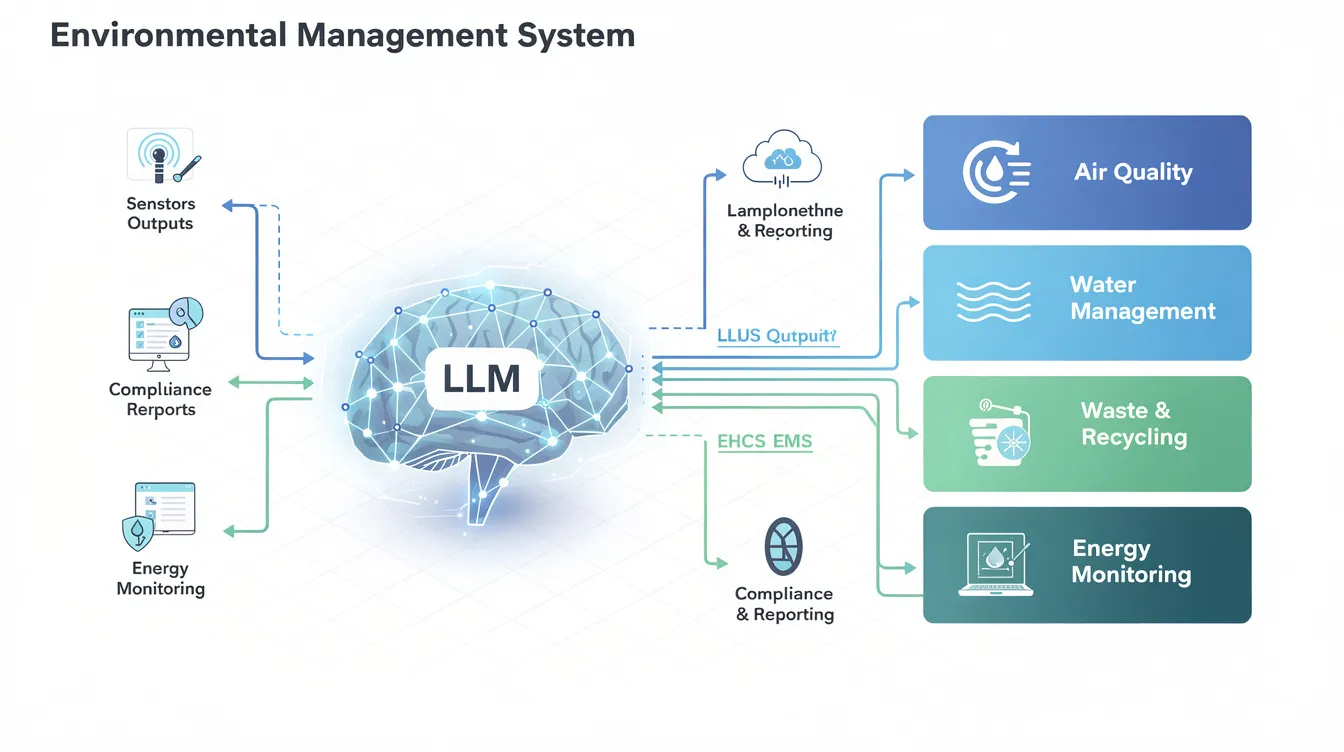
Organizations should also recognize the risk of over-automating. Rare emergencies, upstream supply chain impacts, and aspects visible only under abnormal conditions must be explicitly addressed in prompts – templates that emphasize “normal operations” alone will embed dangerous gaps. Impacts are changes to the environment from an organization’s aspects, and those changes can manifest differently when activities interact with the environment during rare emergencies, abnormal operations, or maintenance events that standard operating procedures never anticipate.
Conclusion and Next Steps
Automated aspect impact analysis using specialized LLM prompts transforms how organizations manage their environmental aspects and impacts under ISO 14001 – delivering consistent, auditable, and regulation-aware results in a fraction of the time required by manual processes. The technology does not replace human expertise; it amplifies it, allowing EHS professionals to focus on strategic environmental management rather than data gathering and repetitive scoring.
To begin implementing automated analysis within your organization:
-
Assess current analysis processes – document existing methods, identify time-consuming steps, and catalogue available data sources
-
Develop pilot prompt templates – start with a single process or site, using the role-based system prompt structure outlined above
-
Train your team on LLM tools – ensure EHS staff understand both the capabilities and limitations, particularly the non-negotiable requirement for human validation
-
Implement a graduated automation approach – expand from pilot to full scope incrementally, validating outputs at each stage against expert judgment and regulatory requirements
Related areas worth exploring include automated EMS monitoring and reporting, AI-enhanced internal environmental auditing, virtual assistants for real-time compliance queries, and the integration of predictive analytics for proactive environmental performance management. As ISO 14001:2026 increases emphasis on criterion transparency and evidence mapping, organizations that build automated, auditable analytical frameworks now will hold a significant advantage.
Additional Resources
-
MOSAIC EHS Advisory and Documentation services for guided implementation of automated EMS analysis
-
ISO 14001 and ISO 45001 integration guide for organizations developing integrated management systems
-
ISO 14001:2026 clause 6.1.2 compliance checklist adapted for LLM automation workflows
-
Singapore environmental regulation reference covering EPMA, NEA, PUB, and URA requirements for prompt development
-
Budgeting guide for ISO certification including cost considerations for technology-assisted implementation
-
Sample LLM prompt library for environmental aspects analysis covering construction, manufacturing, and facilities management operations