
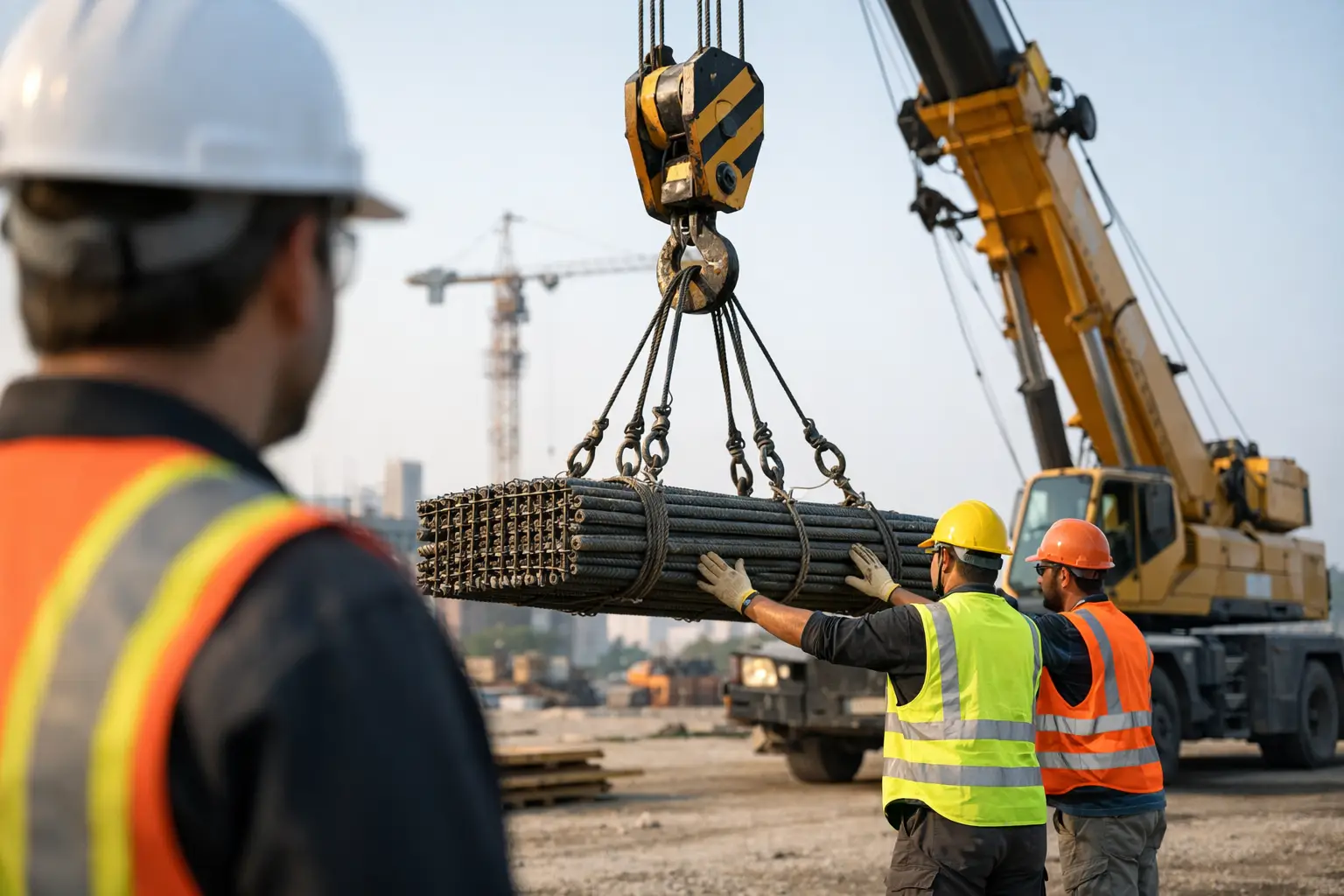
A lift can look routine right up to the moment an assumption fails. A load weight is estimated instead of verified, an outrigger is placed on unsuitable ground, or a signal is misunderstood near an active work area. This guide to lifting operations gives construction and industrial leaders a practical framework for planning, controlling, and reviewing lifts before those gaps become incidents.
Lifting safety is not achieved by relying on a crane operator alone. It depends on coordinated decisions by project management, supervisors, operators, riggers, signalpersons, and workers who understand the exclusion zone. The objective is simple: move the load as planned, without exposing people, structures, equipment, or the public to uncontrolled risk.
Start With a Lift Plan That Reflects Site Conditions
A lift plan should translate the actual job into clear controls. Generic plans copied from earlier projects rarely address the variables that cause lifting incidents: changing ground conditions, restricted access, nearby services, partial road closures, multiple trades, or a load that is more difficult to control than its dimensions suggest.
The level of detail should match the lift’s complexity and risk. A routine lift may require a task-specific risk assessment, equipment checks, and a defined method of work. A critical lift needs a more formal engineered plan, review and approval process, and closer supervision. Project requirements and applicable regulations may define critical lifts differently, but they commonly include heavy or high-percentage capacity lifts, tandem lifts, lifts over occupied areas, lifts near live utilities, lifts involving unusual rigging, and lifts in confined or congested locations.
A usable plan identifies the load, lifting equipment, rigging configuration, lift location, travel path, set-down area, assigned personnel, communication method, and exclusion zone. It must also account for foreseeable changes. If the crane position changes, the radius changes. If the radius changes, the available lifting capacity may change significantly. A plan that does not reflect these relationships is documentation, not control.
Verify the Load Instead of Estimating It
The total lifted weight includes more than the item being moved. It must include the load, hook block, lifting beam or spreader bar, slings, shackles, lifting lugs, and any other below-the-hook device. Confirm the weight from reliable drawings, manufacturer data, shipping information, or a verified calculation.
The center of gravity is equally important. An off-center or unstable load can shift unexpectedly during takeoff, overload one sling leg, or rotate into people and structures. Where the center of gravity is uncertain, the lift should be reassessed before it proceeds. Trial lifting may help validate balance, but only when carried out under controlled conditions and within the approved plan.
Check Capacity at the Actual Working Radius
Crane load charts are configuration-specific. Capacity depends on factors such as boom length, operating radius, counterweight, outrigger position, lifting mode, and whether the crane is static or traveling. The rated capacity shown for one configuration cannot be assumed for another.
The lift team should confirm that the planned load, including rigging, remains within the crane’s permitted capacity at the greatest anticipated radius. This is especially relevant when a load must be picked from one location and placed at another, or when it is moved around a building corner. A load moment indicator is a valuable safeguard, but it does not replace a verified lift plan or competent operational judgment.
Establish Ground, Access, and Work-Area Controls
A correctly selected crane can still become unsafe if the support conditions are unsuitable. The ground beneath outriggers, crawler tracks, or crane wheels must be assessed for bearing capacity, voids, trenches, underground services, slopes, recent excavations, and water ingress. Cribbing, mats, and supporting materials need to be selected and installed for the load and conditions, not improvised from damaged or undersized materials.
Access planning matters as much as crane placement. Delivery vehicles need a controlled route, workers need separation from moving plant, and the crane must have enough clearance to slew, boom, and operate without striking structures, scaffolds, power lines, or adjacent equipment. Conditions can also change during a project. Excavation work, backfilling, heavy rain, and temporary works can all affect the original setup.
Before work begins, define the lifting area and keep nonessential personnel out. Barricades, spotters, signs, and physical segregation should match the site layout and the level of public or workforce exposure. No person should stand under a suspended load or enter the line of fire between the load and a fixed object.
Assign Competent People and One Clear Communication Method
Lifting operations fail when responsibility is assumed rather than assigned. The operator controls the crane, but the operation also requires competent planning, rigging, signaling, supervision, and site coordination. Each person should understand both their authority and their stop-work responsibility.
The rigger must select and inspect suitable rigging, understand sling angles and connection points, and ensure the load is secured correctly. The signalperson must use agreed signals or reliable radio communication and avoid conflicting instructions. The lift supervisor should confirm that the plan is understood, conditions remain suitable, and changes are managed before they create exposure.
Only one designated signalperson should direct the operator during a lift, except where an emergency stop signal is given. Radio communication should be tested before the lift begins, with an agreed channel and simple language. If communication is lost, unclear, or contradictory, the operator should stop the movement until the instruction is confirmed.
Inspect Equipment Before It Is Put Under Load
Pre-use inspection is a working control, not a paperwork exercise. Cranes, hoists, lifting accessories, and below-the-hook devices should be checked for visible damage, missing identification, unauthorized modification, leakage, excessive wear, deformation, damaged wire rope, faulty safety latches, or expired inspection status as required by the governing standard and site rules.
Rigging selection should consider working load limit, sling angle, hitch type, edge protection, load geometry, temperature, and the condition of lifting points. Sling angles deserve particular attention. As the angle between sling legs becomes wider, tension in each sling leg rises. A sling arrangement that appears adequate at a steep angle can become overloaded when spread wider.
Do not use makeshift lifting points, uncertified attachments, or equipment with unclear capacity markings. Where proprietary lifting devices or engineered lifting lugs are involved, follow the manufacturer’s instructions and any project-specific engineering requirements.
Control the Lift From Takeoff to Set-Down
The most useful briefing happens at the work face, immediately before the lift. The supervisor should walk through the sequence with the crew: where the crane will operate, who gives signals, where workers must stand, how the load will be controlled, what may change during the movement, and when the lift must stop.
A controlled initial takeoff is essential. Raise the load slightly to check rigging tension, balance, brake response, clearance, and load stability before continuing. If the load tilts, snags, shifts, or behaves differently from the plan, lower it safely and reassess. Forcing a lift forward to recover schedule time is rarely defensible and often creates a larger delay.
Tag lines can help control rotation where conditions allow, but they can also create entanglement or pull workers into a hazardous position. Use them only when the method keeps workers out of the line of fire. Hands should never be placed between a suspended load and a fixed surface to guide alignment.
Weather is another operational limit, not an afterthought. Wind can make panel, pipe, formwork, and other large surface-area loads difficult to control even when the crane itself remains within limits. Establish wind thresholds based on the equipment manufacturer’s guidance, load characteristics, and lift plan. Stop work when lightning, poor visibility, high winds, or other conditions prevent safe control.
Manage Changes and Record What Matters
Site conditions do not stay static. A revised delivery sequence, a different load, a new crane position, damaged rigging, or an unplanned lift near another trade can invalidate the original controls. Supervisors should treat these as triggers for reassessment, not minor inconveniences.
Good documentation supports safer execution and audit readiness. Keep lift plans, risk assessments, pre-use checks, equipment certificates, operator and rigger competency records, permits where required, briefings, and records of any changes. These documents should be accessible to the people doing the work, not filed away after approval.
MOSAIC Ecoconstruction Solutions supports contractors in building practical lifting-operation controls into their broader EHS management systems, from risk assessments and method statements to audits, training, and site implementation support. The strongest programs make compliance visible in field decisions, not only in completed forms.
A Guide to Lifting Operations That Improves Daily Control
Safe lifting performance is built before the hook takes the load. When project teams verify the load and capacity, assess ground conditions, assign competent roles, control the work area, and stop when conditions change, lifting operations become more predictable and more defensible. The next lift is the right time to test whether the plan on paper truly matches the job in front of the crew.