
An environmental aspect register is a documented record of an organization’s activities, products, and services, the environmental aspects they generate, the resulting impacts, their significance, existing controls, and applicable legal obligations. It is the working document an environmental management system (EMS) relies on to set objectives and prioritize controls, and it sits at the heart of any ISO 14001 certification effort.
Three things matter most for compliance officers building one:
- It is often the document auditors scrutinize most closely during an ISO 14001 audit, unlike a project-level Environmental Impact Assessment (EIA) or EIS, which is scoped to a single development.
- It must show a documented, repeatable method for identifying aspects and scoring their significance, not a subjective guess.
- Every significant aspect needs a visible link to a control, a legal obligation, or an operational objective.
Key Takeaways
A well-built environmental aspect register documents activities, aspects, impacts, and significance scores, then links every significant one to a control and legal obligation an auditor can verify.
| Point | Details |
|---|---|
| Definition matters | An aspect register records activities, aspects, impacts, significance, controls, and legal obligations for the EMS. |
| Score consistently | Apply the same weighted criteria, severity, likelihood, scale, duration, regulatory concern, across every entry. |
| Include emergencies | Abnormal and emergency conditions like spills or fires belong in the register alongside normal operations. |
| Know the EIA distinction | A project EIA is a one-time legal requirement; the register is an ongoing EMS management tool. |
| Get expert support | Com helps construction clients build audit-ready registers and run aspect identification workshops. |
Table of Contents
- Environmental Aspect vs Environmental Impact: What’s the Difference?
- What Fields Belong in an Environmental Aspect Register Template?
- How Do You Identify and Score Significant Environmental Aspects?
- How Does the Register Fit Into an ISO 14001 EMS?
- Aspect Register vs Environmental Impact Assessment: What’s the Real Difference?
- What Common Mistakes Undermine an Aspect Register?
- What Legal Obligations Should the Register Capture?
- Which Tools Help You Build and Maintain the Register?
- How Do You Use the Register to Drive Real Improvement?
- A Practitioner’s View on Getting Started
- Need Help Building an Audit-Ready Register?
- Frequently Asked Questions
- Sources
Environmental Aspect vs Environmental Impact: What’s the Difference?
An environmental aspect is the element of an activity, product, or service that interacts with the environment. An environmental impact is the change to the environment that results from it. Aspects are causes; impacts are effects. Confusing the two is the single most common error compliance officers make when they draft their first register.
A few sector-relevant pairs make the distinction concrete:
- Energy use in plant equipment → greenhouse gas emissions
- Fuel and vehicle use on site → air emissions from combustion
- Chemical or fuel storage → soil contamination from a leak or spill
- Waste disposal to landfill or drain → water contamination
- Site clearance and excavation → biodiversity loss and habitat disruption
- Office printing and material use → paper and resource consumption
- Concrete batching and dust generation → particulate air emissions
Do not stop at normal operating conditions. A comprehensive register also captures abnormal and emergency scenarios, such as a chemical spill, a fire, or flooding, and links those aspects directly to emergency preparedness procedures rather than routine controls.
What Fields Belong in an Environmental Aspect Register Template?
A register earns its keep only when its fields trace a clear line from activity to legal obligation. At minimum, include these columns:
- Activity/process (the operation generating the aspect)
- Environmental aspect (the specific interaction, e.g., diesel combustion)
- Condition (normal, abnormal, or emergency)
- Environmental impact (the resulting effect)
- Adverse or beneficial flag
- Significance scoring criteria and total score
- Significant? Yes/No
- Applicable legal or permit obligations
- Existing controls
- Link to objectives/targets
- Monitoring/measurement method
- Responsible owner
- Review date
- Notes
Each field earns its place with an auditor. Traceability from activity to legal obligation to control is exactly what an ISO 14001 aspects register is expected to demonstrate, and gaps in that chain are the most frequent source of nonconformities.
| Field | Example Entry |
|---|---|
| Activity/process | Site generators, diesel use |
| Condition | Normal |
| Environmental impact | Air emissions and GHG |
| Significance | Significant |
| Legal obligation | Air permit requirement |
| Control | Fuel management procedure |
| Owner / review | Site Manager, reviewed regularly at appropriate intervals |
How Do You Identify and Score Significant Environmental Aspects?
Identifying aspects starts with scoping the EMS boundary, then mapping every process inside it. Walk each activity from raw material intake through to disposal, applying life-cycle thinking so upstream sourcing and downstream waste streams don’t slip through unnoticed. Failing to consider life-cycle stages is one of the most common weaknesses auditors flag during certification reviews.
A workable methodology follows five steps:
- List every activity, product, and service, then identify the aspects each one generates under normal, abnormal, and emergency conditions.
- Score each aspect against fixed criteria, typically on a 1 to 5 scale: severity of environmental harm, likelihood of occurrence, scale or extent, duration or frequency, and regulatory concern.
- Weight the criteria if some carry more risk in your context (regulatory concern often deserves extra weight in construction).
- Sum the weighted scores into a total.
- Compare the total against a fixed threshold to classify the aspect as significant or not.
Pro Tip: Document your scoring method once, in writing, and apply it identically across every process owner and every site. Inconsistent scoring between departments is one of the fastest ways to lose credibility with an auditor.
Not every aspect deserves equal attention. Significance varies widely across activities, and the scoring matrix exists to direct resources toward the aspects that actually carry risk rather than spreading effort evenly across trivial ones.
How Does the Register Fit Into an ISO 14001 EMS?
ISO 14001 clause 6.1.2 requires organizations to determine the aspects of activities they can control or influence, apply life-cycle thinking, and set a documented method for judging which aspects are significant. The register is how that clause gets satisfied in practice, and it is the evidence an auditor will ask to see first.
Maintenance needs an owner, not just a document. Assign each entry to a responsible person, trigger reviews on process changes, incidents, or audit findings, and run a full review at least annually regardless of whether anything obviously changed.
The register feeds directly into:
- Environmental objectives and targets
- Monitoring and measurement requirements
- Training needs for staff handling significant aspects
- The legal obligations register (see our legal register guide)
- Audit checklists reviewed during certification, as detailed in our piece on construction environmental audits
Aspect Register vs Environmental Impact Assessment: What’s the Real Difference?
An aspect register and an Environmental Impact Assessment solve different problems on different timelines. An EIA is project-specific and frequently mandated by law before a development can proceed, evaluating a project’s likely effects on population, biodiversity, water, air, and material assets before permitting decisions are made, as EU directives require. An aspect register is an ongoing operational tool that lives inside the EMS long after the project starts.
- Scope: EIA covers one project or plan; the register covers ongoing operations across a site or organization.
- Timing: EIA happens once, pre-approval; the register is continuously updated.
- Legal status: EIA is often a statutory precondition for permits, a process UNEP and the CBD formalize internationally; the register is an EMS management tool, not usually a standalone legal filing.
A new development’s EIA assesses whether the project should proceed at all. The contractor’s site-level register then manages day-to-day aspects, like diesel use and waste disposal, once construction is underway. Our earlier piece on why EIA matters for project teams walks through that handoff in more detail.
What Common Mistakes Undermine an Aspect Register?
Consultants who review registers for a living see the same failures repeatedly, and most are avoidable with a short checklist.
- Keep the scope aligned with your certification boundary; don’t register activities outside it.
- Include abnormal and emergency conditions, not just routine operations.
- Write down the scoring method and apply it the same way every time.
- Link every significant aspect to a control and an objective, not just a score.
- Assign a named owner to each entry, not a department.
Pitfalls tend to cluster around three habits: listing every trivial interaction as if it carries equal weight, scoring inconsistently across sites or reviewers, and forgetting to update the register after an incident or process change. Missing legal obligations tied to a recorded aspect is the pitfall auditors flag hardest.
Pro Tip: Keep the register compact and evidence-ready. Pre-filled control references and objective links, rather than blank cells an auditor has to chase down, cut audit time noticeably and reduce findings. Registers used successfully on construction sites tend to stay lean, tying each significant aspect to a specific control or permit reference rather than a vague procedure name.
What Legal Obligations Should the Register Capture?
Every significant aspect in the register needs a visible link to the law or permit condition it triggers, not a general note that “regulations apply.” Air emissions from diesel generators, for instance, may trigger a specific air permit condition; chemical storage may trigger hazardous substance handling requirements; wastewater discharge may trigger a trade effluent license. Vague references cause more audit findings than missing controls do, because an auditor cannot verify compliance against a legal requirement the register does not name.

Build the legal obligations column directly from your organization’s legal register rather than treating it as a separate exercise. When the two documents are maintained independently, they drift apart. A generator listed as a significant aspect in the environmental register but absent from the legal register creates an obvious gap that any competent auditor will spot within minutes of cross-referencing the two.
Legal obligations also change. Permit renewals, updated emission limits, and new regulations at the national or local level all require a corresponding update to the register, not just the legal register. Treat a legal change as a mandatory review trigger, on the same footing as a process change or an incident. Construction projects operating under multiple permits, environmental, discharge, waste, often find this cross-referencing is where registers age fastest and where consultants get called in to rebuild trust with regulators. Our environmental compliance guide covers how to structure that link for construction-specific obligations.
Where an aspect touches a regulated activity, note not just the obligation but the evidence you hold to demonstrate compliance, permit copies, monitoring records, or inspection reports, so the register itself becomes a pointer to your compliance file rather than a restatement of it.
Which Tools Help You Build and Maintain the Register?
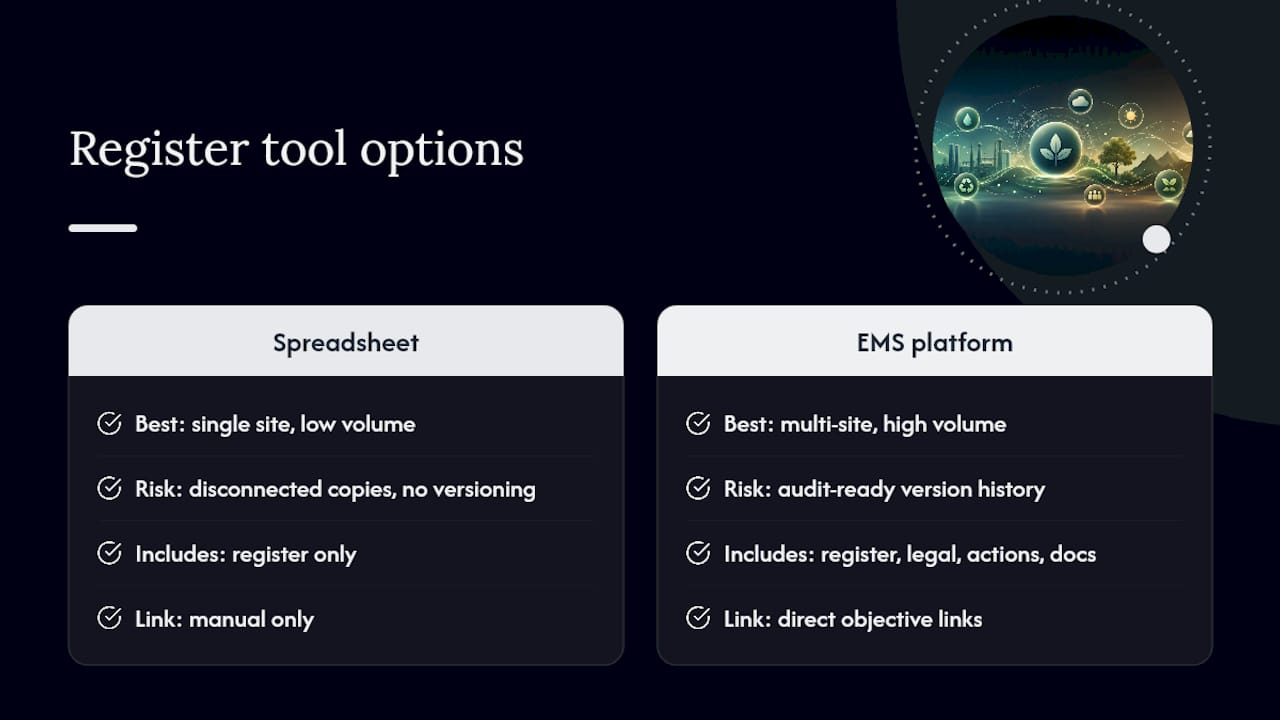
Most organizations start in a spreadsheet, and for a single site with a manageable number of activities, a well-structured spreadsheet with locked scoring formulas and conditional formatting for significance thresholds works fine. The failure mode is not the tool; it’s letting the spreadsheet sprawl across disconnected copies with no version control. This is exactly what auditors flag when they ask “which version is current?”
Dedicated EMS software platforms exist for organizations managing multiple sites or a high volume of significant aspects, typically bundling the aspect register with the legal obligations register, corrective action tracking, and document control in one system. These platforms reduce the manual cross-referencing burden between legal obligations and register entries, which is where spreadsheet-based systems tend to break down over time.
Whichever format you choose, three features matter more than polish: version history so you can show an auditor what changed and when, a locked scoring methodology so entries can’t be re-scored inconsistently by different reviewers, and a direct link field between each significant aspect and its corresponding control or objective. A facility management perspective on compliance system structure offers a useful parallel for organizations weighing whether to centralize environmental and maintenance compliance tracking together.
Template quality matters as much as software choice. A template missing the condition field (normal/abnormal/emergency) or the objective-link column will need retrofitting later, so build those in from the first draft rather than adding them after an audit finding forces the issue.
How Do You Use the Register to Drive Real Improvement?
Compliance is the floor, not the ceiling. A register that only exists to pass an audit wastes the analytical work already done to build it. The significance scores themselves are a prioritization tool: aspects scoring highest for severity, likelihood, and regulatory concern are exactly the ones that should anchor next year’s environmental objectives, not just sit flagged as “significant” in a static column.
Look across the register for patterns rather than treating each row in isolation. If diesel generators, vehicle fleets, and site plant equipment all score high on GHG emissions independently, that’s a signal to set a fuel efficiency or electrification objective at the organizational level rather than managing each piece of equipment separately. Construction firms that treat the register purely as an audit artifact miss this aggregation step, and it’s usually the difference between a compliance program and one that visibly improves year over year.
Monitoring data collected against register entries should feed back into the scoring itself. If a control reduces an aspect’s actual impact, the next review should reflect that in a lower score, freeing resources to focus on aspects that haven’t improved. This feedback loop is what turns the register from a static compliance record into a genuine input for continual improvement planning, which is the outcome ISO 14001 is ultimately built around. Our guide on risk mitigation for construction sites walks through translating high-scoring aspects into concrete site-level controls.
A Practitioner’s View on Getting Started
Start with the template and scoring method above, then run a focused workshop with the actual process owners, not just the EMS team, to populate it. That’s where real aspects surface, not in a desk exercise. Construction clients who build audit-ready registers this way consistently avoid the scramble that comes with retrofitting one under audit pressure.
Need Help Building an Audit-Ready Register?
Building a register that survives an ISO 14001 audit takes more than a template. It takes process owners who know where to look for aspects, a scoring method applied consistently across every site, and controls that are actually documented rather than assumed. Com works directly with construction companies and contractors to run those workshops, close the gaps between the aspect register and the legal register, and make sure every significant aspect has a control an auditor can verify on the spot.

If your team needs to embed environmental controls into project design from the start rather than bolting them on afterward, our Design for Safety consultancy is built for exactly that stage of a project. For ongoing register maintenance and site-level compliance support, our outsourced EHS manpower service can carry the workload between formal reviews. Reach out to request a scoping call and find out what an audit-ready register looks like for your sites.
Frequently Asked Questions
What is an environmental aspect register used for?
It documents an organization’s activities and their environmental aspects, impacts, and significance, giving the EMS a foundation for setting objectives, controls, and legal compliance tracking.
What is the difference between an environmental aspect and an environmental impact?
The aspect is the cause, the specific interaction between an activity and the environment. The impact is the effect, the actual change to air, water, soil, or biodiversity that results.
How often should the register be reviewed?
At minimum annually, plus event-driven updates triggered by process changes, incidents, new legal requirements, or audit findings.
Does every organization need a formal aspect register for ISO 14001?
Yes. Clause 6.1.2 requires a documented method for determining and evaluating environmental aspects, and the register is the standard way organizations demonstrate that method during certification audits.
Is an aspect register the same as an Environmental Impact Assessment?
No. An EIA assesses a specific project before it proceeds and is often legally mandated. The aspect register is an ongoing operational tool used throughout the life of the EMS.
Sources
- ISO 14001 Environmental Aspects Register Guide – CertBetter
- 4 steps in determination and evaluation of environmental aspects — Advisera (14001Academy)
- Environmental impact assessment — Wikipedia