
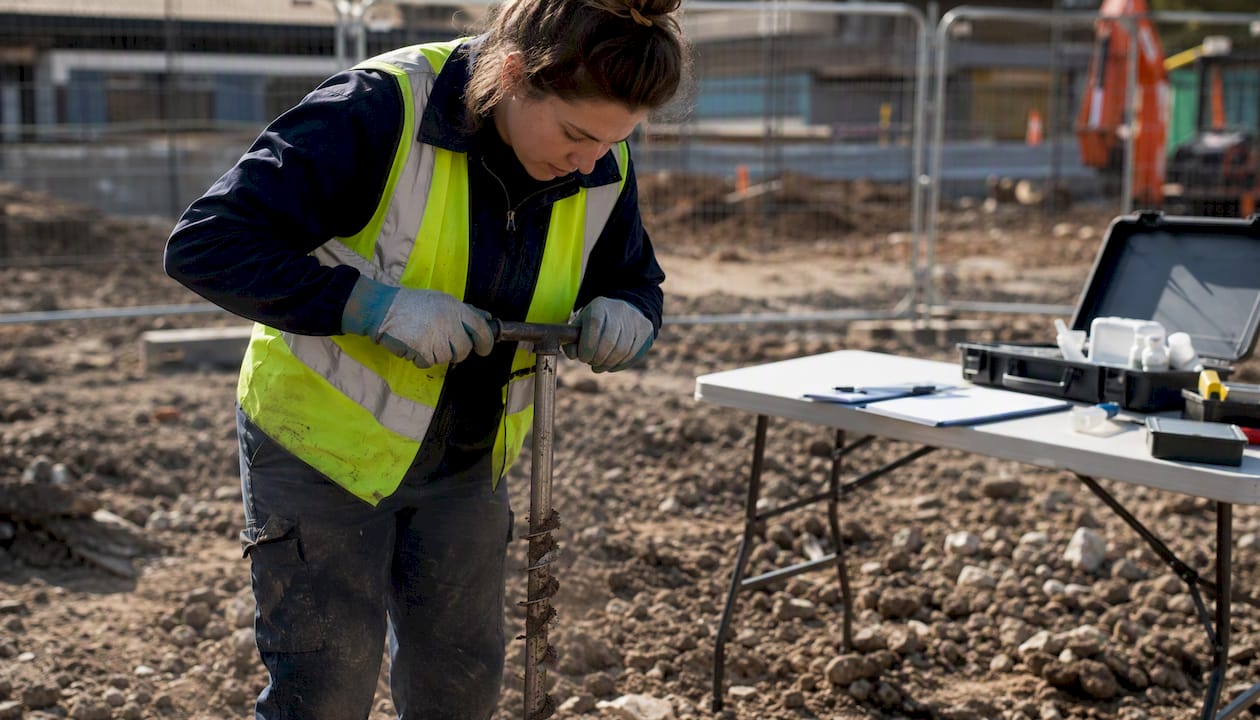
Environmental due diligence (EDD) is the investigative process a buyer, lender, or developer uses to identify a property’s actual and potential environmental liabilities before money changes hands or a project breaks ground. It converts an unknown risk, a contaminated parcel, a leaking tank, a legacy industrial use into a quantifiable one that a deal team can price, negotiate, or walk away from.
The deliverables scale with what the site reveals:
- Phase I / Level I ESA: records review, historical use research, and a site walkover that identifies any Recognized Environmental Conditions (RECs).
- Phase II / Level II ESA: targeted soil, groundwater, or building-material sampling with laboratory results to confirm or rule out contamination flagged in Phase I.
- Phase III / remedial design: a cleanup plan and cost estimate once contamination is confirmed and needs to be addressed.
Buyers, lenders, insurers, and developers typically order EDD during the due diligence window after a letter of intent, before financing commitments are finalized and well before closing.
Key Takeaways
Environmental due diligence identifies and quantifies a property’s environmental liabilities through a phased Phase I, II, and III process that directly shapes financing, price, and legal risk allocation.
| Point | Details |
|---|---|
| EDD is phased by design | Phase I screens for RECs; Phase II samples to confirm them; Phase III designs the cleanup, so cost scales with actual risk. |
| REC findings drive negotiation | Confirmed contamination shifts talks toward price adjustment, escrow, indemnities, or environmental insurance, not automatic deal collapse. |
| ASTM E1527 and AAI compliance are non-negotiable | Require both explicitly in any consultant proposal to preserve liability protections and ensure a defensible report. |
| Timing must match financing milestones | Order Phase I at the letter-of-intent stage and build lab turnaround contingency into your closing schedule. |
| Com supports scope and QA oversight | Com’s consultancy team reviews EDD proposals and manages ESA processes for construction and property deal teams. |
Table of Contents
- Why Environmental Due Diligence Matters for Deals and Development
- What Are the Main Types of Environmental Due Diligence?
- What Do the ESA Phases (Phase I, II, III) Actually Cover?
- What Tasks and Deliverables Should a Phase I or Phase II Include?
- What Contaminants and Site Conditions Usually Raise a Red Flag?
- When Should You Order Environmental Due Diligence, and Who Requires It?
- How Do EDD Findings Change Deal Terms and Negotiations?
- What Standards and Professional Qualifications Should You Require?
- How Do You Commission Environmental Due Diligence the Right Way?
- What Are the Limits of Environmental Due Diligence?
- What a Practitioner Wants Deal Teams to Understand About EDD
- How Com Supports Your Environmental Due Diligence Process
- Sources
Why Environmental Due Diligence Matters for Deals and Development
Skipping environmental due diligence does not eliminate the risk sitting on a parcel. It just moves discovery to a worse moment, usually after the purchase agreement is signed or after construction crews have mobilized.
The exposure is financial, legal, and reputational all at once. A confirmed contamination finding can trigger significant remediation costs, depending on the contaminant and the size of the plume. Lenders routinely decline to finance a property with unresolved environmental conditions, which can collapse a deal at the worst possible stage. Regulators can also hold current owners liable for contamination they didn’t cause, a principle baked into U.S. environmental law. Due diligence exists precisely because courts and regulators expect a “reasonable person” standard of investigation before a transaction closes, and environmental conditions are judged by that same standard.
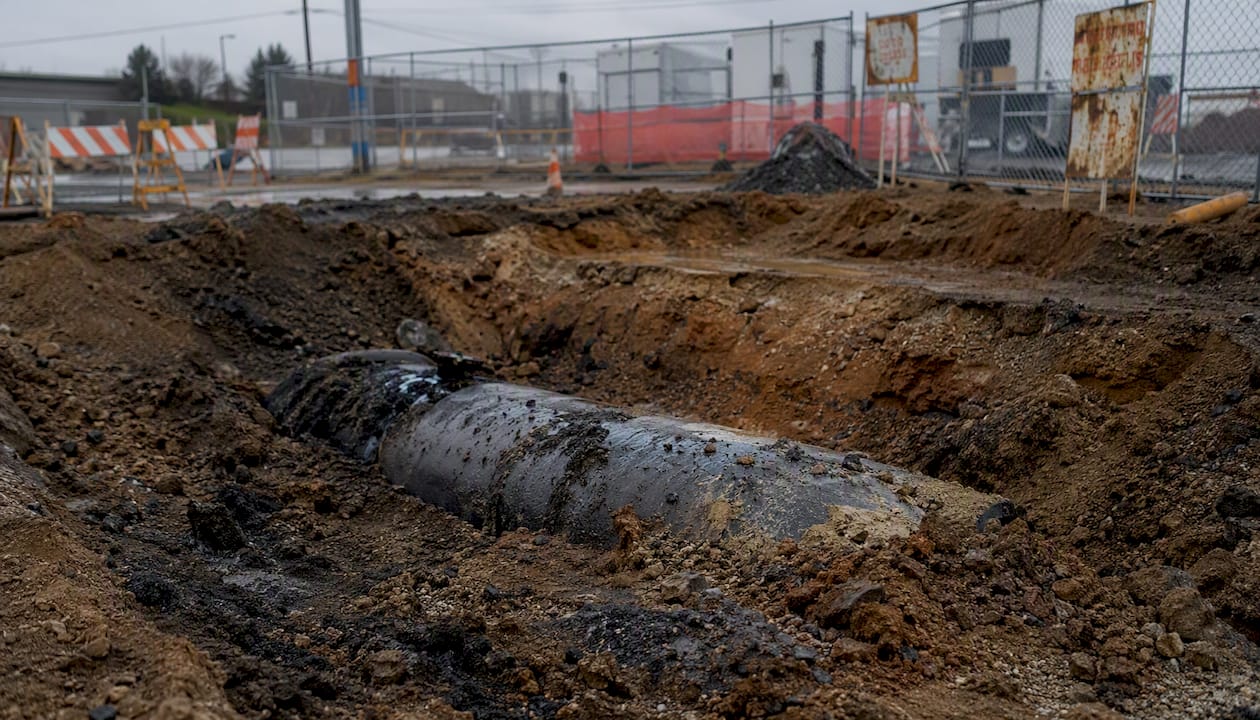
Consider a common scenario: a buyer is two weeks from closing on a former dry-cleaning site when a routine soil boring turns up an undocumented underground storage tank. The Phase I report, completed eighteen months earlier by a previous prospective buyer, never caught it because the tank predated the aerial photographs reviewed. Now the deal team is negotiating a price reduction, the lender is asking for a revised loan-to-value calculation, and the closing date slips by ten weeks while a Phase II confirms the extent of contamination. This is not a rare outlier. It is the reason experienced deal teams treat environmental due diligence as a scheduling priority, not a formality.
Lenders and insurers don’t just recommend EDD. Many require it as a condition of financing or coverage, and the findings directly shape loan terms, environmental insurance premiums, and whether a policy excludes certain contaminants entirely.
What Are the Main Types of Environmental Due Diligence?
Not every transaction needs the same scope of investigation. Matching the type of EDD to the deal’s purpose keeps costs proportional to risk.
- Traditional transaction EDD (TEDD): the standard property-transaction assessment focused on identifying contamination liability tied to a specific parcel, used in most commercial real estate purchases, refinances, and leaseholds.
- Natural resources EDD (NREDD): applies to sites with agricultural, mineral, timber, or water-rights value, where the environmental review also assesses resource quality and extraction potential, not just contamination.
- ESG due diligence: a broader review that folds environmental risk into governance and social factors, common in private equity and corporate acquisitions where investors need a defensible sustainability position for their own stakeholders.
- Limited desk/desktop studies: a records-only review without a site visit, used for quick risk screening on large portfolios or early-stage deal evaluation before committing to a full Phase I.
A buyer acquiring a single office building for owner-occupancy typically needs only TEDD. A private equity fund acquiring a portfolio of manufacturing sites across multiple states might commission desktop studies on all twenty properties first, then escalate the three or four flagged sites to full Phase I and Phase II work. A timber or ranch acquisition calls for NREDD because the environmental review has to account for resource value alongside contamination risk, something a standard TEDD scope doesn’t touch.
What Do the ESA Phases (Phase I, II, III) Actually Cover?
The phase structure exists so money gets spent only where risk demands it. Phase I is comparatively inexpensive and non-invasive. Phase II costs more and requires physical sampling. Phase III is triggered only when contamination is confirmed and needs remediation.
| Phase | What it covers | Typical deliverable | When it’s triggered |
|---|---|---|---|
| Phase I / Level I | Records review, historical use research, regulatory database search, site walkover, interviews | Phase I ESA report with REC/APEC findings and a conceptual site model | Standard on nearly every commercial transaction |
| Phase II / Level II | Soil, groundwater, or building-material sampling; laboratory analysis; risk characterization | Phase II report with lab data and an updated conceptual site model | When Phase I identifies one or more RECs |
| Phase III / Remedial design | Remedial investigation, delineation of contamination extent, cleanup plan, cost estimate | Remediation design and cost estimate | When Phase II confirms contamination requiring cleanup |
A Recognized Environmental Condition, or REC, is the term ASTM E1527 uses to describe the presence or likely presence of a hazardous substance or petroleum product on a property under conditions that indicate a release or threat of release. An Area of Potential Environmental Concern (APEC) is a related but broader designation, sometimes used in state-specific or federal frameworks to flag a location warranting closer scrutiny even before a REC is confirmed.
An ESA typically starts with Phase I and only escalates when the records review or site walkover turns up a red flag. Most transactions never reach Phase II, and even fewer reach Phase III. That escalation logic is exactly why understanding the phase structure matters before you commission anything: paying for Phase II sampling on a site with no RECs is money wasted, and skipping Phase II on a site with an obvious REC is a liability wasted on false confidence.
What Tasks and Deliverables Should a Phase I or Phase II Include?
A proposal that skips key tasks isn’t cheaper, it’s incomplete. Here’s what a defensible Phase I and Phase II should actually contain.
Phase I task checklist:
- Regulatory database and government records search covering the subject property and surrounding parcels.
- Historical use research, including aerial photographs, city directories, and prior ownership records.
- Interviews with current owners, occupants, and where relevant, local government officials.
- Physical site reconnaissance, walking the property and adjacent parcels for visible signs of contamination.
- A conceptual site model (CSM) outline summarizing findings and any identified RECs or APECs.
Phase II task checklist:
- A sampling plan specifying sample types (soil, groundwater, soil vapor, or building materials) and locations tied to the RECs identified in Phase I.
- Use of laboratories holding relevant accreditation, with documented chain-of-custody procedures from sample collection to lab receipt.
- Data validation and QA/QC review before results are finalized in the report.
- An updated conceptual site model incorporating lab results and contamination extent, where applicable.
Deliverables worth asking for by name include a site map showing exact sample locations, complete laboratory data packages (not just summary tables), and a clearly stated set of conclusions with recommended next steps. A report that buries its REC findings in an appendix, without a plain-language summary up front, is a report that will slow down your lawyer and your lender both.
What Contaminants and Site Conditions Usually Raise a Red Flag?
Most Phase I reports flag the same handful of contaminant categories, over and over, because the same industrial and commercial histories keep producing them.
Petroleum hydrocarbons top the list, usually tied to former gas stations, auto repair shops, or heating oil tanks. Heavy metals show up around former manufacturing, plating, or smelting operations. Chlorinated solvents are the calling card of dry cleaners and metal fabrication shops. Asbestos and lead-based paint are common in any structure built before the 1980s, regardless of prior industrial use. Per- and polyfluoroalkyl substances, known as PFAS, have become a more recent and more aggressively scrutinized concern, particularly near airports, fire training facilities, and certain manufacturing operations that used firefighting foam or water-resistant coatings.
The receptors matter as much as the contaminants: groundwater used for drinking supply, indoor air in occupied buildings, and any sensitive receptor nearby, like a school, wetland, or residential area, all raise the stakes of a confirmed release.
During a site walkover, a handful of visible cues should put any deal team on alert: stained or discolored soil, strong chemical odors, visible storage tanks or fill pipes, and any documented history of spills or regulatory violations at the site or its immediate neighbors. Pro Tip: Ask your consultant directly whether PFAS is within the standard Phase I scope for your site’s history. Many older Phase I templates don’t automatically include it, and if the property sits near an airport, fire station, or certain manufacturing uses, that’s a gap worth closing before the report is finalized.
When Should You Order Environmental Due Diligence, and Who Requires It?
Timing environmental due diligence against your deal’s milestones is as important as scoping it correctly. Order too late, and you risk a closing delay. Order too early, and you might be paying for outdated data by the time the deal actually closes, since some AAI-related inquiries need to be updated within specific timing windows before acquisition.
- Phase I ESA: commission this during the due diligence period, immediately after signing a letter of intent, so results are in hand well before financing commitments are finalized.
- Phase II ESA: schedule this as soon as Phase I identifies one or more RECs, ideally with enough runway before closing to allow for lab turnaround, which can take two to four weeks depending on the analytes tested.
- Phase III remedial planning: this typically happens post-acquisition or during a negotiated pre-closing period, once contamination is confirmed and a cleanup approach needs to be designed and costed.
The stakeholders who order this work aren’t limited to buyers. Lenders frequently make Phase I a condition of loan approval. Insurers request it before underwriting environmental liability coverage. Tenants in long-term industrial or manufacturing leases sometimes commission their own EDD to understand what liability they might inherit. Developers planning redevelopment or a change in land use often order it proactively, both to protect their own position and to satisfy permitting and reuse requirements tied to the new use.
The practical scheduling tip deal teams underestimate most: build contingency time into your closing timeline for sampling and lab turnaround. A Phase II that seems straightforward on paper can stretch two to six weeks once you account for mobilization, sample collection, and laboratory queues, and that’s before any negotiation over remedy.
How Do EDD Findings Change Deal Terms and Negotiations?
A confirmed REC doesn’t automatically kill a deal. It shifts the negotiation from “is there a problem” to “who owns the problem and what does fixing it cost.”
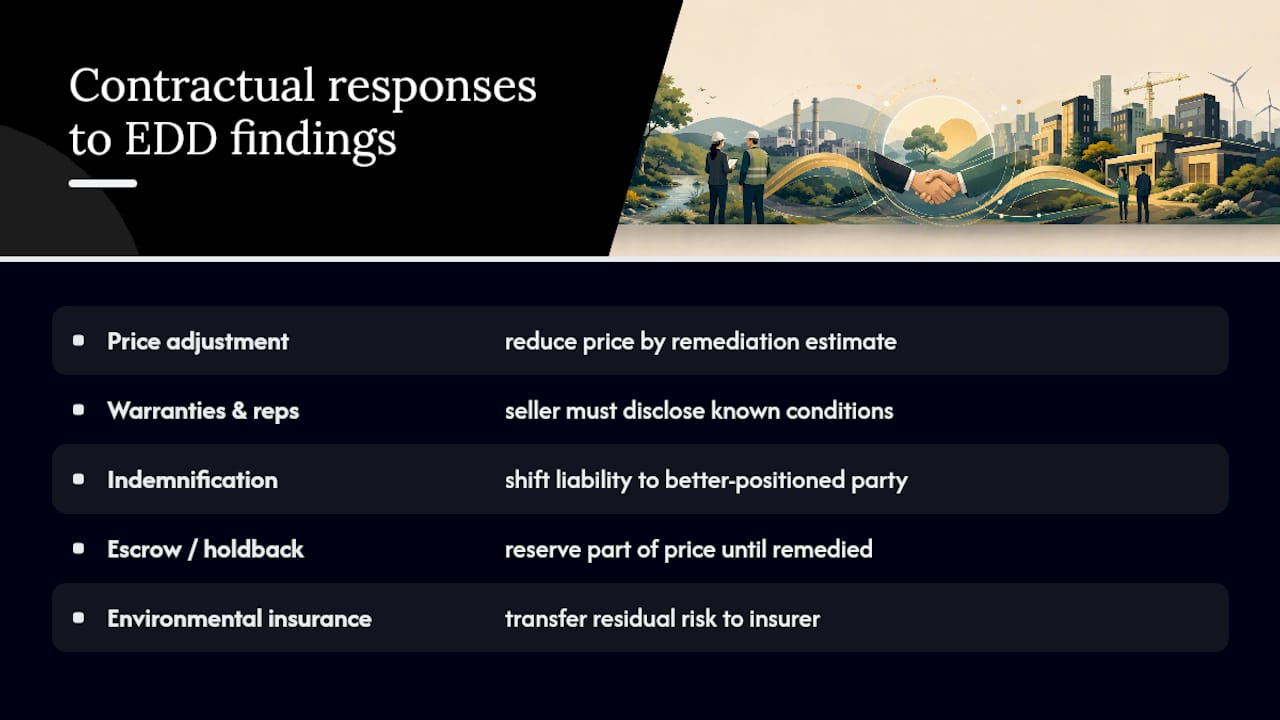
The most common contractual responses fall into a few categories: a straight price adjustment reflecting estimated remediation cost, added warranty and representation language obligating the seller to disclose known conditions, indemnification clauses shifting future liability to whichever party is better positioned to manage it, an escrow or holdback reserving a portion of the purchase price until remediation is complete, or environmental insurance that transfers residual risk to a carrier for a premium.
The decision flow generally runs like this: a finding surfaces, the deal team evaluates the estimated cost and liability exposure, and then chooses among walking away, adjusting price, negotiating a remediation obligation with a defined completion standard, structuring an escrow tied to milestones, or purchasing a pollution legal liability policy. Which option makes sense depends heavily on how confirmed the contamination is, how expensive remediation looks, and how much risk tolerance the buyer’s investors or lender will accept.
Communicating this to lawyers and lenders works best when you lead with priority, not detail. Rank the findings by severity and cost exposure first. Give a defensible cost range rather than a false-precision single number, since remediation estimates before a full delineation are inherently a range, not a point figure. Then state your recommended next step plainly: escrow of a specific amount, a price reduction, or a request for seller-funded remediation before closing. A lender doesn’t need the full laboratory data package in the first conversation. They need to know whether the finding threatens loan approval and what it will cost to resolve.
What Standards and Professional Qualifications Should You Require?
The single most important standard to name in any proposal is ASTM E1527, the practice that defines REC and establishes the accepted scope for a Phase I ESA in the United States. A Phase I performed to this standard is also recognized as meeting the All Appropriate Inquiries (AAI) rule under CERCLA, which matters directly for liability protection: AAI compliance is one of the conditions a purchaser typically needs to satisfy to claim certain landowner liability defenses.
An “environmental professional,” as the term is used in this field, generally means someone with the education, training, and experience to identify conditions indicative of releases and evaluate their significance, not simply anyone holding an environmental science degree. When reviewing a proposal, look for stated credentials, prior experience on comparable property types, and named laboratory partners with documented accreditation.
A commissioning checklist worth applying to any proposal:
- Explicit statement of ASTM E1527 and AAI compliance, not a vague reference to “industry standards.”
- A defined scope covering the full subject property and, where relevant, adjacent parcels.
- Named laboratory partners with accreditation details, not just “an accredited lab” left unspecified.
- A clear QA/QC process description, including chain-of-custody procedures.
- A stated reporting format that includes an executive summary, not just raw data buried in appendices.
- Confirmation of the firm’s professional liability insurance coverage.
How Do You Commission Environmental Due Diligence the Right Way?
Getting a usable, defensible EDD report starts before you ever sign a consultant’s proposal. The groundwork you do at the RFP stage determines whether the report holds up under a lender’s or lawyer’s scrutiny later.
- Define the objective first. A refinancing review, a redevelopment feasibility study, and a straight acquisition each call for a different scope, so state the transaction purpose explicitly in the RFP.
- Confirm ASTM/AAI compliance in writing. Don’t accept a proposal that references “standard practice” without naming ASTM E1527 specifically.
- Require documented sample QA procedures for any Phase II scope. Ask for the chain-of-custody protocol and lab accreditation before work begins, not after results arrive.
- Request a written schedule with milestones. Records review, site visit, draft report, and final report dates should each be dated, not left as “approximately three weeks.”
- Get a cost estimate that separates Phase I from any contingent Phase II work. This lets your deal team budget accurately instead of guessing at total exposure.
When interviewing vendors, ask about their experience on properties comparable to yours in age, industrial history, and geography. Ask which laboratories they partner with and whether those labs hold relevant accreditation. Ask about typical turnaround times for both the site work and the lab results, since lab queues are often the actual bottleneck, not the fieldwork itself. And ask what their standard report format looks like before you commit, since a report with a genuinely useful executive summary saves your legal team hours later.
Pro Tip: Request a sample report (with client details redacted) before signing any consultant proposal. A five-minute skim tells you more about report quality, clarity of the REC findings, and usefulness of the conceptual site model than any sales conversation will.
Cost and timeline vary primarily with site complexity, sample density, and lab turnaround. A straightforward Phase I on a small commercial parcel with a clean use history moves faster and costs less than a Phase I on a large industrial site with multiple historical tenants and a thick regulatory file. Phase II costs scale directly with how many samples and analytes are needed, which is exactly why a well-scoped Phase I, one that clearly identifies which RECs need testing, keeps Phase II proportional instead of open-ended.
What Are the Limits of Environmental Due Diligence?
EDD reduces risk. It does not eliminate it, and treating a clean Phase I report as a guarantee is one of the more expensive mistakes a deal team can make.
Soil and groundwater sampling is inherently spatially limited. A Phase II tests specific locations chosen based on the Phase I findings and site history, not every square foot of a property, so contamination outside the sampled grid can go undetected. Historical records used in Phase I can also be incomplete, particularly for older properties where city directories, permits, or aerial photographs from certain decades simply don’t exist or were never digitized.
The most common pitfalls deal teams run into:
- Under-scoping Phase II by limiting sample locations or analytes to control cost, then discovering contamination outside the tested area after closing.
- Relying on an outdated Phase I report from a prior transaction instead of commissioning a fresh one, when regulatory database updates or site conditions may have changed.
- Ignoring emerging contaminants like PFAS because a template Phase I scope predates broader awareness of the issue.
- Misaligning EDD timing with financing milestones, leaving a lender waiting on results that arrive after the loan commitment deadline has passed.
The mitigation is straightforward, even if it takes discipline to follow: require current AAI and ASTM compliance rather than accepting an inherited report, build contingency provisions into the purchase agreement for findings that surface late, and consider environmental insurance for residual risk that neither party wants to fully absorb through price adjustment alone.
What a Practitioner Wants Deal Teams to Understand About EDD
The single biggest mistake I see in how deal teams approach environmental due diligence isn’t a scoping error. It’s a sequencing error. Teams treat EDD as a box to check somewhere in the middle of due diligence, disconnected from the financing timeline, and then act surprised when a Phase II finding threatens a closing date that was locked in before anyone knew a REC existed.
Align the EDD timeline with your contract milestones from day one, not after the letter of intent is signed. If your financing commitment has a hard deadline, work backward from it: how long does Phase I take, what’s the realistic lab turnaround if Phase II gets triggered, and does your purchase agreement have language that accounts for that contingency. Deals that avoid cost escalation aren’t the ones with the cleanest sites. They’re the ones where the buyer, lender, and consultant agreed on acceptable sampling density and a rough remediation cost band before anyone was under closing-date pressure. That alignment, done early, is worth more than any single line item in the Phase II budget.
The other pattern worth naming: EDD scope should match risk appetite, not just property type. A cash buyer planning to hold a property for decades has a very different tolerance for uncertainty than a fund with a five-year exit horizon and limited partners asking pointed questions about environmental exposure. The same site might justify a standard Phase I for one buyer and a more thorough desktop-plus-Phase-I combination for the other. There’s no universal “right” scope, only the scope that matches what you can actually absorb if the finding goes against you.
How Com Supports Your Environmental Due Diligence Process
Getting environmental due diligence right depends on how well the scope, the schedule, and the QA requirements are defined before a consultant ever sets foot on site, and that’s where a lot of deal teams lose time and money without realizing it. Com works alongside developers, investors, and corporate deal teams to develop clear EDD scopes, manage the ESA process end to end, oversee sampling and laboratory QA, and translate findings into practical remediation and cost planning your lawyers and lenders can actually use.

If you’re staring down a proposal from an environmental consultant and aren’t sure whether the scope matches your transaction’s risk, or you need someone to manage the Phase I through Phase III process against a tight closing timeline, Com’s safety and compliance consultancy team can review that proposal or help structure the scope before you sign anything. Reach out for a scoping conversation before your next transaction milestone locks you into a schedule you can’t adjust.
Sources
Anyone briefing a lawyer, lender, or internal investment committee on an EDD finding should have a short list of primary sources on hand, ones that carry more weight than a summary blog post when questions get technical.
The EPA’s All Appropriate Inquiries factsheet lays out exactly what inquiries and timing windows are required to preserve CERCLA liability protections, and it’s the document to point to when a lender’s counsel questions whether your Phase I meets federal standards. ASTM E1527 is the actual standard practice document defining REC and the accepted Phase I scope, worth having on file whenever a consultant’s proposal claims “industry standard” without naming it. The EPA’s Revitalization-Ready Guide is particularly useful for redevelopment and reuse scenarios, where EDD requirements intersect with permitting and land-use change. For a legal grounding in what “due diligence” means as a standard of care, Cornell Law School’s Legal Information Institute offers a concise, citable definition that holds up in front of counsel. And for teams working with sensitive ecological receptors, the EPA’s ecological risk assessment framework explains how contamination risk to wildlife and ecosystems gets formally evaluated when a site’s environmental profile goes beyond straightforward human-health contamination.
Keep these five bookmarked. They’re the references that hold up when a deal’s environmental findings move from a consultant’s report to a negotiation between lawyers.
- All Appropriate Inquiries Final Rule
- ASTM E1527 Standard Practice for Environmental Site Assessments
- Due Diligence — Legal Information Institute (Cornell Law School)