

Internal audit reviews are an organization’s independent, risk-focused mechanism for protecting value and improving controls. Defined by the Institute of Internal Auditors (IIA) as a systematic, disciplined activity that evaluates and improves the effectiveness of risk management, control, and governance processes, internal auditing delivers something no management self-assessment can replicate: objective assurance from a function that reports directly to the audit committee. ISO management systems, including ISO 9001, ISO 45001, and ISO 27001, mandate internal audits as a non-negotiable element of any certified management system, and certification bodies increasingly scrutinize audit effectiveness rather than mere documentation compliance.
The primary outcomes organizations realize from a well-executed internal audit program include:
- Risk visibility: Systematic identification of control gaps and emerging threats across the enterprise
- Control assurance: Independent verification that controls operate as designed, not merely as documented
- Operational improvement: Process-tracing audits that surface inefficiencies and trigger measurable corrective action
- Regulatory readiness: Continuous evidence of compliance that reduces the cost and disruption of external inspections
- Governance support: Objective reporting to boards and audit committees that informs strategic decision-making
Table of Contents
- Why internal audit reviews define organizational risk management
- How does internal audit differ from external audit and compliance reviews?
- What concrete benefits do internal audit reviews deliver?
- What does the internal audit process look like from planning to follow-up?
- Which standards and guidelines should internal auditors rely on?
- Who should perform internal audits, and what makes an effective auditor?
- How do you get the most value from internal audit reviews?
- What are the most common pitfalls in conducting internal audits?
- How often should you run internal audits, and what do they cost?
- How do you turn audit findings into measurable improvement?
- Key Takeaways
- The case for treating internal audit as a strategic instrument, not a compliance obligation
- MOSAIC’s QES audit program supports your internal audit reviews
- Authoritative standards and further reading
Why internal audit reviews define organizational risk management
An internal audit review, in the precise sense established by the IIA, is an independent, objective assurance and consulting activity designed to add value by improving an organization’s governance, risk management, and control processes. The operative words are independent and objective: the function must be structurally separate from the processes it examines, with reporting lines that run to the audit committee rather than to operational management.
The scope of an internal audit review spans two distinct service modes:
- Assurance engagements: Independent evaluation of evidence to provide an opinion on whether a process, control, or risk management activity meets defined criteria
- Advisory engagements: Consulting and facilitation services, such as control design workshops or risk self-assessment facilitation, where the auditor does not assume management responsibility
Typical audit areas within a single program include financial controls and reporting integrity, workplace safety and environmental compliance, information technology and cybersecurity controls, procurement and contract management, project cost controls and schedule governance, and regulatory compliance across applicable statutory frameworks. In construction and high-compliance industries, process-based audits that trace requirements through actual operational workflows consistently surface findings that documentation-only reviews miss entirely.
An internal audit review is not a management self-check, a departmental performance review, or a pre-audit preparation exercise. It is also not interchangeable with an external audit: the latter serves shareholders and regulators, while the former serves the board, audit committee, and management as an internal assurance instrument.
How does internal audit differ from external audit and compliance reviews?
Professionals frequently conflate internal audit, external audit, compliance review, and management review. Each serves a distinct governance purpose, operates under different independence requirements, and produces different outputs.

| Dimension | Internal Audit | External Audit | Compliance Review | Management Review |
|---|---|---|---|---|
| Purpose | Improve risk management, controls, and governance | Express an independent opinion on financial statements or certification conformance | Verify adherence to a specific regulation or standard | Evaluate system suitability, adequacy, and effectiveness |
| Primary audience | Board, audit committee, and management | Shareholders, regulators, and certification bodies | Regulatory authority or standard body | Top management and process owners |
| Timing | Continuous or risk-based schedule | Annual or certification cycle | Event-driven or periodic | Periodic (typically annual minimum under ISO) |
| Independence | Organizational independence within the entity | Full external independence from the entity | Varies; often conducted by the regulator | Conducted by management itself |
| Primary outputs | Audit reports with findings, root causes, and corrective actions | Audit opinion, management letter, or certification decision | Compliance determination, penalty, or notice | Management review minutes, improvement decisions |
| Follow-up responsibility | Internal audit tracks remediation | Management; external auditor may verify | Regulatory body or management | Management |
The practical distinction matters when designing a governance calendar. A management review under ISO standards evaluates whether the management system as a whole is achieving its intended outcomes; it relies on internal audit findings as one of its primary inputs. An internal audit, by contrast, digs into specific processes to generate those findings. Running a management review without a functioning internal audit program is analogous to reviewing a building’s structural integrity without conducting any inspections: the review meeting produces opinions rather than evidence.
Compliance reviews, whether conducted by OSHA, EPA, or a certification body, are externally imposed and carry enforcement consequences. Internal audits, when executed with rigor, prepare the organization for those external reviews by identifying and remediating gaps before inspectors arrive. The ANSI/ANAB accreditation framework reinforces this relationship, treating internal audit effectiveness as a prerequisite for credible certification.
What concrete benefits do internal audit reviews deliver?
The value proposition of internal audit reviews extends well beyond regulatory compliance. Effective internal audits help organizations achieve strategic goals by verifying compliance, safeguarding assets, and providing leadership with data that supports sound decision-making.
- Improved risk visibility: — A risk-based audit plan systematically covers the organization’s highest-exposure processes, giving the board and audit committee a current, evidence-based picture of the risk landscape, including cybersecurity, AI governance, fraud, business continuity, and regulatory risk.
Research published by Wiley on the value of internal auditing confirms that a well-designed internal audit function is cost-effective: it identifies risks early and prevents the far greater cost of operational failures or regulatory penalties. For boards and audit committees, the function provides assurance that the control environment is operating as intended. For line managers, it surfaces process weaknesses before they escalate into incidents or findings on an external audit report.
Stakeholder alignment: Boards rely on internal audit for governance assurance; audit committees use it to discharge oversight responsibilities; CEOs and COOs use findings to prioritize operational improvement; line managers receive specific, actionable guidance on control gaps within their own processes.
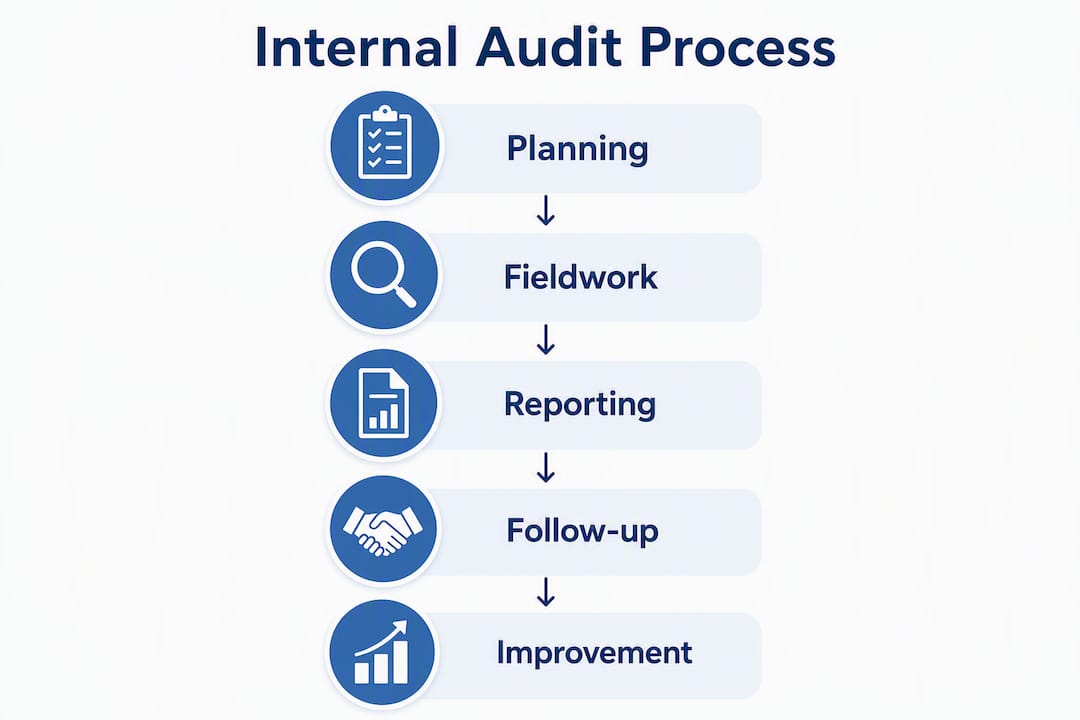
What does the internal audit process look like from planning to follow-up?
A structured internal audit engagement follows a defined sequence. Deviating from this sequence, particularly by compressing planning or skipping follow-up, is one of the most common causes of low-value audits.
- Risk assessment and scoping (3–5 days): — The audit team identifies the key risks within the scope area, maps the relevant controls, and determines the sampling approach. Higher-risk processes receive deeper sampling; lower-risk areas may be reviewed at a higher level. Escalation triggers to the audit committee are defined at this stage.
Pro Tip: Write every finding with four elements: the specific condition observed, the applicable criterion or standard, the root cause (not just the symptom), and the quantified or qualified risk implication. A finding written this way compels a specific corrective action; a vague finding produces a vague response that never closes the gap.
Which standards and guidelines should internal auditors rely on?
The professional and regulatory architecture governing internal audit reviews is anchored in several complementary frameworks, each addressing a different dimension of audit program design.
- IIA Global Internal Audit Standards (2024 edition): — The authoritative standard for the internal audit profession, covering independence, objectivity, proficiency, due professional care, quality assurance, and the governance positioning of the function. The IIA Standards require direct CAE access to the audit committee and mandate a quality assurance and improvement program (QAIP) that includes both internal and external assessments.
An effective audit program charter should specify the function’s mandate and authority, independence and reporting lines, the risk-based annual audit plan methodology, documentation and evidence standards, reporting protocols to the audit committee, and the QAIP process, including periodic external or peer review.
“Internal auditors support this culture by assessing and providing insight into the sufficiency of an organization’s control and risk management environment, instilling greater trust and confidence in an organization’s operations.” — IIA Corporate Governance Engagement Program
Professional credentials that signal auditor competence include the Certified Internal Auditor (CIA), awarded by the IIA, and the Certified Information Systems Auditor (CISA), awarded by ISACA. ANSI/ANAB accreditation of certification bodies provides an additional layer of quality assurance for organizations operating within ISO-certified management systems, reinforcing the credibility of the audit findings those systems produce.
Who should perform internal audits, and what makes an effective auditor?
The resourcing model for internal audit depends on organizational scale, process complexity, and independence requirements. Three primary models are in use:
- In-house audit team: — Appropriate for large organizations with sufficient volume and complexity to justify dedicated headcount. Offers deep institutional knowledge but requires rigorous independence management, including rotation of audit assignments and clear reporting lines to the audit committee rather than to operational management.
Independence is non-negotiable under both ISO and IIA standards: auditors must not audit their own work. Smaller firms that cannot maintain a dedicated audit function typically address this through cross-departmental auditing arrangements, where staff from one department audit another, or by engaging external specialists for the audit cycle.
The attributes that distinguish an effective internal auditor from a competent one include: genuine objectivity and the professional courage to report findings that management may resist; process knowledge sufficient to trace a transaction or activity through its full operational lifecycle; data-analytics capability to identify anomalies in large transaction populations; precise report-writing that produces findings management can act on; and stakeholder engagement skills that make the audit process collaborative rather than adversarial. CIA and CISA credentials are the most widely recognized signals of professional competence in the field.
How do you get the most value from internal audit reviews?
The difference between an audit program that drives measurable improvement and one that produces reports nobody acts on comes down to a small number of disciplined practices.
Risk-based planning is the foundation. The annual audit plan should be derived from the organization’s risk register, not from a calendar rotation of departments. Processes with higher inherent risk, greater regulatory exposure, or a history of control failures receive more frequent and deeper coverage. Lower-risk, stable processes can be rotated on a longer cycle. The audit program itself should be reviewed during management reviews to confirm that findings are driving operational improvements rather than accumulating in a report archive.
Process-tracing audits, which follow a specific transaction or activity from initiation through completion, consistently outperform checklist-based audits in finding real control gaps. They reveal the difference between how a process is documented and how it actually operates, which is precisely the insight that boards and audit committees need.
Evidence-grade reporting requires that every finding be supported by documented evidence in the working papers. Findings without evidence are opinions; findings with evidence are audit conclusions that management and the audit committee can rely on.
Tracking audit effectiveness through measurable KPIs transforms the function from a cost center into a demonstrable value driver. Relevant metrics include: percentage of audit recommendations implemented by the committed due date, reduction in repeat findings across successive audit cycles, average time-to-remediate by finding severity, and stakeholder satisfaction scores from post-audit surveys.
Pro Tip: Integrate audit findings directly into the enterprise risk management (ERM) dashboard and the management review agenda. When a finding closes a gap in the risk register or triggers a change in a risk rating, that linkage makes the audit’s strategic value visible to the board and audit committee in terms they already use to govern the organization.
What are the most common pitfalls in conducting internal audits?
The most damaging audit failures are not technical; they are structural and behavioral. Recognizing these patterns is the first step toward correcting them.
- Tick-box auditing: Auditors work through a checklist of document references rather than tracing processes through actual operations. The remedy is to mandate process-based audit methodology in the audit charter and train auditors to follow transactions rather than verify document existence.
- Vague findings: Findings written as “documentation needs improvement” or “awareness should be increased” do not specify a root cause and cannot generate a specific corrective action. Every finding must cite the exact failed process, the evidence examined, and the risk implication.
- Auditors reviewing their own work: This is the most direct threat to audit objectivity and is explicitly prohibited by both ISO and IIA standards. Cross-departmental arrangements or external specialists are the structural remedy.
- Calendar-driven audit plans: Scheduling audits by department rotation rather than by risk profile means high-risk processes may go unaudited for years while low-risk areas receive disproportionate attention. Shift to a risk-based plan anchored to the organization’s current risk register.
- Weak follow-up and remediation tracking: Issuing a report and moving to the next engagement without verifying corrective action completion is the single most common reason repeat findings persist across audit cycles. Formalize a tracking register with committed due dates, responsible owners, and verification fieldwork requirements.
Red flags that signal an ineffective audit program include persistent repeat findings on the same controls across multiple cycles, consistently low management engagement during fieldwork, missing or incomplete audit evidence in working papers, and CAE access to the audit committee that is filtered through operational management. Each of these signals warrants immediate structural intervention, not incremental improvement.
How often should you run internal audits, and what do they cost?
Audit frequency is a function of risk, not of calendar convention. The governing principle, established in ISO 19011 and reinforced by IIA Standards, is that processes with higher inherent risk or a history of control failures require more frequent audit coverage, while stable, lower-risk processes can be reviewed on a longer rotation.
In practice, this means:
- High-risk processes (safety-critical operations, financial reporting, cybersecurity controls, procurement above defined thresholds): quarterly or semi-annual coverage
- Medium-risk processes (project controls, vendor management, regulatory compliance monitoring): annual coverage
- Lower-risk, stable processes (administrative procedures, low-value procurement, routine maintenance): biennial or rotational coverage
Cost drivers for an internal audit engagement include the breadth and complexity of the scope, the specialist technical skills required (IT/cyber, construction safety, environmental compliance), the extent of external co-sourcing or specialist engagement, data analytics tooling and licensing, and the resources required for follow-up monitoring and verification fieldwork.
A medium-scope process audit, covering a single high-risk process such as project cost controls or safety management on a construction site, typically follows this timeline: planning and risk assessment (1 week), fieldwork and evidence collection (1–2 weeks), draft reporting and management response (2 weeks), final report issuance (3–5 days), and remediation tracking through to verification (4–12 weeks depending on finding severity). Total elapsed time from engagement launch to verified closure of findings commonly runs for a few months for a well-managed engagement.
How do you turn audit findings into measurable improvement?
A finding that does not produce a verified corrective action has no value. The action template below provides the minimum structure for converting every finding into a tracked, measurable remediation.
- Finding statement: Precise description of the condition observed, the criterion it fails to meet, and the evidence examined
- Root cause: The underlying reason the control failed, not the symptom (e.g., “risk assessment procedure not integrated into project mobilization workflow” rather than “risk assessment not completed”)
- Risk implication: The consequence if the gap is not addressed, stated in terms of safety, financial, regulatory, or reputational exposure
- Responsible owner: A named individual with authority to implement the corrective action, not a department or team
- Corrective action: Specific steps to address the root cause, not just the symptom
- Target due date: A committed date, not a range
- Success criteria: The measurable condition that will confirm the corrective action is effective
- Verification method: How the audit team will confirm closure (document review, re-test of the control, observation of the revised process)
Follow-up discipline requires a formal tracking register maintained by the audit function, management responses documented and time-stamped, evidence uploaded against each corrective action, verification fieldwork scheduled before the committed due date, and formal closure criteria applied before a finding is marked closed. Open findings beyond their committed due date are reported to the audit committee at each meeting without exception.
Linking closed findings to the ERM dashboard, specifically updating risk ratings where a corrective action has reduced inherent or residual risk, makes the audit function’s contribution to strategic risk management visible at the governance level and reinforces the case for sustained investment in the program.
Key Takeaways
Internal audit reviews are the organization’s most powerful independent mechanism for identifying control gaps, reducing risk exposure, and driving measurable operational improvement before external auditors or regulators find the problems first.
| Point | Details |
|---|---|
| Risk-based planning is non-negotiable | Audit frequency and scope must follow the organization’s risk register, not a calendar rotation of departments. |
| Findings must specify root cause | Vague findings produce vague responses; every finding needs a condition, criterion, root cause, and risk implication to drive real corrective action. |
| Independence requires structural design | Auditors cannot review their own work; cross-departmental arrangements or external specialists are required under both ISO and IIA standards. |
| Follow-up determines actual value | Issuing a report without verifying corrective action completion is the primary reason repeat findings persist across audit cycles. |
| Com’s QES audit program | Com structures internal audit programs for construction clients as risk-based, process-tracing engagements aligned with IIA Standards and ISO requirements, with tracked remediation through to verified closure. |
The case for treating internal audit as a strategic instrument, not a compliance obligation
The most consequential misunderstanding in audit practice is the belief that internal audit reviews exist to satisfy an external requirement. ISO mandates them. The IIA codifies them. Certification bodies evaluate them. But the organizations that extract the most value from internal audit treat it as the central nervous system of their risk management architecture, not as a periodic obligation to be discharged before the next surveillance audit.
The construction sector illustrates this distinction with particular clarity. A contractor that runs internal audits solely to prepare for a BizSAFE or ISO 45001 certification renewal will produce documentation that satisfies an auditor’s checklist but will not identify the process gaps that precede safety incidents. A contractor that runs process-tracing audits against its actual site operations, follows a risk-based plan that prioritizes high-exposure activities, and tracks corrective actions through to verified closure will find those gaps before they become incidents, regulatory findings, or project delays.
The IIA’s framing of internal auditors as strategic advisors rather than fault-finders is not rhetorical positioning. It reflects a structural reality: the audit function has access to every part of the organization, reports to the audit committee rather than to operational management, and is professionally obligated to report what it finds regardless of organizational preference. That combination of access, independence, and obligation is genuinely rare in any governance structure, and organizations that exploit it fully gain a risk intelligence capability that no other internal function can replicate.
The practical implication for audit committee members and CAEs is straightforward: the audit plan should be reviewed at every audit committee meeting, findings should be linked to the ERM dashboard, and the CAE should have direct, unfiltered access to the committee chair. Where those conditions are not met, the audit function is structurally constrained from delivering its full value, and the organization is carrying more risk than its governance reporting suggests.
MOSAIC’s QES audit program supports your internal audit reviews
Construction contractors and project organizations facing ISO certification, regulatory inspection, or safety audit requirements often need more than a checklist: they need a structured, risk-based internal audit program that produces findings management can act on and that satisfies the scrutiny of external certification bodies.

Com’s QES consultancy delivers exactly that. MOSAIC’s internal audit program for contractors is structured around IIA Standards and ISO management system requirements, with process-tracing methodology, root-cause findings, and remediation tracking through to verified closure. For organizations preparing for ISO 9001, ISO 45001, or regulatory inspections, MOSAIC’s technical specialists cover construction safety, environmental compliance, and quality management systems. Co-sourced audit support is available for organizations that need independent audit capability without the overhead of a dedicated in-house function. Contact MOSAIC for a consultation on structuring or strengthening your internal audit program.
Authoritative standards and further reading
The sources below represent the primary reference architecture for internal audit program design and ISO management system compliance.
- IIA: What Is Internal Audit — The IIA’s foundational document on the definition, purpose, and professional standards governing internal auditing; the starting point for any audit charter or program design.
- IIA Global Internal Audit Standards (2024) — The current authoritative standard covering independence, objectivity, proficiency, quality assurance, and governance positioning; mandatory reference for CAEs and audit committee members.
- IIA: About Internal Audit — Practitioner-oriented overview of the strategic advisory role of internal audit and its relationship to governance and risk management.
- ANSI/ANAB: Importance of Internal Audits and Management Review — Explains how internal audit effectiveness and management review interact within ISO-certified management systems; authoritative for organizations pursuing or maintaining accreditation.
- ISO 9001 Auditing Practices Group Guidance — Technical guidance from ISO TC 176 on conducting internal audits under ISO 9001; directly applicable to quality management system audit programs.
- Sanyog Conformity: ISO Internal Audit Requirements Explained — Practitioner guide covering ISO internal audit requirements, corrective-action tracking, and audit effectiveness criteria emphasized by certification bodies.
- Certbetter: How to Run ISO Internal Audits That Actually Find Problems — Implementation-focused guide on process-based audit methodology, specific findings, and root-cause analysis; directly applicable to avoiding tick-box audit pitfalls.
- Autoresilience.ai: ISO 19011 and Internal Audit Management — Covers risk-based audit program management, frequency decisions, and the integration of audit findings into management review cycles.
- ICAEW: Why an Internal Audit Function Is Beneficial to Businesses — Authoritative overview of the strategic and operational value of internal audit for governance, compliance, and asset stewardship.
Recommended
- Internal Audit vs External Audit Explained – MOSAIC Eco-construction Solutions Pte Ltd
- Internal Audit Program for Contractors – MOSAIC Eco-construction Solutions Pte Ltd
- How to Prepare ISO Internal Audits Well – MOSAIC Eco-construction Solutions Pte Ltd
- Project Safety Management Plan Review – MOSAIC Eco-construction Solutions Pte Ltd