
Regulatory inspections exist to protect workers and the public, enforce minimum statutory standards, and create documented accountability that shifts a contractor’s exposure from catastrophic liability toward structured remediation. For construction firms operating under OSHA, EPA, and local building authority jurisdiction, the practical outcomes are immediate: inspections prevent stop-work orders, reduce workplace injury rates, accelerate certification timelines, and signal to insurers and project owners that a firm’s safety management system is credible.
Regulatory inspections are the mechanism through which government agencies verify that construction sites meet the baseline standards society has determined are non-negotiable for worker safety, environmental protection, and public welfare. The FDA frames inspections as a vital public safety net, and the same logic applies directly to construction: the cost of a single preventable accident far exceeds the cost of sustained compliance.
Core functions inspectors perform on US construction sites:
- Safety verification: Confirming fall protection systems, scaffolding integrity, and PPE compliance meet OSHA 29 CFR 1926 standards
- Environmental controls: Reviewing stormwater pollution prevention plans (SWPPP), hazardous material handling, and EPA permit adherence
- Permit and documentation checks: Validating that building permits, equipment certifications, and training records are current and accessible
- Hazard mitigation review: Assessing lockout/tagout procedures, excavation shoring, and electrical safety protocols
Table of Contents
- What do regulatory inspections actually cover on a US construction site?
- What are the legal and financial consequences of failing an inspection?
- How do inspections and audits improve a construction business beyond avoiding penalties?
- What are the most common inspection deficiencies, and how do you fix them fast?
- How should contractors prepare before, during, and after an inspection?
- When does hiring a QES consultant actually pay off?
- How MOSAIC Ecoconstruction Solutions supports inspection readiness
- Key Takeaways
- The inspection readiness gap most contractors underestimate
- MOSAIC Ecoconstruction Solutions: inspection readiness built into your project cycle
- Useful sources and further reading
What do regulatory inspections actually cover on a US construction site?
OSHA governs the broadest scope of construction site inspections, with 29 CFR Part 1926 establishing standards across fall protection, scaffolding, excavation and trenching, electrical safety, lockout/tagout, and PPE use. EPA and state environmental agencies layer on requirements for stormwater controls, asbestos abatement, and lead-containing material management. Local building departments add permit compliance and structural plan adherence.
Inspectors typically request a specific document package: safety plans and job hazard analyses, OSHA 300 logs and incident reports, training records with sign-in sheets, equipment inspection logs, permit packages, and corrective-action records from prior findings. Firms that cannot produce these documents on demand face immediate credibility deficits, regardless of actual site conditions.
Hazardous materials deserve particular attention. Asbestos inspection before demolition is a regulatory prerequisite under the National Emission Standards for Hazardous Air Pollutants (NESHAP), and inspectors will verify that a licensed asbestos assessor has surveyed the structure before any disturbance work begins.
What are the legal and financial consequences of failing an inspection?
Enforcement outcomes escalate in proportion to violation severity and recurrence. A first-time serious violation under OSHA carries a maximum civil penalty of $16,550 per violation; willful or repeated violations reach $165,514 per citation. Beyond fines, inspectors can issue stop-work orders that halt all site activity, consent decrees requiring third-party monitoring, and in extreme cases, criminal referrals for willful violations resulting in worker fatalities.
| Enforcement Action | Trigger | Operational Impact |
|---|---|---|
| Notice of Violation | Minor or first-time deficiency | Corrective-action deadline imposed |
| Civil Penalty | Serious, willful, or repeat violation | Direct financial loss; insurance notification required |
| Stop-Work Order | Imminent danger or egregious violation | Full site shutdown; schedule and contract penalties |
| Consent Decree | Systemic non-compliance | Third-party oversight; ongoing reporting burden |
| Criminal Exposure | Willful violation causing death | Personal liability for responsible officers |
The compounding effect is the most underappreciated risk. Research on OSHA inspection targeting confirms that firms with elevated injury rates and prior violations are prioritized for future inspections under risk-based scheduling, creating a cycle that increases regulatory burden and operational disruption simultaneously. Inspection failures can escalate to warnings, consent decrees, or facility seizures depending on violation severity and recurrence history.
On the environmental side, EPA’s Audit Policy can eliminate 100% of gravity-based civil penalties when firms voluntarily discover, disclose, and correct violations within strict timelines. Firms that lack a systematic auditing program but still self-disclose may qualify for a 75% penalty reduction. Legal counsel should be engaged to structure voluntary disclosures and preserve attorney-client privilege over audit findings.
How do inspections and audits improve a construction business beyond avoiding penalties?
PwC’s analysis argues that audits are routinely misread as cost centers when they function, in practice, as independent validation mechanisms that reduce operational risk and support business growth. The distinction matters for construction firms competing for owner-mandated prequalification or insurance-rated contracts.
Audits deliver measurable business value through several channels:
- Process weakness identification: Audits surface redundant workflows, inadequate material tracking, and training gaps that generate rework costs
- Insurance premium leverage: A documented compliance history gives underwriters evidence to justify lower EMR (Experience Modification Rate) ratings
- Market access: ISO 45001 and similar certifications, which require audit evidence, are increasingly mandatory for public-sector and large commercial contracts
- Stakeholder confidence: Owners, lenders, and joint-venture partners treat a clean audit record as a proxy for management quality
A well-executed audit functions as an operational diagnostic, not merely a compliance checkpoint. Audit-driven growth research shows that organizations using audit findings to drive process improvement consistently reduce long-term project costs and strengthen their competitive positioning.
Pro Tip: After every regulatory inspection, assign a single corrective-action owner for each finding and set a 30-day close-out deadline. Feed the closed findings into your next pre-bid safety statement. Owners and insurers read that document closely.
What are the most common inspection deficiencies, and how do you fix them fast?
| Finding | Practical Fix | Effort Level |
|---|---|---|
| Missing fall protection at leading edges | Install temporary guardrails or personal fall arrest systems before work begins | Low effort, high impact |
| Inadequate scaffolding documentation | Implement daily pre-start scaffolding inspection log signed by a competent person | Low effort, high impact |
| Absent or expired permits | Maintain a permit binder at the site office; assign one person to track renewal dates | Low effort, high impact |
| Missing equipment inspection records | Use a standardized daily equipment checklist; retain signed copies for 12 months | Low effort, medium impact |
| Incomplete training records | Centralize training sign-in sheets and certifications in a single digital folder accessible on-site | Low effort, high impact |
| Inadequate stormwater controls | Inspect and repair silt fences and inlet protection weekly; document in SWPPP log | Medium effort, high impact |
| Poor housekeeping | Assign end-of-shift cleanup responsibility by trade; conduct weekly documented walkthroughs | Low effort, medium impact |

Fall protection and scaffolding deficiencies consistently top OSHA’s annual most-cited violations list for construction. Addressing those two categories alone eliminates the majority of citation risk on most residential and commercial projects. ConSASS assessments provide a structured framework for identifying these gaps before an inspector does.
How should contractors prepare before, during, and after an inspection?
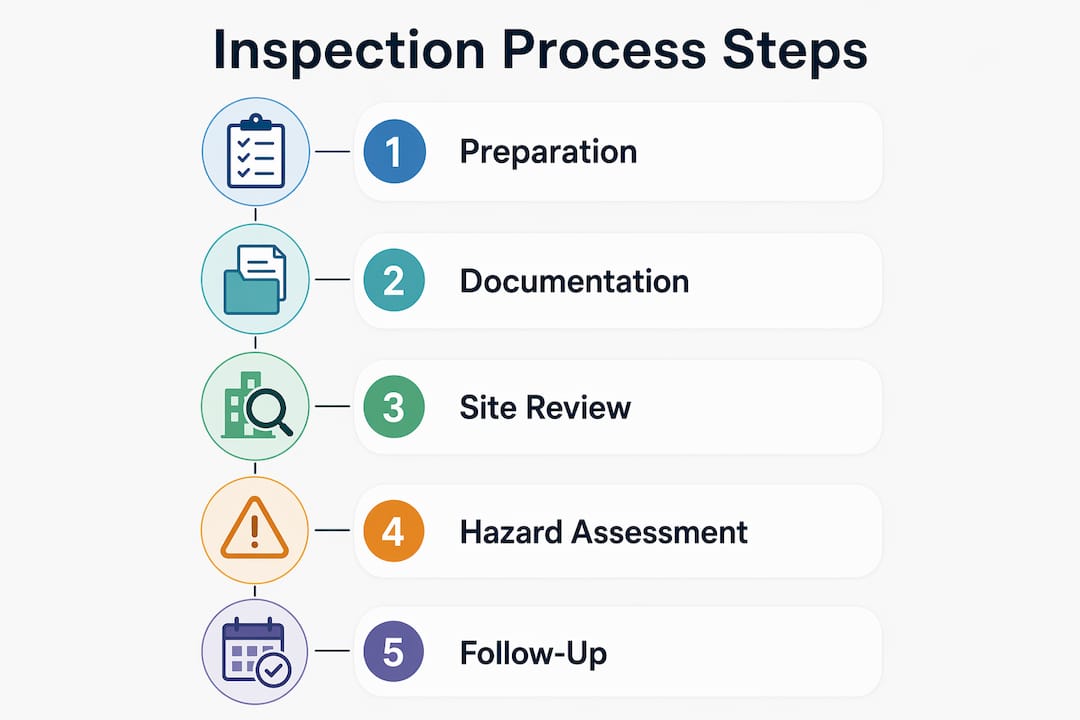
Pre-inspection preparation:
- Conduct a formal self-audit against OSHA 1926 and applicable EPA standards at least 30 days before any anticipated inspection window
- Assemble a document package: safety plan, OSHA 300 log, training records, permit binder, equipment logs, and prior corrective-action evidence
- Designate a single inspection liaison, typically the site safety officer, who will accompany inspectors and control information flow
- Complete quick corrective actions on known deficiencies before the inspection date
- If a voluntary environmental audit is planned, engage legal counsel first to structure privilege protections under EPA Audit Policy
During the inspection:
- Greet inspectors professionally; confirm their credentials and the inspection scope in writing
- Have the liaison accompany inspectors at all times and take contemporaneous notes on every observation
- Assign corrective-action owners on-site for any finding raised during the walkthrough
- Avoid volunteering information beyond what is directly requested
Post-inspection:
- Review the inspection report within 48 hours and prioritize findings by severity
- Submit corrective-action evidence within the timeframes specified in any citation or notice
- Notify your insurer and project owner of any stop-work order or serious citation per contract requirements
- If penalties are issued, evaluate whether to contest through OSHA’s informal conference process before the 15-day deadline
Centralizing compliance documentation before an inspection is the single highest-leverage preparation step. Inspectors who cannot access records quickly treat the gap as a deficiency, regardless of whether the underlying work was performed correctly.
When does hiring a QES consultant actually pay off?
Third-party Quality, Environment, and Safety consultants deliver services that in-house teams rarely replicate at equivalent depth: mock inspections calibrated to current OSHA enforcement priorities, safety management system design, environmental permitting support, ISO 45001 and certification pathway management, and corrective-action project management through close-out.
The ROI case for external QES support becomes compelling at specific thresholds:
| Trigger | Why a Consultant Adds Value |
|---|---|
| Multi-trade project exceeding project value threshold | Complexity of overlapping OSHA subpart requirements exceeds typical in-house capacity |
| Prior OSHA citation or stop-work order history | Risk-based scheduling increases future inspection probability; a consultant reduces that cycle |
| Certification deadline approaching | ISO 45001 or BizSAFE documentation requirements demand structured audit evidence |
| High-hazard scope (demolition, confined space, asbestos) | Regulatory complexity and penalty exposure justify specialist oversight |
A proactive mock inspection conducted 60 days before a scheduled regulatory audit routinely surfaces 80–90% of the findings an inspector would cite, giving the project team time to remediate rather than respond. The difference between a corrective-action plan submitted before an inspection and a citation response submitted after one is measured in both dollars and schedule days.
Integrating safety at the design stage through Design for Safety advisory, a core QES consultant service reduces the volume of field-level hazards that inspectors encounter, which directly lowers citation probability on complex projects.
Pro Tip: When evaluating a QES consultant, ask specifically for mock inspection reports from comparable project types. The deliverable quality of that document tells you more about consultant capability than any credential list.
How MOSAIC Ecoconstruction Solutions supports inspection readiness
MOSAIC Ecoconstruction Solutions maps its QES service portfolio directly to the inspection-readiness needs described throughout this article. Core offerings include safety audits and mock inspections, ConSASS assessments, Design for Safety advisory, BizSAFE and ISO certification support, environmental controls and permit documentation assistance, workforce training, and manpower outsourcing for safety officer roles.
Clients engaging MOSAIC receive structured deliverables: mock inspection reports with prioritized findings, corrective-action plans with assigned owners and close-out timelines, and documented evidence packages formatted for regulatory review. Those outputs directly address the documentation gaps that generate the majority of OSHA citations on construction sites.
- Safety audits benchmarked against current OSHA 1926 enforcement priorities
- Environmental compliance reviews aligned with EPA SWPPP and NESHAP requirements
- Safety induction training programs with documented attendance records ready for inspector review
- Certification pathway management for BizSAFE and ISO 45001
Pro Tip: Request that your QES consultant deliver the mock inspection report in the same format an actual OSHA inspector would use. That format alignment trains your team to recognize and respond to findings under realistic conditions.
Key Takeaways
Proactive regulatory inspection readiness reduces citation risk, lowers insurance costs, and accelerates certification timelines for construction firms operating under OSHA and EPA jurisdiction.
| Point | Details |
|---|---|
| Inspections enforce non-negotiable standards | OSHA, EPA, and local agencies verify safety, environmental, and permit compliance on every covered project. |
| Failing inspections compounds future risk | Prior violations trigger risk-based re-inspection scheduling, increasing regulatory burden and insurance exposure over time. |
| EPA Audit Policy can eliminate penalties | Voluntary disclosure under EPA’s Audit Policy can reduce gravity-based civil penalties by up to 100% when strict conditions are met. |
| Audits drive operational improvement | PwC and audit research confirm that compliance audits reduce rework, strengthen controls, and support market access beyond penalty avoidance. |
| MOSAIC delivers inspection-ready documentation | MOSAIC’s mock inspections, corrective-action plans, and certification support give contractors structured evidence packages before regulators arrive. |
The inspection readiness gap most contractors underestimate
The conventional view treats regulatory inspections as periodic disruptions to be survived. That framing is strategically costly. Contractors who invest in continuous compliance infrastructure, rather than reactive preparation, accumulate a compounding advantage: lower EMR ratings, cleaner prequalification profiles, and faster certification timelines that open contract categories their competitors cannot access.
The firms that struggle most with inspections are rarely the ones with the worst safety practices. They are the ones with adequate practices and inadequate documentation. An inspector cannot credit what cannot be demonstrated. The gap between what a firm does and what it can prove is where most citations originate, and it is precisely the gap that a structured QES program closes.
Proactive audits also reduce regulatory scrutiny over time. Transparent, risk-based inspection systems direct enforcement resources toward higher-risk establishments. A firm that demonstrates consistent compliance through documented audit cycles moves down the priority list, freeing operational bandwidth for project delivery rather than regulatory response.
MOSAIC Ecoconstruction Solutions: inspection readiness built into your project cycle
Construction firms that treat compliance as a project phase rather than an afterthought consistently outperform on inspection outcomes, insurance costs, and certification timelines. MOSAIC Ecoconstruction Solutions delivers the safety consultancy infrastructure that makes that performance repeatable: mock inspections, corrective-action management, environmental permit support, and BizSAFE certification pathway management, all structured around the documentation standards regulators actually use.

Client engagements typically begin with a gap assessment against current OSHA and EPA requirements, followed by a prioritized corrective-action plan and a documentation build-out calibrated to the project’s certification timeline. The result is a firm that enters every regulatory inspection with evidence already assembled, findings already closed, and a compliance record that speaks before the inspector asks a single question. Contact MOSAIC to schedule an inspection readiness assessment for your next project.
Useful sources and further reading
The following authoritative sources underpin the regulatory and compliance guidance in this article. Contractors and safety officers building or reviewing a compliance strategy should consult these directly.
- FDA Inspections: A Vital Public Safety Net — FDA’s rationale for inspections as a public health mechanism; useful for understanding the cost-of-failure argument that applies across regulated industries including construction.
- OSHA Inspection Targeting Research, Harvard Business School — Peer-reviewed evidence on risk-based inspection scheduling and the injury-reduction effect of targeted inspections.
- EPA Audit Policy, via Mondaq — Detailed explanation of voluntary disclosure conditions, penalty mitigation percentages, and legal privilege considerations.
- PwC: Leaning into Regulatory Compliance — Professional services perspective on audits as operational improvement tools rather than cost burdens.
- Withum: How Audits Drive Growth — Practitioner analysis of audit-driven process improvement and competitive positioning.
- OECD Regulatory Enforcement and Inspections Toolkit — The 12-criteria framework for evaluating inspection system effectiveness; useful for firms operating across multiple jurisdictions.
- LearnGxP: Why Regulatory Inspections Are Critical — Training-sector overview of enforcement escalation pathways from warnings through criminal exposure.
Recommended
- Why Site Inspections Matter for Construction Projects
- Regulatory Compliance Consulting for Contractors – MOSAIC Eco-construction Solutions Pte Ltd
- Construction Site Inspection Program That Works – MOSAIC Eco-construction Solutions Pte Ltd
- Top Workplace Inspection Failures to Correct – MOSAIC Eco-construction Solutions Pte Ltd