

Safety induction is the structured orientation that introduces new workers to site-specific hazards, emergency protocols, and safety responsibilities before any operational work begins. Why safety induction is vital becomes clear when you examine the scale of preventable harm in the industry: US workplaces record over 4,700 fatalities annually, with falls remaining the leading cause of construction deaths. Globally, the International Labour Organization reports nearly 3 million work-related deaths each year. These numbers are not abstract. They represent workers who entered sites without adequate orientation. OSHA’s 2026 mandate makes safety training non-negotiable, with violations carrying penalties of up to $156,259 per incident. For project managers and safety officers, a properly executed induction program is the first and most consequential line of defense.
Why safety induction is vital: core components that make it work
An effective safety induction is not a single lecture or a form to sign. It is a structured program covering four critical domains: hazard identification, emergency procedures, worker responsibilities, and site familiarization.
Hazard identification goes beyond generic warnings. Workers must understand the specific risks present on their assigned site, including fall hazards, confined spaces, electrical exposures, and plant movement corridors. Generic hazard lists imported from previous sites create a false sense of preparedness. Failure to tailor induction content risks importing incorrect assumptions about emergency routes and alarm systems, which can turn a routine situation into a fatality.
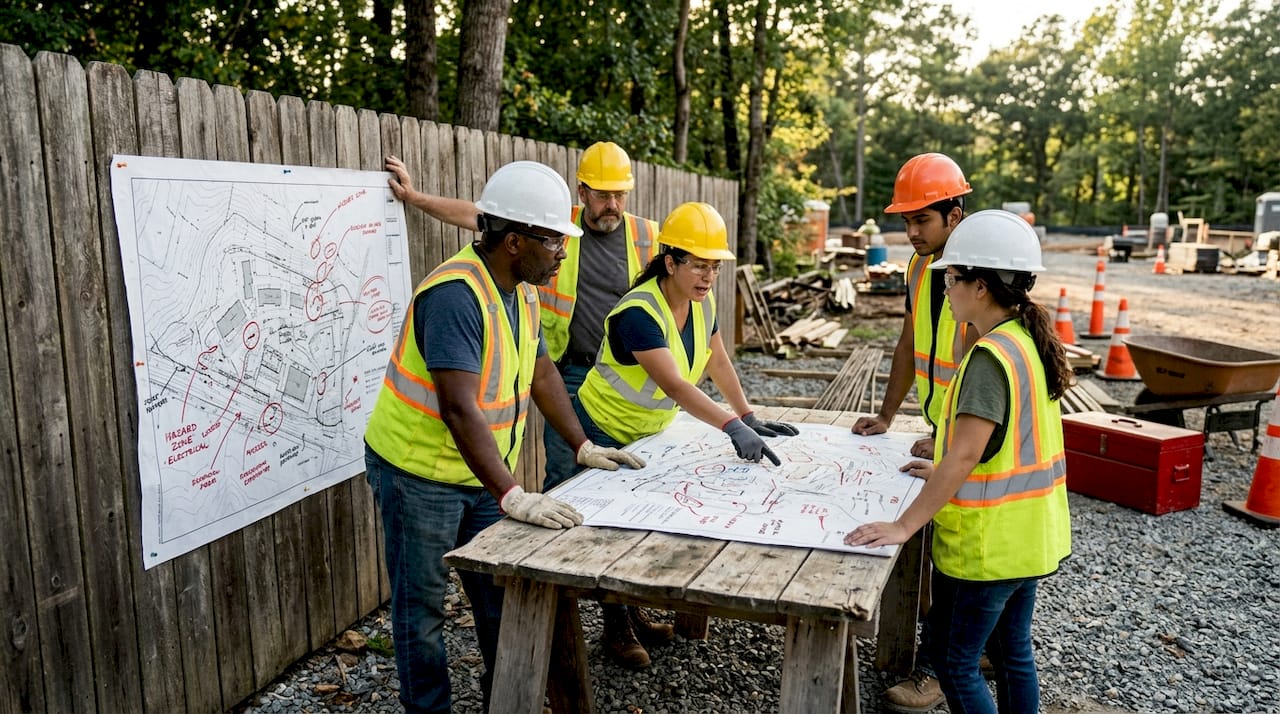
Emergency procedures must be site-specific and tested. Workers need to know the exact evacuation routes, muster points, incident reporting channels, and first-aid locations for the site they are entering. This information changes from project to project.
Worker duties and responsibilities form the behavioral backbone of induction. Workers who understand their accountability under statutory frameworks are more likely to report near-misses, refuse unsafe tasks, and engage with safety officers proactively.
Site walkthroughs and scenario-based assessments are the most underused components. A physical walkthrough converts abstract policy into spatial memory. Scenario-based questions, such as “What do you do if you see a colleague working without fall protection?” verify comprehension rather than passive attendance.
- Hazard identification specific to site conditions and job tasks
- Emergency evacuation routes, muster points, and incident reporting procedures
- Worker rights, duties, and accountability under applicable regulations
- Physical site walkthrough covering plant movement zones and restricted areas
- Scenario-based assessment to verify comprehension before work begins
- Psychosocial hazard awareness, given that 964,000 workers reported work-related stress or anxiety in 2024/25
Digital learning platforms and scenario-based modules now outperform traditional slide presentations in engagement and retention, particularly for distributed construction workforces. Integrating virtual reality in construction inductions allows workers to experience hazardous scenarios safely before setting foot on site.
Pro Tip: Run a brief verbal quiz at the end of every induction session. Ask three site-specific questions. If a worker cannot answer them, the induction has not been completed, regardless of what the sign-in sheet says.
How does safety induction reduce risk in construction environments?
Safety induction reduces risk by closing the gap between what workers assume and what the site actually requires. Workers arriving from other projects carry embedded assumptions about emergency procedures, access routes, and plant behavior. Those assumptions are frequently wrong for the new site.
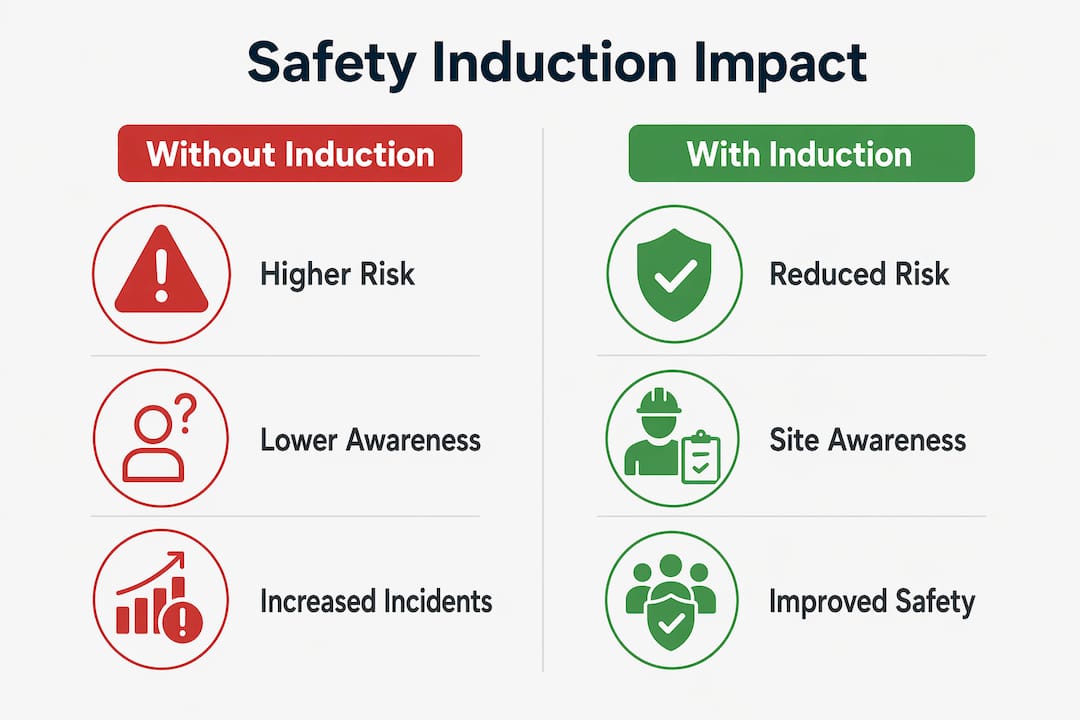
| Risk Factor | Without Induction | With Effective Induction |
|---|---|---|
| Hazard awareness | Worker relies on prior-site assumptions | Worker understands site-specific conditions |
| Emergency response | Delayed or incorrect evacuation | Correct route and muster point followed |
| Near-miss reporting | Underreported due to unclear channels | Reported through known procedures |
| New-worker injury rate | Elevated in first 90 days | Reduced through verified competency |
| Safety culture | Compliance-driven, reactive | Accountability-driven, proactive |
Trained workers show improved morale and reduced incidents compared to untrained counterparts. The mechanism is straightforward: workers who understand why a rule exists are more likely to follow it under pressure than workers who only know that the rule exists.
The induction also functions as the first integration point between a worker and the site’s hazard control hierarchy. When workers understand the hierarchy of controls, from elimination through to personal protective equipment, they make better decisions in the field without waiting for supervisor intervention. This is the difference between a reactive safety program and a genuinely protective one. Learning about construction hazard examples specific to local site conditions further sharpens that awareness before work starts.
How can safety induction be designed to maximize retention?
Most induction programs fail not because the content is wrong, but because the delivery sequence is wrong. Project managers and safety officers who front-load policy documents before site context create cognitive overload. Workers retain almost nothing from a two-hour policy lecture delivered in a conference room before they have seen the site.
The sequence that produces the highest retention follows this order:
- Site walkthrough first. Physical orientation before any policy discussion anchors subsequent information to real locations and real hazards.
- Hazard-specific briefing second. Once workers have seen the site, hazard information connects to what they have observed rather than to abstract descriptions.
- Regulatory and procedural content third. Workers absorb rules more effectively when they already understand the physical context those rules govern.
- Scenario-based verification fourth. Present three to five realistic scenarios and require workers to explain their response. This tests application, not memorization.
- Follow-up within 30–90 days. New-worker injury rates are leading indicators of induction quality. A structured check-in at 30 and 90 days identifies workers who retained the content versus those who need reinforcement.
- Leadership reinforcement continuously. Supervisors who reference induction content in daily toolbox talks signal that the induction was not a one-time event.
Compliance-focused training alone is insufficient. Moving toward risk-informed, competency-based models, as required under ISO 45001, produces measurable reductions in occupational risk. The standard explicitly identifies competence and continual improvement as non-negotiable elements of any safety management system.
Adult learning principles reinforce this sequence. Workers learn by doing, not by watching. Induction programs that include hands-on demonstrations, physical walkthroughs, and scenario challenges produce workers who can apply knowledge under field conditions. Those that rely on slide decks and signature forms produce workers who can confirm attendance.
Pro Tip: Treat the 90-day new-worker injury rate as your induction KPI. If new workers are getting hurt in their first three months, the induction program is not working, regardless of completion rates.
What role does safety induction play in regulatory compliance?
Safety induction is a statutory requirement in most jurisdictions, not an optional best practice. OSHA’s 2026 framework mandates documented safety training before workers begin operational tasks. Violations carry penalties of up to $156,259 per incident, and repeat violations can trigger enhanced enforcement actions including stop-work orders.
The compliance function of induction extends beyond penalty avoidance. Documented induction records serve as primary evidence in incident investigations. When a worker is injured and the investigation asks whether they were informed of the relevant hazard, the induction record is the first document examined. An incomplete or generic record creates significant legal exposure for the principal contractor and the project owner.
Key compliance requirements that a properly designed induction must address:
- Documented evidence of hazard communication specific to the site and task
- Signed acknowledgment of emergency procedures, with site-specific details recorded
- Verification of worker competency, not merely attendance
- Records retained for the duration of the project and beyond, per applicable statutory requirements
- Integration with the site’s formal safety management system, including BizSAFE or ISO 45001 certification requirements
Training outcomes improve when integrated with ISO 45001 management systems, with leadership engagement and formal evaluation cycles. This integration transforms induction from an administrative checkpoint into a component of the site’s overall risk management architecture. The future of construction safety compliance increasingly demands that induction records be auditable, digital, and linked to individual worker competency profiles rather than paper sign-in sheets.
Safety officers who treat induction as a diagnostic tool, asking what hazards workers flagged and how comprehension was verified, build programs that withstand regulatory scrutiny and genuinely protect workers. Those who treat it as paperwork create liability without protection.
Key Takeaways
Safety induction is the single most consequential pre-work activity in construction risk management, and its effectiveness depends on tailored content, verified comprehension, and leadership reinforcement rather than form completion.
| Point | Details |
|---|---|
| Induction is a legal requirement | OSHA 2026 mandates documented training; violations cost up to $156,259 per incident. |
| Generic content creates hazards | Workers carry assumptions from prior sites; induction must address the specific site’s conditions. |
| Signatures do not prove competence | Retention and application within 90 days are the true measures of induction effectiveness. |
| Sequence determines retention | Site walkthrough before policy content produces significantly higher knowledge retention. |
| ISO 45001 integration is required | Embedding induction in a formal safety management system advances auditable, sustainable compliance. |
The induction form is not the finish line
After working across construction safety programs for years, the pattern I see most often is this: a project invests in a thorough induction program, workers sign the form, and the safety officer files it. Three weeks later, a new worker is injured doing something the induction explicitly covered. The investigation finds the form. The form is complete. The worker is still hurt.
The signature is the beginning of accountability, not the end of it. Effective safety leaders use induction as a diagnostic tool, asking what hazards workers flagged and how success was verified. That framing changes everything. It shifts the question from “Did we conduct the induction?” to “Did the induction work?”
The construction sites with the lowest new-worker injury rates share one characteristic: supervisors who treat induction content as a living reference, not a historical document. They cite it in toolbox talks. They ask workers to recall it during pre-task briefings. They treat the benefits of safety training as ongoing rather than front-loaded. That is the difference between a mature safety culture and a compliant one.
— Aman
How Com supports construction safety compliance
Construction companies that want induction programs to hold up under regulatory scrutiny and field conditions need more than a template. Com, operating as MOSAIC Ecoconstruction Solutions, delivers tailored safety audit services and EHS manpower support designed specifically for the construction sector.

Com’s safety audit services identify gaps in induction documentation, competency verification, and hazard communication before regulators or incidents do. For project managers managing multiple sites, Com’s outsourced EHS manpower provides qualified safety professionals who integrate directly into site operations, maintaining induction standards and compliance records across the full project lifecycle. The result is a safety program that functions as operational infrastructure rather than administrative overhead.
FAQ
What is a safety induction in construction?
A safety induction is a structured pre-work orientation that covers site-specific hazards, emergency procedures, and worker responsibilities before any operational tasks begin. It is a statutory requirement under OSHA and equivalent international frameworks.
How long should a construction safety induction take?
Induction length depends on site complexity, but the physical site walkthrough and scenario-based assessment should never be omitted to save time. Effectiveness is measured by worker comprehension at 30 and 90 days, not by session duration.
What are the legal consequences of skipping safety induction?
OSHA 2026 violations for inadequate safety training carry penalties of up to $156,259 per incident. Incomplete induction records also create significant legal exposure during incident investigations.
How does safety induction differ from ongoing safety training?
Safety induction establishes baseline site-specific awareness before work begins. Ongoing safety training builds on that foundation through toolbox talks, refresher courses, and competency assessments throughout the project lifecycle.
What makes a safety induction legally defensible?
A legally defensible induction includes documented hazard communication specific to the site and task, signed acknowledgment of emergency procedures, verified worker comprehension, and records retained per statutory requirements and integrated with the site’s formal safety management system.