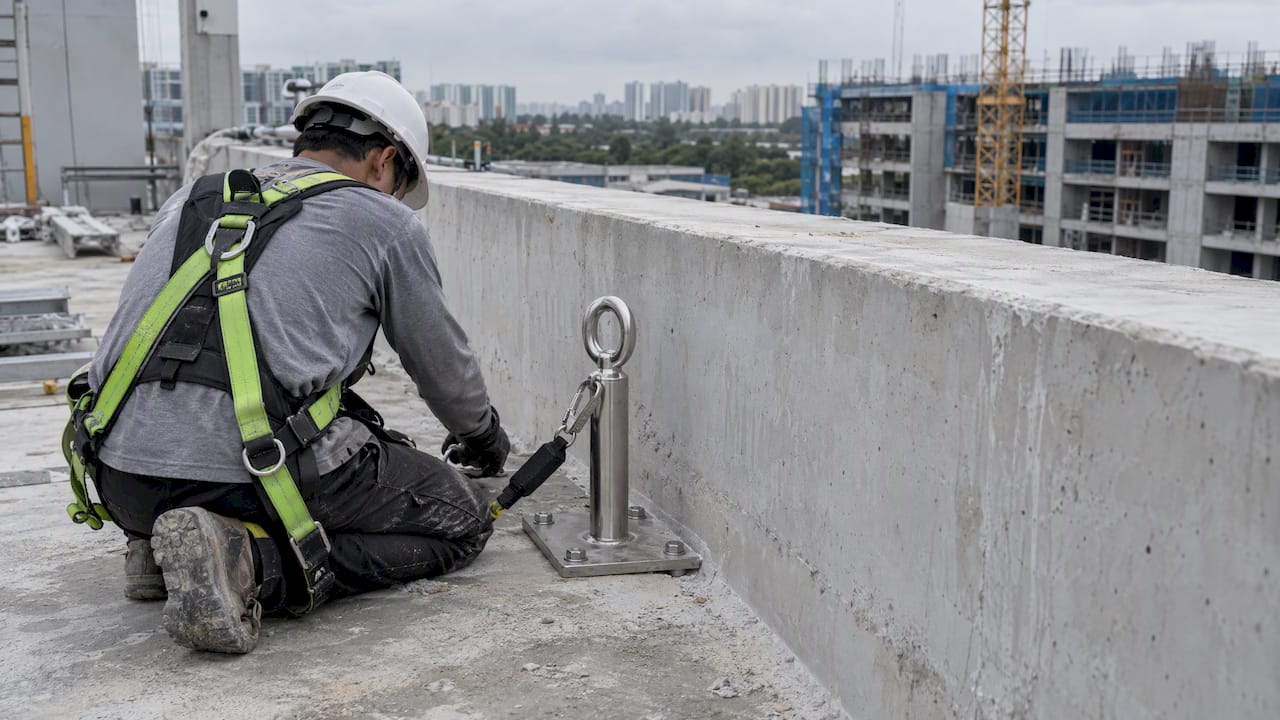

A development project safety plan is defined as a site-specific document that systematically identifies project hazards, assigns control measures, establishes roles and responsibilities, and sets emergency procedures to protect construction personnel and satisfy statutory compliance requirements. Known formally as a Site-Specific Safety Plan (SSSP), this document is the regulatory backbone of any construction project. Project managers and safety officers who treat it as a living risk management instrument rather than a filing formality consistently achieve better audit outcomes and fewer incidents. This guide covers the essential components, the site assessment process, a step-by-step creation sequence, and the most common mistakes that undermine plan credibility with regulators.
What are the essential components of a development project safety plan?
A compliant SSSP must contain clearly defined sections that address real site conditions, not generic industry boilerplate. Depth on key hazards rather than exhaustive generic lists is what regulators and inspectors look for first.
Hazard identification
Focus your hazard register on the 5–10 highest-risk activities for the specific project. For a high-rise residential development, those typically include working at height, crane operations, excavation, formwork, and confined space entry. Listing 40 generic hazards dilutes accountability and signals to auditors that the plan was copied from a template.

Roles and responsibilities
Every duty must be assigned to a named role, not a department. Clear duty assignments reduce confusion during incidents and improve enforcement across the contractor chain. Subcontractors must appear by name with specific obligations documented, not absorbed into a generic “all workers” clause.
Emergency action plan
Emergency plans must define assembly points, communication chains, and incident reporting protocols with enough specificity that any worker on site can follow them without supervision. A plan that states “call the supervisor” as the emergency response is non-compliant and dangerous.
Control measures and training
The hazard control hierarchy places engineering controls above administrative controls and personal protective equipment. Document which controls apply to each identified hazard, and specify the training required before workers perform high-risk tasks. Safety reporting procedures, including near-miss reporting, must be written into the plan with named responsible parties.
Key elements your SSSP must include:
- Site-specific hazard register covering the 5–10 highest-risk activities
- Named roles and responsibilities for all contractors and subcontractors
- Emergency action plan with assembly points and communication chains
- Control measures ranked by the hazard control hierarchy
- Training requirements and documented sign-off procedures
- Safety reporting and near-miss documentation protocols
Pro Tip: Review your roles and responsibilities section with your subcontractor site supervisors before finalizing the plan. Gaps in duty assignment almost always surface at this stage, not during an audit.
How to conduct a site assessment and hazard analysis
The physical site walkthrough is the single most important step in safety plan development. Writing a plan without a site walk produces hazard controls that do not match actual conditions, which inspectors identify immediately and which fail workers in practice.
A structured site assessment follows this sequence:
- Review contract documents and regulatory requirements. Identify any project-specific safety obligations stated in the contract, including client-mandated standards, local authority requirements, and applicable OSHA standards or Singapore WSH Act provisions.
- Conduct a physical site walkthrough before writing a single section. Walk the site with the project manager and a subcontractor representative. Document existing conditions, access points, adjacent structures, utilities, and any pre-existing hazards.
- Apply risk assessment tools. A risk matrix scores each identified hazard by likelihood and consequence, producing a ranked list that drives your top 5–10 hazard focus. The If-Then statement format adds precision: “If excavation depth exceeds 1.5 meters, then shoring must be installed before personnel entry.”
- Identify dynamic site conditions. Construction sites change weekly. Note conditions that will shift as the project progresses, such as crane radius changes, sequencing of trades, and temporary structure removal.
- Link the SSSP to daily Pre-Task Plans. Daily Pre-Task Plans and Job Hazard Analyses address task-level hazards within the broader regulatory framework the SSSP establishes. This connection makes the safety plan operationally relevant, not just a compliance document.
Pro Tip: Photograph site conditions during your walkthrough and attach the images as an appendix to the SSSP. Inspectors treat photographic evidence of site-specific hazard identification as a strong indicator of plan credibility.
Step-by-step process for creating and implementing your safety plan
A structured creation sequence prevents the two most common failures: missing regulatory requirements and producing a document that field teams cannot use. The table below maps each step to its primary output and responsible party.
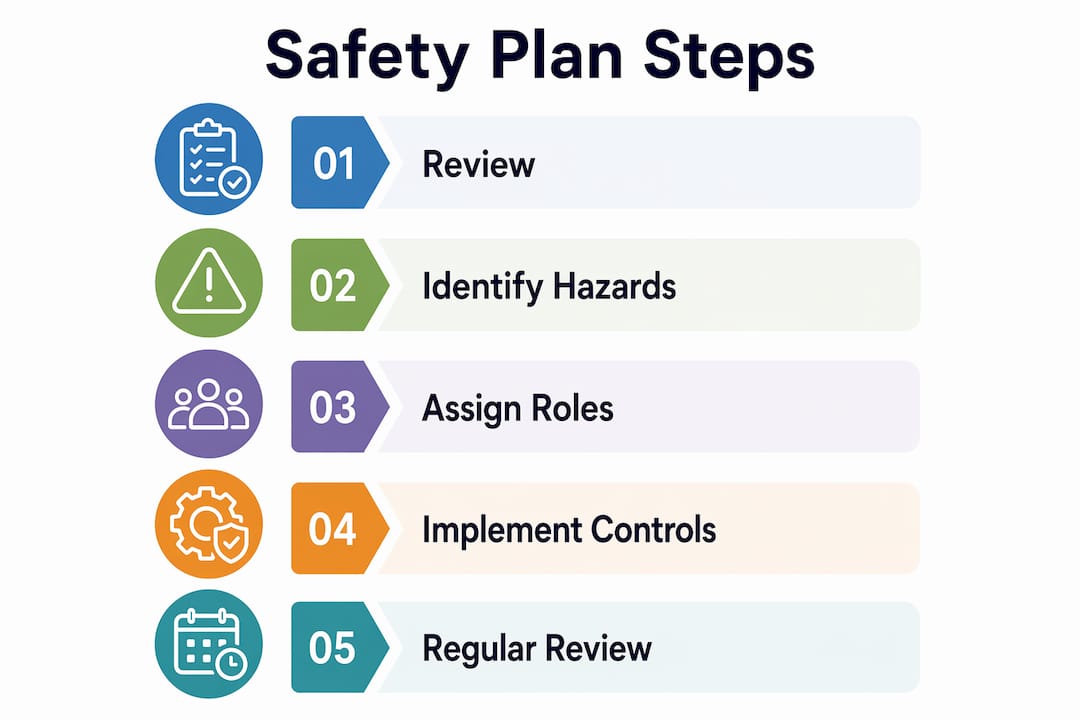
| Step | Action | Output | Responsible Party |
|---|---|---|---|
| 1 | Review contract and regulatory requirements | Compliance checklist | Safety Officer |
| 2 | Conduct physical site walkthrough | Site condition report with photographs | Safety Officer + Project Manager |
| 3 | Identify and rank project-specific hazards | Risk register (top 5–10 hazards) | Safety Officer |
| 4 | Define control measures per hazard | Hazard control schedule | Safety Officer |
| 5 | Assign roles and document responsibilities | Responsibility matrix | Project Manager |
| 6 | Establish training and reporting mechanisms | Training register, reporting forms | Safety Officer |
| 7 | Set review schedule and update triggers | Review calendar | Project Manager + Safety Officer |
The SSSP review cycle should occur every 1–2 weeks on active sites. Monthly reviews are considered inadequate for dynamic construction environments where scope, sequencing, and site conditions change rapidly.
Implementation requires more than document production. Once the plan is finalized, conduct a formal site induction that walks all workers and subcontractors through the key hazards, controls, and emergency procedures. Document attendance. Workforce education at the point of site entry is the mechanism that converts a written plan into practiced behavior.
Additional implementation actions that project managers must execute:
- Distribute the SSSP to all subcontractor supervisors before work commences
- Post emergency action plan details at site entry points and welfare facilities
- Integrate the risk register into weekly site meetings as a standing agenda item
- Record all plan amendments with version numbers and distribution dates
- Confirm that the safety compliance checklist aligns with the current plan version before each regulatory inspection
What are the most common mistakes in safety plan development?
The most damaging mistake is submitting a generic, copied plan with incorrect site details. Regulators and auditors recognize template language immediately. A concise, site-specific 12-page plan consistently outperforms a 60-page generic document in both audit outcomes and field usability.
The second critical error is treating the SSSP as a static document. Safety plans must evolve with project progress, scope changes, and incident reporting. A plan frozen at project kickoff is a compliance liability by week four of construction.
“Safety experts advise treating safety plans as dynamic risk management tools to maintain exposure within legal and organizational limits rather than eliminating all risks entirely. The goal is not a zero-risk document. The goal is a document that accurately reflects current site risk and demonstrates active management.”
Three additional mistakes that undermine plan effectiveness:
- Overlooking subcontractors. Subcontractor roles and training obligations must appear explicitly in the plan. A plan that assigns all responsibilities to the principal contractor creates enforcement gaps that inspectors cite as non-compliances.
- Failing to update the risk register. Risk registers reviewed only monthly are considered ineffective for active sites. Weekly reviews keep the register aligned with current site conditions and demonstrate due diligence to auditors.
- Mismatching plan length and specificity. A plan that is long but vague satisfies neither regulators nor field teams. Every section must address the actual project, not a hypothetical construction site.
Key takeaways
A development project safety plan is only effective when it is site-specific, regularly reviewed, and directly connected to daily field operations.
| Point | Details |
|---|---|
| Site walkthrough is non-negotiable | Write the SSSP only after a physical site assessment to ensure hazard controls match real conditions. |
| Focus on the top 5–10 hazards | Depth on the highest-risk activities produces more credible and enforceable plans than exhaustive generic lists. |
| Assign named roles, not departments | Every responsibility must attach to a specific role, including all subcontractors, to close enforcement gaps. |
| Review every 1–2 weeks | Monthly reviews are inadequate for active construction sites where conditions change rapidly. |
| Link the SSSP to daily task plans | Connecting the safety plan to Pre-Task Plans and Job Hazard Analyses makes it operationally relevant, not just a compliance artifact. |
The case for treating safety plans as operational tools, not compliance documents
My clearest observation after years working across construction safety consultancy is this: the projects with the fewest incidents are not the ones with the thickest safety plans. They are the ones where the safety officer and project manager built the plan together, walked the site together, and updated it together every week.
The industry still produces too many plans written in isolation by a safety officer who has not yet visited the site. Those plans fail in two directions simultaneously. They fail the regulator because the hazard controls do not match site conditions. They fail the workforce because the procedures described bear no resemblance to how work actually happens.
The living document approach is not a best practice aspiration. It is the minimum standard for a plan that functions under real site pressure. When a scope change occurs, the risk register must be updated before the new work starts, not after the next monthly review. When a near-miss happens, the plan must be amended the same day, not at the next scheduled revision.
Engaging site teams in safety planning also produces a measurable cultural shift. Workers who understand why a control measure exists comply with it more consistently than workers who were simply told to follow a rule. That engagement starts at the site induction and requires the project manager to reinforce it at every weekly meeting. For Singapore-specific regulatory context, the construction safety compliance guide provides a detailed framework for aligning your SSSP with local statutory requirements.
— Aman
How Com supports your development project safety plan creation
Com, operating as MOSAIC Ecoconstruction Solutions, provides construction project managers and safety officers with expert consultancy services that cover the full SSSP development cycle, from initial site assessment through regulatory audit preparation.

MOSAIC’s safety consultants bring direct experience with BizSAFE certification, ConSASS audits, and Design for Safety requirements, translating those regulatory frameworks into site-specific plans that hold up under inspection. The firm’s approach integrates safety consultancy services with ongoing plan review support, so your SSSP remains current as site conditions evolve. For projects approaching a formal audit, MOSAIC also provides structured audit preparation guidance that aligns your documentation with current enforcement priorities.
FAQ
What is a Site-Specific Safety Plan (SSSP)?
A Site-Specific Safety Plan is a formal safety document tailored to the exact hazards, conditions, and personnel of a single construction project. It differs from a generic safety policy by addressing the specific risks identified during a physical site assessment.
How often should a construction safety plan be reviewed?
Best practice requires reviewing the SSSP every 1–2 weeks on active construction sites. Monthly reviews are considered inadequate because site conditions, sequencing, and scope change faster than a monthly cycle can capture.
What is the difference between an SSSP and a Pre-Task Plan?
The SSSP establishes the project-level regulatory framework and identifies the top site hazards and controls. A Pre-Task Plan or Job Hazard Analysis addresses task-specific hazards on a daily basis within that broader framework.
How many hazards should a construction safety plan cover?
A compliant safety plan focuses on the 5–10 highest-risk activities specific to the project. Covering fewer hazards in greater depth produces more enforceable controls than listing dozens of generic risks without meaningful mitigation detail.
Do subcontractors need to be named in the safety plan?
Yes. Safety plans must explicitly assign responsibilities to all contractors and subcontractors by role or company name. Generic assignments to “all workers” create enforcement gaps and are a common non-compliance finding during regulatory audits.
Recommended
- Singapore’s 2025 WSH (Design for Safety) Guide for Developers – MOSAIC Eco-construction Solutions Pte Ltd
- The Comprehensive Guide to Design for Safety Professionals (DFSP) in Singapore Construction Projects – MOSAIC Eco-construction Solutions Pte Ltd
- Construction Safety Management System Setup: 2026 Guide
- Design for Safety Process Steps: A Construction Guide