
Developing safety policies means creating formal organizational commitments that define how a company identifies, manages, and controls workplace health and safety risks. These documents are the structural backbone of any effective safety management system, recognized by regulatory bodies including OSHA, NIOSH, and the UK’s Health and Safety Executive (HSE). Research analyzing over 2,000 U.S. organizations confirms that successful H&S policy implementation correlates with a significant positive increase in organizational valuation over time. That finding reframes the question entirely. Safety policies are not administrative overhead. They are a measurable driver of business value.
Why develop safety policies: the core business case
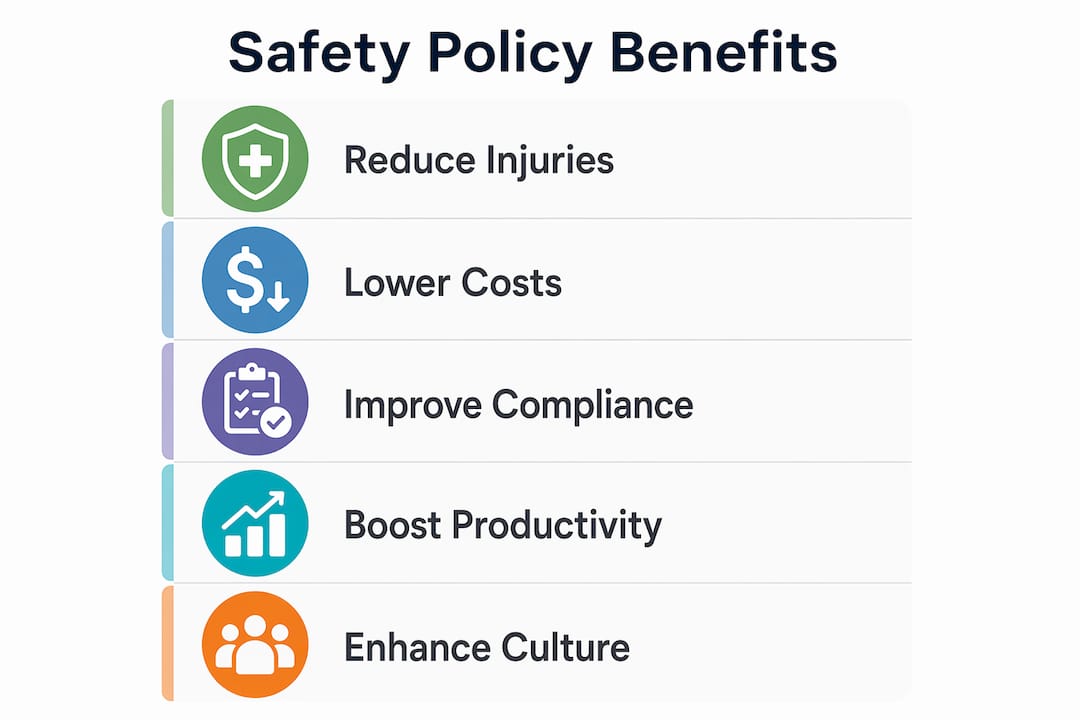
The primary reason organizations develop safety policies is to reduce harm and the financial consequences that follow. The advantages of safety policies extend well beyond regulatory compliance, touching cost structures, workforce stability, and legal exposure simultaneously.
The benefits of safety procedures are well documented by the HSE, which confirms that good H&S policies reduce employee absence, lower turnover, decrease accident frequency, and limit legal risk. Each of those outcomes carries a direct dollar value on the balance sheet. Fewer injuries mean lower workers’ compensation premiums. Lower turnover means reduced recruitment and onboarding costs. Less legal exposure means fewer settlements and regulatory fines.

The financial case is specific. A 20% increase in proactive safety observations produced a 15% reduction in workers’ compensation costs. That ratio demonstrates a clear return on investment from structured safety activity, not from luck or general caution. It shows that measurable safety behaviors, driven by policy, translate directly into measurable cost savings.
The operational benefits are equally concrete:
- Reduced injury and illness rates through defined hazard controls and standardized work procedures
- Lower insurance and compensation costs tied directly to improved safety performance metrics
- Stronger regulatory compliance with OSHA standards, BizSAFE requirements, and ISO 45001 frameworks
- Improved employee morale and retention because workers in safe environments report higher job satisfaction and attendance
- Greater operational efficiency as clear procedures eliminate ambiguity and reduce time lost to incident response
Proactive safety policy adoption also improves productivity by establishing clear expectations for safe work practices. When workers know exactly what is expected of them, they spend less time improvising and more time executing.
How do safety policies shape organizational culture?
Safety policies function as the lens through which an organization views every production and risk decision. A policy that sits in a filing cabinet does nothing. A policy that is embedded in daily operations, communicated consistently, and enforced by leadership becomes the foundation of safety culture.
OSHA’s Safety and Health Program Management Guidelines state that safety policies must communicate safety as a core organizational value with shared goals and accountability. That standard is not met by publishing a document. It is met when leadership allocates resources, holds managers accountable, and participates visibly in safety activities.
Pro Tip: Measure leadership commitment by tracking resource allocation, not just policy sign-offs. A manager who approves a safety budget and attends toolbox talks demonstrates commitment. One who only signs the annual policy review does not.
Leadership commitment is demonstrated through four specific actions:
- Resource allocation: Funding training, equipment, and personnel dedicated to safety
- Accountability structures: Assigning named individuals to specific safety responsibilities within the policy
- Continuous review: Scheduling formal policy reviews tied to incident data, regulatory updates, and operational changes
- Visible participation: Leaders attending safety briefings, conducting site walks, and responding to near-miss reports
A strong safety policy paired with visible leadership commitment is the foundation of a high-performing safety management system. Without that pairing, even a well-written policy fails to change behavior. The policy sets the standard. Leadership behavior determines whether that standard is taken seriously.
Effective safety leadership transforms policies from static documents into active management tools that shape how supervisors respond to near-misses, how workers report hazards, and how the organization learns from incidents.
What are the risks of not having adequate safety policies?
Organizations without well-developed safety policies face a predictable set of consequences. The absence of formal policy does not mean safety is managed informally. It means safety is managed inconsistently, and inconsistency is where accidents originate.
Without a well-developed safety policy manual, companies face inconsistent practices and increased regulatory exposure. Regulators do not accept “we handle it case by case” as a defense. They expect documented systems, defined roles, and evidence of training.
The specific risks of inadequate safety policies include:
- Increased accident frequency because workers receive no standardized guidance on hazard identification or control measures
- Role confusion when no policy defines who is responsible for safety inspections, incident reporting, or emergency response
- Regulatory penalties from OSHA, the Ministry of Manpower, or equivalent bodies that audit for documented safety programs
- Civil litigation exposure when negligence claims cite the absence of written safety procedures as evidence of organizational indifference
- Reputational damage that affects client relationships, tender eligibility, and organizational valuation
Health and safety policies contribute to organizational reputation and stakeholder confidence well beyond compliance benefits. Contractors and developers increasingly require evidence of formal safety programs before awarding projects. An organization without documented policies loses competitive standing, not just regulatory standing.
The financial consequences compound over time. A single serious incident triggers workers’ compensation claims, regulatory investigations, legal fees, and productivity losses simultaneously. The cost of developing a thorough safety policy is a fraction of the cost of one preventable fatality.
How to develop effective safety policies for your organization
Generic, downloaded policy templates carry specific legal risk. Regulators expect policies to address specific hazards and organizational structures. A mismatched template can serve as evidence of negligence rather than safety commitment in a regulatory proceeding. That risk alone justifies the investment in customized policy development.
Developing effective safety guidelines requires a structured process:
- Conduct a site-specific hazard analysis before writing a single policy statement. Identify the actual tasks, materials, equipment, and environments your workforce encounters.
- Involve frontline workers in the drafting process. They hold operational knowledge that no consultant or manager can replicate from a desk.
- Align with applicable regulatory standards, including OSHA 29 CFR, ISO 45001, and Singapore’s Workplace Safety and Health Act where relevant.
- Assign named accountability within each policy section. Vague language like “management is responsible” creates enforcement gaps.
- Establish a review cycle tied to incident data, regulatory changes, and operational updates. Annual reviews are a minimum. Quarterly reviews are better practice in high-hazard environments.
Pro Tip: Link each policy section to a specific regulatory requirement. That cross-reference makes compliance audits faster and demonstrates to regulators that your policies are deliberate, not decorative.
Customizing safety policies to accurately reflect organizational hazards and structures avoids regulatory penalties and improves practical enforceability. A policy that workers recognize as relevant to their actual work is a policy they will follow. For construction organizations, safety documentation forms the connective tissue between policy intent and field-level execution.
Construction managers benefit particularly from structured training programs that reinforce policy content. The benefits of safety training for construction managers include improved policy comprehension, faster hazard identification, and stronger accountability at the supervisory level. Technology also plays a role. Modern construction software solutions help subcontractors maintain safety documentation consistency across multiple sites, reducing the administrative burden of policy compliance.
Key Takeaways
Developing safety policies is the single most effective structural action an organization can take to reduce injuries, control costs, and build a durable safety culture.
| Point | Details |
|---|---|
| Policies drive financial returns | A 20% rise in proactive safety observations produced a 15% reduction in workers’ compensation costs. |
| HSE confirms broad operational benefits | Good H&S policies reduce absence, lower turnover, decrease accidents, and limit legal risk. |
| Leadership commitment is non-negotiable | Resource allocation, accountability, and visible participation determine whether policies change behavior. |
| Generic templates create legal risk | Regulators treat mismatched policies as evidence of negligence, not safety commitment. |
| Customization and review sustain effectiveness | Policies must reflect actual site hazards and undergo regular review tied to incident data and regulatory updates. |
Safety policies as a value driver, not a compliance checkbox
The organizations I have seen struggle most with safety are not the ones that lack policies. They are the ones that treat policies as a compliance exercise completed once a year and filed away. That distinction matters enormously in practice.
Framing safety policy development as a business case, rather than a cost center, is the single most effective way to secure executive buy-in and sustained resource allocation. Linking safety metrics to financial outcomes transforms leadership attitudes toward investing in safety programs. When a safety manager presents workers’ compensation cost reductions alongside observation frequency data, the conversation shifts from “how much does this cost?” to “how do we scale this?”
The construction sector carries particular urgency here. Project timelines, subcontractor relationships, and tender requirements all intersect with safety policy quality. An organization that cannot demonstrate a documented, audited safety management system loses work before a single bid is submitted. The competitive cost of weak policies is often invisible until it is too late to recover.
Policies also need to evolve. Emerging risks, including those from new materials, equipment, and work methods, require policy updates that precede incidents rather than respond to them. The organizations that build continuous review into their safety management cycles are the ones that maintain both compliance standing and workforce trust over the long term.
— Aman
Strengthen your safety program with Com
Safety policies are only as effective as the systems that support them. Com, operating as MOSAIC Ecoconstruction Solutions, works with construction companies and developers to build safety management systems that meet BizSAFE, ISO 45001, and MOM regulatory requirements.

A professional safety audit identifies gaps between your written policies and actual field practices, giving you a clear, prioritized remediation path. Pair that with structured training from the top safety training topics for 2026 to reinforce policy content at every level of your organization. Com’s consultancy approach ensures your policies reflect your actual hazards, not a generic template downloaded from the internet.
FAQ
Why develop safety policies in the first place?
Safety policies establish a formal organizational commitment to health and safety, reducing injuries, controlling costs, and providing a legal defense framework. Research confirms that organizations with strong H&S policies show measurable increases in valuation over time.
What are the main advantages of safety policies for construction companies?
The primary advantages include reduced workers’ compensation costs, stronger regulatory compliance with OSHA and MOM requirements, improved employee retention, and greater eligibility for project tenders that require documented safety programs.
How do safety policies protect organizations from legal liability?
Well-crafted safety policies demonstrate due diligence to regulators and courts by documenting hazard controls, assigning accountability, and establishing training records. The absence of written policies is frequently cited as evidence of negligence in civil litigation.
How often should safety policies be reviewed and updated?
Safety policies require a minimum annual review, with additional updates triggered by incidents, regulatory changes, or new work methods. High-hazard environments such as construction sites benefit from quarterly policy reviews.
What is the difference between a safety policy and a safety procedure?
A safety policy states the organization’s commitment and objectives regarding health and safety. A safety procedure defines the specific steps workers must follow to perform a task safely. Both are required components of an effective safety management system.