

Safety analytics is defined as the systematic use of data, statistical methods, and machine learning techniques to predict, prevent, and manage workplace safety risks before they cause harm. For safety professionals and decision-makers in construction and industrial sectors, the role of safety analytics has shifted from a reporting function to the central mechanism of proactive risk management. Regulatory frameworks such as ISO 45001 and Singapore’s BizSAFE program now expect organizations to demonstrate data-driven safety performance, not just incident counts. The construction sector, with its high-hazard environment and complex supply chains, stands to gain the most from this shift.
How predictive safety analytics transforms traditional safety programs
Predictive safety analytics is the practice of using historical incident data, near-miss reports, and operational variables to forecast where and when safety failures are most likely to occur. This is a fundamental departure from traditional safety management, which relies almost entirely on lagging indicators such as lost-time injury rates and recordable incident counts. Lagging indicators tell you what went wrong. Predictive analytics tells you what is about to go wrong.

The distinction between lagging and leading indicators is the foundation of any serious safety data analysis program:
| Indicator Type | Examples | Primary Purpose |
|---|---|---|
| Lagging | Lost-time injury rate, recordable incidents, fatality count | Measure past failures |
| Leading | Safety observation frequency, near-miss reports, training completion | Forecast future risk |
| Predictive | Machine learning risk scores, behavioral pattern flags, site condition indices | Prevent incidents before they occur |
Predictive models require 2–3 years of consistent historical data to generate reliable risk forecasts. That threshold matters because models trained on sparse or inconsistent records produce unreliable outputs that erode trust in the entire program.
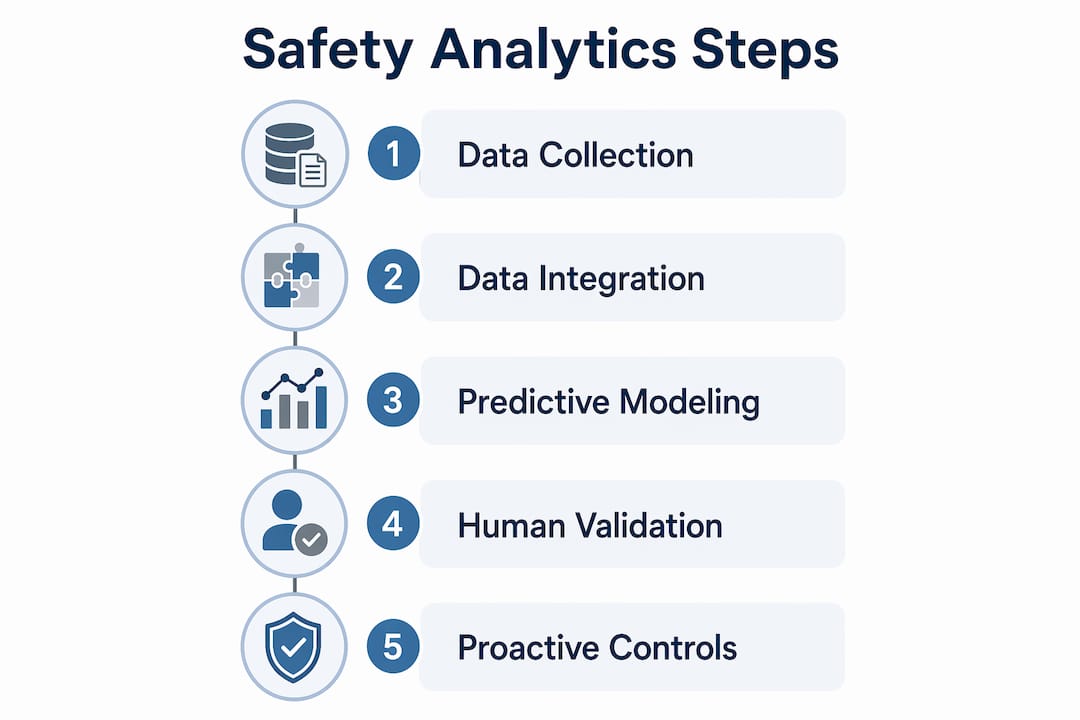
Predictive analytics is a decision-support tool, not a crystal ball. Human expertise remains the validation layer that determines whether a model’s output translates into a meaningful field intervention. A risk score flagging a particular work zone as high-risk still requires a competent safety officer to assess conditions on the ground and authorize corrective action. AI amplifies human safety expertise by parsing complex data into prioritized actions, but it does not replace the judgment that experienced safety professionals bring to ambiguous field conditions.
Organizations that have integrated proactive safety controls with traditional lagging measures have seen incident rates drop by 30% within six months. That figure reflects the compounding effect of earlier detection and faster intervention, not simply better reporting.
Pro Tip: If your organization has fewer than two years of structured incident data, do not attempt to build a predictive model yet. Start with descriptive analytics to identify your highest-frequency hazard categories, then build the data infrastructure needed for predictive capability.
What frameworks support safety analytics implementation?
The Predictive Safety Analytics Framework, known in the industry as PSAF, delivers weekly portfolio-level risk scores that identify deteriorating site conditions weeks before recordable incidents occur. Weekly updates represent a structural advantage over monthly reporting cycles because emerging hazards develop and escalate faster than a monthly review cadence can capture.
Implementing safety analytics in construction and industrial settings requires more than software. The organizational conditions that determine success include:
- Leadership commitment. Senior leaders must treat risk scores as operational intelligence, not administrative output. When leadership reviews weekly dashboards and acts on findings, field teams recognize that the data matters.
- Worker engagement. Near-miss reporting rates and behavioral observation data are only as reliable as the workers submitting them. Psychological safety, meaning the confidence that reporting will not result in blame, is a prerequisite for data quality.
- Integration with existing HSE systems. Safety analytics tools must connect with permit-to-work systems, incident management platforms, and audit records. Siloed data produces incomplete risk pictures.
- Data visualization and dashboards. Risk scores presented as raw numbers have limited operational value. Dashboards that map risk by work zone, trade, or time period allow safety managers to direct resources with precision.
Successful implementation depends on organizational readiness, including leadership commitment and worker engagement, more than on the technical sophistication of the software selected. This finding consistently surprises organizations that invest heavily in platform selection while underinvesting in change management.
The combination of lagging and leading measures within a single framework produces the most complete risk picture. Lagging data anchors the model in historical reality. Leading data provides the forward signal. Predictive scores synthesize both into a ranked list of intervention priorities.
Pro Tip: Before selecting an analytics platform, map your existing data sources. Identify which systems hold incident records, inspection results, and training completions. The platform that connects most cleanly to your current data infrastructure will deliver faster value than the one with the most features.
Practical applications of safety analytics for compliance and risk management
Safety data analytics translates directly into field-level decisions that reduce incidents and satisfy regulatory requirements. The applications below represent the highest-value use cases for construction and industrial safety teams.
-
Proactive hazard identification. Machine learning models classify workers and operational areas into risk categories based on behavioral patterns, environmental conditions, and historical incident data. This classification shifts generalized safety programs to precision-targeted interventions focused on the specific crews, zones, and tasks that carry the highest current risk.
-
Risk-based audit scheduling. Traditional audit schedules are fixed by calendar. Analytics-driven audit programs schedule inspections based on current risk scores, directing audit resources to the sites and work packages most likely to produce a recordable event. This approach satisfies ISO 45001 requirements for continual improvement while concentrating effort where it produces the greatest safety return.
-
Behavior-based safety optimization. Behavioral observation data, when aggregated and analyzed, reveals systemic patterns that individual supervisors cannot detect. A single unsafe act is an incident waiting to happen. A pattern of the same unsafe act across multiple crews and shifts is a systemic failure in training, procedure design, or supervision.
-
Near real-time data updates. Weekly risk forecasting shifts organizational focus from investigating past incidents to identifying emerging hazards. This structural change in how safety teams spend their time is the operational definition of moving from compliance to prevention.
-
Regulatory compliance documentation. Analytics platforms generate audit trails, trend reports, and performance dashboards that satisfy the documentation requirements of BizSAFE, ISO 45001, and the Workplace Safety and Health Act. Automated reporting reduces the administrative burden on safety officers while producing more consistent and defensible compliance records.
A well-structured safety risk assessment workflow integrates analytics outputs directly into the risk assessment process, ensuring that data-driven findings translate into documented controls rather than informal conversations.
What are the biggest challenges in adopting safety analytics?
The barriers to effective safety analytics adoption are organizational more often than technical. Understanding them in advance allows safety leaders to address them before they derail implementation.
“Most organizations underestimate the data volume and quality needed for effective predictive analytics. Starting with descriptive analytics is the advised path for organizations with limited historical records.” — Predictive Safety Analytics Complete Guide 2026
The most common challenges include:
- Data quality gaps. Incident records that lack consistent categorization, near-miss reports that are incomplete, and inspection data stored in disconnected spreadsheets all degrade model accuracy. Garbage in, garbage out is not a cliché in this context. It is the primary reason predictive models fail in practice.
- Cultural resistance. Safety teams accustomed to monthly incident reviews resist the shift to weekly risk forecasting. The change feels like additional workload rather than a more effective use of existing effort. Transparent communication about why the cadence is changing, and what decisions it enables, is the most effective response.
- Overreliance on technology. Organizations that treat risk scores as deterministic predictions rather than probabilistic signals make poor decisions. A high-risk score requires human validation before triggering a field intervention. The model identifies where to look. The safety professional determines what to do.
- Insufficient training. Safety officers who do not understand how a model generates its outputs cannot explain those outputs to field supervisors. Training must cover both how to read dashboards and how to communicate findings to non-technical audiences.
Transitioning to a predictive safety culture requires altering communication strategies and leadership focus toward near real-time risk identification. Organizations that treat this as a technology project rather than a cultural change program consistently underperform against those that invest equally in both dimensions.
Aligning analytics adoption with established frameworks such as ConSASS and ISO 45001 provides a structured pathway that reduces the ambiguity of implementation and anchors the program in recognized regulatory expectations.
Key Takeaways
Safety analytics delivers its greatest value when predictive models, organizational readiness, and human expertise operate as an integrated system rather than independent components.
| Point | Details |
|---|---|
| Predictive models need quality data | Build at least 2–3 years of structured incident and observation data before deploying predictive models. |
| Leading indicators drive prevention | Combine near-miss reports, behavioral observations, and risk scores to detect hazards before incidents occur. |
| Culture determines adoption success | Leadership commitment and worker engagement matter more than software selection for sustained analytics programs. |
| Weekly risk scoring outperforms monthly reviews | PSAF-style weekly updates identify deteriorating site conditions weeks before recordable incidents emerge. |
| Human validation is non-negotiable | Treat risk scores as decision-support signals, not deterministic outputs. Safety professionals must validate every high-risk flag. |
Why safety analytics is reshaping how I think about construction safety
My view on the importance of safety analytics has shifted considerably over the years of working with construction organizations at different stages of safety maturity. The most persistent misconception I encounter is that analytics is a technology problem. Organizations spend months evaluating platforms and almost no time asking whether their incident data is categorized consistently enough to train a model. The data infrastructure question is always more consequential than the software question.
What I find genuinely compelling about the current state of predictive safety analytics is the weekly risk scoring model. Monthly incident reviews are fundamentally backward-looking. By the time a pattern appears in a monthly report, the conditions that produced it have already generated harm. Weekly risk scores change the conversation from “what happened last month” to “where are we most exposed right now.” That shift in question is the shift in culture that actually prevents fatalities.
The integration of AI with human expertise is where I see the most misunderstanding among safety leaders. AI does not make safety decisions. It surfaces the signals that human experts would otherwise miss in the volume of data that modern construction sites generate. The safety officer who understands that distinction uses AI as a force multiplier. The one who does not either ignores the outputs or trusts them uncritically. Neither produces better safety outcomes.
My advice to safety leaders considering analytics adoption: start with the data you have, not the data you wish you had. Descriptive analytics applied to clean historical data produces more value than a predictive model trained on inconsistent records. Build the data discipline first. The predictive capability follows naturally.
— Aman
How Com supports safety analytics and compliance in construction
Com, operating as MOSAIC Ecoconstruction Solutions, works directly with construction companies and industrial organizations to build the safety data infrastructure and compliance frameworks that make analytics programs viable. The team brings deep expertise in safety auditing, risk assessment, and certification support across BizSAFE and ISO 45001 standards.

For organizations pursuing BizSAFE Star certification, Com provides structured support that aligns safety data practices with certification requirements, ensuring that analytics outputs contribute directly to audit readiness. The consultancy also conducts compliance-focused safety audits that identify data gaps and recommend corrective actions grounded in current regulatory expectations. Organizations ready to move from reactive incident management to data-driven prevention will find Com’s approach direct, technically grounded, and calibrated to the realities of Singapore’s construction sector.
FAQ
What is the role of safety analytics in construction?
Safety analytics in construction is the use of historical incident data, behavioral observations, and machine learning models to identify and address safety risks before they produce recordable incidents. It shifts safety management from reactive reporting to proactive hazard control.
How much data is needed to start predictive safety analytics?
Predictive models generally require 2–3 years of consistent, high-quality historical data. Organizations with less data should begin with descriptive analytics to build the data foundation needed for predictive capability.
What are the main benefits of safety analytics for risk management?
The primary benefits include earlier hazard detection, targeted interventions for high-risk crews and zones, and improved regulatory compliance documentation. Organizations that integrate proactive controls with traditional measures have recorded incident reductions of 30% within six months.
Does AI replace safety professionals in analytics programs?
AI does not replace safety professionals. It enhances human expertise by processing large volumes of data into prioritized risk signals that safety teams then validate and act on in the field.
What is the Predictive Safety Analytics Framework?
The Predictive Safety Analytics Framework, or PSAF, is a structured approach that generates weekly portfolio-level risk scores to identify deteriorating site conditions weeks before recordable incidents occur. It combines lagging and leading indicators into a single, regularly updated risk picture.