
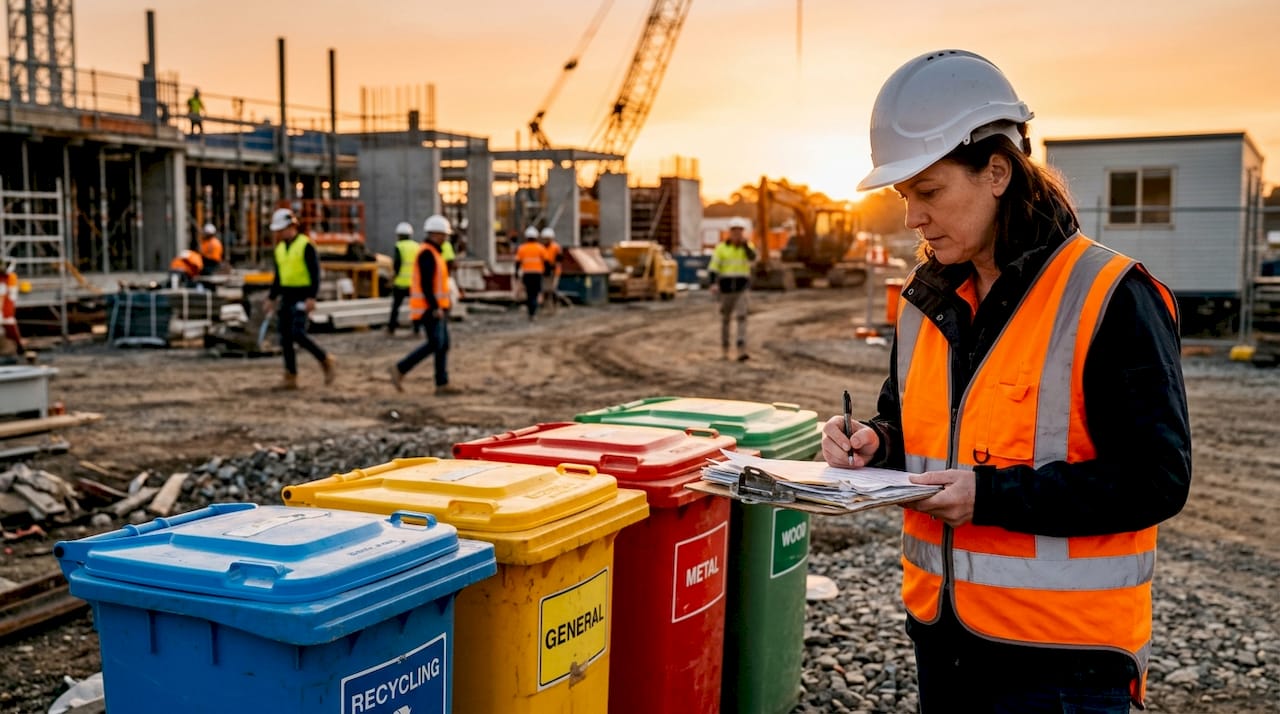
Construction waste management is defined as the systematic process of identifying, reducing, handling, and disposing of materials generated during building, renovation, or demolition projects. The industry standard framework for this process is the 5 Rs: Reduce, Reuse, Recycle, Recover, and Responsible Disposal. For project managers and sustainability officers, mastering this framework is not optional. Regulatory bodies, ESG reporting requirements, and site safety obligations all demand a documented, traceable approach to construction debris disposal. Getting it right from the start protects your budget, your license, and your workforce.
What is construction waste management and why does it matter?
Construction waste management is the operational discipline that governs how waste streams are planned for, sorted, tracked, and removed from a construction site. The term overlaps with the broader concept of waste management in construction, but the industry standard document that formalizes it is the Construction Waste Management Plan, commonly abbreviated as CWMP. A CWMP is not a suggestion. On large projects, it is a permitting requirement submitted before ground is broken.
The financial case is direct. A well-implemented waste management strategy should aim to reduce overall waste generation by at least 20% and achieve a target of recycling or reusing at least 50% of all construction debris. Those targets translate into measurable reductions in haulage costs, landfill fees, and material procurement spend. They also satisfy the sustainability reporting requirements that institutional clients and government contracts increasingly mandate.

Waste management also functions as a safety discipline. Proper waste management directly reduces onsite accidents by minimizing clutter, improving material storage, and lowering injury risks from trips, falls, and improper material handling. A clean site is a safer site, and that connection runs through every effective waste management program.
What does an effective construction waste management plan include?
A Construction Waste Management Plan is the central nervous system of compliant site operations. It documents every material stream, assigns responsibility for each waste category, and establishes traceable records from generation to final disposal.
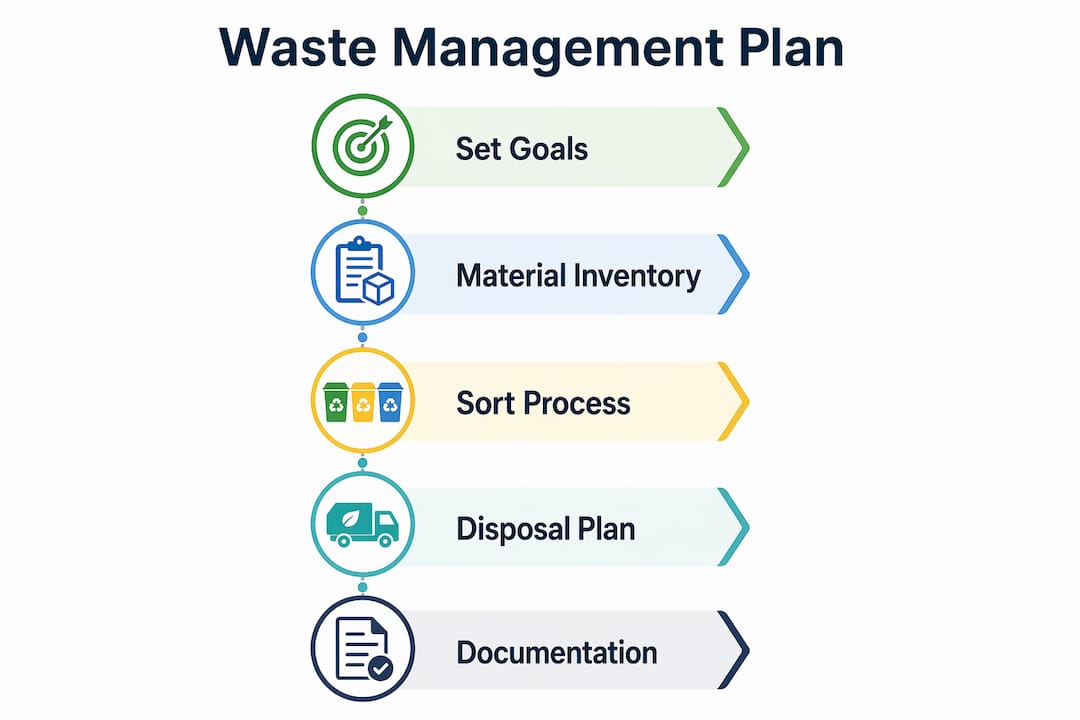
The core components of a CWMP are:
- Waste reduction goals: Quantified targets for total waste generated and recycling rates, aligned with project sustainability certifications such as LEED or local regulatory thresholds.
- Material inventory: A pre-construction audit of all materials entering the site, including estimated waste volumes by type (concrete, timber, metals, packaging).
- Sorting and disposal procedures: Clear protocols for segregating waste at the point of generation, including designated container locations and responsible personnel.
- Hauling and vendor plans: Documented agreements with licensed waste carriers, including confirmation of their disposal or recycling facilities.
- Tracking and reporting methods: Systems for recording waste volumes removed, disposal destinations, and recycling rates throughout the project lifecycle.
Documentation is not a bureaucratic afterthought. A Site Waste Management Plan requires traceable records including disposal receipts, photo logs, and signed manifests. These records protect the project owner and the contractor from regulatory penalties and legal liability. They also provide the data needed for ESG reporting and sustainability certification audits.
| CWMP Component | Primary Purpose |
|---|---|
| Waste reduction goals | Set measurable targets for generation and recycling rates |
| Material inventory | Quantify expected waste by type before work begins |
| Sorting procedures | Assign responsibility and location for waste segregation |
| Vendor documentation | Confirm licensed disposal and recycling pathways |
| Tracking and reporting | Maintain traceable records for compliance and ESG reporting |
The CWMP should be submitted during the permitting or pre-construction phase. Treating it as a live document, updated as site conditions change, is the practice that separates compliant projects from those that face enforcement action.
How to reduce and manage construction waste effectively on-site
Source reduction is the highest-priority action in any waste management program. Recycling alone is not enough. Eliminating waste before it is generated removes the entire lifecycle burden of material use, transport, and disposal. This means making waste reduction decisions at the design and procurement stages, not after materials arrive on site.
The most effective pre-construction step is ordering exact quantities. Pre-construction procurement strategies, including ordering to precise specifications and engaging supplier take-back programs, can reduce waste volume by up to 20% before work starts. Avoiding over-packaging and specifying materials with minimal off-cuts also contributes significantly to waste prevention.
Once on site, the following sequence governs effective waste management:
- Segregate at the source. Place waste containers at the point of generation, not at a central collection point. Workers are far more likely to sort correctly when the right container is within arm’s reach.
- Use color-coded containers for high-value recyclables. Specific color-coded containers for metals, clean timber, and other high-value recyclables increase recycling rates, reduce contamination, and can offset disposal costs through material recovery revenue.
- Avoid the flat “recycle everything” policy. Mixing waste streams in a single recycling container causes contamination that renders the entire load unrecyclable. A contaminated load goes to landfill at full cost.
- Reuse materials on site where possible. Formwork timber, temporary fencing, and packaging materials can often be reused across multiple project phases before disposal.
- Track waste volumes in real time. Digital platforms that centralize waste documentation provide visibility into waste trends. This data enables adjustments before the project exceeds its waste budget or recycling targets.
Pro Tip: Assign a named waste coordinator on every project, not just a general site supervisor. A dedicated coordinator tracks container fill rates, schedules collections before overflow occurs, and maintains the disposal receipt log without competing priorities.
Connecting waste handling to site safety is not optional. Reviewing construction hazard examples shows that cluttered walkways and improperly stored materials are among the most common causes of on-site injuries. Waste management and hazard control share the same physical space.
What are the common challenges in construction waste management?
The most persistent challenge is the “black box” problem in waste haulage. A contractor arranges for a skip to be collected, and the waste disappears from the site. Without documentation of where it goes, the project owner retains legal liability for any illegal dumping that occurs downstream. Tracking where construction waste goes after leaving the site is critical. Photo logs and official disposal receipts protect companies from regulatory penalties and enforce supplier accountability.
The second major challenge is poor waste auditing at the start of a project. Without a pre-construction material inventory, project teams have no baseline against which to measure waste generation. They cannot identify which trades or phases are generating excess waste, and they cannot make data-driven adjustments.
Key challenges and their solutions:
- Inadequate segregation training: Workers who do not understand sorting requirements contaminate recyclable streams. The solution is mandatory induction training with visual guides posted at every waste station.
- Insufficient container capacity: Overflowing skips create safety hazards and force mixed disposal. The solution is scheduling collections based on fill rate data, not fixed calendar intervals.
- Vendor non-compliance: A licensed carrier may subcontract to an unlicensed operator. The solution is requiring carriers to provide facility-specific disposal receipts, not just a general manifest.
- Cost pressure overriding compliance: Project managers under budget pressure may cut waste management spending. The solution is presenting waste management as a cost recovery mechanism, not a cost center, by quantifying material recovery revenue and avoided landfill fees.
Pro Tip: Request the waste transfer note and the final disposal facility certificate from your haulage contractor within 48 hours of each collection. If they cannot provide both documents, replace the contractor before the next collection cycle.
Balancing cost, compliance, and sustainability goals requires treating waste management as a data problem. Centralizing waste documentation in digital platforms enables project managers to optimize costs and environmental outcomes simultaneously, rather than trading one against the other.
What regulations and standards govern construction waste management?
Regulatory requirements for construction waste management operate at multiple levels: national legislation, local authority permits, and voluntary sustainability standards that are increasingly becoming contractual obligations. Understanding which frameworks apply to your project is a prerequisite for compliant operations.
The environmental compliance requirements for construction projects typically mandate that waste be handled by licensed contractors, disposed of at approved facilities, and documented with traceable records. Failure to meet these requirements exposes the project owner, the main contractor, and potentially the waste carrier to enforcement action, fines, and reputational damage.
| Standard or Framework | Application | Documentation Required |
|---|---|---|
| Site Waste Management Plan (SWMP) | Large construction and demolition projects | Material inventory, disposal receipts, photo logs |
| LEED (Leadership in Energy and Environmental Design) | Sustainability-certified projects | Waste diversion rates, recycling facility certifications |
| ESG Reporting Frameworks | Publicly listed developers and institutional clients | Waste generation data, recycling rates, carbon impact |
| National Environmental Agency (NEA) Requirements | Singapore-based construction projects | Licensed contractor records, disposal manifests |
Record keeping is the foundation of regulatory compliance. Every disposal event must generate a paper trail: the waste transfer note issued when waste leaves the site, the facility receipt confirming the disposal destination, and the recycling certificate where applicable. These records must be retained for the duration specified by the applicable regulation, typically a minimum of two years after project completion.
Proactive compliance means building these documentation requirements into the CWMP before the project starts. Retrofitting a documentation system after an enforcement inquiry is far more costly than establishing it at the pre-construction stage. The business waste management guide for Singapore projects provides a detailed reference for NEA compliance obligations and recycling standards applicable to the local construction sector.
Key takeaways
Effective construction waste management requires a documented plan, source reduction at the procurement stage, and traceable disposal records to meet regulatory obligations and sustainability targets.
| Point | Details |
|---|---|
| Define and plan early | Submit a CWMP during permitting, not after construction begins. |
| Prioritize source reduction | Order exact quantities and use take-back programs to cut waste by up to 20% before work starts. |
| Segregate with color-coded bins | Assign specific containers to high-value recyclables to prevent contamination and recover material costs. |
| Document every disposal event | Collect waste transfer notes and facility receipts within 48 hours of each collection to avoid legal liability. |
| Connect waste to safety culture | Proper waste handling reduces clutter and directly lowers the risk of on-site trips, falls, and injuries. |
Waste management is a project management discipline, not an afterthought
After working across construction compliance for years, the pattern I see most often is this: waste management gets assigned to whoever is available, not whoever is accountable. A named waste coordinator with clear authority changes the outcome on every project I have observed. The documentation gets done, the containers get emptied on schedule, and the recycling targets get hit because someone owns the result.
The second observation is about procurement. Project managers who engage their procurement teams on waste reduction before the design is finalized consistently outperform those who try to manage waste after materials arrive on site. The risk management decisions made at the design stage have a direct and measurable impact on waste volumes. This is not theoretical. It shows up in the final waste audit numbers.
Digital tracking is the third lever that separates high-performing projects from average ones. A spreadsheet updated weekly is not a waste management system. A platform that captures waste volumes by trade, by phase, and by material type gives project managers the data to intervene before a target is missed, not after. Treating waste management as a data discipline is the shift that makes the difference between compliance and genuine performance.
The uncomfortable truth is that most construction waste problems are procurement and planning failures, not site execution failures. Fix the front end of the project, and the site becomes manageable.
— Aman
How Com supports construction waste compliance and site safety
Construction waste compliance does not exist in isolation from broader site safety obligations. The two disciplines share the same regulatory framework, the same documentation requirements, and the same consequences for failure.

Com, operating as MOSAIC Ecoconstruction Solutions, provides safety audit services that assess construction sites against current compliance requirements, including waste management documentation, environmental controls, and site safety standards. For organizations pursuing formal recognition, Com also delivers BizSAFE Star certification support, guiding project teams through the full certification process. If your project needs a structured compliance review that covers both waste management obligations and site safety requirements, Com provides the expertise to get it done correctly.
FAQ
What is construction waste management?
Construction waste management is the systematic process of identifying, reducing, handling, and disposing of materials generated during building, renovation, or demolition projects. It applies the 5 Rs framework: Reduce, Reuse, Recycle, Recover, and Responsible Disposal.
What should a construction waste management plan include?
A Construction Waste Management Plan must include waste reduction targets, a material inventory, sorting and disposal procedures, licensed hauling arrangements, and traceable documentation such as disposal receipts and photo logs.
How can construction waste be reduced on site?
Source reduction at the design and procurement stages is the most effective method. Ordering exact quantities and using supplier take-back programs can reduce waste volume by up to 20% before construction begins.
Why is waste documentation legally important?
Tracking where waste goes after it leaves the site protects project owners from liability for illegal dumping. Photo logs and official disposal receipts are the primary evidence that waste was handled in compliance with applicable regulations.
How does waste management connect to site safety?
Proper waste management reduces on-site accidents by eliminating clutter, improving material storage, and lowering the risk of trips, falls, and handling injuries. Waste control and hazard control operate in the same physical environment.