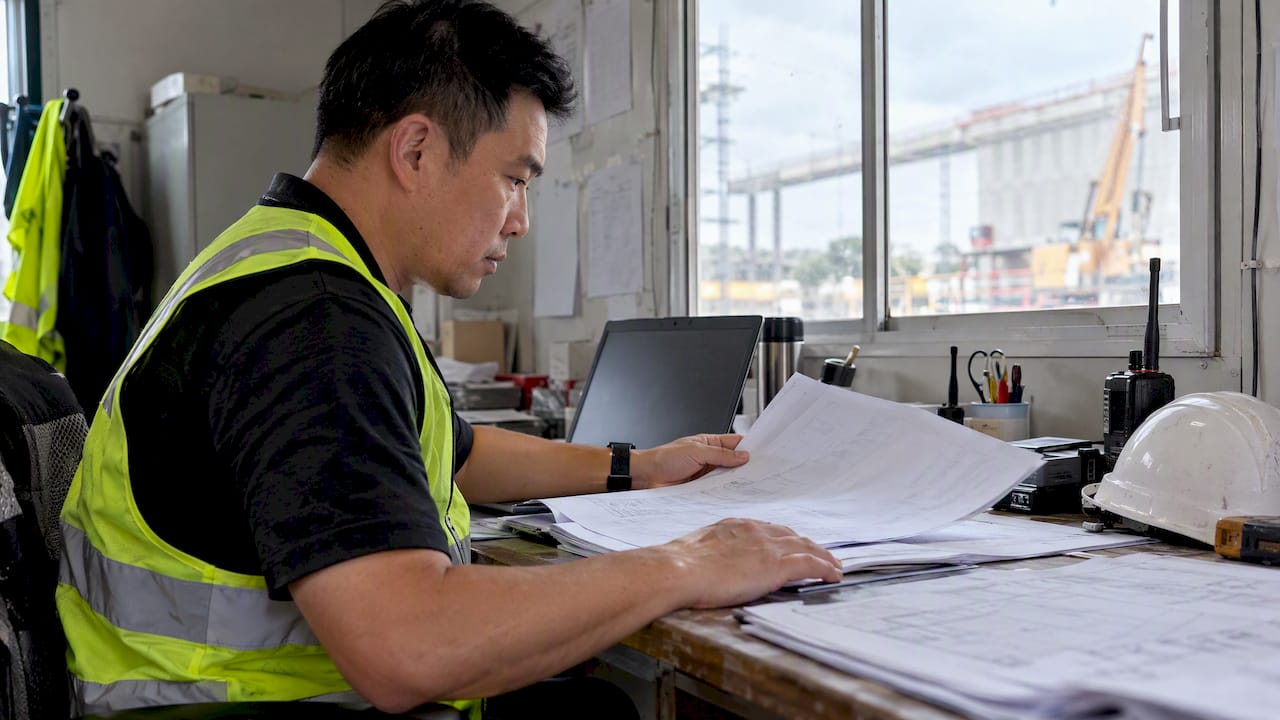

A safety management review is a formal, periodic evaluation conducted by top management to determine whether an organization’s occupational health and safety (OHS) management system remains suitable, adequate, and effective. Defined under ISO 45001 Clause 9.3, this process is not a compliance checkbox. It is a structured leadership activity that synthesizes audit findings, incident data, performance metrics, and regulatory changes to direct system-level improvements. For construction safety managers operating under Singapore’s Workplace Safety and Health Act and international certification frameworks, understanding this process is foundational to maintaining both legal compliance and genuine safety culture.
What is safety management review and how does it differ from audits?
Construction safety professionals frequently conflate three distinct processes: management reviews, safety audits, and site inspections. Confusing these activities leads to misaligned evidence collection, missed leadership decision opportunities, and ultimately a weaker safety management system. Each process serves a different function in the safety management process hierarchy.
A safety audit is a systematic, evidence-based process that verifies whether the safety management system conforms to defined standards. Auditors examine documents, conduct interviews, and observe site conditions to produce findings and corrective actions. A site inspection, by contrast, is an operational check of physical conditions and worker behaviors at a specific point in time. Neither activity is a substitute for a management review.
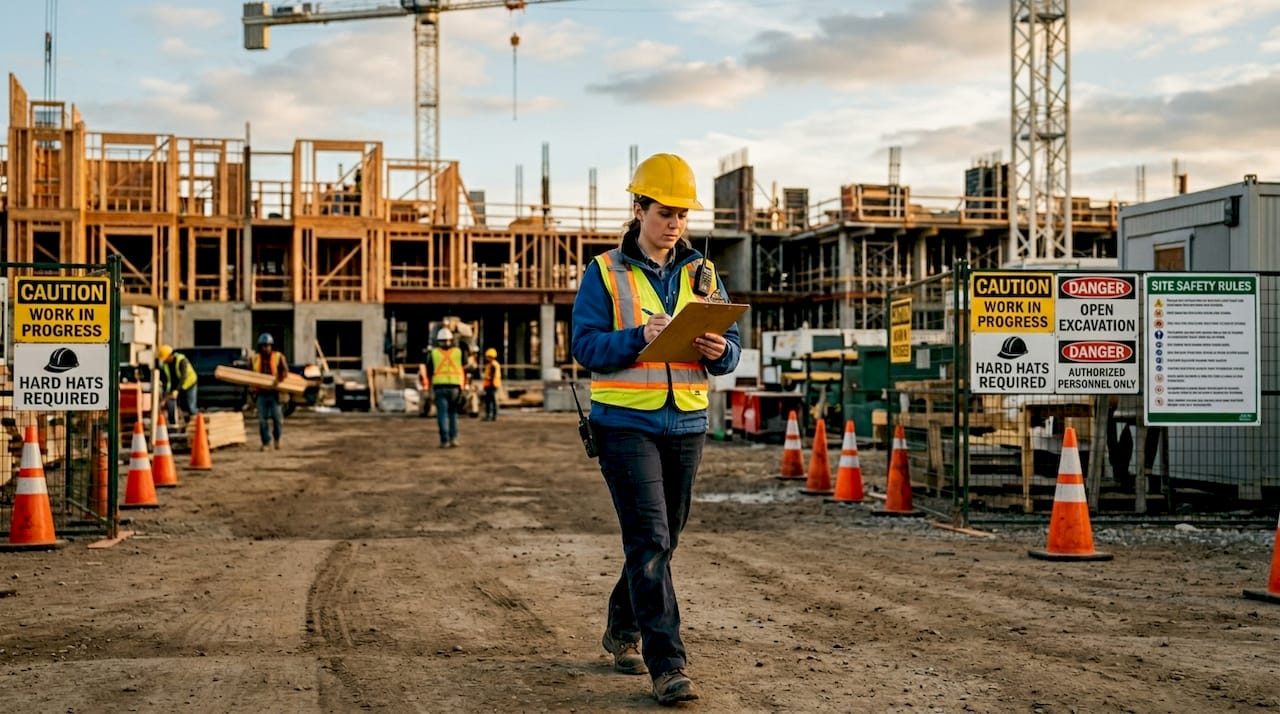
The management review operates at a higher strategic level. Where audits verify conformance, management reviews synthesize audit results and performance data to determine whether the system sets the right standards and whether those standards still meet organizational needs. The output is not a list of nonconformities. It is a set of leadership decisions: resource allocation, policy revisions, system suitability assessments, and strategic direction for safety culture.
| Dimension | Safety inspection | Safety audit | Management review |
|---|---|---|---|
| Who conducts it | Site supervisor or safety officer | Internal or external auditor | Top management or senior leadership |
| Frequency | Daily to weekly | Quarterly to annually | At planned intervals per ISO 45001 |
| Primary focus | Physical conditions and behaviors | System conformance and compliance | System effectiveness and strategic direction |
| Output | Corrective actions, hazard reports | Audit findings, nonconformity reports | Decisions on resources, policy, and improvement |
| Feeds into | Audit evidence | Management review inputs | Organizational safety strategy |
Pro Tip: When preparing for a management review, treat audit reports as raw data, not conclusions. Leadership’s role is to interpret what the data means for system direction, not to re-audit findings already documented.
What are the typical inputs and outputs of a safety management review?
The quality of a management review depends entirely on the completeness and relevance of its inputs. Audit reports are primary inputs, summarizing findings, corrective actions, and compliance status that inform leadership decisions. Incomplete or poorly structured inputs produce reviews that are superficial and fail to drive meaningful change.
Typical inputs for a safety management review include:
- Results of previous management reviews and the status of follow-up actions
- Audit findings, including both internal and external audit reports
- Incident investigation reports, near-miss data, and injury frequency rates
- Safety performance metrics such as lost-time injury rates, hazard observation counts, and training completion rates
- Legal and regulatory compliance updates, including changes to Singapore’s WSH Act or new MOM advisories
- Feedback from workers, worker representatives, and relevant external stakeholders
- Risk assessment outcomes and changes in operational context, such as new project types or subcontractor profiles
- Resource adequacy assessments, covering personnel, equipment, and training budgets
Typical outputs from a safety management review include:
- Decisions on the continued suitability and adequacy of the OHS management system
- Specific improvement actions with assigned owners and completion timelines
- Resource allocation decisions, including additional safety personnel or technology investments
- Policy and objective updates reflecting new organizational priorities or regulatory requirements
- Documented evidence of leadership engagement, which is a direct requirement under ISO 45001
The ILO guidance on OHS planning links initial and ongoing reviews to lawful compliance and system planning, reinforcing that data completeness is not an administrative preference. It is a statutory expectation. A management review conducted without current incident data or compliance status updates cannot produce decisions that genuinely protect workers or satisfy regulatory scrutiny.
How to conduct an effective safety management review in construction settings
Construction environments present specific challenges for safety management reviews: high workforce turnover, multiple concurrent subcontractors, dynamic site conditions, and project-specific regulatory requirements. A structured process addresses these complexities without adding unnecessary administrative burden.
-
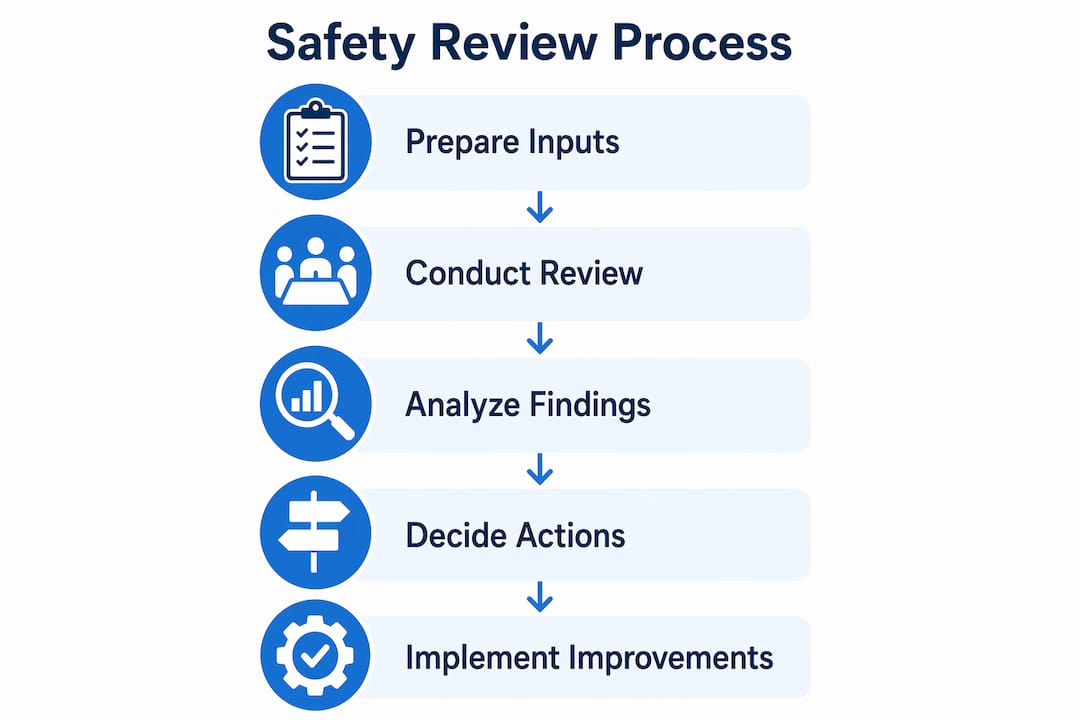
Preparation. Assign a review coordinator, typically the project safety manager or WSH officer, to compile all required inputs at least two weeks before the review meeting. This includes consolidating audit reports, incident statistics, training records, and any outstanding corrective actions from previous reviews. Gaps in input data must be identified and resolved before the meeting, not during it.
-
Data collection and analysis. Safety performance data should be presented in trend format, not as isolated figures. A single month’s incident rate means little. Three to six months of trend data reveals whether the system is improving, stable, or deteriorating. Construction safety managers should use tools like Microsoft Power BI or even structured Excel dashboards to visualize performance trends for leadership audiences unfamiliar with raw safety data.
-
Review meeting. Top management, including the project director or site director, must lead this meeting. The safety manager’s role is to present data and facilitate discussion, not to make system-level decisions unilaterally. Agenda items should follow the ISO 45001 Clause 9.3 input list systematically, with time allocated for each topic. Meetings that skip agenda items or run without a structured format produce incomplete outputs and expose the organization to audit findings.
-
Decision documentation. Every decision made during the review must be recorded with clarity: what was decided, who is responsible, and by what date. Building a site safety management system requires that these records be retained as documented information, accessible for subsequent audits and regulatory inspections.
-
Follow-up and verification. Decisions without follow-up are intentions, not improvements. Assign a tracking mechanism, whether a shared action register or a dedicated safety management software module, to monitor completion of all review outputs. The status of these actions becomes a mandatory input for the next management review, creating a closed-loop improvement cycle.
Pro Tip: Invite a frontline worker representative or a subcontractor safety coordinator to contribute input during the preparation stage. Their observations on ground-level hazards and procedural gaps frequently surface issues that data alone cannot capture, and their involvement strengthens the review’s credibility with the workforce.
Why ongoing safety management reviews are critical for construction safety and compliance
Regular safety management reviews are the mechanism through which construction organizations catch systemic deficiencies before they produce incidents. Regular review cycles enable leadership accountability and resource prioritization for safety controls, functions that no audit or inspection can replicate because neither activity carries decision-making authority.
The construction sector carries one of the highest occupational fatality rates of any industry globally. In Singapore, the Ministry of Manpower’s WSH statistics consistently identify construction as a high-risk sector, making the frequency and rigor of management reviews a direct factor in workforce protection. A review cycle that occurs only annually, or that is conducted without genuine leadership engagement, cannot respond to the pace of change on active construction sites.
Management reviews also serve a function that extends beyond compliance verification. They challenge whether current standards meet organizational needs and set the direction for safety culture evolution. This is a qualitatively different activity from confirming that procedures exist and are followed. It requires leadership to ask whether the procedures themselves are adequate for the hazards the organization actually faces.
For organizations pursuing or maintaining ISO 45001 certification, the management review is a mandatory element under Clause 9.3. Certification bodies assess not only whether reviews occur but whether they are substantive: whether inputs are complete, whether outputs include genuine decisions, and whether follow-up actions are tracked to closure. A perfunctory review that produces no resource decisions or policy changes will draw a major nonconformity finding during external audits. Construction firms operating under Singapore’s BizSAFE framework face analogous expectations, with WSH management systems requiring demonstrable leadership commitment at every review cycle.
Key takeaways
A safety management review is the highest-level mechanism in any OHS system, requiring top management to synthesize performance data, audit findings, and regulatory changes into concrete decisions that drive system improvement and resource allocation.
| Point | Details |
|---|---|
| Formal leadership activity | Management reviews are conducted by top management, not safety officers, and produce strategic decisions rather than corrective action lists. |
| Distinct from audits | Audits verify conformance; management reviews assess whether the system’s standards are adequate and aligned with organizational goals. |
| Inputs determine quality | Complete inputs, including incident trends, audit reports, and compliance updates, are required for reviews to produce meaningful outputs. |
| Structured process matters | Preparation, structured meetings, documented decisions, and tracked follow-up are the four non-negotiable stages of an effective review. |
| Compliance and culture | Regular reviews satisfy ISO 45001 Clause 9.3 and BizSAFE requirements while actively shaping the organization’s safety culture trajectory. |
Why most construction management reviews fall short
The most consistent failure pattern observed across construction safety reviews is not procedural. It is attitudinal. Leadership teams treat the management review as a documentation exercise rather than a decision-making forum, and the result is a meeting that satisfies the form of ISO 45001 Clause 9.3 while entirely missing its substance.
The second failure is data presentation. Safety managers frequently present raw statistics to leadership audiences who lack the context to interpret them. A lost-time injury rate of 1.2 per million man-hours means nothing to a project director who has no benchmark for what that figure represents in the context of the project’s scope and workforce profile. Trend visualization, peer comparisons, and plain-language interpretation of data are not optional enhancements. They are prerequisites for leadership engagement.
Technology integration changes this dynamic significantly. Review effectiveness improves when leadership actively engages with visualized data and when worker representatives contribute during preparation stages. Digital safety management platforms that aggregate incident data, audit findings, and training completion in real time give leadership the context they need to make substantive decisions rather than ratifying pre-prepared summaries.
The third failure is cultural. Organizations that treat safety reviews as compliance obligations produce reviews that satisfy auditors but do not protect workers. Organizations that treat reviews as genuine leadership accountability mechanisms produce reviews that do both. The distinction lies in whether the review produces decisions that cost something: budget commitments, process changes, personnel additions, or policy revisions that require organizational effort to implement.
— Aman
How MOSAIC supports your safety management review process

MOSAIC Eco-construction Solutions brings specialized expertise in OHS management system development, safety audit procedures, and regulatory compliance to construction organizations across Singapore. For firms seeking to formalize or strengthen their safety management review process, MOSAIC’s safety consultancy services provide structured support from input preparation through leadership facilitation and follow-up tracking. MOSAIC also integrates the ConSASS methodology, offering continuous WSH improvement beyond periodic auditing cycles. Whether your organization is pursuing ISO 45001 certification, maintaining BizSAFE status, or building a review process from the ground up, MOSAIC delivers the technical depth and regulatory knowledge that construction safety demands.
FAQ
What is a safety management review under ISO 45001?
A safety management review under ISO 45001 is a planned evaluation by top management, required under Clause 9.3, to assess whether the OHS management system is suitable, adequate, and effective. It produces documented decisions on improvements, resource allocation, and policy updates.
How often should a safety management review be conducted?
ISO 45001 requires reviews at planned intervals, with most organizations conducting them quarterly or annually depending on project scale and risk profile. High-risk construction projects benefit from more frequent review cycles to respond to changing site conditions.
What is the difference between a safety audit and a management review?
A safety audit verifies conformance to defined standards through document review, observation, and interviews, producing nonconformity findings. A management review is a leadership activity that synthesizes audit results and performance data to determine system effectiveness and direct strategic improvements.
What inputs are required for a safety management review?
Required inputs include previous review action status, audit findings, incident and near-miss data, safety performance metrics, legal compliance updates, worker feedback, and resource adequacy assessments. Incomplete inputs produce reviews that cannot generate substantive leadership decisions.
Can a safety officer conduct the management review independently?
No. ISO 45001 Clause 9.3 specifies that top management must conduct the review. The safety officer’s role is to compile inputs, present data, and facilitate discussion. Decision-making authority and accountability rest with organizational leadership.