When professionals working in construction try to explain construction safety programs to new stakeholders, the conversation too often defaults to hard hats and high-visibility vests. That framing understates the scope of what a mature safety program actually demands. An occupational health and safety management system (OHSMS), the recognized industry term for what most practitioners call a “construction safety program,” is a structured, documented, and continuously evaluated management framework that governs every aspect of hazard identification, risk control, regulatory compliance, and workforce protection on a construction site. This article breaks down the core components, regulatory foundations, and implementation practices that define a high-performing OHSMS.
Table of Contents
- Key Takeaways
- Explaining construction safety programs: what they really are
- Regulatory frameworks governing construction safety
- Job hazard analysis: the operational core
- Training, culture, and continuous improvement
- My perspective on what makes programs actually work
- How MOSAIC Safety Solutions can support your program
- FAQ
Key Takeaways
| Point | Details |
|---|---|
| More than PPE compliance | An effective OHSMS addresses leadership commitment, hazard analysis, and cultural accountability far beyond personal protective equipment. |
| Regulatory dual framework | OSHA 29 CFR Part 1926 and ISO 45001:2018 together define the minimum written program requirements and management system architecture. |
| JHAs are living documents | Job hazard analyses must be updated after incidents or site changes; static templates create compliance liability, not protection. |
| Training drives culture | Role-specific, regular safety training is the mechanism through which policy translates into worker behavior and incident reduction. |
| Continuous improvement is mandatory | Safety audits, management reviews, and worker feedback loops are not optional enhancements but structural requirements of a compliant program. |
Explaining construction safety programs: what they really are
The term “construction safety program” is used broadly across the industry, but the underlying concept maps directly to what ISO 45001:2018 defines as an occupational health and safety management system. According to ISO 45001:2018, a compliant system encompasses leadership accountability, hazard identification using the hierarchy of controls, legal compliance mechanisms, formal auditing, and corrective action processes. These are not aspirational attributes. They are auditable clauses with documented evidence requirements.
Where many construction firms go wrong is treating safety as a collection of stand-alone compliance documents rather than an integrated system. A fall protection plan stored in a filing cabinet and never reviewed is not a safety program. It is a liability exposure. The importance of safety programs that genuinely function lies in their ability to improve worker trust, reduce incident frequency, enhance organizational reputation, and demonstrate defensible compliance during regulatory inspections. Each of those outcomes requires the program to be actively implemented, not merely documented.
Core components every program must contain
A fully structured construction OHSMS is built from seven interdependent components. Understanding each one individually, and how they connect, is prerequisite knowledge for any construction manager or safety professional responsible for program development.
- Written safety policies and hazard communication plans. OSHA requires written programs for hazard communication, lockout/tagout, fall protection, and emergency action, each specifying effective dates and responsible persons. These documents must be reviewed at minimum annually.
- Leadership commitment and worker participation. Leadership and worker participation are foundational to effective programs, distinguishing mature systems from mere paperwork exercises. Top-level accountability is not a formality under ISO 45001; it is a clause requirement.
- Job hazard analyses (JHAs) and risk assessments. Task-level hazard identification, conducted with worker input and referenced against the hierarchy of controls, forms the operational core of any site safety system. More on this in the JHA section below.
- Emergency planning and response. Written emergency action plans must address site-specific scenarios including fire, structural failure, chemical release, and medical emergencies, with designated personnel and practiced procedures.
- Training and competence documentation. Workers must be trained for their specific roles before hazard exposure, with records maintained to demonstrate competence during inspections.
- PPE protocols. Personal protective equipment is the last line of defense in the hierarchy of controls, not the first. Programs that lead with PPE rather than engineering or administrative controls invert the hierarchy and expose the organization to liability.
- Incident reporting and corrective action. OSHA 300, 300A, and 301 logs must be maintained and accessible for inspection. Near-miss reporting, root cause analysis, and documented corrective actions close the continuous improvement loop.
Pro Tip: When auditors inspect a construction site, they look for evidence of active program use: dated toolbox talk records, signed JHAs, and training rosters with specific hazard topics. A pristine binder with no signatures is a red flag, not a green light.
Regulatory frameworks governing construction safety
Two primary frameworks define the regulatory architecture that construction safety programs must satisfy: OSHA 29 CFR Part 1926 in the United States, and ISO 45001:2018 as the internationally recognized management system standard. These frameworks are complementary rather than competing, and understanding the distinction between them is operationally significant.
| Framework | Scope | Key Requirements | Enforcement Mechanism |
|---|---|---|---|
| OSHA 29 CFR Part 1926 | Federal construction safety regulations, USA | Written programs, PPE, fall protection, scaffolding, electrical, confined space, recordkeeping | OSHA inspections, citations, financial penalties |
| ISO 45001:2018 | International OHSMS standard | Leadership, hazard identification, legal compliance, audits, corrective actions, continual improvement | Third-party certification audits |
| Singapore WSH Act | National workplace safety law, Singapore | Risk assessments, safe work procedures, incident reporting, competency requirements | MOM inspections, prosecutions |
OSHA’s construction standard mandates specific written programs tied to identified hazards. For example, OSHA’s heat illness prevention requirements mandate that employers provide water, rest, shade, and training when the heat index reaches 80°F or above, with those provisions subject to verification during National Emphasis Program inspections. This illustrates a critical principle: valid programs are those actively implemented and accessible to workers, not simply documented in an office.
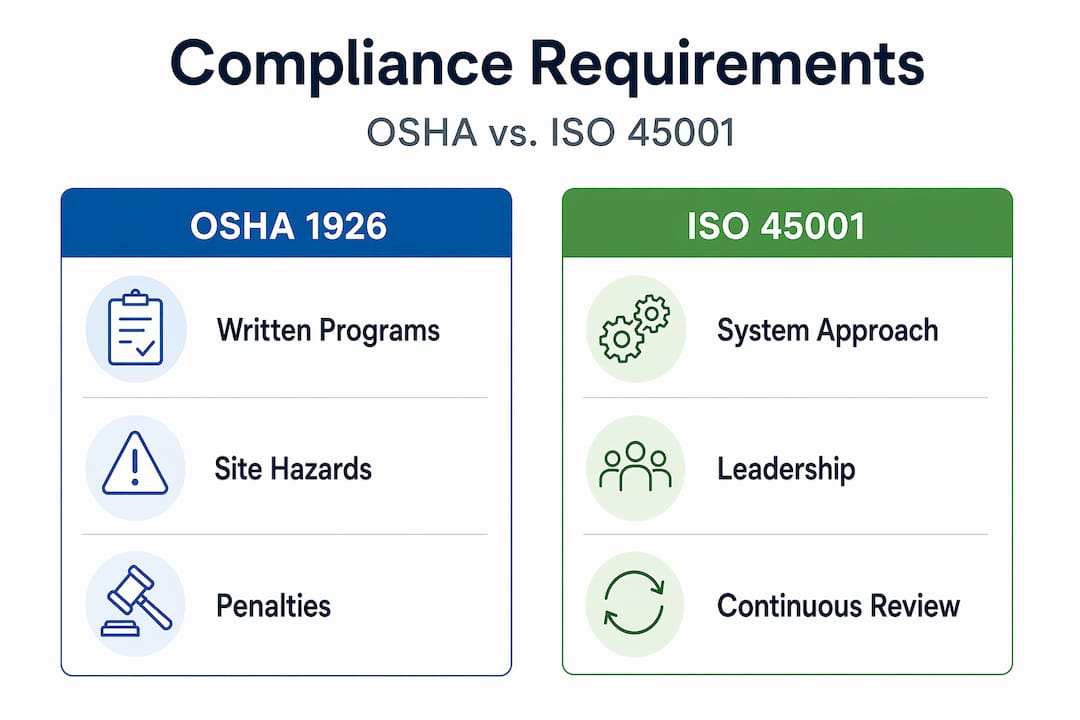
ISO 45001:2018, by contrast, defines construction safety programs as full management systems with interlocking clauses covering context of organization, planning, support, operation, performance evaluation, and improvement. Organizations pursuing ISO 45001 certification must demonstrate that their OHSMS operates as a living system with management review cycles and measurable safety objectives, not a static document set.
Pro Tip: For construction firms operating across multiple regulatory jurisdictions, aligning your OHSMS with ISO 45001 first creates a structural backbone that can be adapted to satisfy OSHA, the Singapore WSH Act, or other national frameworks without rebuilding from scratch. Read more about ISO 45001 compliance alignment for a framework-specific approach.
Job hazard analysis: the operational core
If regulatory frameworks define the architecture of an OHSMS, job hazard analyses (JHAs) are its operational mechanism. A JHA, also referred to as a job safety analysis (JSA), translates broad safety policy into task-specific, worker-relevant guidance before work begins. OSHA’s guidance on the five-step JHA process defines a proactive method centered on practical hazard control and direct worker engagement, published as OSHA Publication 3071.
The five steps are as follows:
- Select the job to be analyzed. Prioritize tasks with the highest injury history, severe potential consequences, or newly introduced work methods.
- Break the job into discrete steps. Each step should describe a distinct action, not a broad task category. “Pour concrete” is too vague; “Position pump hose at form edge, maintaining clearance from rebar” is a usable step.
- Identify hazards for each step. For each action, identify physical, chemical, biological, and ergonomic hazards. Worker involvement at this stage is non-negotiable. Workers performing the task daily identify hazards that supervisors miss.
- Apply controls using the hierarchy of controls. Starting from elimination and substitution, progressing through engineering controls, administrative controls, and finally PPE. Superficial JSAs that jump directly to PPE as the primary control fail both the hazard analysis purpose and regulatory scrutiny.
- Review, communicate, and update the JHA. Pre-task briefings using the completed JHA are required to make the document operationally useful. JHAs must be living documents updated when work scope changes, after any incident, or when new hazards are introduced.
The most common JHA failure mode is template stagnation. A construction site risk assessment conducted six months prior to a significant scope change provides no real protection and offers false compliance assurance. Mature programs assign explicit responsibility for JHA maintenance and trigger mandatory reviews based on defined change criteria.
Pro Tip: During safety briefings, test JHA quality by asking workers whether they can locate their task in the document and identify the controls assigned to them. If they cannot, the JHA is performing as a paperwork exercise rather than a protective tool.
Training, culture, and continuous improvement
The benefits of safety training extend well beyond individual knowledge gain. Structured, role-specific training is the mechanism through which written policy becomes observable worker behavior. Without it, the most sophisticated OHSMS remains inert. The following practices characterize high-performing safety programs in this domain:
- Role-specific training design. A scaffold erector requires fundamentally different competency training than a confined space entry attendant. Generic “construction safety” modules satisfy neither regulatory requirements nor operational needs. Programs must map training content to job roles and documented hazard exposures.
- Leadership visibility in safety activities. Senior leadership participation in toolbox talks, site walks, and incident reviews signals organizational priority to the workforce. When leaders engage with construction site safety measures directly, safety culture shifts from compliance-driven to values-driven.
- Data-driven audit and inspection cycles. Safety audits are not fault-finding exercises. They are diagnostic tools that measure program effectiveness against defined objectives. Using audit findings to update training content, revise JHAs, and adjust procurement of PPE creates a feedback loop that progressively reduces incident rates.
- Worker feedback mechanisms. Anonymous reporting systems, near-miss registers, and structured post-incident reviews give frontline workers a direct channel to improve program quality. Programs that exclude worker input consistently underperform against those that treat workers as safety intelligence sources.
- Digital safety management tools. Mobile-based JHA completion, digital OSHA log maintenance, and electronic permit-to-work systems reduce administrative friction and increase real-time data visibility for site supervisors and safety managers.
The integration of document control practices into safety program management addresses one of the most persistent operational gaps: version control of safety documents across active sites. When workers reference outdated JHAs or superseded emergency procedures, the written program becomes a source of hazard rather than protection.
My perspective on what makes programs actually work
I have reviewed safety programs across dozens of construction organizations, and the pattern separating functional programs from decorative ones is consistent. The organizations that treat their OHSMS as a quality management problem, rather than a compliance checklist, achieve measurably better outcomes. They schedule JHA reviews on the same cadence as procurement orders. They track near-miss rates with the same rigor applied to cost variances. They give safety officers genuine authority to halt work.
What I find troubling is how frequently senior leadership endorses a safety program at the policy level and then undermines it operationally by scheduling pressure. An OHSMS with a signed leadership commitment statement and a project coordination framework that consistently overrides safety stops is not a functioning system. It is a legal defense document waiting to be tested in court.
The practical wisdom I would offer to any construction safety professional is this: the quality of your JHAs is a proxy for the quality of your entire program. If your JHAs read like manufacturer instructions rather than task-specific, worker-verified hazard analyses, your program has a structural problem that no amount of training hours will fix. Invest in rebuilding your hazard identification process first, because everything downstream of it depends on that foundation.
— Aman
How MOSAIC Safety Solutions can support your program

Constructing a compliant, functional OHSMS requires more than downloading templates. MOSAIC Safety Solutions provides specialist consultancy for construction firms at every stage of safety program development, from initial safety certification requirements and BizSAFE structuring through to ISO 45001 audit preparation and ongoing program maintenance. For organizations that need to verify program effectiveness before a regulatory inspection, MOSAIC’s safety audit services provide structured gap analysis against OSHA and WSH Act requirements, with documented corrective action support. Whether your immediate priority is achieving certification, resolving a compliance gap, or building a safety culture that holds under operational pressure, MOSAIC’s consultancy team works directly with your technical and management staff to deliver programs that perform in the field, not just on paper.
FAQ
What does a construction safety program include?
A construction safety program, formally termed an occupational health and safety management system, includes written hazard-specific plans, leadership accountability structures, job hazard analyses, emergency response procedures, worker training documentation, and incident reporting logs compliant with OSHA or equivalent national regulations.
Why are job hazard analyses critical to safety compliance?
JHAs translate site-specific hazards into task-level controls that workers can apply before starting work. OSHA’s five-step JHA process requires worker involvement and application of the hierarchy of controls, making JHAs the primary operational mechanism of a compliant safety program.
What is the difference between OSHA 29 CFR 1926 and ISO 45001?
OSHA 29 CFR Part 1926 is a federal regulatory standard with enforceable requirements and financial penalties for non-compliance. ISO 45001:2018 is a voluntary international management system standard that structures how organizations identify hazards, evaluate performance, and pursue continuous improvement, often sought for third-party certification.
How often should construction safety programs be reviewed?
Written safety programs require annual review at minimum per OSHA guidance, and must be updated whenever site conditions change, new hazards are introduced, or incidents occur. JHAs specifically should be treated as living documents with update triggers tied to scope changes and near-miss events.
What are the core benefits of structured safety training in construction?
Structured safety training improves worker competency, reduces incident frequency, demonstrates regulatory compliance, and supports the organizational safety culture necessary for sustained hazard control. Training effectiveness is measured through observable behavior change and declining incident rates, not hours of instruction delivered.