
General contractors often assume compliance is someone else’s problem the moment a subcontract is signed. That assumption carries serious legal and financial consequences. What is contractor compliance, exactly? It is the systematic adherence by contractors and their subcontractors to all legal, regulatory, and safety requirements governing construction operations, covering everything from licensing and insurance verification to OSHA safety standards, certified payroll, and employment classification. Understanding the full contractor compliance definition, and who bears responsibility for it on a multi-employer jobsite, is no longer optional. It is the difference between a project that closes cleanly and one that triggers federal citations, audits, or litigation.
Table of Contents
- Key takeaways
- What contractor compliance actually requires
- OSHA’s multi-employer policy and general contractor liability
- Managing compliance documentation and workflows
- PPE fit requirements under OSHA’s 2024 rule
- My perspective on what contractors consistently get wrong
- Strengthen your compliance program with professional audits
- FAQ
Key takeaways
| Point | Details |
|---|---|
| Compliance cascades downward | General contractors bear legal responsibility for subcontractor compliance failures under OSHA’s multi-employer citation policy. |
| Documentation is the defense | Inspection records, hazard notifications, and corrective action logs are the primary evidence of reasonable diligence. |
| Payroll timing matters | Certified payroll must be submitted weekly on federally funded projects, not batched retrospectively. |
| PPE fit is now mandatory | OSHA’s 2024 final rule requires that all PPE properly fits each individual worker, not merely that it is available on site. |
| Automation reduces audit risk | Gate control models and compliance tracking software catch credential gaps that manual spreadsheets routinely miss. |
What contractor compliance actually requires
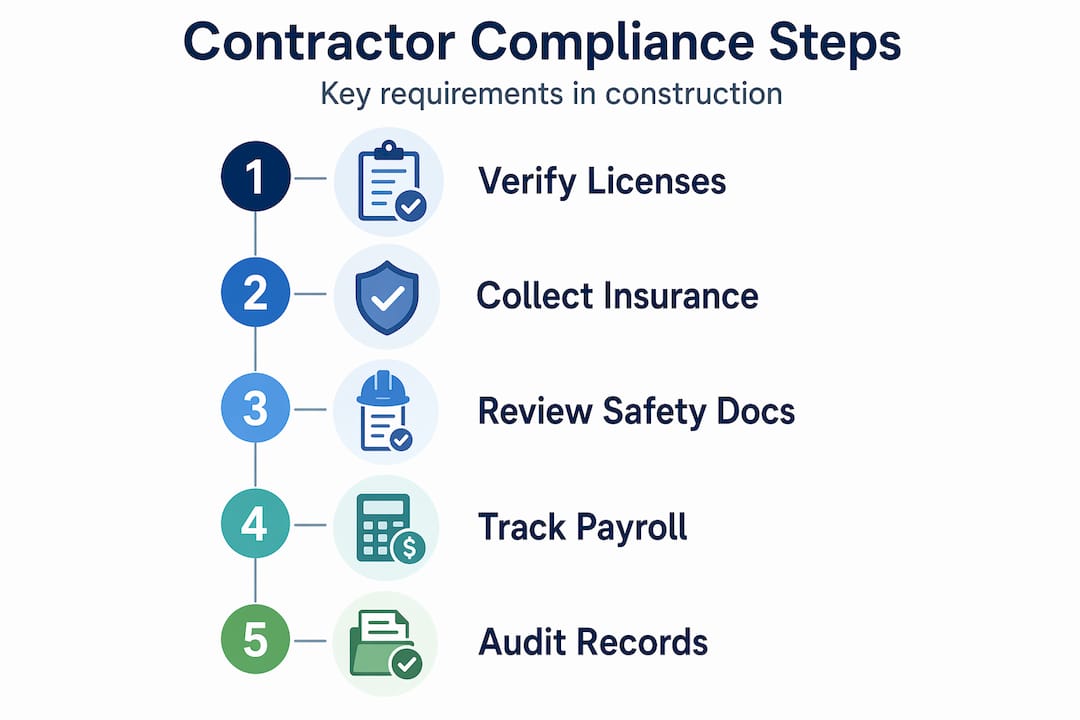
The contractor compliance definition extends well beyond holding a valid license. At its broadest, contractor compliance management encompasses every obligation a contractor must satisfy before, during, and after construction work, across legal, financial, safety, and operational dimensions. The scope is wider than most project managers initially account for, and the consequences of gaps compound quickly.
The core contractor compliance requirements that every construction professional must verify include:
- License and certification verification: Every contractor and specialty subcontractor must hold current, jurisdiction-appropriate licenses. Expired or misclassified licenses void insurance coverage and expose the controlling employer to direct liability.
- Insurance coverage: Workers’ compensation, general liability, and umbrella policies must meet project-specific minimum thresholds. Insurance verification cascades to lower-tier subcontractors; a second-tier subcontractor with lapsed coverage can create upstream exposure.
- OSHA regulatory adherence: This includes competent person designations on site, regular hazard inspections, fall protection systems, confined space programs, and provision of task-appropriate PPE.
- Certified payroll reporting: On federally funded projects subject to the Davis-Bacon Act, certified payroll is a legal declaration of prevailing wage compliance. Falsification constitutes a federal crime.
- Employment classification accuracy: Misclassifying employees as contractors triggers back taxes, penalty assessments, and potential debarment from public projects. Contract terms and IRS Form W-9 or 1099-NEC paperwork must align with actual working arrangements.
- Subcontractor cascading obligations: The controlling employer is responsible for verifying that every subcontractor below it maintains compliant credentials, not just direct hires.
Pro Tip: Build a pre-qualification matrix for every subcontractor tier, not just direct hires. Require license certificates, insurance certificates, and safety plans as gating documents before any mobilization is permitted on site.
The importance of contractor compliance becomes clearest when examining what happens in its absence. A single uninsured subcontractor injury can exceed seven figures in unplanned costs. A missed Davis-Bacon certification can freeze project funding. A competent person who exists only on paper rather than performing actual inspections exposes the general contractor to multi-employer OSHA citations. These are not theoretical scenarios; they are recurring patterns on complex construction projects.
OSHA’s multi-employer policy and general contractor liability
This is where contractor compliance requirements become genuinely complex for general contractors. OSHA’s Multi-Employer Citation Policy recognizes four distinct employer roles on a construction site: the creating employer (who generates the hazard), the exposing employer (whose workers face the hazard), the correcting employer (responsible for fixing it), and the controlling employer (who supervises the worksite). A general contractor typically occupies the controlling employer role, and that designation carries obligations regardless of which subcontractor created a hazardous condition.
The practical implication is direct: controlling employers face citation risk for subcontractor-created hazards if OSHA determines they failed to exercise reasonable diligence. Contractual language shifting responsibility to subcontractors does not relieve this exposure. What matters is whether the controlling employer actually exercised control and documented that exercise.
OSHA defines the inspection standard precisely. Under 29 C.F.R. § 1926.20(b)(2) and § 1926.32(f), controlling employers must conduct frequent and regular inspections by competent persons with actual authority to abate hazards. The steps that constitute demonstrable compliance follow a logical sequence:
- Designate qualified competent persons with verifiable credentials and documented authority to stop work and correct unsafe conditions.
- Conduct and record site-wide inspections at frequencies proportional to site complexity and active trade density, not merely at project milestones.
- Issue written hazard notifications to subcontractors whenever a non-conforming condition is identified, with a defined corrective action deadline.
- Document subcontractor responses and verify that remediation occurred before work in the affected area resumes.
- Require OSHA-compliant safety plans from every subcontractor as a contract deliverable, and hold regular safety meetings to reinforce site-wide expectations.
Controlling employer compliance on multi-employer sites is, in practice, largely a documentation exercise. Evidence of inspections, hazard notifications, subcontractor responses, and remediation is the primary defense against OSHA enforcement actions.
The hazard identification process must be structured enough to produce this evidence trail systematically. Ad hoc walk-throughs with no written record provide virtually no protection when a citation arrives.
Managing compliance documentation and workflows
Understanding what does contractor compliance mean in daily operations requires examining the documentation infrastructure that makes it functional. The gap between having compliance policies and demonstrating compliance to a regulator or auditor comes down almost entirely to records.

The most effective operational model for preventing compliance gaps is the gate control approach. Under this model, subcontractors cannot start work until their compliance documentation has passed verification checks. This includes current license certificates, insurance certificates of coverage with the correct named insured, competent person designations, and project-specific safety plans.
| Documentation Method | Risk Profile | Verification Capability | Audit Readiness |
|---|---|---|---|
| Manual spreadsheets | High. Expiration dates are easy to miss | Low. No automated alerts | Poor. Requires manual assembly |
| Compliance tracking software | Low. Automated expiry alerts | High. Real-time status visibility | Strong. Audit trail generated automatically |
| Hybrid (software + spot checks) | Moderate. Gap risk reduced | Moderate to high | Good. Combines digital records with physical verification |
Manual spreadsheet systems are a structural liability on projects with more than three or four subcontractors. The problem is not that spreadsheets are inaccurate at the moment of entry. The problem is that they do not alert anyone when a certificate issued on day one expires on day ninety. Automated systems track expiration dates, flag gaps, and generate the audit trails that regulators expect to see.
Certified payroll demands the same operational discipline. Treating certified payroll as a weekly workflow rather than a periodic administrative task is one of the most underrated contractor compliance best practices. Submitting a stack of reports covering eight pay periods at once signals to auditors that real-time monitoring was absent. Submission calendars tied to each payroll period close that vulnerability directly.
Pro Tip: Assign ownership of the certified payroll submission calendar to a specific role, not a general team responsibility. Ambiguous ownership is the most common reason contractors miss submission deadlines on prevailing wage projects.
Review the subcontractor safety onboarding checklist as a practical starting framework for structuring gate control documentation requirements across project phases.
PPE fit requirements under OSHA’s 2024 rule
One of the more significant developments in how to ensure contractor compliance involves personal protective equipment. OSHA’s 2024 final rule, codified as an amendment to 29 CFR 1926.95©, establishes an explicit requirement that PPE must fit each affected employee properly, not simply be available at the job trailer. This aligns construction standards with existing requirements in general industry and shipyards, eliminating a long-standing discrepancy.
The safety rationale is straightforward but frequently underestimated in practice:
- Ill-fitting PPE can create new hazards. Oversized gloves reduce grip control. Loose hard hat suspension systems reduce impact absorption. Improperly sized PPE can cause tripping, equipment entanglement, or restricted visibility.
- The rule disproportionately addresses underserved worker populations. OSHA’s findings specifically identified that smaller workers and women in construction have historically been issued PPE sized for average male body dimensions, reducing its protective effectiveness.
- Compliance requires demonstrable fit assessment, not just inventory. The 2024 PPE fitting standard shifts the compliance threshold from mere availability to documented suitability for each individual worker.
For compliance programs, this means integrating PPE fit assessment into the new worker onboarding process, maintaining records of what was issued and to whom, and establishing a process for workers to request alternative sizing without friction. Contractors who rely on a single PPE size ordered in bulk are no longer meeting the regulatory standard.
My perspective on what contractors consistently get wrong
I have reviewed compliance programs across dozens of construction projects, and the pattern of failure is almost always the same. Contractors invest time in building the compliance framework, getting the documentation templates in place, setting up the subcontractor pre-qualification checklist. Then the project mobilizes, and within three weeks, the compliance program becomes something that gets checked before inspections rather than something that runs the site.
What I have seen work consistently is treating compliance as an operational rhythm rather than a paper exercise. The teams that avoid citations and audit findings are the ones where the superintendent reviews the inspection log every Monday morning, where the payroll coordinator has a non-negotiable Tuesday submission deadline, and where every new subcontractor mobilization triggers the gate control sequence without exception.
The cascading liability exposure from lower-tier subcontractors is genuinely underestimated. I have seen general contractors receive OSHA citations for hazards created by a subcontractor’s subcontractor, in areas the general contractor’s staff had not physically visited in two weeks. Contractual indemnification clauses offer limited protection in that scenario. Documented inspection frequency and written hazard communications are what actually matter to an investigator.
The technology case for compliance software is now settled. The projects that still rely on spreadsheets and email chains to track certificates are the ones that discover expired insurance three days after an incident. That discovery timing is never favorable. Modern compliance tracking tools are not optional sophistication. They are the minimum viable infrastructure for managing multi-employer site risk in 2026.
— Aman
Strengthen your compliance program with professional audits

Maintaining contractor compliance on active construction projects demands more than internal checklists. Professional safety audits provide an independent verification layer that identifies documentation gaps, non-conforming site conditions, and systemic compliance deficiencies before regulators do. MOSAIC Ecoconstruction Solutions delivers structured safety audit services tailored to the construction sector, providing detailed findings, corrective action frameworks, and ongoing compliance support. Whether you are managing prevailing wage requirements, OSHA multi-employer obligations, or subcontractor credential verification, MOSAIC’s consultancy team provides the technical depth and regulatory understanding your project requires. Contact MOSAIC to discuss a compliance audit scoped to your current project portfolio.
FAQ
What is the contractor compliance definition in construction?
Contractor compliance in construction refers to a contractor’s adherence to all applicable legal, regulatory, safety, and financial requirements governing their work, including licensing, insurance, OSHA standards, payroll reporting, and employment classification. The obligation extends to verifying that subcontractors at all tiers meet the same standards.
What does contractor compliance mean for general contractors specifically?
For general contractors acting as controlling employers, contractor compliance means exercising documented oversight of site-wide safety conditions, including subcontractor-created hazards, through regular competent person inspections and written corrective action records. OSHA can cite controlling employers for subcontractor violations when reasonable diligence was not demonstrated.
What are the key elements of a contractor compliance checklist?
A contractor compliance checklist should cover current license and certification verification, insurance certificate review, competent person designation, project-specific safety plan submission, PPE fit assessment records, and certified payroll submission scheduling for federally funded work.
How does OSHA’s 2024 PPE rule affect contractor compliance requirements?
The 2024 amendment to 29 CFR 1926.95© requires that PPE must properly fit each individual worker on construction sites, shifting the compliance standard from availability to documented individual suitability. Contractors must now integrate fit assessment and alternative sizing processes into their PPE programs.
Why is certified payroll compliance often a source of audit risk?
Certified payroll compliance failures typically result from treating submissions as periodic administrative tasks rather than weekly operational obligations. Batching multiple reports or missing the seven-day submission deadline after each payroll period signals to federal auditors that real-time prevailing wage monitoring was absent.