
Most organizations treat an environmental management system as a compliance checkbox. They implement it to satisfy a regulator, earn a certification, then shelve it. This approach misses the fundamental value of the framework entirely. An environmental management system is, at its core, a structured mechanism for embedding environmental responsibility into the operating DNA of an organization. As the US EPA defines it, EMS integrates environmental thinking into everyday operations and compliance requirements, creating a feedback loop that continuously improves both environmental performance and organizational efficiency. The distinction matters enormously for any professional charged with delivering measurable sustainability outcomes.
Table of Contents
- Key Takeaways
- What is an environmental management system?
- The PDCA cycle: the engine of continuous improvement
- Major EMS standards: ISO 14001 and EMAS compared
- EMS in practice: who it serves and how
- Challenges and success factors in EMS implementation
- My perspective on EMS as a strategic business instrument
- How MOSAIC can support your EMS and compliance goals
- FAQ
Key Takeaways
| Point | Details |
|---|---|
| EMS goes beyond compliance | An environmental management system drives continuous improvement, not just regulatory adherence. |
| PDCA is the core methodology | The Plan-Do-Check-Act cycle structures every EMS activity from policy setting to corrective action. |
| ISO 14001 and EMAS differ significantly | EMAS demands public environmental reporting and employee involvement beyond ISO 14001 requirements. |
| EMS scales to any organization size | Flexible EMS frameworks apply equally to startups, mid-size firms, and large industrial corporations. |
| The “Act” phase is the hardest | Translating audit findings into genuine operational change is where most EMS programs stall or fail. |
What is an environmental management system?
An environmental management system is a formalized set of processes, policies, and practices that an organization uses to identify, monitor, control, and reduce its environmental impacts. It is not a product or a piece of software. It is an organizational framework, analogous to a financial management system, that directs how decisions with environmental consequences are made, tracked, and improved over time.
The core structure of an EMS typically encompasses the following elements:
- Environmental policy: A documented commitment from senior leadership establishing the organization’s environmental principles and obligations.
- Significant aspects and impacts: A systematic process for identifying which organizational activities affect the environment and to what degree.
- Legal and regulatory register: A living record of applicable environmental laws, permits, and compliance obligations.
- Objectives and targets: Specific, measurable environmental goals aligned to the organization’s identified impacts and policy commitments.
- Operational controls: Procedures that govern how high-impact activities are conducted to minimize environmental risk.
- Monitoring and measurement: Defined metrics and schedules for tracking environmental performance against targets.
- Internal audit program: Periodic reviews that assess conformance with EMS requirements and identify areas for correction.
- Management review: Senior leadership evaluation of overall EMS performance and strategic direction.
The role of environmental management systems in this structure is to create accountability at every level of an organization, from procurement decisions to site operations. This systematic accountability is what separates an EMS from ad hoc environmental initiatives that produce inconsistent results.
The PDCA cycle: the engine of continuous improvement
The Plan-Do-Check-Act cycle is the methodological backbone of every credible EMS framework, and it is codified explicitly within ISO 14001’s structure. Understanding each phase in operational terms is critical for professionals responsible for implementation.
- Plan: The organization establishes its environmental context, identifies significant aspects and associated impacts, determines legal obligations, and sets measurable objectives. For a construction firm, this phase would include mapping activities like concrete batching, earthwork, and waste generation to their downstream environmental consequences.
- Do: Operational controls are implemented, roles are assigned, resources are allocated, and staff receive the training necessary to execute environmental procedures correctly. This is where policy commitments translate into site-level behavior, contractor management, and procurement decisions.
- Check: The organization monitors environmental performance against its defined objectives, conducts internal audits, evaluates compliance with legal obligations, and records nonconformities. This phase generates the evidence base that makes the entire system defensible to external auditors and regulators.
- Act: Based on audit findings and performance data, the organization takes corrective actions, addresses root causes of nonconformities, and modifies objectives or controls as needed. It then feeds those modifications back into the next Plan phase, completing the improvement loop.
The iterative nature of PDCA is what gives an EMS its longevity. A single compliance audit produces a point-in-time snapshot. An EMS operating on PDCA produces a continuously improving trajectory.
Pro Tip: During the “Do” phase, avoid the common error of treating EMS procedures as documentation exercises. Procedures that are not operationally tested through drills, walkthroughs, or line supervisor reviews rarely survive contact with real site conditions.
Major EMS standards: ISO 14001 and EMAS compared
Two frameworks dominate the formal EMS certification space: ISO 14001 and the Eco-Management and Audit Scheme (EMAS). Both are credible, but they serve different strategic purposes and carry different levels of rigor.
ISO 14001: the global standard
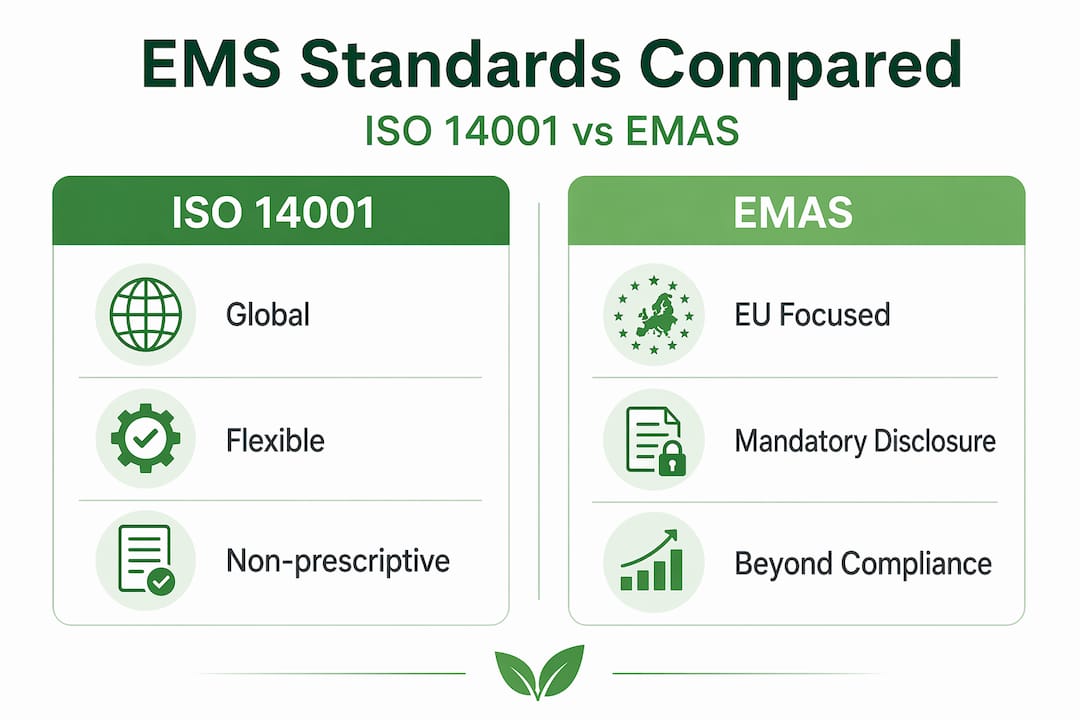
ISO 14001 is the most widely adopted EMS standard globally, recognized across all industry sectors and jurisdictions. Its non-prescriptive design means organizations must define their own environmental objectives based on their specific context and significant impacts. This flexibility is a deliberate design choice that makes ISO 14001 applicable to a hospital, a software firm, and a heavy civil contractor with equal relevance.

The benefits of ISO 14001 certification include demonstrated credibility with clients and regulators, access to procurement opportunities that require certified supply chains, and a structured mechanism for reducing environmental liability exposure. For organizations operating within Singapore’s environmental compliance framework, ISO 14001 certification provides tangible evidence of systematic environmental stewardship.
EMAS: the premium tier
EMAS, administered within the European Union, imposes requirements that go substantially further than ISO 14001. EMAS registration requires organizations to produce verified public environmental statements, engage employees actively in environmental improvement processes, and demonstrate measurable performance improvement over successive registration cycles. Approximately 4,500 organizations hold EMAS registration, a figure that reflects both its rigor and the depth of commitment its adoption signals.
Framework comparison
| Feature | ISO 14001 | EMAS |
|---|---|---|
| Geographic scope | Global | Primarily European Union |
| Public environmental reporting | Not required | Mandatory and independently verified |
| Employee involvement | Encouraged | Formally required |
| Prescriptive performance targets | No | No, but measurable improvement required |
| Integration with national regulation | Flexible | Directly linked to EU environmental law |
| Certification body | Accredited third-party auditor | Competent national body |
Key benefits that both frameworks share include:
- Reduced risk of environmental incidents and associated regulatory penalties.
- Improved operational efficiency through systematic resource and waste management.
- Enhanced credibility with investors, insurers, and public procurement bodies.
- A documented framework that supports due diligence in mergers, acquisitions, and project tendering.
The role of environmental management in maintaining market competitiveness is increasingly cited by ISO as a driver for adoption, particularly as climate-related supply chain scrutiny intensifies across industries.
EMS in practice: who it serves and how
One of the most persistent misconceptions about EMS is that it belongs exclusively to large industrial manufacturers with visible emissions and complex waste streams. This is demonstrably false. Flexible EMS frameworks accommodate organizations regardless of size, sector, or operational complexity, and the scalability is a core feature of the standard’s design.
Consider how EMS applies across different organizational contexts:
- Technology companies use EMS to manage energy consumption in data centers, e-waste from hardware cycles, and carbon footprints from corporate travel and logistics.
- Professional services firms apply EMS to paper consumption, office energy use, and supply chain selection criteria for sustainability-rated vendors.
- Construction contractors deploy EMS to control dust, noise, water runoff, waste generation, and hazardous material handling across project sites.
- Healthcare organizations implement EMS to manage pharmaceutical waste streams, sterilization chemical disposal, and building energy performance.
The role of environmental management systems in regulatory compliance is also frequently underestimated. An EMS does not just help organizations meet current regulations. It builds the internal capacity to identify emerging regulatory requirements, assess their operational impact, and adapt ahead of enforcement deadlines. This proactive posture is particularly relevant in jurisdictions where environmental regulations are evolving rapidly, including Singapore’s National Environment Agency requirements for construction sector environmental controls.
Pro Tip: If your organization is pursuing ISO 14001 for the first time, begin the significant aspects and impacts assessment before drafting any procedures. Organizations that write procedures first routinely discover they have controlled the wrong activities. The assessment drives the system; the system does not drive the assessment.
The application of ISO 14001 across Singapore’s construction sector demonstrates that EMS adoption translates directly into competitive differentiation on public and private tenders where environmental performance credentials are evaluated.
Challenges and success factors in EMS implementation
Knowing what an environmental management system entails is significantly easier than sustaining one through multiple PDCA cycles. The challenges are well-documented, and they cluster around a predictable set of organizational dynamics.
The most difficult phase is the “Act” phase. Audit findings generate nonconformities. Nonconformities require corrective actions. Corrective actions require resources, authority, and follow-through. When those elements are absent or contested, the EMS produces paperwork without producing change. This is the critical failure mode that separates certified organizations from genuinely performing ones.
The success factors that distinguish effective EMS programs include:
- Visible management commitment: Senior leadership must treat EMS objectives as operational priorities equal in weight to financial targets. An environmental policy signed but never referenced in management reviews is a compliance artifact, not a commitment.
- Integrated operational controls: EMS procedures must be embedded within existing work instructions, procurement standards, and contractor management frameworks. A standalone EMS manual that exists outside daily operations has no operational traction.
- Competent internal auditors: Internal audits conducted by untrained personnel produce findings of marginal value. Investing in auditor competency directly improves the quality of the “Check” phase output.
- Meaningful objectives: EMS objectives must reflect actual environmental impacts specific to the organization’s context. Generic targets like “reduce waste” without baseline data or measurable thresholds provide no navigational value.
- Employee engagement at all levels: Environmental performance is determined by the behaviors of people executing work, not by the quality of documentation. Programs that engage frontline workers in identifying impacts and proposing improvements consistently outperform top-down documentation exercises.
Maintaining momentum beyond initial certification is a structural challenge that requires scheduled management reviews, refreshed training programs, and periodic external benchmarking to prevent the EMS from calcifying into a static compliance artifact.
My perspective on EMS as a strategic business instrument
I have observed a pattern across organizations that implement EMS primarily for certification optics: they achieve the certificate and then wonder why environmental performance metrics barely move. The certification is not the outcome. It is a verification that the framework exists. The outcome is what the framework produces over successive operating cycles.
What I find consistently underappreciated is that an EMS, when genuinely integrated into business operations, becomes one of the most effective operational risk management tools an organization possesses. It forces a systematic inventory of environmental exposures before incidents occur, not after. That proactive posture has direct financial implications in insurance premiums, regulatory penalty avoidance, and incident response costs.
The evolving strategic role of EMS in responding to climate-related supply chain disruption is a dimension that most implementation guides still treat as peripheral. In my view, it is becoming the primary business case for EMS adoption in the next decade. Organizations that have functional, data-generating EMS programs will be positioned to respond to climate disclosure requirements, scope 3 emissions reporting obligations, and green procurement criteria with documented evidence rather than estimates.
The organizations that treat EMS as a dynamic, evidence-generating system rather than a compliance archive are the ones that will convert environmental management into genuine competitive advantage. That shift in framing is the single most important thing I would want any environmental professional to take from this discussion.
— Aman
How MOSAIC can support your EMS and compliance goals

For construction firms and project developers operating under Singapore’s regulatory framework, the gap between understanding EMS and executing one effectively is where projects face real compliance exposure. Com’s team at MOSAIC Ecoconstruction Solutions provides specialist QES consultancy, structured safety audit services, and ISO 14001 certification support designed specifically for the construction sector’s operational complexity. From conducting initial significant aspects assessments to guiding organizations through surveillance audits, MOSAIC delivers the technical depth and regulatory familiarity that generalist consultants cannot replicate. Organizations looking to strengthen site-level environmental controls or fulfill outsourced safety officer needs will find that MOSAIC’s integrated approach covers every phase of the EMS lifecycle, from policy development through verified performance improvement.
FAQ
What is an environmental management system in simple terms?
An environmental management system is a structured organizational framework that helps companies identify, control, and continuously improve their environmental impacts, typically built around the Plan-Do-Check-Act methodology codified in standards like ISO 14001.
What are the core components of an EMS?
The core components include an environmental policy, a register of significant environmental aspects and impacts, defined objectives and targets, operational controls, a monitoring program, internal audits, and periodic management reviews.
How does ISO 14001 differ from EMAS?
ISO 14001 is a globally recognized, non-prescriptive standard applicable across all sectors, while EMAS requires mandatory public environmental reporting, independently verified statements, and formal employee involvement, making it a more rigorous framework primarily adopted within the European Union.
Can small organizations implement an EMS?
Yes. EMS frameworks are explicitly designed to be scalable, and flexible EMS design enables organizations of any size to manage environmental impact systematically, from single-site small businesses to multinational corporations.
Why is the “Act” phase considered the hardest part of EMS implementation?
The “Act” phase requires translating audit findings into actual operational changes, which demands resources, management authority, and organizational follow-through. As Advisera’s EMS implementation guidance notes, success depends on integrating corrective actions into daily business processes rather than treating them as documentation tasks.